“Buddhism” is a broad term that encompasses many different cultural traditions, which differ widely in their superficial trappings but share a common core of ethical and psychological teachings. My understanding (although I may be wrong, since I’m not an expert) is that the “superficial trappings” are intended to be symbolic only, and tailored to the cultural beliefs of the particular audience they were aimed at. An analogy that is often used is that of a raft. If you want to get from one side of a river to the other, you will make a raft of whatever material is available, but once the raft has got you safely to the other side you will discard it – not carry it around with you for the rest of your life. Clinging too strongly to the mythological, metaphysical or cosmological trappings of Buddhism is discouraged, because ultimately they are irrelevant to the deep psychological and moral truths that the teaching is trying to drive you towards.
But more than any other Buddhist writer I’ve come across, Brian Ruhe does have a deep and literal belief in the mythological, metaphysical and cosmological trappings of the particular form of Buddhism that he subscribes to. In his case, this is Theravada Buddhism – the earliest form of Buddhist teaching, which originated in India 2500 years ago. At that time the dominant culture of India was Brahmanism – a precursor of modern Hinduism – so not surprisingly most of the Theravada writings are steeped in Brahmanical mythology and cosmology (though not all of them – when the Buddha preaches to sun-worshippers or fire-worshippers or ancestor-worshippers or atheists he talks to these groups in their own terms, not those of Brahmanism). But Brian Ruhe, unless he’s indulging in a level of deadpan irony which is over my head, believes in the literal truth of the various heavenly realms and supernatural beings that are spoken of in the Theravada canon.
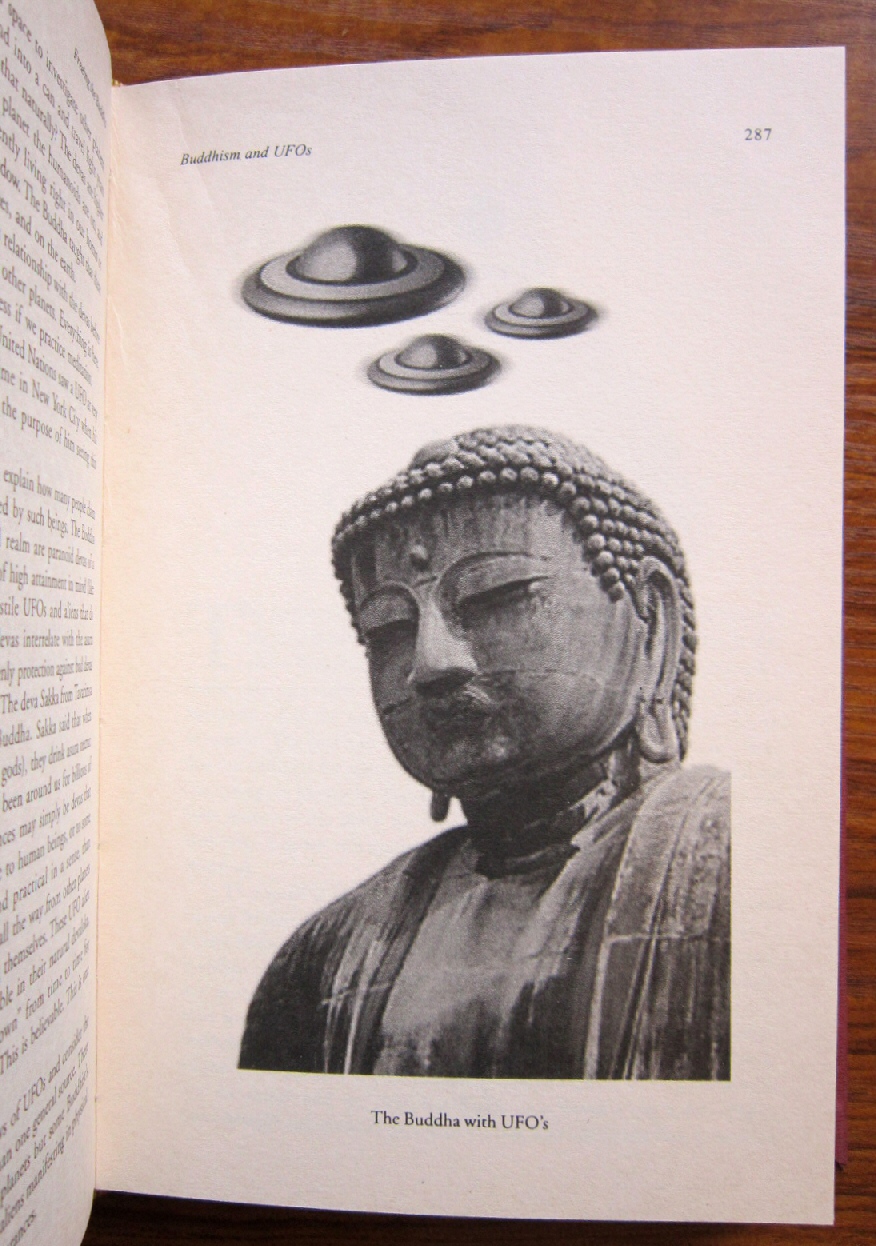
Hopefully you can see where this is leading, and that I’m finally getting around to the subject of this post. Based on the popular mythological beliefs current in India when they were first written down, the Theravada scriptures talk a lot about “devas” – a term that is often translated as “gods” (and probably comes from the same root as our word “deity”), but is closer in concept to the Western idea of “angels”. These are supernatural beings that are superior in many ways to human beings, but far from being omnipotent, who normally reside on higher planes of existence but can descend down to the mundane world and appear to mortals when they want to. Ergo, in Brian Ruhe’s world-view, devas are UFOs and UFOs are devas. It’s as simple as that.
On the face of it, Ruhe’s theory is simply saying that “Unexplained speculative phenomenon A can be explained in terms of unexplained speculative phenomenon B”... which is a perfectly valid statement but not a particularly helpful one. But at another level, there may be a lot of truth in what he says. Practitioners of Theravada Buddhism sometimes claim to experience contact with devas and deva-worlds while they are in a trance-like state during meditation. Objectively, this can be dismissed as a form of lucid dreaming or self-hypnosis, but there may well be an underlying mystical experience – that has nothing to do with devas or UFOs – that the meditators are interpreting in terms of the cultural beliefs and expectations that are most familiar to them. Many westerners having exactly the same subjective experience might well objectivize it in terms of a UFO or alien abduction.

8 comments:
Sounds interesting! I would guess that your 'But at another level...' is perhaps what Ruhe is getting at. The fundamentally Buddhist notion of dependent co-arising entails that nothing ever exists independently 'from its own side', but each seeming thing is the product of exterior causes. From this perspective (a Buddhist one), a 'lucid dream' has no greater claim on reality than a 'deva'. I'm wondering if Ruhe -- as a Buddhist -- really holds to the 'reality' (in anything more than a phenomenological sense) of devas any more than Charles Fort held to the 'reality' of the Super-Sargasso Sea...?
Thanks for a very perceptive comment. I think you're probably right, and the comparison with Fort may be quite close to the truth -- in both cases they are trying to provoke people into thinking deeply for themselves, rather than offering a literal description of things.
I am the author, Brian Ruhe. Hello! I wish I knew this was posted about my book. I found it by accident. The only thing that is worse than being talked about is not being talked about so I do thank you Andrew!
You wrote well, very intelligently. I should give a proper response. It is indeed true that I do in fact really believe the cosmology taught by the Buddha in the Theravada tradition based on the Pali suttas.
I think you are mistaken in your seeming assumption that millions of Theravadin Buddhists today don't believe that. They do. A big percentage of them do. You make it seem like Brian Ruhe is an odd person for believing the Buddhist teachings. Amongst Western Buddhist teachers I do teach this a lot more than others, I admit. So I probably believe it more strongly than others, maybe.
But this cosmology is part of the Buddhist world view of karma and rebirth. In my 2010 book, available on Amazon:
A Short Walk on an Ancient Path - A Buddhist Exploration of Meditation, Karma and Rebirth
I repeat this cosmology and go more into karma.
You were a bit too brief about what I wrote about UFOs. I do belief, as many ethnic Buddhist do, that SOME UFOs could be devas like nagas because the Buddha taught that nagas can take on whatever form they like- physical form. They can appear before us and then disappear, as UFOs do. I think most UFOs are not devas, but genuine extraterrestrial craft, or secret military vehicles.
I even formed a UFO meetup.com group in Vancouver in 2009 and I have over 200 You Tube videos, including "Buddhism and UFOs". Take a look at that on You Tube.
You're right about meditation states. They can be varied and mysterious but the Buddha did teach the nature of devas, angels, and it makes sense for a Buddhist to have some conviction about those teachings.
Buddhism is timeless, it's about life right now, not 2500 years ago. The Buddha said his teachings were timeless.
Feel free to ask question for this blog. I'm enjoying this. I have to thank you for the attention, Andrew, because it's an old book.
I forwarded your review to my Facebook and Twitter. May you be well happy and peaceful!
Brian Ruhe
My contact info is:
Brian Ruhe author of | A Short Walk On An Ancient Path
| and Freeing the Buddha www.theravada.ca | Ph. 604-738-8475
brian@theravada.ca www.youtube.com/user/BrianRuhe
Hi Brian - Thanks very much for getting in touch. Thanks also for the gentle tone of your reply, since I said a few negative things about your book. I'm happy to admit I may have been wrong when I called your approach individualistic and un-Buddhist. That's what it seemed like to someone like me who only knows about Buddhism from reading books, and attending classes, that were grounded in the Western academic tradition. There is (and has been for well over a century) a tendency in the West to present Theravadin Buddhism as a kind of rationalistic philosophy that uses some of the trappings of religion to get its message across. I've accepted that view because it was the first I came across, and so much of what I've read since has reinforced it. That was why parts of your book jarred when I read it. But now that I think about it, I can see that it's far more likely that you're reflecting the original teachings as they are understood in Asia, whereas the Western academics are twisting it to make it palatable to other Western academics. I will definitely check out your YouTube videos and other writings.
Hi again Andrew,
You are so right about Theravada Buddhism being presented as a rationalistic religion. I have a video below, explaining that. In the 19th century in Sri Lanka Col. Henry Steel Olcott and Madame Blavatsky competed against the Christians by trying to contrast Buddhism with Christianity, saying it was more scientific and rational. The problem with that is that Buddhism is emotional, trying to reach more exulted and uplifted states of mind.
The video is:
Rationalism vs. Emotion in Buddhism
at this link:
https://www.youtube.com/watch?v=sI383_BGDuw
Be well,
Brian
--
Brian Ruhe author of | A Short Walk On An Ancient Path
|and Freeing the Buddha www.theravada.ca | brian@theravada.ca
youtube.com/user/BrianRuhe
Thanks Brian - that's an interesting video. I've heard of Blavatsky and Olcott of course, but I don't know anything about their work in Sri Lanka - I will have to read up about it.
First i would like to thank Mr.Brian Ruhe for his very informative description of my religion.Yes i am a buddhist and i belong to theravada,and sir you are on point with your understanding of my religion and i thank you for correcting the author of this blog.
Thank you kindly, Shashika!
Post a Comment