Search This Blog

Showing posts with label Art. Show all posts

Sunday, 26 June 2016

WHAAM!

The new extension to the Tate Modern museum opened last week. I only need the slimmest of excuses to visit London, so I went to see it. The new part (called the Switch House) mainly houses contemporary art installations, while the original building (which used to be Bankside Power Station) contains older works of “modern art”. Prominent among the latter is Roy Lichtenstein’s iconic painting WHAAM!, pictured above. This was far and away my favourite item in the whole museum – not surprisingly, given the irresistible combination of comic-book nostalgia and military aircraft nostalgia!

Roy Lichtenstein was a controversial artist, because so many of his paintings copied the layout of published comic-book panels (for numerous examples, see this page). But I think it’s wrong to belittle his work for this reason. Yes, it’s a shame that the original artist goes uncredited, but the artistic medium, display context, gigantic size and sheer painstaking precision of Lichtenstein’s works make them totally different from the original (a fact that isn’t always clear when you see small side-by-side comparisons on a web page). In any case, the comic-book industry is much more relaxed about the "swiping" of panel layouts than it is about, say, the unlicensed use of lucrative franchise characters.

The display caption to WHAAM! states that it is “based on an image from All American Men of War published by DC comics in 1962”. But looking at its Wikipedia entry the situation is a little more complicated than that. The basic layout (including the words “I pressed the fire control and ahead of me rockets blazed through the sky” and the sound effect “WHAAM”) does indeed come from a single panel in All American Men of War #89. However, the American aircraft in that panel is clearly a jet – probably a Korean-vintage F-86 Sabre. The plane in Lichtenstein’s painting looks more like a P-51 Mustang – and Wikipedia makes a good case for that being taken from a panel in the following issue, #90. Lichtenstein’s victim aircraft is noticeably different from either of those panels – Wikipedia suggests it comes from #89 again, but from a different story in that issue. Whatever sources Lichtenstein used, I still think the result is one of the greatest works of art of the 20th century.

As regards the new Switch House, I have to confess that most of the items on display went over my head. For the most part I mean that figuratively, but the small object pictured below was literally over my head ... because it was hanging from the ceiling in one of the rooms (sorry it’s out-of-focus – my camera was on maximum digital zoom). Regular readers will know I have an uncanny ability to spot things that “look a bit like a dick” (see for example this statue of Balzac or these 1940s comic-book aliens). The work pictured below is a sculpture by Louise Bourgeois entitled Fillette, which is French for “little girl”. I guess that’s what it’s meant to depict ... but it still looks like a dick to me.

Sunday, 14 February 2016

Some old X-Files

I don’t usually hoard old magazines (except Fortean Times), but I kept these three issues of Cinefantastique because between them they contain complete episode guides to the first four seasons of The X-Files. I was prompted to dig them out last week – not because of the “reboot” currently showing on Channel 5, or from any general sense of nostalgia, but because I needed to do some research for a new book I’m working on. In looking through them, I was struck by how highbrow some of the X-Files episode titles were. Here are a few of the more Fortean examples – two from each of those first four seasons (just focusing on the titles, not the storylines).

The Jersey Devil (Season 1, Episode 5). One of America’s lesser known cryptids, this one dates back to those pre-Darwin days when mysterious creatures weren’t required to conform to the logic of evolutionary genetics. According to Wikipedia it’s “a kangaroo-like creature with the head of a goat, leathery bat-like wings, horns, small arms with clawed hands, cloven hooves and a forked tail”. Wings AND arms AND hooves… they don’t make them like that any more.

Ghost in the Machine (Season 1, Episode 7). This cool-sounding phrase was coined by the British philosopher Gilbert Ryle in 1949, as a disparaging description of the dualistic theory of human nature (i.e. a spiritual soul inhabiting a material body).

Little Green Men (Season 2, Episode 1). A facetious term for extraterrestrials, which was already well established when Mack Reynolds wrote The Case of the Little Green Men in 1951 – a Fortean-themed detective novel I wrote about in a blog post last year.

Fearful Symmetry (Season 2, Episode 18). This phrase comes from William Blake’s famous poem “Tiger, Tiger, burning bright”. The poem isn’t very Fortean, but its author was – as I explained in A 19th Century Contactee. One of the strangest spiritual creatures Blake claimed to have encountered was “The Ghost of a Flea” – his painting of which I happened to see in the Tate Gallery last year (see photo at the bottom of this post).

Paper Clip (Season 3, Episode 2). This is a reference to Operation Paperclip, a real world “conspiracy” that brought hundreds of German scientists – many of them war criminals – to the United States in the aftermath of WW2, giving them clean new records and salaried positions working for the U.S. government. It may be no coincidence that “Nasa” sounds a bit like “Nazi”.

Talitha Cumi (Season 3, Episode 24). This is one of several X-Files titles derived from a foreign language. In this case it’s Aramaic, the language spoken by Jesus. It’s a quote from the New Testament, which of course is full of Jesus quotes, but most of them only appear in translation. This example (from Mark 5:41) is one of only about a dozen that are given in the original Aramaic first (I’d be interested to know why they were singled out in this way). From the King James version: “And he took the damsel by the hand, and said unto her, Talitha cumi; which is, being interpreted, Damsel, I say unto thee, arise.”

Tunguska (Season 4, Episode 8). This, of course, was the site of a mysterious explosion that flattened two thousand square kilometres of Siberian forest in 1908. It was probably caused by a meteor impact, although several odd things about it have led to various alternative explanations (e.g. an exploding UFO). As mentioned in my post about Ian Watson last year, his novel Chekhov’s Journey offers a particularly weird interpretation of the Tunguska event.

Terma (Season 4, Episode 9). This has to be one of the most obscure X-Files titles of all. It’s a technical term from Tantric Buddhism, referring to secret teachings carefully handed down among the inner circle of adepts. Such as, for example, that Tantric classic “Sex Secrets of the Ancient Masters” (which I really must get round to writing one of these days).

Sunday, 6 December 2015

A Few Fortean Novels by Ian Watson

UFOs and the Men in Black – Temporal anomalies and the Tunguska event – Tantric Sex and the Tibetan Book of the Dead – Alchemy and the paintings of Hieronymus Bosch – Space Gods and a Martian Inca… The novels that Ian Watson wrote in the 1970s and 80s certainly aren’t short of Fortean ideas. I don’t always remember to make a distinction on this blog between fictional works that are “good” (i.e. enjoyable to read) and ones that are “interesting” (i.e. thought-provoking). So I’ll say right away that Ian Watson is very much a master of the second category, without always finding his way into the first. I’ve read six of his novels in three short bursts – three in 1997, two in 2004 and one just last week. Some are definitely better than others, but here’s a quick rundown in the chronological order that I read them:

Miracle Visitors (1978) is one of the books on my Charles Fort in Fiction list. I bought my copy in 1997, from Watkins esoteric bookshop in London. They’d shelved it among the non-fiction UFO books, which is quite appropriate really. Although the story has “characters” and a “plot”, they’re primarily vehicles for the author to get his ideas across. I’m not averse to novels of this type, as long as the ideas are good ones – which they are in this case. There are countless science fiction stories about UFOs, but almost all of them are based on some variant of the Extraterrestrial Hypothesis (ETH). What’s unusual about Miracle Visitors is that Watson opts for a Psycho-Social Hypothesis (PSH), in which the whole UFO Phenomenon (with a capital P) is a manifestation of a higher state of consciousness. Still more unusual, he actually manages to make the PSH sound interesting – he even works the Men in Black into the Phenomenon as well as the different kinds of Close Encounter.

I was sufficiently impressed with Miracle Visitors that I went out and bought two more Watson novels. The first of these was Chekhov’s Journey (1983). This has nothing to do with Star Trek – the title character is the playwright Anton Chekhov, who really did go on a long and somewhat mysterious journey in 1890. The novel is set a century later in 1990, when a documentary film is being made about Chekhov’s journey. Since so few facts are known about it, they use a form of “past-life regression” hypnosis to fill in some of the details. This brings all sorts of wacky weirdness to light, including a connection to the Tunguska explosion (which occurred in 1908) and a spacecraft from the future which is hurtling backwards in time. Of all the Watson novels I’ve read, this is probably my favourite – certainly in terms of being exciting and enjoyable to read.

The other Watson novel I read in 1997 was Alien Embassy (1977). This is set in a strange future society based on Tibetan Buddhism, in which the space program ostensibly uses Tantric sex rituals as a mystical means of travelling to the stars. Now I may be wrong, but this strikes me as the single most brilliant idea for a science fiction novel that anyone has ever come up with. Unfortunately the execution doesn’t live up to the concept, and Watson heads off on a deeply undesirable tangent. Ignoring all the potentialities of sex, mysticism and space travel, the novel is almost exclusively about (wait for it) … politics. Aaarghh! It’s not surprising that it was another seven years before I picked up another Watson novel.

When I did, it was another really good one. The Gardens of Delight (1980) is based on the intriguing concept of a planet modelled on The Garden of Earthly Delights by Hieronymus Bosch. This extraordinary triptych can be seen in the Prado Museum in Madrid, which I’ve visited a couple of times (that’s my souvenir postcard at the bottom of this post). It’s arguably the strangest, most baffling artwork of the Renaissance period, and there are innumerable theories and speculations as to its meaning. According to one school of thought, it depicts an allegory of the alchemical process… and that’s the interpretation Watson opts for here. The result is a really fascinating and original novel, which ought to be read by anyone who’s a fan of Bosch’s painting.

The other Watson book I read in 2004 was God’s World (1979). I have to be honest and say I don’t have a clear recollection of this one. The back cover blurb sounds promising enough: “Earth has been alerted by messengers of God and summoned to the planet of angels, 82 Eridani. Powered by a mysterious space drive found in the Gobi desert, a crusading space ship is launched through High Space to explore this heavenly world.” Beyond that, all I can remember is a bunch of rather dull people on a spaceship talking to each other. As with Alien Embassy, I suspect that if the reader took the blurb and wrote their own novel around it, they’d have a lot more fun.

Much the same is true of the novel I’ve just read – The Martian Inca (1977). I bought this one several years ago, but it kept slipping down the pile before I got round to reading it. As with all Watson’s novels, the basic premise is fascinating. An unmanned sample-return mission is sent to Mars, and on its return it crash-lands in a remote part of Bolivia. The soil sample contains a psychoactive substance which causes one of the villagers to have a revelatory vision (or a pseudo-revelatory one – it isn’t clear which), after which he claims to be a reincarnated Inca with special powers (again, it’s ambiguous as to whether these powers are real or self-delusion) – and promptly sets off to lead a populist revolution. At the same time, a crewed mission lands on Mars and is exposed to the same substance, with equally strange results. I imagine that’s pretty much how Watson pitched the novel to his publishers, in which case it’s not surprising that they jumped at it. Unfortunately, however, the end-product doesn’t live up to the pitch. In particular, the details of the flight to Mars and the Bolivian revolution are too sketchy for the reader to engage with, or believe in, to any great extent.

I don’t want to end on a negative note, though. There is so much trite, unchallenging, formulaic science fiction around that novels like these are a much-needed antidote to all that.

Sunday, 9 August 2015

Cambridge Oddities

Cambridge is one of the few tourist hotspots that it actually makes sense to visit in August. There are crowds of tourists, of course, but that’s offset by the fact that there aren’t any undergraduates (and if you stay in your old college, you don’t have to share the lavatorial facilities with half a dozen barely housetrained students). That’s why I decided to spend a couple of nostalgic days there last week. Here is a quick rundown of some of the more unusual sights in the town:

One of the oldest buildings in Cambridge, dating from circa 1130, is the Round Church opposite St John’s College. Round churches are often associated with the Knights Templar (as with the Temple Church in London), but this one seems to have been built by a lesser known order, active at the same time, called the “Fraternity of the Holy Sepulchre”.
As I mentioned a few months ago in Isaac Newton and me, I spent my undergraduate years at Trinity College – as did Newton himself. Standing outside his old rooms in Great Court is an apple tree, pictured below. There probably wasn’t an apple tree there in Newton’s time (it’s clear from his account of the falling apple that it took place at his home in Lincolnshire), but Newton did keep a small private garden on this plot of land. He also had a large wooden shed which he used as a laboratory for his alchemical experiments – it may have been here, or inside Great Court itself.

(For more about Newton and alchemy, see my book Isaac Newton: Pocket Giants).
Sometimes erroneously associated with Newton, but actually nothing to do with him, is the Mathematical Bridge at the back of Queens’ College. The present bridge is the third to occupy this site, all using same timber-framed design. The first was built in 1748; this one dates from 1905. The mathematical nature of the bridge lies in the ingenious way the wooden ribs are arranged so that “each member is in compression with little or no bending moment”.
Cambridge has seen more than its fair share of scientific discoveries, and even one of the pubs claims to have played a part in one of them! Outside the Eagle in Bene’t Street there is a plaque that reads:
DNA Double Helix 1953: “The Secret of Life”. For decades the Eagle was the local pub for scientists from the nearby Cavendish Laboratory. It was here on February 28th 1953 that Francis Crick and James Watson first announced their discovery of how DNA carries genetic information.
One of the newer oddities in Cambridge is the Corpus Clock, dating from 2008 and belonging to Corpus Christi College. It stands at the end of Bene’t Street right opposite King’s College, giving it one of the highest tourist footfalls in England. The clock is unusual for several reasons: it has circles of LEDs instead of hands, and it only tells the correct time every five minutes (the rest of the time it runs erratically fast or slow). It also has a monstrous, animated insect called a Chronophage squatting on top of it.
It was somewhere near Corpus Christi College, back in the 16th century, that a man named Thomas Hobson used to rent out horses from a large livery stable. Although he had dozens of horses, customers always had to take whichever horse he wanted to hire out next. This gave rise to the phrase “Hobson’s Choice” – still used today to mean “no choice at all”. In his old age, Hobson helped to set up a new water supply to the town, which became known as “Hobson’s Conduit”. Cambridge doesn’t seem to have a monument to Hobson’s Choice, but it does have one to Hobson’s Conduit – on the corner of Lensfield Road and Trumpington Street:
From a Fortean point of view, the Haunted Bookshop – tucked away in a narrow alley called St Edward’s Passage – sounds highly promising. I had visions of shelves packed with occult and paranormal books – or horror fiction, at the very least. Unfortunately, however, the stock turned out to be predominantly antiquarian children’s books. The name comes from the fact that the building (previously an alehouse) is supposed to have its own ghost in the form of an occasionally glimpsed “White Lady”.
Cambridge has numerous free museums, of which by far the largest is the Fitzwilliam Museum on Trumpington Street. The quirkiest thing I spotted there was a pair of paintings by William Hogarth called Before and After, dating from 1731. At first sight they look innocuous enough – partly because the eye (my eye, anyhow) tends to be drawn to the girl rather than the bloke. But the latter is worth a second look in both pictures. In Before there is the distinct hint of a “bulge in his trousers” (I’m quoting from the official blurb), while in After “the man’s unbuttoned breeches reveal a tuft of pubic hair and his penis, chafed red from its exertions”. Sleazy stuff for the genteel 18th century!

Here’s Before...
... and After:

Sunday, 28 June 2015

Dragon Slayers

I didn’t specifically set out to take pictures of dragon slayers last Wednesday, but by the end of the day I realized I had five of them. Together with another four photos I already had, I decided that was enough for a blog post!

There are plenty of dragon-slaying legends, many of them symbolizing the triumph of good over evil. In this sense the ultimate dragon-slayer must be St Michael – the Biblical archangel who defeats “the great dragon, the primeval Serpent, known as the devil or Satan” (Revelation 12:9). Three versions of this story are depicted above. The one in the middle is a picture I took in the Louvre in Paris two years ago, which featured previously in my post Monsters, Mystery and a Monkey. It’s an early work by Raphael, dating from around 1504.

The other two pictures I took in the National Gallery in London last week. The one on the left is by another Italian painter, Piero della Francesca, and dates from 1469. It’s less dramatic than Raphael’s version, and the dragon looks... well, unimpressive to say the least. The picture on the right was painted the previous year, 1468, by the Spanish artist Bartolomé Bermejo. His dragon is the weirdest-looking of the three – the caption describes it as “a monstrous creature, part-reptile, part-bat”.

The other saintly dragon slayer that everyone has heard of is St George (who is the patron saint of England, despite having no historical or legendary connection with the country). The story of George and the Dragon is essentially a Christianized version of the archetypal dragon-slaying legend (cf. my earlier post on Dragons and Dinosaurs), in which a community regularly appeases their local dragon by feeding it young female virgins. Then they suddenly realize the next in line is the King’s daughter, so it’s time to find themselves a dragon-slayer.

Here are three pictorial versions of St George and the Dragon, all by Italian artists:
The one at top left is by Raphael again – it’s a companion piece to his picture of St Michael and hangs next to it in the Louvre. To its right is a later version (circa 1555) by Tintoretto, which I saw in the National Gallery last week. Interestingly this reverses Raphael’s perspective – it has the fleeing princess in the foreground while St George, on horseback, fights the dragon in the background. I think Tintoretto’s version is much more dramatic – a kind of High Renaissance version of a “damsel in distress” pulp magazine cover!

The third picture is also in the National Gallery. It’s by Uccello, dating from around 1470, and has a more cartoony look than the other pictures. Perhaps the most remarkable thing about it is the strange (and rather Fortean-looking) atmospheric phenomenon looming in the background behind St George.

A less well known dragon-slaying legend is that of Apollo and Python. The latter was a giant serpent-like dragon in Greek mythology (after which the snake genus was named), which according to legend was slain by the god Apollo. I have to admit I’d never heard of this legend until I saw Turner’s painting of it in the Tate Gallery last week (I’ve been rude about Turner in the past, but he’s started to grow on me since I saw the film Mr Turner).

At first sight Turner’s “dragon” looks very snake-like, although if you look closely there is a huge claw-like hand visible. Basically it’s difficult to work out exactly what’s going on, which is a generic problem I have with most of Turner’s work (he painted two other “horror” pictures, one of Death on a Pale Horse and one of Sea Monsters, which are even more confusing).

Finally, here are a couple of mediaeval dragon-slayers from Somerset. The one on the left can be seen on the wall of the church in Stoke-sub-Hamdon, and was featured previously in my post on Dragon Symbolism. As I said in that post, it may be intended to represent St Michael, due to its proximity to a hill called St Michael’s Hill.

I saw the dragon-slayer on the right a few weeks ago in Wells Cathedral, on the wall of the staircase leading to the Chapter House. I don’t think he’s meant to be anyone famous – I’ve seen him described variously as a “peasant”, a “priest” or a “pilgrim”. With his right hand he’s holding one of the pillars which support the roof, while casually using his left hand to slay a small dragon with his walking stick!

Sunday, 6 July 2014

Subversive Aliens

I went to two exhibitions of “subversive art” in London last week. The first was Comics Unmasked: Art and Anarchy in the UK at the British Library, which I mentioned briefly in my post about Fortean Comics a few weeks ago. As I said on that occasion, I’ve never been very interested in the subversive side of comics – but I was still disappointed at how little there was in the exhibition that I could relate to. All the comics on show seemed to date either from before I was born, or from after I’d passed the peak of my comic-reading phase.

There was, however, one artist on display whose name is well known to people of my generation – even non-comic-reading ones. That’s Bob Monkhouse, who was a high-profile game-show host in the 1960s and 70s. Before he went into TV, however, he worked in the comics industry for a few years. The “subversive” work on display consisted of a story he produced for a comic called Oh Boy in 1949. This features a superhero named the Tornado battling a villainous race of aliens, whose subversiveness consists not so much of their politics as their physical appearance – which, as you can see from the picture above, is distinctly penis-like (for other monstrous dicks on this blog, see Phallic Satire).

I had to use a picture I found on the internet, because there were signs all over the place saying that photography was forbidden. That struck me as a little ironic for an exhibition that claimed to be subversive. Even more ironic was the fact that visitors had to pay the blatantly capitalist sum of ten pounds to get in!

The other exhibition I went to was much better – Banksy, the unauthorised retrospective at Sotheby’s S2 gallery. This one was free entry and you could take whatever photos you wanted to. And for added subversiveness, just as the title suggests, the exhibit was unauthorised. In fact the artist not only didn’t authorise it, but he was reportedly disgusted that an event of this type was put on at all. Now that’s what I call a subversive exhibition!

You can find good quality images of all the works on show by clicking the link above. My favourite picture was Lenin on Roller Skates, but the most Fortean had to be the one with the flying saucers. Here is my own photo of the picture in situ:

Sunday, 23 February 2014

Satan, Sin and Death

The dramatic scene depicted above is the work of the 18th century painter and engraver William Hogarth. This particular engraving is based on a painting he produced circa 1735-40, but it’s easier to see what’s going on in this black-and-white version. It’s a scene from Milton’s Paradise Lost in which Satan, en route from Hell to Earth, encounters two strange figures guarding the Gates of Hell:

Before the gates there sat on either side a formidable Shape. The one seemed woman to the waist, and fair, but ended foul in many a scaly fold, voluminous and vast – a serpent armed with mortal sting. [...] The other Shape – if shape it might be called, that shape had none distinguishable in member, joint, or limb. Or substance might be called that shadow seemed, for each seemed either. Black it stood as Night, fierce as ten Furies, terrible as Hell, and shook a dreadful dart.

The first figure is the personification of Sin, while the second figure is Death. It’s interesting that Satan himself is portrayed in relatively heroic form, although his facial features look more monstrous in the original painted version than in this engraving.

“Satan, Sin and Death” is an unusual departure for Hogarth, most of whose works are satirical in nature (see for example Paranormal investigation, 18th century style and Another historical myth-conception). Hogarthian satire was pretty gentle stuff, aimed at broad social classes rather than at specific individuals. By the end of the 18th century, however, all that had changed – and political caricatures were every bit as viciously ad hominem as they are today.

James Gillray (1756 – 1815) was one of the first great political cartoonists. His own variation on the theme of “Sin, Death and the Devil”, dating from 1792, is shown below. Death is represented by the Prime Minister of the time, William Pitt the Younger, while the Devil is Pitt’s Lord Chancellor, Baron Thurlow. They are separated by the figure of Sin in the person of Queen Charlotte, the wife of King George III. Even today, the depiction of the present Queen in such an unflattering way would be frowned on in some quarters (although Conspiracy Theorists might detect a resemblance between Her Majesty and Milton’s personification of Sin, in that both of them are half reptilian).
William Blake (mentioned previously in A 19th Century Contactee and Reinventing Ezekiel's Wheel) was born the year after Gillray. He had something of an obsession with Milton’s Paradise Lost, producing at least 30 illustrations based on it. The earlier of Blake’s two versions of “Satan, Sin and Death” (circa 1807) is depicted below. Like Hogarth, Blake makes the figure of Satan look surprisingly heroic... while his version of Death is a semi-transparent ghost.

Sunday, 16 February 2014

Monsters, Mystery and a Monkey

I can’t think of anything to write about this week, so here are a few more interesting paintings I saw in the Louvre Museum last summer. The photos are a bit blurry because they’re my own, but I’ve included links to better images.

The first picture was painted by Raphael around 1504, when he was just 21 years old. It depicts the story of Saint Michael and the dragon from the Book of Revelation, which I mentioned in a previous post (Dragon Symbolism). The dragon in question was Satan himself, although Raphael’s version doesn’t look much like the traditional depiction of Satan... or the traditional depiction of a dragon, for that matter. It looks more like one of Hieronymus Bosch’s demons, as do the various monsters in the background. They’re easier to see in the Louvre’s own picture – Saint Michel terrassant le démon. With the exception of the figure of Saint Michael himself, there is quite a striking resemblance to Bosch... who after all lived at the same time as Raphael.
The second picture is one of the most Fortean of all paintings – Les Bergers d’Arcadie by Nicolas Poussin, dating from around 1639. The title means “The Shepherds of Arcadia” – Arcadia being a place in ancient Greece. That doesn’t sound very Fortean, except that many people (on the basis of no evidence whatsoever, as far as I can make out) believe the picture really depicts the tomb of Jesus Christ near Rennes-le-Chateau in France. I would really like to go back in time and tell Poussin that’s what people in the 21st century think the painting is meant to depict. He would probably laugh quite a bit.
The last picture is by a French painter named Jean-Siméon Chardin, who is nothing like as well known as Raphael or Poussin. But I still think it’s a good picture. It’s called “The Antiquarian Monkey” (or in French, Le Singe antiquaire), and it was painted around 1726. It depicts a monkey trying to look like the kind of refined, educated, middle-aged gentleman that I try to look like. Except the monkey does it better.

Sunday, 26 January 2014

Thought-forms and Wormholes, 17th century style

I recently came across a couple of interesting old book illustrations. The first (above) appears to show four men mentally projecting the image of a dragon, a bit like a Tibetan tulpa or thought-form. Or maybe it’s a real dragon, and they’re fighting it off with Cyclops-like eye-beams.

Actually the picture comes from an optics textbook by Johann Zahn called Telescopium, which was published in 1685. The dragon appears in Figure XXIII near the end of the book. The text is in Latin, but as far as I can make out it’s an illustration of the light rays running from an extended object AB to observers C, D, E and F. Why object AB happens to be a flying dragon, I’ve no idea.

The second picture (below) appears to show some kind of huge vortex or wormhole opening up in the sky. That’s the kind of thing I always wish would happen, but it never does (except in movies). Actually the picture is an illustration from a book called Conversations on the Plurality of Worlds, by Bernard de Fontenelle. It was first published in French in 1686, the year after Zahn’s book, although this picture may be from a later edition (the clothes look 18th century to me).

The picture is meant to be a symbolic depiction of a man telling a woman all about the structure of the Solar System. If you look carefully, you can see that the circles depict the six planets that were known at that time, as well as the Earth’s moon and some of the moons of Jupiter and Saturn. According to the Wikipedia article on Conversations on the Plurality of Worlds, it was one of the first ever popular science books (i.e. not written in Latin). It explains the heliocentric theory of the Solar System, which was still quite a novelty at the time, and “muses on the possibility of extraterrestrial life”.

A few months ago I started a Tumblr picture blog called Amazing Visions, which I post to when I think about it (mostly reblogs of other people’s posts, to be honest). When I’ve published this post I’m going to post the two pictures to Tumblr as well. I haven’t got many followers, so do check it out if you’re into Tumblr.

Wednesday, 1 January 2014

Crossword Exegesis

I don’t really know what an exegesis is, but people expect a crossword compiler to have a big vocabulary. What I mean is, on the other side of the following image are the answers to last week’s crossword and/or trivia quiz, together with an explanation of the various Fortean connections.

If you want to do the puzzle but haven’t done so yet, reading beyond this point will take you into spoiler territory. But if you’ve done the puzzle, or just want to see the answers, scroll on...


ACROSS

1. Author of Chariots of the Gods: ERICH VON DANIKEN. An easy one to start with! But EvD’s ideas weren’t as original as many people imagine – see Reinventing Ezekiel's Wheel.

9. First of the seven churches mentioned in the Book of Revelation: EPHESUS. A Turkish town and a major centre of early Christianity. It was also the site of one of the Seven Wonders of the World: the Temple of Artemis.

10. “Their weapons were no match for the Bossonian LONGBOW" (Robert E. Howard). This comes from the only full-length Conan novel that Howard wrote, The Hour of the Dragon (also sometimes published as Conan the Conqueror). Not a particularly Fortean story, although some of Howard’s other fiction is. I think I’ll make that the subject of my next blog post.

11. "Voyagers who have shown every indication of intent to EVADE " (Charles Fort). This comes from The Book of the Damned, a few paragraphs after the oft quoted “I think we're property” – the voyagers in question being extraterrestrial ones.

12. Yggdrasil, for example: ASH. Yggdrasil is the World Ash Tree in Norse mythology.

13. The world ends without this, according to T.S. Eliot: A BANG. From The Hollow Men (1925): “This is the way the world ends: Not with a bang but a whimper.” Another Eliot poem from the same period, The Waste Land, is packed with Fortean themes – I’ll have to add that to my list of future posts as well.

14. Site of the Crucifixion: CALVARY. From the Latin Calvariæ Locus = “place of the skull”. The Hebrew equivalent is Golgotha.

16. "I had long hoped for a personal CONTACT with a man from a flying saucer" (George Adamski). A quote from Flying Saucers have Landed, co-authored with the far more interesting Desmond Leslie.

18. The queen of the fairies, according to Shakespeare: TITANIA. From A Midsummer Might’s Dream, of course. The picture (fourth image on top row) shows a detail from The Reconciliation of Oberon and Titania (1847) by Sir Joseph Noel Paton.

21. Sayings of Jesus that are not found in the Gospels: AGRAPHA. This is an obscure one, but anyone who’s tried compiling a crossword will know that the more words you fill in, the harder it gets to find unobscure words to fit the remaining spaces! But Agrapha isn’t so obscure that it doesn’t have its own Wikipedia page.

23. Max ERNST, German surrealist. Perhaps the most Fortean connection here is Ernst’s bird-man creation called Loplop, which was adopted as a kind of mascot by Jon Downes and the Centre for Fortean Zoology (see picture – third image on the top row).

25. URI Geller, Israeli-born psychic. Geller’s 1973 appearance on the Dimbleby Talk-In was one of my Fortean Events that Shook the World.

26. "Thus SPAKE Zarathustra", by Friedrich Nietzsche. Written in the 1880s, this philosophical work focused on two concepts more often associated with the 20th century: “The Superman” and “God is Dead”.

27. Lenape people living in New Jersey when the Europeans arrived: RARITAN. This is one of two grid entries where I just couldn’t find anything Fortean that would fit. There’s a modern-day city in New Jersey named Raritan, as well as Raritan Bay between New Jersey and New York.

28. "IMMORAL Tales" (1974), featuring Paloma Picasso as Countess Erzsébet Báthory. The Báthory segment focuses on the historical countess, not the later legends that associate her with vampirism. So she doesn’t slaughter large quantities of female virgins and bathe in their blood in order to restore her youth. She just slaughters large quantities of female virgins and bathes in their blood because she enjoys it (see picture – first image on bottom row).

29. Britain's best-known cryptid: LOCH NESS MONSTER. In light of the upcoming Scottish independence vote, perhaps I should have worded this as “Scotland's best-known cryptid” to stay on the safe side.

DOWN

1. The building pictured [in last week’s post]: EXETER CATHEDRAL. Another non-Fortean one – I needed a 15-letter word or phrase beginning with E and ending with L, and this was the best I could do. The answer was actually written on the image, if you can read Latin: Exoniensis Ecclesiae Cathedralis.

2. Eldest son of Abraham, according to the Book of Genesis: ISHMAEL. In the Judaeo-Christian tradition, Ishmael is less important than his younger half-brother Isaac. In Islam, however, Ishmael is the more important of the two, being a direct ancestor of Muhammad.

3. Herman HESSE, author of Siddhartha. According to Wikipedia, this 1922 novel “deals with the spiritual journey of self-discovery of a man named Siddhartha during the time of the Gautama Buddha.... It was published in the U.S. in 1951 and became influential during the 1960s.”

4. The James OSSUARY is inscribed "James, son of Joseph, brother of Jesus". If the inscription is genuine, it might constitute archaeological evidence for the Biblical Jesus... but quoting Wikipedia again, “most scholars hold the last part of the inscription to be a forgery”.

5. The DELPHIC Sibyl, prophetess of Apollo. The illustration (second image on top row) is from Michelangelo’s Sistine Chapel ceiling.

6. Professional assassin in feudal Japan: NINJA. I’m not sure if this is an easy one or not – everyone uses the word “ninja”, but do they really know what it means?

7. An esoteric branch of Judaism: KABBALA. When I compiled the crossword a few years ago, I convinced myself this was a valid spelling – although “Kabbalah”, “Cabala” and “Qabbala” are more common.

8. A type of hippie found in 1980s Britain: NEW AGE TRAVELLER. Again the spelling may look wrong to some people, but that’s how it’s spelled here in Britain. And hey, spelling rules are just another fascist conspiracy anyhow. If you catch my drift, man.

15. ANN Greenslit Pudeator, hanged as a witch in Salem in 1692. It was tragic, of course, that so many innocent women were accused of witchcraft in the 17th century... but really, with a name like Ann Greenslit Pudeator, what do you expect? She probably had a pierced nasal septum and wore black lipstick, too.

17. "Alles Vergangliche ist NUR ein Gleichnis" (Everything transient is only a symbol - Goethe). These words are sung by the Chorus Mysticus at the end of Mahler’s 8th Symphony (see The Curse of the Ninth).

19. "The Serpent Power: Secrets of TANTRIC and Shaktic Yoga" by Arthur Avalon. The author’s real name was Sir John Woodroffe, who derived his pseudonym from Arthurian mythology. Oddly, though, the book isn’t about Arthurian mythology but about Indian mysticism. Woodroffe was one of the first proponents of the New Age formula “if it’s old, and it doesn’t come from the Judaeo-Christian or Graeco-Roman tradition, then it must be good.”

20. Thomas AQUINAS, author of "Summa Theologica". Aquinas was a 13th century scholar who specialized in interpreting the works of Aristotle (that’s what scholars used to do in those days, in lieu of thinking for themselves). He was often depicted trampling on a rival Aristotle-interpreter named Averroës, as seen in the painting by Gozzoli in the rightmost image above.

21. Belief that all living and non-living things have a spiritual essence: ANIMISM. Closely related to paranoia: the belief that all living and non-living things are out to get you.

22. Generic term for Indian languages related to Sanskrit: PRAKRIT. Most mystical and religious Indian writings are in Sanskrit, although the earliest Buddhist scriptures are in a Prakrit language called Pali. “Karma” and “Nirvana” are Sanskrit – the Pali equivalents are “Kamma” and “Nibbana”.

24. The largest moon of Saturn: TITAN. One of the few bodies in the Solar System that astrobiologists believe may support alien life – thought probably not as advanced as the alien life envisaged by Philip K. Dick in The Game-Players of Titan.

26. SIMON Magus, a sorcerer mentioned in the Book of Acts. All the Bible says about Simon is that he became a Christian, but not a very good one. However, later writers describe him as one of the founders of Gnosticism, and presumably for that reason he’s one of the many highbrow figures namedropped by Philip K. Dick in VALIS.

Friday, 27 December 2013

Fortean Crossword

Apparently the crossword puzzle marks its centenary this month. A few years ago I put together a Fortean-themed crossword which I thought would be worth repeating here. You can either print it out or do it in your head... or just ignore the grid and treat the questions as a trivia quiz.

Answers next week – together with an exegesis of all the Fortean connections.
ACROSS

1. Author of Chariots of the Gods [5, 3, 7]
9. First of the seven churches mentioned in the Book of Revelation [7]
10. “Their weapons were no match for the Bossonian -------“ (Robert E. Howard) [7]
11. "Voyagers who have shown every indication of intent to -----" (Charles Fort) [5]
12. Yggdrasil, for example [3]
13. The world ends without this, according to T.S. Eliot [1, 4]
14. Site of the Crucifixion [7]
16. "I had long hoped for a personal ------- with a man from a flying saucer" (George Adamski) [7]
18. The queen of the fairies, according to Shakespeare [7]
21. Sayings of Jesus that are not found in the Gospels [7]
23. Max -----, German surrealist [5]
25. --- Geller, Israeli-born psychic [3]
26. "Thus ----- Zarathustra", by Friedrich Nietzsche [5]
27. Lenape people living in New Jersey when the Europeans arrived [7]
28. "------- Tales" (1974), featuring Paloma Picasso as Countess Erzsébet Báthory [7]
29. Britain's best-known cryptid [4, 4, 7]

DOWN

1. The building pictured below [6, 9]
2. Eldest son of Abraham, according to the Book of Genesis [7]
3. Herman -----, author of Siddhartha [5]
4.The James ------- is inscribed "James, son of Joseph, brother of Jesus" [7]
5. The ------- Sibyl, prophetess of Apollo [7]
6. Professional assassin in feudal Japan [5]
7. An esoteric branch of Judaism [7]
8. A type of hippie found in 1980s Britain [3, 3, 9]
15. --- Greenslit Pudeator, hanged as a witch in Salem in 1692 [3]
17. "Alles Vergangliche ist --- ein Gleichnis" (Everything transient is only a symbol - Goethe) [3]
19. "The Serpent Power: Secrets of ------- and Shaktic Yoga" by Arthur Avalon [7]
20. Thomas -------, author of Summa Theologica [7]
21. Belief that all living and non-living things have a spiritual essence [7]
22. Generic term for Indian languages related to Sanskrit [7]
24. The largest moon of Saturn [5]
26. ----- Magus, a sorcerer mentioned in the Book of Acts [5]

Sunday, 15 December 2013

Orgy in the Temple

After the two videos I posted last week, there were still a few iMovie features I wanted to try out... so I started looking for another offbeat idea that would lend itself to a two-minute video clip. And I found one.
Arthur C. Clarke’s short story “I Remember Babylon” was published in the May 1960 issue of Playboy magazine. Essentially it’s an early speculation on the possibilities of satellite TV (which didn’t exist in 1960 – the idea was pure science fiction). The story contains the rather silly idea that you could beam blue movies into people’s homes in the form of “a highbrow movie about ecclesiastical art”... if the art in question came from certain Indian temples, that is.

The story refers specifically to the Temple of the Sun at Konarak, although I’ve also included two temples from the Khajuraho complex where the action is even more outrageous (some of the acts depicted there are illegal – I’ve only shown the legal ones). The text isn’t very specific about the musical soundtrack, except that it has sudden changes of mood and tempo. That made me think of Mahler, so I used various snippets from the final movement of the Resurrection Symphony. That fits in with the “ecclesiastical” theme, too.

The movie in Arthur C. Clarke’s story is titled “Aspects of 13th century Tantric sculpture”. However, it’s not certain that the erotic temple sculptures at Konarak (modern spelling Konark) and Khajuraho really are connected with Tantric practices. There seem to be three possibilities:
  • The images depict Maithuna – Tantric sexual union performed in a ritual context. This sounds great in principle... but it doesn’t explain the depiction of illegal acts (Either you can use your imagination at this point, or you can consult Wikimedia Commons).
  • Rather than real world events, the sculptures are meant to depict the goings on in some other-worldly paradise. Brian Ruhe mentions something similar in his book Freeing the Buddha, which I referred to in Buddhism and UFOs: “The fourth heaven is Tushita Heaven, another very popular vacation spot. This is the heaven with the number one greatest amount of sensuous pleasures – sex, drugs, rock ‘n’ roll.” Konarak and Khajuraho are Hindu temples, not Buddhist, but the same idea may apply.
  • It’s possible that the sculptures have no religious significance at all, or that they’re meant to depict “bad” rather than “good” things. It’s a fallacy to assume that any image in a place of worship must be an object of worship itself. Christian churches often contain images of the devil (such as this one at Rennes-le-Chateau), while the ubiquitous Sheela-na-gig is no less lascivious than the erotic Indian carvings. One of the highlights of Wells Cathedral in Somerset is a man with toothache – nothing especially religious about that. Mediaeval masons liked to have a bit of fun – as do their modern counterparts. The sculpture of an astronaut was added to a cathedral in Salamanca during renovations in 1992, while Washington National Cathedral has a gargoyle-like carving of Darth Vader.

Sunday, 17 November 2013

From Sardanapalus to Ashurbanipal

One of the most iconic works in the Louvre Museum is The Death of Sardanapalus, painted by Eugène Delacroix at the height of the Romantic Era in 1827. The painting is 5 metres wide by 4 metres tall, and it has to be seen to be fully appreciated – a small-scale photo like mine really can’t do it justice.

Sardanapalus was supposed to be the last king of Assyria, at the fall of that mighty empire in the 7th century BC. According to legend, instead of protecting the country against invaders, Sardanapalus spent his life in hedonism and debauchery, surrounded by wealth and loose women. When the enemy finally arrived outside his palace in Nineveh, rather than defending the city he had his concubines slaughtered and then set fire to his palace while he was still inside it.

The legend of Sardanapalus appealed to the romantic imagination – besides this painting by Delacroix, it was the subject of a play by Lord Byron in 1821. The source of the legend was a Greek historian named Diodorus Siculus, who lived in the first century BC – in other words, 600 years after the alleged events took place. In the 1820s, virtually everything anyone knew about the ancient world came from reading the Graeco-Roman classics – archaeology was still in its infancy.

The tide turned in the 1840s, when serious archaeological exploration of Northern Iraq was carried out first by the French and then by the British. It was the latter who made the greatest discoveries, under the direction of Austen Henry Layard and his local-born assistant Hormuzd Rassam, and as a result many of the best finds are now in the British Museum. On my last visit there I bought a book called Assyrian Sculpture. The picture on the cover shows one of numerous wall carvings found by Rassam at Nineveh, in the palace of Ashurbanipal – the Assyrian king from 669 to 631 BC. Although he wasn’t the last king of Assyria (and he wasn’t a drunken hedonist who committed suicide, but a great warrior who died a natural death), Ashurbanipal is generally believed to be the historical figure on which the legend of Sardanapalus was based.

The picture on the cover of the book is one of many in the British Museum depicting a favourite pastime of Assyrian kings, usually referred to as a “lion hunt”. It wasn’t really a lion hunt, though, but the ritualized slaying of a captured lion. At first sight the picture looks rather comical, due to Ashurbanipal’s rigidly upright posture as he runs the lion through with his sword. To some extent this is artistic licence – the Assyrians usually depicted kings and other dignified individuals in highly formalized poses. But more importantly, the lion is already dead – it wouldn’t have got near the king if it wasn’t! It’s got an arrow through its head, and Ashurbanipal is holding it up but the neck as he runs it through. You might think the lion looks unrealistically small, but this would have been an Asiatic Lion, not the much larger African lion seen in zoos today.

The book also includes a comic-strip style wall carving showing the sequence of events leading up to the slaying of the lion (this has to be read from right to left, like a Japanese manga comic). On the right, a small boy releases the lion from its cage. The boy is inside a little cage of his own, in case the lion is smart enough to turn round and try to eat him. But instead the lion runs leftwards towards Ashurbanipal, getting a first arrow in his back in the process. It then leaps up towards the king, who is protected by a soldier holding a shield and spear while Ashurbanipal fires point-blank at the hapless lion.
The contrast between the historical Ashurbanipal and the legendary Sardanapalus could hardly be greater – the first indulging in warlike bloodsports (and fighting human foes, as depicted in other sculptures) while the latter spent his life shagging the opposite sex in the comfort of his palace. From a moral point of view both are equally reprehensible, but the first is more consistent with the leader of a militaristic empire, while the latter only makes sense in the cosily decadent imaginations of poets and artists!

Looking back, I see that I mentioned the Ashurbanipal-Sardanapalus link once before, in Art and Archaeology. The ancient Assyrians also featured in The Bible's Excluded Middle and The Siege of Lachish.

I also spotted this small-scale sketch of The Death of Sardanapalus in another room in the Louvre – I assume it was a trial version that Delacroix painted before embarking on the full-scale one. The woman in the foreground who is having her throat slit in the final version looks like she is being decapitated in this one!

Sunday, 10 November 2013

Hoaxes in the Age of Reason

Judging from Alex Boese’s excellent book The Museum of Hoaxes, the 18th century was something of a golden age for that particular art form. It’s probably no accident that this coincided with the so-called “Age of Reason”, sandwiched between the witch-burning Puritanism of the 17th century and the Gothic romanticism of the 19th. A hoax works best when the victims think of themselves as sophisticated, logically-minded intellectuals!

I was reminded of two of the most famous hoaxes of the 18th century by this picture I saw on the British Museum website. You may spot the reason immediately – but if not, bear with me and everything will become clear in the end. The picture dates from 1771, and shows a central figure wearing female dress while adorned with distinctly male accessories, including a sword and Masonic regalia (the picture is subtitled “The Female Freemason”). The subject is the Chevalier d'Eon, whose gender was much disputed – living first as a man, and then from middle age onwards as a woman.

Nowadays this would be seen as a transgender issue, but in the 18th century that simply wasn’t an option. Whether you were a man or a woman was simply a question of anatomy, and if you claimed to be one when you were actually the other then you were perpetrating a hoax. As it happened, d’Eon claimed to be anatomically female, but was eventually revealed by post-mortem examination to be anatomically male. So to that extent, the skeptics – like the creator of this print – were right.

You can tell the artist considered d’Eon to be a hoaxer from the two pictures he’s drawn hanging on the wall. These depict two of the most notorious London-based hoaxes of the 18th century. The picture hanging on the left shows Mary Toft allegedly giving birth to rabbits. This isn’t an exact reproduction of William Hogarth’s Cunicularii, which I described some time ago in Paranormal investigation, 18th century style, but it’s the same subject. As I described in that earlier post, the hoax was particularly aimed at “supposedly intelligent and educated individuals who ‘want to believe’... and hence are easily duped by hoaxers.”

The picture hanging on the right side of the d’Eon portrait depicts the “Great Bottle Hoax” of 1749. This was the result of a wager between the Duke of Portland and the Earl of Chesterfield regarding the gullibility of the public. The Duke claimed he could advertise a patently absurd feat – that a man was capable of squeezing himself into a quart bottle – and still fill a London theatre with people prepared to hand over cash to see it. The (non) event took place at the New Theatre in Haymarket, and the Duke won his bet easily – every seat in the house was sold, and many people had to stand or were turned away. I’ve seen conflicting descriptions of the ensuing events. Some say the curtains simply remained closed, while others say a man appeared, showed the audience a bottle, thanked them for their money, and promptly left. What all accounts agree on is the riot that followed – some versions even end with the complete destruction of the theatre!

You can read more about the Mary Toft case, the Great Bottle Hoax and other examples of 18th century hoaxes on the Museum of Hoaxes website.

Sunday, 3 November 2013

Phallic Satire

When I mentioned diminutive representations of male genitalia a couple of weeks ago, I was thinking about serious art. When it comes to cartoons and caricatures it’s a different matter altogether. This was apparent at an exhibition I went to at the British Museum last week called Shunga: sex and pleasure in Japanese art. Shunga are woodblock-printed images depicting erotic scenes, and many of the examples were of a comical nature with outrageously exaggerated anatomical details. One of the wall displays quoted Narisue Tachibana as saying, as long ago as 1254: “The Old Masters depict the size of the thing far too large... If it were depicted the actual size there would be nothing of interest.”

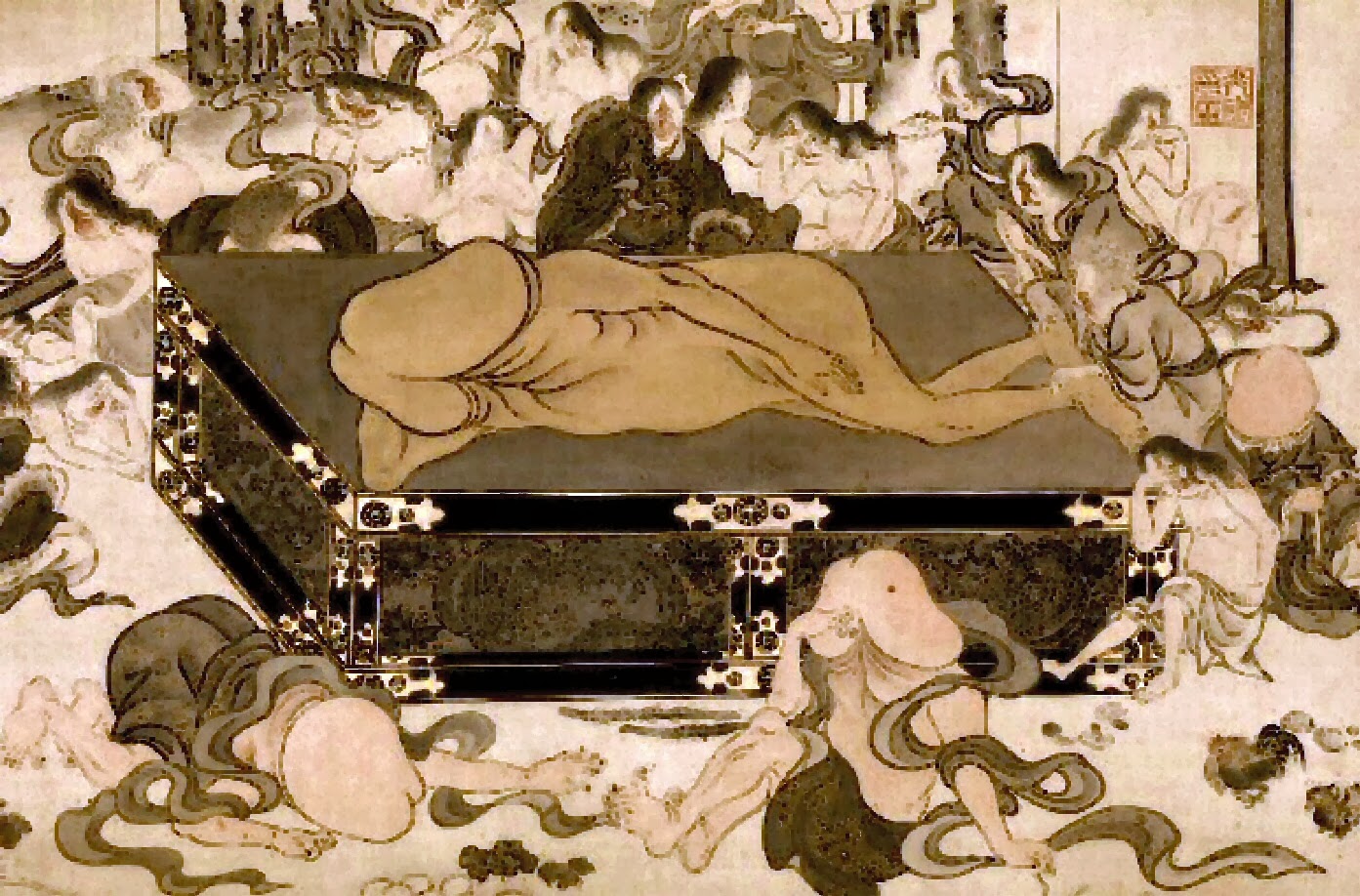
The highlight of the exhibition for me was the section dealing with shunga parodies. Alongside illustrated books on such perfectly innocent topics as etiquette, cooking and geography, there were X-rated parodies in which the words and images were subtly altered using standard schoolboy formulas such as “sounds a bit like penis” or “looks a bit like a vagina”. Probably the most outrageous example was entitled “Penis Parinirvana”, dating from the mid-19th century (the image shown here comes from the museum’s website, because photography wasn’t allowed in the exhibition). The word “Parinirvana” is used to describe the death of the Buddha, and it’s a common subject in Buddhist art. A typical example is this one from Wikimedia Commons. As you can see, Penis Parinirvana is pretty much the same thing, except that the Buddha and several of the mourners take the form of giant sex organs!
With its combination of sexual imagery and religious irreverence, you might think Penis Parinirvana would fall foul of the official censors. Apparently, however, although shunga were technically illegal, the authorities almost always turned a blind eye – the only time they enforced the law was if a politician or other public figure was satirized!

There is another image in the British Museum collection (although not on public display) that is very reminiscent of Penis Parinirvana: “Small figures gathered around a giant phallus”. This engraving is the work of Vivant Denon – a name that will be familiar to anyone who has visited the Louvre in Paris, since one of the museum’s three wings (the one with the Mona Lisa) is named after him. Denon’s fame rests on the fact that he was the first director of the Louvre, but he also produced a number of erotic engravings in the 1790s entitled Oeuvre Priapique. This particular example is a parody of several popular engravings of the time that depicted beached whales. In Denon’s version, which has a distinctly cryptozoological feel, the beached creature is an enormous phallus!

Sunday, 20 October 2013

Phallic Symbols (mostly small ones)

When I first spotted this statue of Balzac at the Musée Rodin in Paris, I though it was something else altogether. But I was wrong. Gigantic erections are something you almost never see in mainstream European art. I’m not sure why, because male genitalia are hardly a rarity in classical sculptures and paintings. It’s just that they always seem to be little ones.

There is a word for the artistic representation of an erect penis: ithyphallic. You can do a Google image search for “ithyphallic” if you want to, but you’ll be disappointed – most of the results come from the ancient world (where erections were believed to have magical properties – see Phascinating Phacts). It all changed with the Renaissance – big dicks were out and tiny dicks were in. The result is particularly comical in the case of mythological figures like the Greek god Zeus (≈ the Roman god Jupiter), who spent much of his career inseminating females. The only picture I’ve found that shows him with anything approaching a hard-on is a fresco by the 16th century Italian painter Giulio Romano, depicting Jupiter seducing Olympia.

Although some ancient Roman figures are shown with enormous erections, these always seem to depict specifically “phallic” gods such as Priapus. Even the great hero Hercules is generally shown with an unheroic little wiener, despite having an otherwise heavily muscled physique and heroic posture. Usually, anyhow. I saw this irreverent statue of Hercules at the British Museum’s Pompeii exhibition earlier this year (photography wasn’t allowed, so this is an official image, not mine). Notice how his dick is smaller than his little finger.

It’s not just the great mythological figures of Europe who are underendowed in the genital department. There’s a type of statue you sometimes see that I used to think of as a “naked Buddha”, but actually they don’t depict the Buddha at all – they come from another Asian religion called Jainism.
According to the label on the statue depicted here, which I saw in London’s V&A Museum, it depicts the Jina Parshvanatha, the 23rd Jain saviour, engaged in “sky-clad” meditation. His penis is about the same size as his thumb.

The Buddha is described in a Mahāyāna text called the Gaṇḍhavyūha as having a sex organ “like a thoroughbred elephant or stallion”, that can be retracted into his body when not in use. Presumably for that reason, depictions of the Buddha never show his penis – in fact the clingy drapery sometimes shows the very obvious absence of a penis.

Nevertheless, like Zeus or Jupiter, there’s no doubt the Buddha knew how to use it – witness the countless images of Buddha-incarnations copulating with female consorts (in the Tantric form of Buddhism at least). Here’s one I saw on my recent trip to Paris, in the Musée Guimet. It’s a type of devotional painting called a thangka, although at first glance you could be forgiven for thinking it was an example of early mediaeval interracial porn...

Saturday, 28 September 2013

A 17th Century Assassination

This year sees the 50th anniversary of one of the most notorious political assassinations in history. While JFK was the fourth U.S. President to be assassinated, it’s a less common fate of heads of state on this side of the Atlantic. One of the few examples I’ve come across is King Henri IV of France, who was stabbed to death on a Paris street in 1610, more than 400 years ago. This photo shows his tomb in the cathedral of St Denis, which I visited last week (all the images in this post are from last week’s trip to France).

The 17th century was an age of suspicion and paranoia, just as the 20th century was. But whereas the 20th century was all about Communists versus Capitalists, back in the 1600s it was Protestants versus Catholics. Henri was born in Catholic France, but raised in the small Protestant country of Navarre – of which he became king in 1572. A few months later he was one of the primary targets of the St Bartholomew Day’s Massacre – he only escaped with his life after promising to convert back to Catholicism. But he didn’t actually do that until 1593, by which time he stood to be crowned King of France (“Paris is worth a Mass”, he is supposed to have said). Religious commentators see Henri as cynical and duplicitous, while secular commentators see him as logical and pragmatic.

Henri IV survived at least two assassination attempts before the final, successful one. This took place on 14 May 1610 – the day following his second wife’s coronation as Queen of France. The King’s carriage was forced to stop due to a blockage caused by two carts, one carrying wine and the other hay. At this point, the assassin François Ravaillac leapt up and stabbed the King to death.

The official view, of course, is that Ravaillac acted alone. How he knew the road would be blocked at just that point, and why the authorities failed to clear the streets ahead of the King’s carriage, are unanswered questions on a par with the Grassy Knoll and the Magic Bullet. Even under extreme torture Ravaillac swore he had no accomplices, which proves exactly one thing – that the torturers wanted Ravaillac to swear he had no accomplices. Torture isn’t designed to extract the truth, it’s designed to extract whatever message the interrogators want to hear.

Having inherited the throne of France by an indirect route, Henri IV created a new dynasty – the House of Bourbon. On his death, the heir to the throne was his eight-year old son, who became Louis XIII. In turn he was succeeded by his own son, the most famous of all the Bourbon kings – Louis XIV, the Sun King who reigned for 72 years from 1643 to 1715. It was this latter Louis who commissioned the opulent Palace of Versailles, where I spotted this statue of his grandfather Henri IV.

Because Louis XIII was still a child when he inherited the throne of France, the country was ruled over by his mother, Marie de’ Medici. Anyone who believes in the Cui Bono school of conspiracy theories need look no further than her (or someone very close to her) for the instigator of her husband’s murder. It was an odd coincidence, anyway, that the assassination happened to take place the day after she was crowned Queen of France.

Marie wasn’t a shrinking violet. In 1621 she commissioned a series of 21 paintings to commemorate her life and achievements. But she didn’t call on any old hack – she turned to Peter Paul Rubens, one of the greatest artists of the day. And they aren’t small paintings either – they’re four metres (13 feet) high, and if set side by side (ignoring the spaces between them) they amount to a total length of 75 metres (almost 250 feet). As can be seen from the upper of the two photos, the Marie de’ Medici Cycle has a whole gallery to itself in the Musée du Louvre. The detail in the lower photo shows the most famous of the paintings, which is divided into two scenes. On the left, the assassinated King is borne heavenward by Jupiter and Saturn, while his assassin Ravaillac is depicted as a snake. On the right, various real and supernatural figures are imploring Marie to take the crown of France, which she graciously accedes to do.
Because of his inclination toward Protestantism, Henri IV was quite popular (at least some of the time) with Queen Elizabeth I of England. The most famous Elizabethan, William Shakespeare, even used Henri as the model for one of his leading characters – the King of Navarre in Love’s Labour’s Lost. But there is an even stronger connection between Henri IV (and Marie de’ Medici) and British history. Their youngest child, Henrietta Maria, who was only 6 months old when her father was assassinated, went on to marry the ill-fated King Charles I. Two of Henrietta’s sons became Kings of England: Charles II and James II. They were both grandsons of Henri IV, just as Louis XIV was.

James II, as a Catholic, found it as tough to be king in England as the Protestant-leaning Henri IV had in France. James endured the Monmouth Rebellion (which happened in this part of the world, as recounted in my book Bloody British History: Somerset) and was then forced to flee the country when Parliament sided with William of Orange against him. Exiled in France, his cousin Louis XIV gave him the Château of Saint-Germain-en-Laye to live in – you can see the tomb of James II in the nearby church.