Search This Blog

Showing posts with label Sacred sex. Show all posts

Sunday, 28 April 2024

Colin Wilson, Philosopher of the Paranormal

Back in the 1970s, Colin Wilson was one of the big names of what might be called "mass-market forteana". But while I did borrow a copy of his 600-page blockbuster The Occult circa 1978, it was only much later that I started to discover just how interesting his ideas are. It began in 2001, when I bought a book by Fortean Times contributor Gary Lachman called Turn Off Your Mind: The Mystic Sixties and the Dark Side of the Age of Aquarius (which I'm sure everyone spotted in my recent shelfie post, towards the right-hand end of the middle shelf). Colin Wilson made an appearance in Lachman's book in the context of the H. P. Lovecraft revival of the 1960s - including the wonderfully surreal cover of Wilson's 1967 novel The Mind Parasites. As evidenced by the photo above, I bought a second-hand copy as soon as I could find one, as well as two later novels in the same vein, The Philosopher's Stone (1969) and The Space Vampires (1976).

The other paperback shown above is a non-fiction one, The Psychic Detectives (1984), which I bought in 2016 when I was researching my own book, Pseudoscience and Science Fiction. Here's what I said about Wilson there:
As his career progressed, he became increasingly fascinated with the world of strange powers. A recurrent theme throughout his fiction and non-fiction is that most people live a robotic existence far below their real potential.
That use of the word "robotic" brings me on to the main subject of this post, which is the Kindle book shown in the above photo - Gary Lachman's Beyond the Robot: The Life and Work of Colin Wilson (2016). I only became aware of it last month, when Gary posted the following on Facebook:
I've just heard that the paperback of Beyond the Robot, my book about Colin Wilson, is now out of print. If you are among the many who didn't buy a copy, there's still time to not get the Kindle edition too.
Since I'm a chronic sufferer from the "Why do friends never read my books?" syndrome, I clearly had to buy it immediately! I'm glad I did, as I found it a fascinating and information-packed read which got 5 out of 5 stars from me on Goodreads. However, this post isn't really a review of the book, so much as a summary of a few things I found particularly interesting from a fortean point of view.

To start with, Fortean Times (as well as some of the "Unconventions" they organized) makes several appearances in the book. At one point Lachman specifically mentions "writing pretty regularly for the Fortean Times", and after Colin Wilson's death in 2013 Gary's obituary of him appeared in FT 310 (the same issue as my review of a comic-strip book about particle physics, FWIW). Although I've never actually met Gary, I did spot him at a couple of Uncons - and, I think, in the audience at the "Aliens and the Imagination" event I mentioned on this blog in 2011. Way back in 1978, in the guise of his musical alter-ego Gary Valentine, Lachman also wrote Blondie's paranormal-themed hit "I’m Always Touched by Your Presence, Dear".

As for Colin Wilson himself, he only came on to fortean-type subjects a decade or so after he started writing. His original focus was on existential philosophy, and his first book on that subject, The Outsider, was published in 1956 when he was just 24. It received a lot of rave reviews, including one in The Observer - which Lachman describes as one of Britain's "highbrow Sunday papers" (which pleased me a lot, since they published a two-page feature by me just a couple of months ago).

In hindsight, it's not surprising that Wilson's own personal take on philosophy eventually led to an interest in the paranormal, since it's ultimately all about widening human consciousness beyond the normal trivialities of everyday life. That's why he was drawn to the Lovecraftian style of fiction - he had no time for the more mainstream kind of novelist "who, in the service of realism, simply portrays life as it is". Another fortean favourite who made an impression on Wilson was Aleister Crowley. According to Lachman, Crowley was the model for one of the characters in Wilson's early novel Man Without a Shadow (1963) - Carradoc Cunningham, an occultist and master of "sex magic". Apparently Wilson himself harboured interests along the latter lines, believing that sexual orgasm can unlock higher states of consciousness and "open the doors of perception".

When Wilson came to write about the paranormal - The Occult (1971) being his first and best-known, but far from only, book on the subject - he did so in a way that was almost diametrically opposed to the standard approach for the genre. As Lachman puts it:
If scientists and other skeptics were ever going to broaden their minds about the occult, then it had to be presented to them logically, in a way that made sense, not in a sensational "believe it or not" manner.
As with his first book about philosophy, Wilson's first book on the paranormal also got rave reviews. In part, this was because "highbrow" readers were far more open to such topics at that time than they are today. Referring to a favourable review that New Scientist gave of Wilson's follow-up book Mysteries (1978), Lachman says:
Such acclaim from a scientific publication for a book about the paranormal is unusual today, and shows that in the 1970s, the paranormal was treated with respect by many scientists, unlike in our more narrowly skeptical times.
Another thing I remember myself from those times, is that interest in fringe topics was much more wide-ranging and eclectic than it is today. The "paranormal", for example, meant a lot more than just ghosts and poltergeists. Listing some of the topics that Wilson covered in Mysteries, Lachman includes "plant telepathy, psychic surgery, transcendental meditation, biofeedback, Kirlian photography, multiple personality and synchronicity". All great stuff - makes me feel more nostalgic than ever for the 20th century!

Colin Wilson was an incredibly prolific author, and I kept noting down titles of books of his that I ought to seek out. The most intriguing-sounding of all is Atlantis and the Kingdom of the Neanderthals (2006) - something I should have known about already, as Wilson mentioned it in an article he himself wrote for Fortean Times, called "A 100,000-year-old Civilization?" It appeared in FT 272 in March 2011, and I have to admit I'd forgotten all about it (although I looked back at it just now, which is how I know it mentions the Atlantis book). In any case, I've already acquired my copy of Atlantis and the Kingdom of the Neanderthals from eBay, as you can see here:


Sunday, 18 September 2016

Sacred Porn

As you can see from the screenshot above, I’ve been doing some more online research. Just why I decided to do a Google search for “walter fritz hotwife bareback gangbang porn” will become clear in due course. You’ll be relieved to see, however, that the search results are entirely Safe for Work. You can also see that it’s rather old news, dating back three months. However, I only belatedly encountered it in the latest issue of Fortean Times (FT 345, October 2016) – and I’m glad I did, because it’s part of an ongoing (and increasingly bizarre) saga that I’ve been following off and on for a quarter of a century now.

When I first joined the Civil Service in 1991, my boss was a loveable old bloke who was full of eccentric ideas (sadly he’s no longer alive). One of his favourite hobby-horses was the theory that Jesus was married to Mary Magdalene. At first I assumed this was his own idea (that was the way he presented it), but before long I discovered it was quite widespread in certain circles. I read about it in Fortean Times, and even saw a couple of talks on the subject at FT Unconventions. Then in 2003 Dan Brown put the idea at the heart of The Da Vinci Code and it entered mainstream consciousness.

In its most developed form (à la The Da Vinci Code), the theory goes way beyond Jesus simply being married. It holds that Tantra-style “sacred sex” rituals were at the heart of early Christianity, just as they are in certain forms of Buddhism, Hinduism, Taoism and many other non-western traditions. If true this would be an astonishing revelation – implying that all round the world, there is an inextricable and fundamental link between religion and copulation.

For a long time, this was just a fringe theory based on speculation and wishful thinking – with no real hard evidence. That suddenly changed in September 2012, when the religious historian Karen King (a professor at Harvard University, just like Robert Langdon in The Da Vinci Code) announced the discovery of “The Gospel of Jesus’s Wife”. Despite its grandiose title, this was really just a tiny, business-card-size scrap of papyrus bearing a few words written in an ancient Egyptian language called Coptic. But among those few words was the phrase “Jesus said to them, my wife” – potentially turning conventional Christian scholarship on its head.

Needless to say “The Gospel of Jesus’s Wife” was a controversial discovery. Harvard accordingly subjected the papyrus to a barrage of forensic tests – all of which indicated its authenticity. Strangely (from the point of view of an outsider), the one thing they didn’t bother to scrutinize was the back history of the fragment. Apparently the issue of “provenance” isn’t something academics normally bother about, so it was left to a journalist named Ariel Sabar to do the necessary detective work. His findings are written up in a long article in The Atlantic magazine – and this is where the story starts to get really bizarre.

After considerable effort, Sabar traced the original ownership of “The Gospel of Jesus’s Wife” to a Florida businessman and amateur Egyptologist named Walter Fritz. The exact nature of Fritz’s “businesses” – some of them at least – almost defied belief. I’m going to have to quote Sabar’s own words here, or you’ll think I’m making it up:
Beginning in 2003, Fritz had launched a series of pornographic sites that showcased his wife having sex with other men – often more than one at a time. One home page billed her as “America’s #1 Slut Wife”.
This was lucrative stuff – at one point about a third of the couple’s income was coming from porn site subscriptions. But it wasn’t just sex and money – there was a spiritual dimension too. Fritz’s wife told Sabar “that she was clairvoyant and had channelled the voices of angels since she was 17” ... and then added “I’m here to do God’s service”. Fritz claimed that during sexual intercourse his wife often muttered phrases in Aramaic – the language spoken by Jesus, which she had no conscious knowledge of.

Although Fritz talked openly about his sexual and pornographic activities, he continued to maintain that “The Gospel of Jesus’s Wife” was the real thing. But after publication of the Atlantic article his credibility seems to have taken a nose-dive, and even Professor King herself now considers that the papyrus is most likely a hoax.

And what about that sacred porn? Sabar says in his article that “all of the sites seem to have been taken down in late 2014 and early 2015 ... but archived pages and free images and videos were easy to find online”. This brings me back to my starting point – the Google search pictured at the top of this post. I tried all sorts of keywords drawn from Sabar’s article – but frustratingly they all led back to that article, or to things written about it. Of course some of the search terms threw up porn images, but nothing I felt sure was Walter Fritz and his Aramaic-channelling wife.

Sunday, 3 July 2016

The Museum of Witchcraft and Magic

This has to be one of the most fortean items I’ve ever seen in a museum – a spoon that was supposedly bent “with mind power” by Uri Geller! I spotted it last week amongst countless other fascinating objects in the Museum of Witchcraft and Magic in Boscastle, Cornwall. This was my second visit there – I went five years ago (see this blog post), but that was on a very busy day and the milling crowds made it difficult to see everything properly. It was much quieter last week and I managed to see a lot that I missed the first time – including Uri Geller’s spoon.

Other items on display include mediaeval books on witchcraft (including Saducismus Triumphatus, which I’ve written about before), protective charms used by soldiers in the 1st and 2nd world wars, Ouija boards, a large collection of magical artifacts that belonged to Gerald Gardner (the founder of modern Wicca), and several dead cats that had been walled up inside houses to keep the rats away. To top it all, there’s a “sex magic” display featuring a large number of little dicks (at least twice as many as I managed to get in this photo):
Actually the main reason I wanted to go to that part of Cornwall was to visit a much newer and less well known museum just a few miles from Boscastle – the Cornwall at War Museum. It’s off-topic for this blog, but highly recommended for anyone interested in 20th century military history. It’s a big place, occupying more than a dozen recently renovated buildings at what used to be RAF Davidstow. There are two full-size aircraft (a Hawker Hunter and a Fairey Gannet), several torpedoes, missiles and target drones, and loads of smaller items.

In one building I spotted an R1155 radio similar to the one I own (cf. the post about my various Museum Pieces). More surprisingly, in a different display in the same building I saw another very familiar object. This is something I’ve had since I was 12 years old, when I inherited all my father’s junk after he died. It’s nothing special – just a camera controller from a photo-reconnaissance aircraft – but I’ve always wondered exactly what period and what type of aircraft it came from. Unfortunately the one in the museum is unlabelled, although it appears to be identical to mine (as you can see from the two photos below). However, an online search yielded this page which includes a picture of one inside a 1950s-era Canberra PR.3/7.

Sunday, 6 December 2015

A Few Fortean Novels by Ian Watson

UFOs and the Men in Black – Temporal anomalies and the Tunguska event – Tantric Sex and the Tibetan Book of the Dead – Alchemy and the paintings of Hieronymus Bosch – Space Gods and a Martian Inca… The novels that Ian Watson wrote in the 1970s and 80s certainly aren’t short of Fortean ideas. I don’t always remember to make a distinction on this blog between fictional works that are “good” (i.e. enjoyable to read) and ones that are “interesting” (i.e. thought-provoking). So I’ll say right away that Ian Watson is very much a master of the second category, without always finding his way into the first. I’ve read six of his novels in three short bursts – three in 1997, two in 2004 and one just last week. Some are definitely better than others, but here’s a quick rundown in the chronological order that I read them:

Miracle Visitors (1978) is one of the books on my Charles Fort in Fiction list. I bought my copy in 1997, from Watkins esoteric bookshop in London. They’d shelved it among the non-fiction UFO books, which is quite appropriate really. Although the story has “characters” and a “plot”, they’re primarily vehicles for the author to get his ideas across. I’m not averse to novels of this type, as long as the ideas are good ones – which they are in this case. There are countless science fiction stories about UFOs, but almost all of them are based on some variant of the Extraterrestrial Hypothesis (ETH). What’s unusual about Miracle Visitors is that Watson opts for a Psycho-Social Hypothesis (PSH), in which the whole UFO Phenomenon (with a capital P) is a manifestation of a higher state of consciousness. Still more unusual, he actually manages to make the PSH sound interesting – he even works the Men in Black into the Phenomenon as well as the different kinds of Close Encounter.

I was sufficiently impressed with Miracle Visitors that I went out and bought two more Watson novels. The first of these was Chekhov’s Journey (1983). This has nothing to do with Star Trek – the title character is the playwright Anton Chekhov, who really did go on a long and somewhat mysterious journey in 1890. The novel is set a century later in 1990, when a documentary film is being made about Chekhov’s journey. Since so few facts are known about it, they use a form of “past-life regression” hypnosis to fill in some of the details. This brings all sorts of wacky weirdness to light, including a connection to the Tunguska explosion (which occurred in 1908) and a spacecraft from the future which is hurtling backwards in time. Of all the Watson novels I’ve read, this is probably my favourite – certainly in terms of being exciting and enjoyable to read.

The other Watson novel I read in 1997 was Alien Embassy (1977). This is set in a strange future society based on Tibetan Buddhism, in which the space program ostensibly uses Tantric sex rituals as a mystical means of travelling to the stars. Now I may be wrong, but this strikes me as the single most brilliant idea for a science fiction novel that anyone has ever come up with. Unfortunately the execution doesn’t live up to the concept, and Watson heads off on a deeply undesirable tangent. Ignoring all the potentialities of sex, mysticism and space travel, the novel is almost exclusively about (wait for it) … politics. Aaarghh! It’s not surprising that it was another seven years before I picked up another Watson novel.

When I did, it was another really good one. The Gardens of Delight (1980) is based on the intriguing concept of a planet modelled on The Garden of Earthly Delights by Hieronymus Bosch. This extraordinary triptych can be seen in the Prado Museum in Madrid, which I’ve visited a couple of times (that’s my souvenir postcard at the bottom of this post). It’s arguably the strangest, most baffling artwork of the Renaissance period, and there are innumerable theories and speculations as to its meaning. According to one school of thought, it depicts an allegory of the alchemical process… and that’s the interpretation Watson opts for here. The result is a really fascinating and original novel, which ought to be read by anyone who’s a fan of Bosch’s painting.

The other Watson book I read in 2004 was God’s World (1979). I have to be honest and say I don’t have a clear recollection of this one. The back cover blurb sounds promising enough: “Earth has been alerted by messengers of God and summoned to the planet of angels, 82 Eridani. Powered by a mysterious space drive found in the Gobi desert, a crusading space ship is launched through High Space to explore this heavenly world.” Beyond that, all I can remember is a bunch of rather dull people on a spaceship talking to each other. As with Alien Embassy, I suspect that if the reader took the blurb and wrote their own novel around it, they’d have a lot more fun.

Much the same is true of the novel I’ve just read – The Martian Inca (1977). I bought this one several years ago, but it kept slipping down the pile before I got round to reading it. As with all Watson’s novels, the basic premise is fascinating. An unmanned sample-return mission is sent to Mars, and on its return it crash-lands in a remote part of Bolivia. The soil sample contains a psychoactive substance which causes one of the villagers to have a revelatory vision (or a pseudo-revelatory one – it isn’t clear which), after which he claims to be a reincarnated Inca with special powers (again, it’s ambiguous as to whether these powers are real or self-delusion) – and promptly sets off to lead a populist revolution. At the same time, a crewed mission lands on Mars and is exposed to the same substance, with equally strange results. I imagine that’s pretty much how Watson pitched the novel to his publishers, in which case it’s not surprising that they jumped at it. Unfortunately, however, the end-product doesn’t live up to the pitch. In particular, the details of the flight to Mars and the Bolivian revolution are too sketchy for the reader to engage with, or believe in, to any great extent.

I don’t want to end on a negative note, though. There is so much trite, unchallenging, formulaic science fiction around that novels like these are a much-needed antidote to all that.

Sunday, 23 August 2015

Rocket to the Morgue

While I was writing last week’s post about L. Ron Hubbard I suddenly remembered a novel called Rocket to the Morgue, in which one of the characters is based on Hubbard. I bought the copy pictured above (second-hand, as you can tell from the condition) in 2008, and was impressed enough to write about it at the time. It should have featured in my post about Charles Fort in Fiction, since it belongs to the select group of novels that mention Fort by name, but I managed to miss it out. So I thought I’d rectify the omission now.

Rocket to the Morgue was written by a man named William White, and originally appeared in 1942 under the pen-name of H. H. Holmes. White is better known by another pseudonym, Anthony Boucher, which he used on a number of classic short stories including “The Compleat Werewolf” and “The Quest for Saint Aquin”, and as founding editor of The Magazine of Fantasy and Science Fiction. The paperback reprint of Rocket to the Morgue has the name Anthony Boucher on the cover.

The novel is essentially a murder mystery, although that’s secondary to the real interest of the book. The action takes place against the backdrop of science fiction fandom – and prodom – as it existed at the time the book was written. No real-world authors make an appearance, but even Wikipedia acknowledges that many of the characters are based on real people. Most of these will be pretty obscure to modern-day readers – the main exceptions are Robert A. Heinlein (who features as “Austin Carter”) and L. Ron Hubbard (“Vance Wimpole” – described by one of the other characters as “an eccentric, a madman if you will”). Somewhat confusingly, there is also a passing reference to another writer named “René Lafayette”, which as mentioned last week was a pseudonym used by Hubbard.

As an aside, it’s worth emphasizing just how different the world of 1942 was. L. Ron Hubbard was a pulp writer, pure and simple. Scientology and Dianetics still lay in the future, and Hubbard’s name would have meant nothing to the general public. Science fiction fandom would have been equally obscure. There were no blockbuster sci-fi movies in 1942, and the cutting edge of the genre still lay in the pulp magazines. Although the novel is full of characters who conform to the modern stereotype of the science fiction geek, that stereotype would have been unknown to most readers when the book first came out.

The most Fortean character in the book isn’t a science fiction author – he’s a rocket scientist. His name is Hugo Chantrelle, and it’s a mishap with one of his rocket tests that gives the book its title (and is illustrated, in stylised form, on the cover). But Chantrelle is more than just a scientist: “The time-dreams of Dunne, the extra-sensory perception of Rhine, the sea serpents of Gould, all these held his interests far more than any research conducted by the Institute. He was inevitably a member of the Fortean Society of America, and had his own file of unbelievable incidents eventually to be published as a supplement to the works of Charles Fort.”

Surprising as it may seem, Chantrelle too is based on a real person – Jack Parsons, who was one of the founders of NASA’s Jet Propulsion Laboratory. Like his fictional counterpart, Parsons was no ordinary scientist. He was on friendly terms with the real-life L. Ron Hubbard, and with the notorious occultist Aleister Crowley. One of my all-time favourite Fortean Times covers (FT132, pictured below) described him as “Playboy, antichrist and missile messiah”. Here are a few selected passages from the article about Parsons in that issue:

  • Before each test launch, he was in the habit of invoking Aleister Crowley’s Hymn to Pan, the wild horned god of fertility. Parsons was an active member of the California Agape Lodge of the sex magical group Ordo Templi Orientis, and in letters addressed the Great Beast as “Most Beloved Father”.
  • He practised “sex magic” but was so lacking in occult disciplines that his early workings more resembled early free-love orgies than anything else. Outside of these “religious” activities, Parsons was an incorrigible womaniser, who also blithely styled himself the Antichrist.
  • In August 1945, on leave from his less than spectacular naval career, Scientology founder L. Ron Hubbard was introduced to Parsons. Jack was impressed by Ron’s exuberance and energy and wrote in a letter to Crowley: “I deduced that he is in direct touch with some higher intelligence... He is the most Thelemic person I have ever met and is in complete accord with our own principles”.
  • In January 1946, the two commenced a long and complex magical ritual called the “Babalon Working”. This was intended to create nothing less than an elemental being. As far as Parsons was concerned, the invocation worked. The elemental turned up two weeks later in the form of the beautiful blue-eyed, red-haired Marjorie Elizabeth Cameron.
  • In April 1946, Parsons, Cameron and Hubbard, acting as scribe, attempted the second part of the Babalon Working, which was intended to raise a “moonchild” in the manner described in Crowley’s novel of the same name, with Cameron the vessel for Parsons’ magical seed. The mundane world intruded, however, and the tricky Hubbard, despite his intense and apparently sincere involvement with the Babalon working, vanished with $10,000 of Parsons’ money.

Sunday, 2 February 2014

Chinese Alchemy

In a second-hand shop a few years ago I picked up a large-format book called Ritual and Magic, which consists of material recycled from Peter Brookesmith’s partwork The Unexplained from the 1980s. It’s really very good, and full of things I’ve never seen mentioned elsewhere. Here’s an example from the very first page of the first chapter:

“Sexual symbolism was in common use among alchemists and some of them interpreted such symbolic phrases as the marriage of the Red King and the White Queen not only chemically but also sexually. Some went so far as to attempt to manufacture the philosopher’s stone – the mysterious substance that would transmute base metal into gold – from human semen. Thus 18th century German records tell of an alchemical group that engaged in experiments of this sort. The leader of the group, an officer of high rank in the Austrian army, collected the raw materials for this curious research by paying soldiers to masturbate. The soldiers under the officer’s command were so enthusiastic to supplement their meagre pay that they neglected their military duties in almost incessant masturbation.”

The idea of collecting semen for use in the transmutation of metals seems a bit far-fetched, to say the least. But there was another side to alchemy, which was concerned with the prolonging of human life rather than the production of gold. In this context, the use of semen – as the basis for an elixir of life – makes a lot more sense. Enough sense for a work of fiction, anyway.

There’s just one problem with the scenario. Without going into gratuitous detail, if the secret of eternal youth simply involved the consumption of human semen, someone would have noticed by now. So there has to be some gimmick that makes the elixir of life really difficult to synthesize in practice.

Something else that’s been on my list of potential story ideas for ages is Chinese five-element theory. The topic has fascinated me ever since I first came across it in the 1990s – particularly as it relates to the interaction between different personality types (as illustrated in simplistic form in the accompanying picture). I produced my Zen Dynamics website more than 12 years ago, but I always thought the five-element cycle would make a good framework for a story as well.

Chinese element theory comes from Taoism, and the Chinese form of alchemy also comes from Taoism... so things were coming together. Taoism even makes a big deal about semen (see Wikipedia if you don’t believe me)... but it’s all about the retention of semen, not its collection. Needless to say, semen retention doesn’t have the same narrative potential that semen collection does. The great thing about fiction, however, is that you don’t have to tell the truth – in fact the whole point is that you’re supposed to make things up. So I made up my own form of Chinese Alchemy.

Chinese Alchemy (ISBN 978-1-611529-69-2) is available in Kindle format from Amazon.com and Amazon UK, and in other ebook formats direct from the publisher JMS Books – and hopefully from other retailers as well. Here is the blurb:

The secret of eternal youth is known to few, and attained by even fewer. It involves the preparation of an elixir, made from the sperm of five copulating couples, under conditions that make the undertaking all but impossible. The couples must represent specific physical and personality types, and ethical constraints rule out all the more obvious approaches to the task. Horny young bisexual Kelvin stumbles across the secret and decides to embark on the quest that has defeated so many before him. A fast-moving romp with a bizarre cast of characters, ranging from students and professors to porn stars and Satanists.

Friday, 27 December 2013

Fortean Crossword

Apparently the crossword puzzle marks its centenary this month. A few years ago I put together a Fortean-themed crossword which I thought would be worth repeating here. You can either print it out or do it in your head... or just ignore the grid and treat the questions as a trivia quiz.

Answers next week – together with an exegesis of all the Fortean connections.
ACROSS

1. Author of Chariots of the Gods [5, 3, 7]
9. First of the seven churches mentioned in the Book of Revelation [7]
10. “Their weapons were no match for the Bossonian -------“ (Robert E. Howard) [7]
11. "Voyagers who have shown every indication of intent to -----" (Charles Fort) [5]
12. Yggdrasil, for example [3]
13. The world ends without this, according to T.S. Eliot [1, 4]
14. Site of the Crucifixion [7]
16. "I had long hoped for a personal ------- with a man from a flying saucer" (George Adamski) [7]
18. The queen of the fairies, according to Shakespeare [7]
21. Sayings of Jesus that are not found in the Gospels [7]
23. Max -----, German surrealist [5]
25. --- Geller, Israeli-born psychic [3]
26. "Thus ----- Zarathustra", by Friedrich Nietzsche [5]
27. Lenape people living in New Jersey when the Europeans arrived [7]
28. "------- Tales" (1974), featuring Paloma Picasso as Countess Erzsébet Báthory [7]
29. Britain's best-known cryptid [4, 4, 7]

DOWN

1. The building pictured below [6, 9]
2. Eldest son of Abraham, according to the Book of Genesis [7]
3. Herman -----, author of Siddhartha [5]
4.The James ------- is inscribed "James, son of Joseph, brother of Jesus" [7]
5. The ------- Sibyl, prophetess of Apollo [7]
6. Professional assassin in feudal Japan [5]
7. An esoteric branch of Judaism [7]
8. A type of hippie found in 1980s Britain [3, 3, 9]
15. --- Greenslit Pudeator, hanged as a witch in Salem in 1692 [3]
17. "Alles Vergangliche ist --- ein Gleichnis" (Everything transient is only a symbol - Goethe) [3]
19. "The Serpent Power: Secrets of ------- and Shaktic Yoga" by Arthur Avalon [7]
20. Thomas -------, author of Summa Theologica [7]
21. Belief that all living and non-living things have a spiritual essence [7]
22. Generic term for Indian languages related to Sanskrit [7]
24. The largest moon of Saturn [5]
26. ----- Magus, a sorcerer mentioned in the Book of Acts [5]

Sunday, 15 December 2013

Orgy in the Temple

After the two videos I posted last week, there were still a few iMovie features I wanted to try out... so I started looking for another offbeat idea that would lend itself to a two-minute video clip. And I found one.
Arthur C. Clarke’s short story “I Remember Babylon” was published in the May 1960 issue of Playboy magazine. Essentially it’s an early speculation on the possibilities of satellite TV (which didn’t exist in 1960 – the idea was pure science fiction). The story contains the rather silly idea that you could beam blue movies into people’s homes in the form of “a highbrow movie about ecclesiastical art”... if the art in question came from certain Indian temples, that is.

The story refers specifically to the Temple of the Sun at Konarak, although I’ve also included two temples from the Khajuraho complex where the action is even more outrageous (some of the acts depicted there are illegal – I’ve only shown the legal ones). The text isn’t very specific about the musical soundtrack, except that it has sudden changes of mood and tempo. That made me think of Mahler, so I used various snippets from the final movement of the Resurrection Symphony. That fits in with the “ecclesiastical” theme, too.

The movie in Arthur C. Clarke’s story is titled “Aspects of 13th century Tantric sculpture”. However, it’s not certain that the erotic temple sculptures at Konarak (modern spelling Konark) and Khajuraho really are connected with Tantric practices. There seem to be three possibilities:
  • The images depict Maithuna – Tantric sexual union performed in a ritual context. This sounds great in principle... but it doesn’t explain the depiction of illegal acts (Either you can use your imagination at this point, or you can consult Wikimedia Commons).
  • Rather than real world events, the sculptures are meant to depict the goings on in some other-worldly paradise. Brian Ruhe mentions something similar in his book Freeing the Buddha, which I referred to in Buddhism and UFOs: “The fourth heaven is Tushita Heaven, another very popular vacation spot. This is the heaven with the number one greatest amount of sensuous pleasures – sex, drugs, rock ‘n’ roll.” Konarak and Khajuraho are Hindu temples, not Buddhist, but the same idea may apply.
  • It’s possible that the sculptures have no religious significance at all, or that they’re meant to depict “bad” rather than “good” things. It’s a fallacy to assume that any image in a place of worship must be an object of worship itself. Christian churches often contain images of the devil (such as this one at Rennes-le-Chateau), while the ubiquitous Sheela-na-gig is no less lascivious than the erotic Indian carvings. One of the highlights of Wells Cathedral in Somerset is a man with toothache – nothing especially religious about that. Mediaeval masons liked to have a bit of fun – as do their modern counterparts. The sculpture of an astronaut was added to a cathedral in Salamanca during renovations in 1992, while Washington National Cathedral has a gargoyle-like carving of Darth Vader.

Sunday, 3 November 2013

Phallic Satire

When I mentioned diminutive representations of male genitalia a couple of weeks ago, I was thinking about serious art. When it comes to cartoons and caricatures it’s a different matter altogether. This was apparent at an exhibition I went to at the British Museum last week called Shunga: sex and pleasure in Japanese art. Shunga are woodblock-printed images depicting erotic scenes, and many of the examples were of a comical nature with outrageously exaggerated anatomical details. One of the wall displays quoted Narisue Tachibana as saying, as long ago as 1254: “The Old Masters depict the size of the thing far too large... If it were depicted the actual size there would be nothing of interest.”

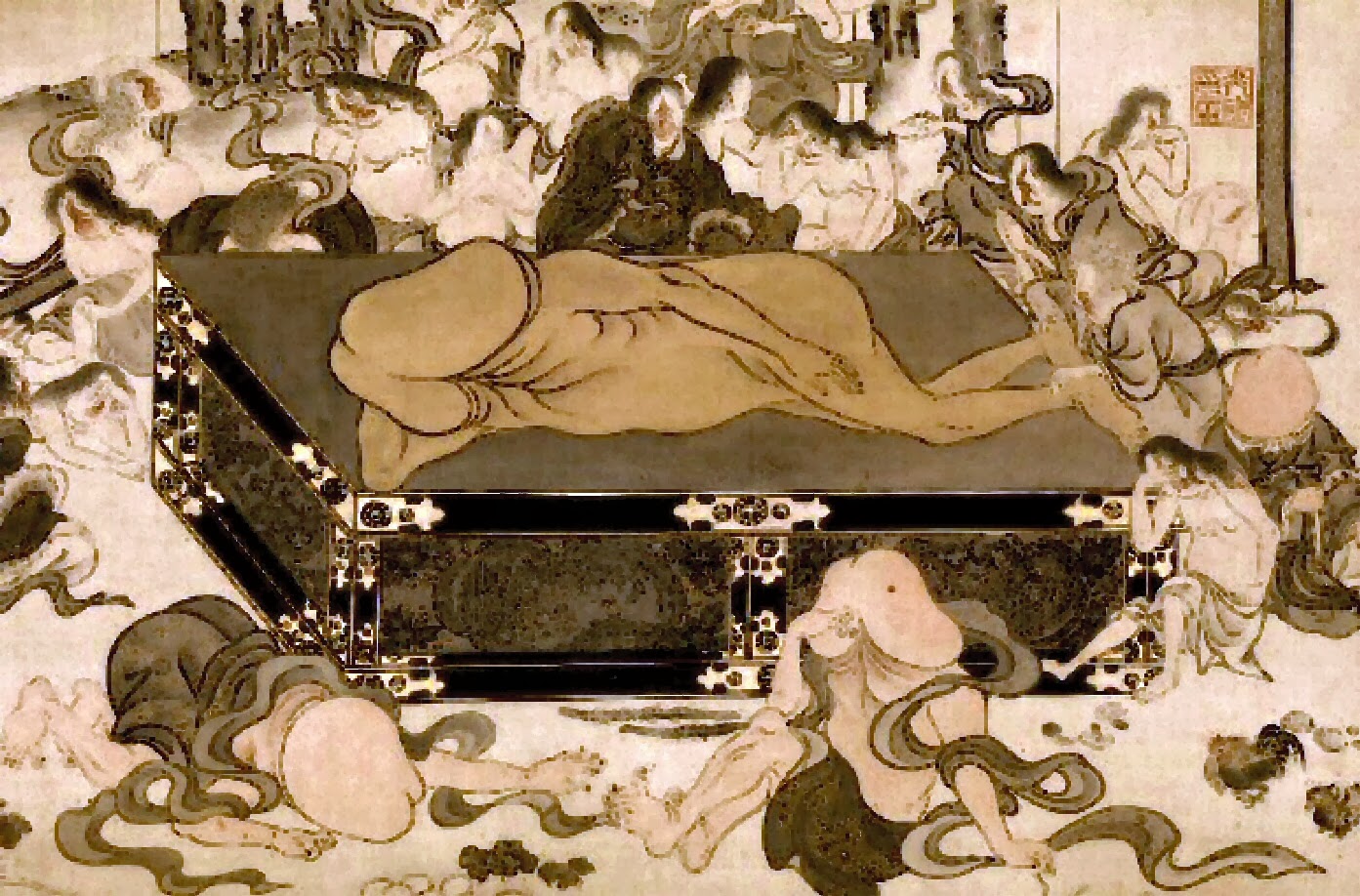
The highlight of the exhibition for me was the section dealing with shunga parodies. Alongside illustrated books on such perfectly innocent topics as etiquette, cooking and geography, there were X-rated parodies in which the words and images were subtly altered using standard schoolboy formulas such as “sounds a bit like penis” or “looks a bit like a vagina”. Probably the most outrageous example was entitled “Penis Parinirvana”, dating from the mid-19th century (the image shown here comes from the museum’s website, because photography wasn’t allowed in the exhibition). The word “Parinirvana” is used to describe the death of the Buddha, and it’s a common subject in Buddhist art. A typical example is this one from Wikimedia Commons. As you can see, Penis Parinirvana is pretty much the same thing, except that the Buddha and several of the mourners take the form of giant sex organs!
With its combination of sexual imagery and religious irreverence, you might think Penis Parinirvana would fall foul of the official censors. Apparently, however, although shunga were technically illegal, the authorities almost always turned a blind eye – the only time they enforced the law was if a politician or other public figure was satirized!

There is another image in the British Museum collection (although not on public display) that is very reminiscent of Penis Parinirvana: “Small figures gathered around a giant phallus”. This engraving is the work of Vivant Denon – a name that will be familiar to anyone who has visited the Louvre in Paris, since one of the museum’s three wings (the one with the Mona Lisa) is named after him. Denon’s fame rests on the fact that he was the first director of the Louvre, but he also produced a number of erotic engravings in the 1790s entitled Oeuvre Priapique. This particular example is a parody of several popular engravings of the time that depicted beached whales. In Denon’s version, which has a distinctly cryptozoological feel, the beached creature is an enormous phallus!

Sunday, 20 October 2013

Phallic Symbols (mostly small ones)

When I first spotted this statue of Balzac at the Musée Rodin in Paris, I though it was something else altogether. But I was wrong. Gigantic erections are something you almost never see in mainstream European art. I’m not sure why, because male genitalia are hardly a rarity in classical sculptures and paintings. It’s just that they always seem to be little ones.

There is a word for the artistic representation of an erect penis: ithyphallic. You can do a Google image search for “ithyphallic” if you want to, but you’ll be disappointed – most of the results come from the ancient world (where erections were believed to have magical properties – see Phascinating Phacts). It all changed with the Renaissance – big dicks were out and tiny dicks were in. The result is particularly comical in the case of mythological figures like the Greek god Zeus (≈ the Roman god Jupiter), who spent much of his career inseminating females. The only picture I’ve found that shows him with anything approaching a hard-on is a fresco by the 16th century Italian painter Giulio Romano, depicting Jupiter seducing Olympia.

Although some ancient Roman figures are shown with enormous erections, these always seem to depict specifically “phallic” gods such as Priapus. Even the great hero Hercules is generally shown with an unheroic little wiener, despite having an otherwise heavily muscled physique and heroic posture. Usually, anyhow. I saw this irreverent statue of Hercules at the British Museum’s Pompeii exhibition earlier this year (photography wasn’t allowed, so this is an official image, not mine). Notice how his dick is smaller than his little finger.

It’s not just the great mythological figures of Europe who are underendowed in the genital department. There’s a type of statue you sometimes see that I used to think of as a “naked Buddha”, but actually they don’t depict the Buddha at all – they come from another Asian religion called Jainism.
According to the label on the statue depicted here, which I saw in London’s V&A Museum, it depicts the Jina Parshvanatha, the 23rd Jain saviour, engaged in “sky-clad” meditation. His penis is about the same size as his thumb.

The Buddha is described in a Mahāyāna text called the Gaṇḍhavyūha as having a sex organ “like a thoroughbred elephant or stallion”, that can be retracted into his body when not in use. Presumably for that reason, depictions of the Buddha never show his penis – in fact the clingy drapery sometimes shows the very obvious absence of a penis.

Nevertheless, like Zeus or Jupiter, there’s no doubt the Buddha knew how to use it – witness the countless images of Buddha-incarnations copulating with female consorts (in the Tantric form of Buddhism at least). Here’s one I saw on my recent trip to Paris, in the Musée Guimet. It’s a type of devotional painting called a thangka, although at first glance you could be forgiven for thinking it was an example of early mediaeval interracial porn...

Sunday, 7 April 2013

Phascinating Phacts

Of all the words in the English language, “fascinating” has one of the oddest derivations. In modern usage the word simply means “very interesting”, with vague overtones of “mesmerizing” or “casting a spell on”. But it originates from the old Latin word fascinus, which referred to a special kind of charm or amulet taking the form of an erect human phallus (sometimes with wings). Phallic charms of this type were extremely popular in the days of ancient Rome, when it was believed they had the power to ward off evil influences. If you type “fascinus” into a Google image search you’ll see the sort of thing I’m talking about.

Phallic symbolism was surprisingly common in ancient religions, as I pointed out in my post on A Victorian Theology of Everything a couple of years ago. The book I referred to in that post was one I’d found in a second-hand bookshop, and at the time I had no idea who the anonymous author was. I’ve since discovered that it was a man named Hargrave Jennings (1817–1890), who seems to have more or less invented the subject of “phallicism”, and then devoted his whole career to writing about it.

Widespread as they are, phallic icons and amulets are usually purely symbolic in nature. But there’s one example—in fiction, at least—where it’s the real thing: the Talisman of Set. This features in one of the best occult novels of the twentieth century – Dennis Wheatley’s The Devil Rides Out, first published in 1934. The novel was used as the basis for a 1967 Hammer film of the same title, which (within the limitations of the 90 minute format) is reasonably faithful to the book. The screen version omits large chunks of occult background, but the basic plot is preserved, as well as a surprising amount of Wheatley’s dialogue. But the film doesn’t mention the Talisman of Set.

One of the main characters (in both the book and the film) is a young man named Simon, who is being pursued by a Crowleyesque occultist called Mocata. In the film, the reason why Mocata is so desperate to get hold of Simon is never explained – you just have to take it for granted. But the book goes into much more detail: Simon has discovered the secret of the Talisman of Set. This object, which is supposed to have been lost and found countless times throughout history, is nothing less than the mummified phallus of the Egyptian God Osiris! And unlike a Roman fascinus, this is no lucky charm – “whenever it is found it brings calamity upon the world” (it was given its sinister powers by Set, the brother of Osiris – hence its name). In 1914, the Talisman of Set had unleashed the Great War on the world, and now (in the 1930s) Mocata wants to use it to trigger a second global war.

Despite being the procreative organ of one of the most powerful gods in the Egyptian pantheon, the Talisman—when it’s finally tracked down—isn’t much to look at: “a small black cigar-shaped thing, which was slightly curved”. Eventually Mocata is defeated, and (in the novel) the Talisman of Set is duly incinerated... thus averting the threat of a Second World War. In reality, of course, the Second World War wasn’t averted... so perhaps that’s why Hammer decided to omit the Talisman of Set from the movie version. Or then again, maybe they were worried that the sight of Christopher Lee and Charles Gray chasing across Europe in pursuit of a shrivelled black phallus wouldn’t have gone down too well with the viewing public!

Sunday, 16 September 2012

A Fortean History of Somerset

I was very pleased to be given the opportunity to write a volume on Somerset for the Bloody British History series from The History Press. This is my kind of history – all the good bits and none of the boring bits. As well as the eponymous “bloody” history (prehistoric cannibals, Viking invaders, Catholic-massacring Puritans and Victorian murderers) there is no shortage of more offbeat items to interest a Fortean audience:
  • Joseph of Arimathea is reputed to have brought the Holy Grail to Glastonbury in 63 AD.
  • Cadbury Castle may have been the inspiration for the legend of King Arthur’s Camelot – it was certainly the stronghold of a powerful warrior chief around the time Arthur is presumed to have lived.
  • When the Saxons invaded Somerset in the 7th century, they found that the locals believed Saint Patrick was buried at Glastonbury... this may not have been true (see Saint Patrick of Glastonbury?) but it did wonders for the pilgrimage trade.
  • During the 12th century, when Glastonbury Abbey was in desperate need of funds for rebuilding work, the monks dug up an even more lucrative pilgrimage attraction – nothing less than the bones of King Arthur himself!
  • At their height, the Knights Templar owned much of the land in Somerset, and at two Templar sites symbolic “heads” have been found that might be related to the mysterious Head that the Templars are supposed to have worshipped (much more detail is given in Juliet Faith’s book The Knights Templar in Somerset).
  • When Henry VIII ransacked Glastonbury Abbey in 1539, he found a vast treasure trove of gold and jewels that he was quick to turn into much-needed cash for the royal coffers. Relics – including the reputed horn of a unicorn – that had no obvious financial value were thrown away. Later in the 16th century, a man rummaging through the ruins of the Abbey found what he claimed was the alchemists’ secret formula that would transmute base metals into gold. That man was Edward Kelley... soon to become the most notorious and sought-after occultist in Europe.
  • The “whistling” ghost of Mother Leakey from Minehead was famous enough to be described in some detail by Sir Walter Scott. Less well known is the role the ghost played in the downfall and execution of John Atherton – a man from Bridgwater who became the first and only Anglican Bishop to be hanged for sodomy.
  • Much of the theoretical basis for the 17th century witch-hunts, in America as well as England, was laid down by the book Saducismus Triumphatus by Somerset-born Joseph Glanvill – who has a reasonable claim to having been the world’s first paranormal investigator (see The Daemon of Tedworth).
  • One of the best-documented exorcisms of the 18th century took place in the Temple Church in Bristol, but the subject was a man from Somerset: George Lukins, the Yatton demoniac. In the same century, another Somerset man, a professional geologist named John Beaumont, wrote extensively about a race of demons that he believed had a personal vendetta against him.
  • Some years before she wrote Frankenstein, Mary Shelley attended a lecture by the Somerset-based electrical experimenter Andrew Crosse. The latter subsequently gained an undeserved reputation as a “real-life Frankenstein”, when the press announced that he had created artificial life in his laboratory – something Crosse himself never claimed to have done.
  • During the 19th century, a former Church of England vicar named Henry Prince set up a “free love commune” in rural Somerset that he called the Abode of Love, where he and the other members indulged in Hieros Gamos style sex rituals behind 15-foot high walls.
Bloody British History: Somerset is available from Amazon UK and all good booksellers.

Sunday, 9 September 2012

A Brief History of Tantric Sex

My interest in Tantric sex is purely theoretical. Like all my other theories, my theory of Tantric sex is ingenious and almost certainly wrong. One point that is emphasized by all modern writers on the subject is that Tantra stems from an ancient tradition. Up to a point, I’m sure that’s right. The word Tantra was certainly in use on the Indian subcontinent 2000 years ago, and encompassed a good deal of what would nowadays be called sacred sexuality. And the religious use of sexual imagery and rituals—not necessarily under the name of Tantra—was around for at least a thousand years before that. But in functional terms, I don’t think it had anything in common with present-day Tantra at all.

My theory is that Tantra underwent two massive reinventions: the first about 2000 years ago and the second within the last 50 years. If you go back to prehistoric times, I think people had a very confused idea of how the natural world worked. Their lives were dominated by things like droughts, disease and crop failures, and they desperately wanted to be able control these things but had no idea how to go about it. The most powerful thing that was within their control was sex—an act that seemed to create new life out of nothing. So they reasoned, illogically by modern standards, that performing the right kind of sexual rituals could have other “magical” effects as well. Prior to the Axial Age of circa 500 BC, when most modern religions have their origin, religious rituals—including sexual ones—were misguided attempts to control the natural world rather than having any kind of spiritual dimension (New Agers will disagree vehemently with this... but as I said, it’s just my theory and probably wrong).

The big change that started around 500BC, when the more mystical aspects of the Hindu-Buddhist, Graeco-Roman and Judaeo-Christian traditions have their roots, was the shift of religion away from superstitious ritual towards soteriology. Now “soteriology” is one of my favourite words, even though I don’t really know what it means. I use it to mean the idea that there are higher states of existence than those of everyday life, which can be attained through appropriate religious practices. If you sat down with a blank piece of paper, and tried to think up a list of “appropriate religious practices” to attain a higher state of existence, then all-night drug-fuelled sex orgies, or the visualization of animal-headed, multi-limbed deities copulating with each other, probably wouldn’t immediately spring to mind. But people had a long tradition of doing these things, albeit for completely different reasons, so (presumably because they enjoyed them) they decided to keep the sexual elements and redefine their function in soteriological terms. I suspect this happened in all the traditions—Judaeo-Christian, Graeco-Roman and Hindu-Buddhist—but it’s only in the last (and then only in a small minority of practitioners) that’s it’s survived to the present day.

The object shown on the left can be seen in the Victoria and Albert Museum in London. It isn’t exactly clear what’s going on, but it’s obviously sexual (and quite possibly illegal). According to the caption: “For Buddhist Tantric practitioners, the ass-headed protective deity Kharamukha Samvara is an embodiment of the enlightened state. The sexual imagery is a metaphor for enlightenment, with the male representing compassion and the female wisdom.” If you look closely, the “embodiment of the enlightened state” is wearing a necklace of human skulls, and trampling on two small human-like figures (cf. my earlier post on Tantric Buddhism). I think the imagery is far easier to understand if it originated in some ancient pagan magical superstition, and was later glossed over with a Buddhist “soteriological” interpretation.

I first encountered the idea of Tantric sex in 1980, when I was looking for a book on yoga (but I bought the book on Tantric sex anyway). In those days, it still had a strongly spiritual dimension, and interest was limited to the “hippie” mystical fringe. But since then the subject has snowballed to the extent that it is now a mainstream industry that everyone has heard of. But in today’s world, you can’t be mainstream and talk about spirituality – it’s a contradiction in terms. There’s a limit to the number of punters who are desperate to attain a higher level of spiritual awareness... and they tend to lead alternative lifestyles with limited disposable income for high-end workshops and one-on-one counselling sessions. On the other hand, there is a never-ending supply of well-to-do, middle-aged couples who want to liven up their sex lives. So modern Tantric practitioners tend to say things like “Tantra had its origins way back in the past when people believed in Gods and Goddesses, but many people nowadays are uncomfortable with such ideas so we can safely dispense with them.”

I’m not criticizing neo-Tantra per se – it’s probably more socially useful, less ludicrous and certainly no more cynical than the traditional form of Tantra. But why do people have to call it Tantra? Sacred Sex without the Sacred is just Sex!

Sunday, 1 July 2012

Post-Fortean Books

Several years ago I used the lulu.com self-publishing website to set up my own “publishing imprint” called Post-Fortean Books. But because I had a properly paying job at the time, I didn’t really have the leisure or motivation to do much in the way of marketing or publicity. Since then times have changed, and I’ve just gone through the process of reissuing all the books on Kindle. Four of them are also listed on iTunes, while the other two have just been submitted. Here are the details (in each case the link at the beginning goes to the US Amazon site and the one at the end to amazon.co.uk):

The Case of the Invisible College and Other Mysteries: A collection of Sherlock-Holmes style detective stories set in present-day Oxford. All the stories have loosely Fortean themes (“The Dangerous Book”, “The Invisible College”, “The Shakespearean Super-Chimp”, “The Abducted Astrobiologist”, “The Ghost in the Machine”, “The Shocking Science Quarterly” and “The Inverted Pyramid”). This one is listed on iBooks. [Get it from Amazon UK]

The Aquarius Code: A loose pastiche of The Da Vinci Code, written in 2006 when such things were topical. My story has a stronger fantasy/sci-fi element, though, and plenty of Fortean trappings (Earth Mysteries, Glastonbury, occult rites, Illuminati etc). A 17,000 word novella. This one has just shown up on iTunes as well as Kindle. [Get it from Amazon UK]

The Promethean Galaxy: This is the only non-fiction work on the list. It’s a short (18,000 words) "exploration of the Galaxy" in science, philosophy, arts, mysticism and literature. It’s Fortean only in the sense that it refuses to take sides. Again, this one has just appeared on iTunes as well. [Get it from Amazon UK]

Kundalini Conspiracy: A 23,000 word novella that I stitched together in 2004 from several earlier short stories. Not great literature, but it’s bursting with Fortean themes (abductions, government conspiracies, past-life regression, mind control, Lovecraftian cults, cattle mutilation and probably other things I’ve forgotten). I tried to make the hero sympathetic, but I’ve been told he’s an obnoxious little pervert. This one is available as a printed book as well as being listed on iTunes and Kindle. [Get it from Amazon UK]

The Naked Guru: Just a short story (7,000 words). This is another one set in Oxford, but the style is very different from The Invisible College... more in the “sleazy comic-book sci-fi” genre (if such a thing exists). I billed this one as “For Mature Readers Only” because it’s all about a sex cult, though actually the sexual content isn’t much greater than Kundalini Conspiracy or The Aquarius Code. Only on Kindle so far. [Get it from Amazon UK]

Six Dimensional Sex: Another one for mature readers! This is set in the Swinging Sixties, and it’s a parody of a particular type of science fiction that was popular at that time -- both in its repetitively sexual narrative and avant-garde writing style. It’s an absolutely terrible book (deliberately, because I was parodying a terrible style) but my hope is that the word Sex in the title will sell it despite its awfulness. Again, this one is only on Kindle so far. [Get it from Amazon UK]

Sunday, 20 May 2012

Bacchus and Ariadne

Here is a picture for anyone who thinks classical mythology and/or renaissance art is dull. It’s the work of the 16th century Italian artist Agostino Carracci, and it depicts the legendary tale of Bacchus and Ariadne. In Greek mythology, Ariadne was a Cretan princess who fell in love with the hero Theseus. He dumped her on the island of Naxos, where shortly afterwards the god Bacchus arrived to help her get over him. While the legendary account has them indulging in a robust sex session, it’s not often depicted as explicitly as it is here! A more traditional version was produced by Agostino’s brother Annibale Carracci.

It was not unknown for artists to produce generic porn images and slap classical-sounding titles on them to “get them past the censor”. But that’s not the case here, since the scene really does depict the legend of Bacchus and Ariadne. The male figure is wearing a wreath of vine-leaves, which was a universally recognized symbol of the god Bacchus. And in the background you can see Theseus making a getaway in his ship... again a widely recognized symbol often seen in depictions of this story.

Bacchus is often euphemistically described as the “god of wine”, but actually he was the god of drunkenness, debauchery and all-night sex orgies. Not surprisingly he had a large cult following, particularly in the decadent times of the later Roman Empire. We even used to worship him here in Somerset, as can be seen from this (sadly rather damaged) statue in the Roman ruins at Bath.


Friday, 10 February 2012

Devilish superstitions

Paul Jackson sent this photograph of a Bronze Age round barrow at Wilsford Cum Lake near Amesbury in Wiltshire. The barrow—a prehistoric burial mound—is the grassy hump in the background (it can be seen more clearly in the inset, which comes from Google Street View). Barrows of this kind are fairly common in Wiltshire, as well as other parts of Britain, but this is a particularly well-preserved example. It’s 4.4 metres (14½ feet) high and 36 metres (118 feet) in diameter; it dates from circa 1000 BC.

Round barrows are artificial mounds, built during the Bronze Age for the burial of high-status individuals. Over time, however, their original purpose—and man-made origin—was forgotten. They were widely considered “the work of the devil”, and in some parts of the country round barrows are known as “Devil’s humps”.

Over the centuries, ignorant superstition has attributed a wide range of phenomena to the “work of the Devil”, from eclipses and fossils to warts, migraines and masturbation. As mentioned in The Devil of Rennes-le-Chateau, masturbation continued to be demonized well into the nineteenth century. Production of excessive amounts of semen (to get back to the subject of the photograph) was thought to lead to loss of energy and vitality. Ejaculation twice a week into the marital uterus was good; ejaculation six times a day over your jeans was bad.

One of the most vocal proponents of the anti-masturbation movement was William Acton, who wrote in 1857: “Apathy, loss of memory, abeyance of concentrative power, indisposition for action and incoherence of language are the most characteristic mental phenomena resulting from masturbation in young men. The large expenditure of semen has exhausted the vital force.”

The “too much ejaculation is bad for you” superstition is surprisingly widespread. As well as Victorian England, similar beliefs can be found in the Tantric Yoga and Kamasutra-style “sacred sex” practices of India, and in Taoism and Qi Gong in China. In the context of the latter system, the loss of ejaculatory fluid is associated with a corresponding loss of “qi”, the vital life force -- resulting in premature aging, general fatigue and susceptibility to disease.

The word “cum”, by the way, is Latin for “with”. Wilsford Cum Lake is a parish made up of two small villages, one called Wilsford and the other called Lake. I’m sure that’s what you thought as soon as you saw Paul’s photograph.

Thursday, 14 April 2011

Tantric Buddhism

Here is the last of three interesting pictures I took in the British Museum last week (the others were a prophetic print and a crystal ball):

In the modern sense of the term, Tantric Sex is about as bland and innocuous as anything you can think of which has the word "Sex" in the title... but it still comes as a bit of a surprise to see the Buddha indulging in it. Furthermore, if you look closely, some of the imagery is far from bland and innocuous!

This particular object, originating from Nepal and made of gilt copper, depicts the Buddha (in his esoteric form of Samvara) embracing his female "wisdom partner". She is holding a ritual dagger in her right hand, while he is wearing a long dangling necklace made of human skulls. Both of them are stomping on two small figures... not demons, as you might guess, but gods -- one is Bhairava (a manifestation of the Hindu god Siva), and the other is the goddess Kali.

The usual explanation for this kind of "Tantric" Buddhist imagery is that it was devised by early Buddhists as an aid to meditation. Visualizing the sex act is supposed to be conducive to the union of wisdom (symbolized by the dagger) and mental purification (symbolized by the skulls). Personally I find this explanation rather cynical (a few years ago my career as a book reviewer for the Buddhist Society came to an abrupt end when I dared to suggest this!)... but it's a pretty cool idea nevertheless. In any other religion, if you close your eyes and visualize people having sex they call you a pervert!

The fact is that Tantric visualization is quite a rare thing in Buddhism -- as far as I know it's not practiced by Zen Buddhists in Japan, or by Theravada Buddhists in South Asia. My guess is that it originally had nothing to do with Buddhism at all, but started out as a fairly standard "sex magic" practice in the Himalayan region -- then got grafted onto Buddhism when the missionaries realized it was the only way they were going to convert the locals!

Friday, 8 April 2011

Novel space technologies

The main difference between space technologies in the real world and in science fiction is that real world technologies have to work, whereas SF technologies don't (that's why Star Trek has got warp drive and NASA hasn't). You might think it would be pretty risky to build a spaceship based on a description from an SF novel, and you'd be right. On the other hand, amongst all those way-out ideas, there might be some pointers to a future breakthrough...

That's obviously the way the European Space Agency was thinking when they set up the ITSF (Innovative Technologies from Science Fiction) database in 2001. Divided into categories such as Communications, Robotics, Materials, Propulsion and Space Transportation, the database is a repository of ideas from such Great Thinkers as Arthur C. Clarke, Larry Niven, Robert A. Heinlein and Isaac Asimov.

I even submitted one item myself, taken from Ian Watson's thoroughly bizarre novel Alien Embassy (1977). In this, the participants indulge in Tibetan sacred sex rituals in order to project their astral essences to the planets of other star systems (all the enlightened races in the Galaxy do this). Believe it or not, the item did make it into the ITSF database (minus one or two of the more technical details), but under Feasibility they put "not able to judge". They probably didn't even try it!

Friday, 4 March 2011

Hellfire Caves

The meeting place of a notorious eighteenth century Pagan Sex Cult is not, one might be forgiven for thinking, the obvious venue for a fun day out for all the family. Yet that is exactly what the current proprietors of the Hellfire Caves in Buckinghamshire have been forced to turn them into (presumably driven by the First Law of 21st Century Tourism: if it's not a fun day out for all the family, it won't make any money).

The Hellfire Club, or the "Order of Friars of St. Francis of Wycombe", was a mock religious society founded by Sir Francis Dashwood of West Wycombe in 1746. It held its meetings in a network of caves, designed by Dashwood himself, which were adorned with statues of pagan gods and goddesses. Despite its religious trimmings, however, it seems likely that the club's members were simply world-weary atheists looking for a novel form of entertainment.

At the heart of the cave network is the so-called Inner Temple -- pictured at left as it is today (as usual, the photograph comes courtesy of Paul Jackson). It was in this Inner Temple that the Hellfire Club's most secret activities took place. And they really were secret... speculations as to their nature range from sinister Satanic rituals to wild Caligula-style orgies. Whatever they were, they were probably more fun that the rather genteel tea party depicted in the management's current tableau!

Saturday, 26 February 2011

A Victorian Theology of Everything

Phallic Worship: a Description of the Mysteries of the Sex Worship of the Ancients, with the History of the Masculine Cross.
Here's another item from my collection of "books no-one else has got" (or alternatively, "books no-one else would buy"). This one dates from 1880, and was both anonymous and Privately Printed (these may have been legal ploys to circumvent the blasphemy laws of the time). The book's subject matter is Phallicism... the worship of what the Victorians coyly referred to as "the male generative organ".

The book isn't just about primitive pagan beliefs -- it's about every religion that ever existed. The author's theory is that in the dim recesses of prehistory there was One True Religion, which was (ahem) cock worship. Over time the True Faith became corrupted and transformed into the vast diversity of religions we find today (or in 1880, to be precise). The author finds traces of Phallicism in ancient Egypt, ancient Scandinavia and ancient Greece, among the Phoenicians, Druids and Native Americans, in modern day India, China and Japan... and even in the Judaeo-Christian tradition (which was more sacrosanct in the 19th Century than it is today). Any theological allusion to a tree, pole, pillar, obelisk, rod or staff is a Phallic Symbol, as are any references to bulls, rams, goats and serpents. Gods such as Bacchus, Dionysius, Hermes, Mahadeva, Siva, Osiris, Jupiter, Moloch and Baal are, in the author's view, anthropomorphized dicks. We are told (and I'm careful to put the following in quotes): "the great object of veneration in the Ark of the Covenant was doubtless a phallic emblem" and "the cross, or crucifix, has a sexual origin".

Although completely batty (like all eccentrics, he - or she - takes the germ of a good idea to ridiculous extremes) this is actually a nice book... it manages to discuss all of the world's religions in a positive light (even if a cranky one), without claiming that any of them are superior or inferior to the others!