Search This Blog

Showing posts with label Religion. Show all posts

Sunday, 17 March 2024

Medieval Monsters


A few years ago I discovered (by reading about it in a book, I'm sorry to say, rather than actually noticing it with my own eyes) that several of the village churches around where I live have strange demonic or cryptozoological-looking creatures crawling over their upper reaches. Colloquially you could refer to these as "gargoyles", although strictly speaking that word only refers to fancifully decorated waterspouts. The proper term for the non-functional ornaments I'm referring to is "grotesques" (which can be used as a noun as well as an adjective).

The main purpose of this post is to show off some of the photographs I took after my attention was drawn to these bizarre medieval carvings (a good excuse to give my 75 - 300 mm zoom lens an airing). Before that, however, it's interesting to speculate as to their purpose, since no one seems to know just why they were produced in the first place. Explanations I've seen include heraldic symbols relating to the local gentry, and depictions of local folklore - which here in Somerset would mostly mean dragons (as discussed in a previous post). But while some of the carved figures may well conform to one or other of those theories, they don't explain all of them - particularly the more demonic-looking ones.

By "demonic" I don't necessarily mean overtly so, in the sense of having horns and pointed ears or whatever, but just generally malevolent-looking - like the ape-headed, cloven-hoofed figure shown at the top of this post. This, and many of the other examples I've seen, are basically "chimeras" - fanciful combinations of two or more unrelated species. These were common in the mythology of ancient Greece and Egypt, but by the Middle Ages they'd become firmly associated with Hell (Dante's depiction of it, which I talked about last week, includes several chimera-like demons).

The decorations in and around medieval churches were, almost invariably, a form of communication with the congregation, who could understand imagery even if they were unable to read. So my own personal theory is that these demonic - or otherwise "ungodly" - creatures were depicted on the exterior of the church simply to emphasize that they weren't inside it. In other words, if you came into church you were safe from such monsters, but if you stayed outside you were at their mercy.

All the pictures in this post were taken on the same day in August 2019, at three different churches - Langport, Long Sutton and Huish Episcopi - the carvings on which date from circa 1450, 1490 and 1500 respectively. The ape-demon shown above, for example, is clinging to the tower of Long Sutton church - as you can see more clearly in the following wider-angle view, which also includes a vaguely pig-like face looking straight at you:

Here's another figure from Long Sutton, which reminds me a bit of a Chinese lion-dog statue:

Now two examples from Huish Episcopi. I've no idea what the first one is meant to be, partly because it's so badly weathered, but I'd say it's definitely in the demonic category. As for the much better preserved second one, it clearly depicts a chimera with a human face and four-legged body:

 Turning to Langport church, this one is absolutely covered in inter-species hybrids! Here are a couple of striking ones:

 ... and a few more:

 Langport also has a human head, but it doesn't look at all happy - possibly a soul tormented in Hell? Though it's difficult to make out from this angle, it's actually depicted wearing a crown, suggesting that maybe it's some recently deceased (and presumably unpopular) king. I mentioned last week that Dante used his description of Hell as a vehicle for political satire - perhaps that's what's going on here too! (incidentally, what looks like a bad case of chromatic aberration around the upper part of the head is actually a lead cover that's been added to protect it from the elements).

Thursday, 28 December 2023

Fortean shelfies


Following on from last week's instalment What does fortean mean? I thought I'd post a couple of "shelfies" featuring books that fit my wider definition of the word. The one above contains newer books (what I think of as "newer" anyway, i.e. post-1990), while the one below shows books I've acquired second-hand - some of them genuine "retro-forteana" dating back to the 1950s or even earlier.

Although these are what I think of as my "fortean" books, they don't include everything I own that might fit the definition. For example, I've amassed a vast collection of fiction, much of which (as pointed out in the previous post) could easily be considered fortean. I also have numerous science books (many of them acquired as review copies for Fortean Times, or as research for my own writing) which are "fringy" enough to class as borderline forteana. But just two of them managed to squeeze into the picture above, both by my colleague Brian Clegg: How to Build a Time Machine and Extra-Sensory.

Another near-fortean topic that I have a whole shelf of books about is Buddhism (again many of them review copies, having spent 10 years as a book reviewer for the Buddhist Society). But I tend not to think of Buddhism as a fortean subject - unlike "alternative" religions, New Age beliefs and holistic therapies, all of which are quite well represented above. Amongst the latter is Scent Therapy by Raje Airey - who of the 10 or so authors featured here that I know personally, is the one I've known longest - since I went to school with her!

Looking at the picture above, I was surprised to see how biased my book-buying habits seem to be towards British authors. I honestly hadn't been aware of that until now. But certainly on subjects like UFOs, I do prefer the more methodical, less sensational approach of researchers like Jenny Randles, Nigel Watson, David Clarke and Mark Pilkington - with How UFOs Conquered the World and Mirage Men (book and DVD) by the latter two probably being my all-time favourite takes on the subject.

Turning to the older books pictured below, you'll spot quite a few classic UFO titles there - plus one oddity I was particularly pleased to find in a second-hand bookshop: The House of Lords UFO Debate (1979). Another rarity, which I've written about previously on this blog, is The Riddle of the Flying Saucers by Gerald Heard. Dating from 1950, it's the oldest of my UFO books - though not the oldest on this shelf, that honour going to Paranormal Cognition from 1944.

Another book I was pleased to get hold of was Damon Knight's biography of Charles Fort (with the brilliant subtitle "Prophet of the Unexplained", which sadly isn't shown on the spine). I bought this from a UK bookseller, but it's actually stamped "Miami Public Library" inside, so I'm not sure how and when it crossed the Atlantic. Another ex-library book - and a particularly battered and much-read copy it is too - is Three Men Seeking Monsters by Nick Redfern. In this case the library in question is much closer to home, on the Isle of Portland - specifically, the library of Portland Prison. The inmates there obviously include some very discerning readers!


Sunday, 18 September 2016

Sacred Porn

As you can see from the screenshot above, I’ve been doing some more online research. Just why I decided to do a Google search for “walter fritz hotwife bareback gangbang porn” will become clear in due course. You’ll be relieved to see, however, that the search results are entirely Safe for Work. You can also see that it’s rather old news, dating back three months. However, I only belatedly encountered it in the latest issue of Fortean Times (FT 345, October 2016) – and I’m glad I did, because it’s part of an ongoing (and increasingly bizarre) saga that I’ve been following off and on for a quarter of a century now.

When I first joined the Civil Service in 1991, my boss was a loveable old bloke who was full of eccentric ideas (sadly he’s no longer alive). One of his favourite hobby-horses was the theory that Jesus was married to Mary Magdalene. At first I assumed this was his own idea (that was the way he presented it), but before long I discovered it was quite widespread in certain circles. I read about it in Fortean Times, and even saw a couple of talks on the subject at FT Unconventions. Then in 2003 Dan Brown put the idea at the heart of The Da Vinci Code and it entered mainstream consciousness.

In its most developed form (à la The Da Vinci Code), the theory goes way beyond Jesus simply being married. It holds that Tantra-style “sacred sex” rituals were at the heart of early Christianity, just as they are in certain forms of Buddhism, Hinduism, Taoism and many other non-western traditions. If true this would be an astonishing revelation – implying that all round the world, there is an inextricable and fundamental link between religion and copulation.

For a long time, this was just a fringe theory based on speculation and wishful thinking – with no real hard evidence. That suddenly changed in September 2012, when the religious historian Karen King (a professor at Harvard University, just like Robert Langdon in The Da Vinci Code) announced the discovery of “The Gospel of Jesus’s Wife”. Despite its grandiose title, this was really just a tiny, business-card-size scrap of papyrus bearing a few words written in an ancient Egyptian language called Coptic. But among those few words was the phrase “Jesus said to them, my wife” – potentially turning conventional Christian scholarship on its head.

Needless to say “The Gospel of Jesus’s Wife” was a controversial discovery. Harvard accordingly subjected the papyrus to a barrage of forensic tests – all of which indicated its authenticity. Strangely (from the point of view of an outsider), the one thing they didn’t bother to scrutinize was the back history of the fragment. Apparently the issue of “provenance” isn’t something academics normally bother about, so it was left to a journalist named Ariel Sabar to do the necessary detective work. His findings are written up in a long article in The Atlantic magazine – and this is where the story starts to get really bizarre.

After considerable effort, Sabar traced the original ownership of “The Gospel of Jesus’s Wife” to a Florida businessman and amateur Egyptologist named Walter Fritz. The exact nature of Fritz’s “businesses” – some of them at least – almost defied belief. I’m going to have to quote Sabar’s own words here, or you’ll think I’m making it up:
Beginning in 2003, Fritz had launched a series of pornographic sites that showcased his wife having sex with other men – often more than one at a time. One home page billed her as “America’s #1 Slut Wife”.
This was lucrative stuff – at one point about a third of the couple’s income was coming from porn site subscriptions. But it wasn’t just sex and money – there was a spiritual dimension too. Fritz’s wife told Sabar “that she was clairvoyant and had channelled the voices of angels since she was 17” ... and then added “I’m here to do God’s service”. Fritz claimed that during sexual intercourse his wife often muttered phrases in Aramaic – the language spoken by Jesus, which she had no conscious knowledge of.

Although Fritz talked openly about his sexual and pornographic activities, he continued to maintain that “The Gospel of Jesus’s Wife” was the real thing. But after publication of the Atlantic article his credibility seems to have taken a nose-dive, and even Professor King herself now considers that the papyrus is most likely a hoax.

And what about that sacred porn? Sabar says in his article that “all of the sites seem to have been taken down in late 2014 and early 2015 ... but archived pages and free images and videos were easy to find online”. This brings me back to my starting point – the Google search pictured at the top of this post. I tried all sorts of keywords drawn from Sabar’s article – but frustratingly they all led back to that article, or to things written about it. Of course some of the search terms threw up porn images, but nothing I felt sure was Walter Fritz and his Aramaic-channelling wife.

Sunday, 1 November 2015

A Very Odd Picture


It’s not every day you see the founder of a major world religion working in a comic book studio, so imagine my surprise when I saw this picture in the British Museum yesterday, which depicts not one but two of them doing just that. The caption reads: “Nakamura Hikaru (born 1984): Buddha and Jesus drawing manga, cover artwork for Saint Oniisan vol. 10. This artwork for the front cover of a manga book depicts Buddha creating his own manga, helped by Jesus.”

I know almost nothing about manga comics, but Nakamura Hikaru is described as a “young and very popular manga artist who specialises in comedy.” Apparently Saint Oniisan is her best-selling title, with weekly sales around 30,000 (which would have been a relatively low figure back in the heyday of comics in the mid-20th century, but much higher today when fewer people read comics). As far as I can tell, the series deals with the comic adventures of Jesus and the Buddha as they attempt to pass themselves off as ordinary people in modern-day Tokyo. The caption goes on to say “The playful depiction of the founders of two world religions as youthful men on holiday in Japan has achieved cult status. The two divine beings negotiate the ups and downs of their life together in a humble flat in suburban Tokyo. The series explores dilemmas in everyday life with visual gags, puns and word play.”

The current display in the British Museum focuses on the work of three manga artists of different generations, Nakamura Hikaru being the youngest. As well as the cover image, several black and white pages from Saint Oniisan are also on display (see example below). There is also a short interview with Hikaru in which she says “I was surprised by the positive reactions to my manga. I received letters from religious specialists, university professors, Buddhist priests and Christian clergy. I have also had requests to use my manga in universities for teaching purposes.”

Wednesday, 1 January 2014

Crossword Exegesis

I don’t really know what an exegesis is, but people expect a crossword compiler to have a big vocabulary. What I mean is, on the other side of the following image are the answers to last week’s crossword and/or trivia quiz, together with an explanation of the various Fortean connections.

If you want to do the puzzle but haven’t done so yet, reading beyond this point will take you into spoiler territory. But if you’ve done the puzzle, or just want to see the answers, scroll on...


ACROSS

1. Author of Chariots of the Gods: ERICH VON DANIKEN. An easy one to start with! But EvD’s ideas weren’t as original as many people imagine – see Reinventing Ezekiel's Wheel.

9. First of the seven churches mentioned in the Book of Revelation: EPHESUS. A Turkish town and a major centre of early Christianity. It was also the site of one of the Seven Wonders of the World: the Temple of Artemis.

10. “Their weapons were no match for the Bossonian LONGBOW" (Robert E. Howard). This comes from the only full-length Conan novel that Howard wrote, The Hour of the Dragon (also sometimes published as Conan the Conqueror). Not a particularly Fortean story, although some of Howard’s other fiction is. I think I’ll make that the subject of my next blog post.

11. "Voyagers who have shown every indication of intent to EVADE " (Charles Fort). This comes from The Book of the Damned, a few paragraphs after the oft quoted “I think we're property” – the voyagers in question being extraterrestrial ones.

12. Yggdrasil, for example: ASH. Yggdrasil is the World Ash Tree in Norse mythology.

13. The world ends without this, according to T.S. Eliot: A BANG. From The Hollow Men (1925): “This is the way the world ends: Not with a bang but a whimper.” Another Eliot poem from the same period, The Waste Land, is packed with Fortean themes – I’ll have to add that to my list of future posts as well.

14. Site of the Crucifixion: CALVARY. From the Latin Calvariæ Locus = “place of the skull”. The Hebrew equivalent is Golgotha.

16. "I had long hoped for a personal CONTACT with a man from a flying saucer" (George Adamski). A quote from Flying Saucers have Landed, co-authored with the far more interesting Desmond Leslie.

18. The queen of the fairies, according to Shakespeare: TITANIA. From A Midsummer Might’s Dream, of course. The picture (fourth image on top row) shows a detail from The Reconciliation of Oberon and Titania (1847) by Sir Joseph Noel Paton.

21. Sayings of Jesus that are not found in the Gospels: AGRAPHA. This is an obscure one, but anyone who’s tried compiling a crossword will know that the more words you fill in, the harder it gets to find unobscure words to fit the remaining spaces! But Agrapha isn’t so obscure that it doesn’t have its own Wikipedia page.

23. Max ERNST, German surrealist. Perhaps the most Fortean connection here is Ernst’s bird-man creation called Loplop, which was adopted as a kind of mascot by Jon Downes and the Centre for Fortean Zoology (see picture – third image on the top row).

25. URI Geller, Israeli-born psychic. Geller’s 1973 appearance on the Dimbleby Talk-In was one of my Fortean Events that Shook the World.

26. "Thus SPAKE Zarathustra", by Friedrich Nietzsche. Written in the 1880s, this philosophical work focused on two concepts more often associated with the 20th century: “The Superman” and “God is Dead”.

27. Lenape people living in New Jersey when the Europeans arrived: RARITAN. This is one of two grid entries where I just couldn’t find anything Fortean that would fit. There’s a modern-day city in New Jersey named Raritan, as well as Raritan Bay between New Jersey and New York.

28. "IMMORAL Tales" (1974), featuring Paloma Picasso as Countess Erzsébet Báthory. The Báthory segment focuses on the historical countess, not the later legends that associate her with vampirism. So she doesn’t slaughter large quantities of female virgins and bathe in their blood in order to restore her youth. She just slaughters large quantities of female virgins and bathes in their blood because she enjoys it (see picture – first image on bottom row).

29. Britain's best-known cryptid: LOCH NESS MONSTER. In light of the upcoming Scottish independence vote, perhaps I should have worded this as “Scotland's best-known cryptid” to stay on the safe side.

DOWN

1. The building pictured [in last week’s post]: EXETER CATHEDRAL. Another non-Fortean one – I needed a 15-letter word or phrase beginning with E and ending with L, and this was the best I could do. The answer was actually written on the image, if you can read Latin: Exoniensis Ecclesiae Cathedralis.

2. Eldest son of Abraham, according to the Book of Genesis: ISHMAEL. In the Judaeo-Christian tradition, Ishmael is less important than his younger half-brother Isaac. In Islam, however, Ishmael is the more important of the two, being a direct ancestor of Muhammad.

3. Herman HESSE, author of Siddhartha. According to Wikipedia, this 1922 novel “deals with the spiritual journey of self-discovery of a man named Siddhartha during the time of the Gautama Buddha.... It was published in the U.S. in 1951 and became influential during the 1960s.”

4. The James OSSUARY is inscribed "James, son of Joseph, brother of Jesus". If the inscription is genuine, it might constitute archaeological evidence for the Biblical Jesus... but quoting Wikipedia again, “most scholars hold the last part of the inscription to be a forgery”.

5. The DELPHIC Sibyl, prophetess of Apollo. The illustration (second image on top row) is from Michelangelo’s Sistine Chapel ceiling.

6. Professional assassin in feudal Japan: NINJA. I’m not sure if this is an easy one or not – everyone uses the word “ninja”, but do they really know what it means?

7. An esoteric branch of Judaism: KABBALA. When I compiled the crossword a few years ago, I convinced myself this was a valid spelling – although “Kabbalah”, “Cabala” and “Qabbala” are more common.

8. A type of hippie found in 1980s Britain: NEW AGE TRAVELLER. Again the spelling may look wrong to some people, but that’s how it’s spelled here in Britain. And hey, spelling rules are just another fascist conspiracy anyhow. If you catch my drift, man.

15. ANN Greenslit Pudeator, hanged as a witch in Salem in 1692. It was tragic, of course, that so many innocent women were accused of witchcraft in the 17th century... but really, with a name like Ann Greenslit Pudeator, what do you expect? She probably had a pierced nasal septum and wore black lipstick, too.

17. "Alles Vergangliche ist NUR ein Gleichnis" (Everything transient is only a symbol - Goethe). These words are sung by the Chorus Mysticus at the end of Mahler’s 8th Symphony (see The Curse of the Ninth).

19. "The Serpent Power: Secrets of TANTRIC and Shaktic Yoga" by Arthur Avalon. The author’s real name was Sir John Woodroffe, who derived his pseudonym from Arthurian mythology. Oddly, though, the book isn’t about Arthurian mythology but about Indian mysticism. Woodroffe was one of the first proponents of the New Age formula “if it’s old, and it doesn’t come from the Judaeo-Christian or Graeco-Roman tradition, then it must be good.”

20. Thomas AQUINAS, author of "Summa Theologica". Aquinas was a 13th century scholar who specialized in interpreting the works of Aristotle (that’s what scholars used to do in those days, in lieu of thinking for themselves). He was often depicted trampling on a rival Aristotle-interpreter named Averroës, as seen in the painting by Gozzoli in the rightmost image above.

21. Belief that all living and non-living things have a spiritual essence: ANIMISM. Closely related to paranoia: the belief that all living and non-living things are out to get you.

22. Generic term for Indian languages related to Sanskrit: PRAKRIT. Most mystical and religious Indian writings are in Sanskrit, although the earliest Buddhist scriptures are in a Prakrit language called Pali. “Karma” and “Nirvana” are Sanskrit – the Pali equivalents are “Kamma” and “Nibbana”.

24. The largest moon of Saturn: TITAN. One of the few bodies in the Solar System that astrobiologists believe may support alien life – thought probably not as advanced as the alien life envisaged by Philip K. Dick in The Game-Players of Titan.

26. SIMON Magus, a sorcerer mentioned in the Book of Acts. All the Bible says about Simon is that he became a Christian, but not a very good one. However, later writers describe him as one of the founders of Gnosticism, and presumably for that reason he’s one of the many highbrow figures namedropped by Philip K. Dick in VALIS.

Friday, 27 December 2013

Fortean Crossword

Apparently the crossword puzzle marks its centenary this month. A few years ago I put together a Fortean-themed crossword which I thought would be worth repeating here. You can either print it out or do it in your head... or just ignore the grid and treat the questions as a trivia quiz.

Answers next week – together with an exegesis of all the Fortean connections.
ACROSS

1. Author of Chariots of the Gods [5, 3, 7]
9. First of the seven churches mentioned in the Book of Revelation [7]
10. “Their weapons were no match for the Bossonian -------“ (Robert E. Howard) [7]
11. "Voyagers who have shown every indication of intent to -----" (Charles Fort) [5]
12. Yggdrasil, for example [3]
13. The world ends without this, according to T.S. Eliot [1, 4]
14. Site of the Crucifixion [7]
16. "I had long hoped for a personal ------- with a man from a flying saucer" (George Adamski) [7]
18. The queen of the fairies, according to Shakespeare [7]
21. Sayings of Jesus that are not found in the Gospels [7]
23. Max -----, German surrealist [5]
25. --- Geller, Israeli-born psychic [3]
26. "Thus ----- Zarathustra", by Friedrich Nietzsche [5]
27. Lenape people living in New Jersey when the Europeans arrived [7]
28. "------- Tales" (1974), featuring Paloma Picasso as Countess Erzsébet Báthory [7]
29. Britain's best-known cryptid [4, 4, 7]

DOWN

1. The building pictured below [6, 9]
2. Eldest son of Abraham, according to the Book of Genesis [7]
3. Herman -----, author of Siddhartha [5]
4.The James ------- is inscribed "James, son of Joseph, brother of Jesus" [7]
5. The ------- Sibyl, prophetess of Apollo [7]
6. Professional assassin in feudal Japan [5]
7. An esoteric branch of Judaism [7]
8. A type of hippie found in 1980s Britain [3, 3, 9]
15. --- Greenslit Pudeator, hanged as a witch in Salem in 1692 [3]
17. "Alles Vergangliche ist --- ein Gleichnis" (Everything transient is only a symbol - Goethe) [3]
19. "The Serpent Power: Secrets of ------- and Shaktic Yoga" by Arthur Avalon [7]
20. Thomas -------, author of Summa Theologica [7]
21. Belief that all living and non-living things have a spiritual essence [7]
22. Generic term for Indian languages related to Sanskrit [7]
24. The largest moon of Saturn [5]
26. ----- Magus, a sorcerer mentioned in the Book of Acts [5]

Sunday, 15 December 2013

Orgy in the Temple

After the two videos I posted last week, there were still a few iMovie features I wanted to try out... so I started looking for another offbeat idea that would lend itself to a two-minute video clip. And I found one.
Arthur C. Clarke’s short story “I Remember Babylon” was published in the May 1960 issue of Playboy magazine. Essentially it’s an early speculation on the possibilities of satellite TV (which didn’t exist in 1960 – the idea was pure science fiction). The story contains the rather silly idea that you could beam blue movies into people’s homes in the form of “a highbrow movie about ecclesiastical art”... if the art in question came from certain Indian temples, that is.

The story refers specifically to the Temple of the Sun at Konarak, although I’ve also included two temples from the Khajuraho complex where the action is even more outrageous (some of the acts depicted there are illegal – I’ve only shown the legal ones). The text isn’t very specific about the musical soundtrack, except that it has sudden changes of mood and tempo. That made me think of Mahler, so I used various snippets from the final movement of the Resurrection Symphony. That fits in with the “ecclesiastical” theme, too.

The movie in Arthur C. Clarke’s story is titled “Aspects of 13th century Tantric sculpture”. However, it’s not certain that the erotic temple sculptures at Konarak (modern spelling Konark) and Khajuraho really are connected with Tantric practices. There seem to be three possibilities:
  • The images depict Maithuna – Tantric sexual union performed in a ritual context. This sounds great in principle... but it doesn’t explain the depiction of illegal acts (Either you can use your imagination at this point, or you can consult Wikimedia Commons).
  • Rather than real world events, the sculptures are meant to depict the goings on in some other-worldly paradise. Brian Ruhe mentions something similar in his book Freeing the Buddha, which I referred to in Buddhism and UFOs: “The fourth heaven is Tushita Heaven, another very popular vacation spot. This is the heaven with the number one greatest amount of sensuous pleasures – sex, drugs, rock ‘n’ roll.” Konarak and Khajuraho are Hindu temples, not Buddhist, but the same idea may apply.
  • It’s possible that the sculptures have no religious significance at all, or that they’re meant to depict “bad” rather than “good” things. It’s a fallacy to assume that any image in a place of worship must be an object of worship itself. Christian churches often contain images of the devil (such as this one at Rennes-le-Chateau), while the ubiquitous Sheela-na-gig is no less lascivious than the erotic Indian carvings. One of the highlights of Wells Cathedral in Somerset is a man with toothache – nothing especially religious about that. Mediaeval masons liked to have a bit of fun – as do their modern counterparts. The sculpture of an astronaut was added to a cathedral in Salamanca during renovations in 1992, while Washington National Cathedral has a gargoyle-like carving of Darth Vader.

Saturday, 28 September 2013

A 17th Century Assassination

This year sees the 50th anniversary of one of the most notorious political assassinations in history. While JFK was the fourth U.S. President to be assassinated, it’s a less common fate of heads of state on this side of the Atlantic. One of the few examples I’ve come across is King Henri IV of France, who was stabbed to death on a Paris street in 1610, more than 400 years ago. This photo shows his tomb in the cathedral of St Denis, which I visited last week (all the images in this post are from last week’s trip to France).

The 17th century was an age of suspicion and paranoia, just as the 20th century was. But whereas the 20th century was all about Communists versus Capitalists, back in the 1600s it was Protestants versus Catholics. Henri was born in Catholic France, but raised in the small Protestant country of Navarre – of which he became king in 1572. A few months later he was one of the primary targets of the St Bartholomew Day’s Massacre – he only escaped with his life after promising to convert back to Catholicism. But he didn’t actually do that until 1593, by which time he stood to be crowned King of France (“Paris is worth a Mass”, he is supposed to have said). Religious commentators see Henri as cynical and duplicitous, while secular commentators see him as logical and pragmatic.

Henri IV survived at least two assassination attempts before the final, successful one. This took place on 14 May 1610 – the day following his second wife’s coronation as Queen of France. The King’s carriage was forced to stop due to a blockage caused by two carts, one carrying wine and the other hay. At this point, the assassin François Ravaillac leapt up and stabbed the King to death.

The official view, of course, is that Ravaillac acted alone. How he knew the road would be blocked at just that point, and why the authorities failed to clear the streets ahead of the King’s carriage, are unanswered questions on a par with the Grassy Knoll and the Magic Bullet. Even under extreme torture Ravaillac swore he had no accomplices, which proves exactly one thing – that the torturers wanted Ravaillac to swear he had no accomplices. Torture isn’t designed to extract the truth, it’s designed to extract whatever message the interrogators want to hear.

Having inherited the throne of France by an indirect route, Henri IV created a new dynasty – the House of Bourbon. On his death, the heir to the throne was his eight-year old son, who became Louis XIII. In turn he was succeeded by his own son, the most famous of all the Bourbon kings – Louis XIV, the Sun King who reigned for 72 years from 1643 to 1715. It was this latter Louis who commissioned the opulent Palace of Versailles, where I spotted this statue of his grandfather Henri IV.

Because Louis XIII was still a child when he inherited the throne of France, the country was ruled over by his mother, Marie de’ Medici. Anyone who believes in the Cui Bono school of conspiracy theories need look no further than her (or someone very close to her) for the instigator of her husband’s murder. It was an odd coincidence, anyway, that the assassination happened to take place the day after she was crowned Queen of France.

Marie wasn’t a shrinking violet. In 1621 she commissioned a series of 21 paintings to commemorate her life and achievements. But she didn’t call on any old hack – she turned to Peter Paul Rubens, one of the greatest artists of the day. And they aren’t small paintings either – they’re four metres (13 feet) high, and if set side by side (ignoring the spaces between them) they amount to a total length of 75 metres (almost 250 feet). As can be seen from the upper of the two photos, the Marie de’ Medici Cycle has a whole gallery to itself in the Musée du Louvre. The detail in the lower photo shows the most famous of the paintings, which is divided into two scenes. On the left, the assassinated King is borne heavenward by Jupiter and Saturn, while his assassin Ravaillac is depicted as a snake. On the right, various real and supernatural figures are imploring Marie to take the crown of France, which she graciously accedes to do.
Because of his inclination toward Protestantism, Henri IV was quite popular (at least some of the time) with Queen Elizabeth I of England. The most famous Elizabethan, William Shakespeare, even used Henri as the model for one of his leading characters – the King of Navarre in Love’s Labour’s Lost. But there is an even stronger connection between Henri IV (and Marie de’ Medici) and British history. Their youngest child, Henrietta Maria, who was only 6 months old when her father was assassinated, went on to marry the ill-fated King Charles I. Two of Henrietta’s sons became Kings of England: Charles II and James II. They were both grandsons of Henri IV, just as Louis XIV was.

James II, as a Catholic, found it as tough to be king in England as the Protestant-leaning Henri IV had in France. James endured the Monmouth Rebellion (which happened in this part of the world, as recounted in my book Bloody British History: Somerset) and was then forced to flee the country when Parliament sided with William of Orange against him. Exiled in France, his cousin Louis XIV gave him the Château of Saint-Germain-en-Laye to live in – you can see the tomb of James II in the nearby church.

Sunday, 11 August 2013

Museum Secrets

The third season of the Canadian documentary series Museum Secrets started airing a couple of weeks ago on the Yesterday channel here in the UK. It’s a series I particularly enjoy because it’s about unusual things in easily accessible locations. About half the museums featured I’ve already been to, and most of the rest are in cities that are relatively easy to get to. The programme’s format also suits my limited attention span – each episode consists of six short segments centred around various items in the featured museum. The series is unusual in that it doesn’t have a regular team in front of the camera – the only continuity is provided by the voiceover, and the people you see on screen are all local experts in the relevant fields. On one occasion, one of the experts was someone I once worked with – a former RAF pilot who was featured in the episode about the Imperial War Museum.

Here’s just one interesting fact I learned from each of the 14 episodes in the first two seasons:

Episode 1.1: The Vatican (Rome). During the renaissance period there was a lot nudity on display in the Vatican, in paintings and sculptures. Michelangelo’s Sistine Chapel ceiling, completed in 1512, is a good example. But by the 1530s a wave of Puritanism was sweeping over Europe, and things started to get covered up with fig leaves and drapery. When Michelangelo tried to put dozens of naked people in his Last Judgment (begun in 1536), he encountered opposition from various quarters – not least a man named Cesena. Michelangelo’s response was to paint Cesena into the bottom right hand corner of the painting (detail reproduced here). It’s a rather unflattering portrait, with long pointed ears like a donkey, but Michelangelo was respectful enough to conceal Cesena’s genitalia... with a snake!

Episode 1.2: The Louvre (Paris). When the popular French King Henri IV was stabbed to death in a Paris street in 1610, the official view was that the assassin – like Lee Harvey Oswald – acted alone. But that didn’t stop the conspiracy theorists, many of them pointing the finger at Henri’s ambitious and politically well-connected widow, Marie de’ Medici.

Episode 1.3: Royal Ontario Museum (Toronto). In the museum’s collection is a 19th century Sioux headdress that has no established provenance... but it may have belonged to none other than Sitting Bull himself, who took refuge in Canada after the Battle of the Little Bighorn.

Episode 1.4: The Egyptian Museum (Cairo). Over the centuries, the ancient Egyptians produced literally millions of animal mummies – especially of creatures like baboons and falcons that were powerful religious symbols. People used to buy the animal mummies to use as offerings to the gods. But mummies were time-consuming to make, and baboons and falcons aren’t the easiest creatures to come by... so most of the mummies were fakes!

Episode 1.5: Natural History Museum (London). One of the less well-known objects in the museum sounds like something out of a Victorian adventure novel. The “Cursed Amethyst” was stolen from the Temple of Indra during the Indian Mutiny of 1857... and ever since then dire misfortune is said to befall anyone who dares hold the jewel in their grasp!

Episode 1.6: The Metropolitan Museum (New York). When the Antioch Chalice was first displayed in New York early in the 20th century, it was popularly touted as the Holy Grail. Even academics believed it was a drinking cup from the time of Christ. But subsequent research has identified it as a humble lamp base from a 6th century church.

Episode 2.1: The Hermitage (Saint Petersburg). The story of the murder of the “mad monk” Rasputin in 1916 has been told many times, but the possible involvement of the British Secret Service is rarely mentioned. Yet the fatal bullet appears to have been an unjacketed round from a Webley revolver, and the only person on the scene with such a weapon was a British Secret Service agent. Rasputin’s death was very much in British interests, since he was pushing for the Russians to withdraw their support for the allies in the war against Germany.

Episode 2.2: American Museum of Natural History (New York). Despite its vast size and sophistication, the Inca civilization left behind no written records. What it did leave behind were countless knotted strings called quipu. Most of these were subsequently destroyed as being worthless... until it was realized that their variety and complexity meant that the knots must hold gigabytes of information. In fact it’s probable that the quipu are the Inca equivalent of written records – but no-one knows how to read them.

Episode 2.3: National Archaeological Museum (Athens). Many ancient Greeks, including philosophers like Pythagoras and Plato, took part in secret rituals known as the Eleusinian mysteries. Little is known about the rituals, except that they involved the consumption of a beverage known as Kykeon, and that they culminated in a revelatory state of consciousness. So it’s reasonable to suppose that Kykeon contained some kind of psychoactive drug!

Episode 2.4: Imperial War Museum (London). Now that it’s been released under the Freedom of Information Act, it’s interesting to contrast Britain’s top secret Civil Defence Plan, dating from the 1950s, with the cheerful public information films of the same period. The former stressed (for the benefit of the few people with security clearance to read it) that only those who got into underground shelters fast enough would survive a nuclear attack, while the latter assured the masses that they would be perfectly safe as long as they stayed in their homes for a day or two until the radiation had passed over.

Episode 2.5: National Museum of Anthropology (Mexico City). I was surprised to learn that some of the notorious “crystal skulls” are genuine pre-Columbian artifacts – I thought they were all modern fakes. But the real ones weren’t as special as their New Age devotees make out. Apparently it was quite common to use rock crystal to make ritual objects, and these took many other forms besides skulls. And ritual skull carvings are found in many other materials besides rock crystal – the skull being the symbol of the god of death.

Episode 2.6: Museum Island (Berlin). Although the Vikings boasted that their swords were indestructible, most Viking swords that are found have been shattered. Many of these shattered swords are stamped with the word Ulfberht, which was the name of an ancient steel foundry. In fact it was the greatest foundry in early mediaeval Europe. So did the Ulfberht foundry make swords that shattered the first time you used them? No – because the broken swords were all cheap fakes. As far as I know, this is the earliest example of poor quality goods being passed off with designer labels!

Episode 2.7: Kunsthistoriches Museum (Vienna). Everyone knows that alchemists claimed to be able to transform base metals into gold, but this is generally assumed to be charlatanism. Yet the Vienna museum has a gold medallion that, apparently, started out as a silver medallion. It was transformed into gold by a 17th century alchemist, who immersed it in a chemical solution in front of witnesses that included the Holy Roman Emperor Leopold I. However, it all appears to have been a clever conjuring trick. The medallion was probably made from gold to start with, and only coated in silver. The chemical may have been Nitric Acid (called aqua fortis by the alchemists), which would have dissolved the silver while leaving the gold untouched.

Episode 2.8: Topkapi Palace (Istanbul). “The Book of Ingenious Devices” is a lavishly illustrated manuscript by an Arab scholar named al-Jazari. It’s filled with drawings of sophisticated mechanical devices which al-Jazari claimed to have made for the amusement of the Sultan (a couple of examples are shown below). The book looks a bit like something Leonardo da Vinci might have produced... except that it’s dated 1206, two and a half centuries before Leonardo was born.

Sunday, 17 March 2013

The Papal Prophecies

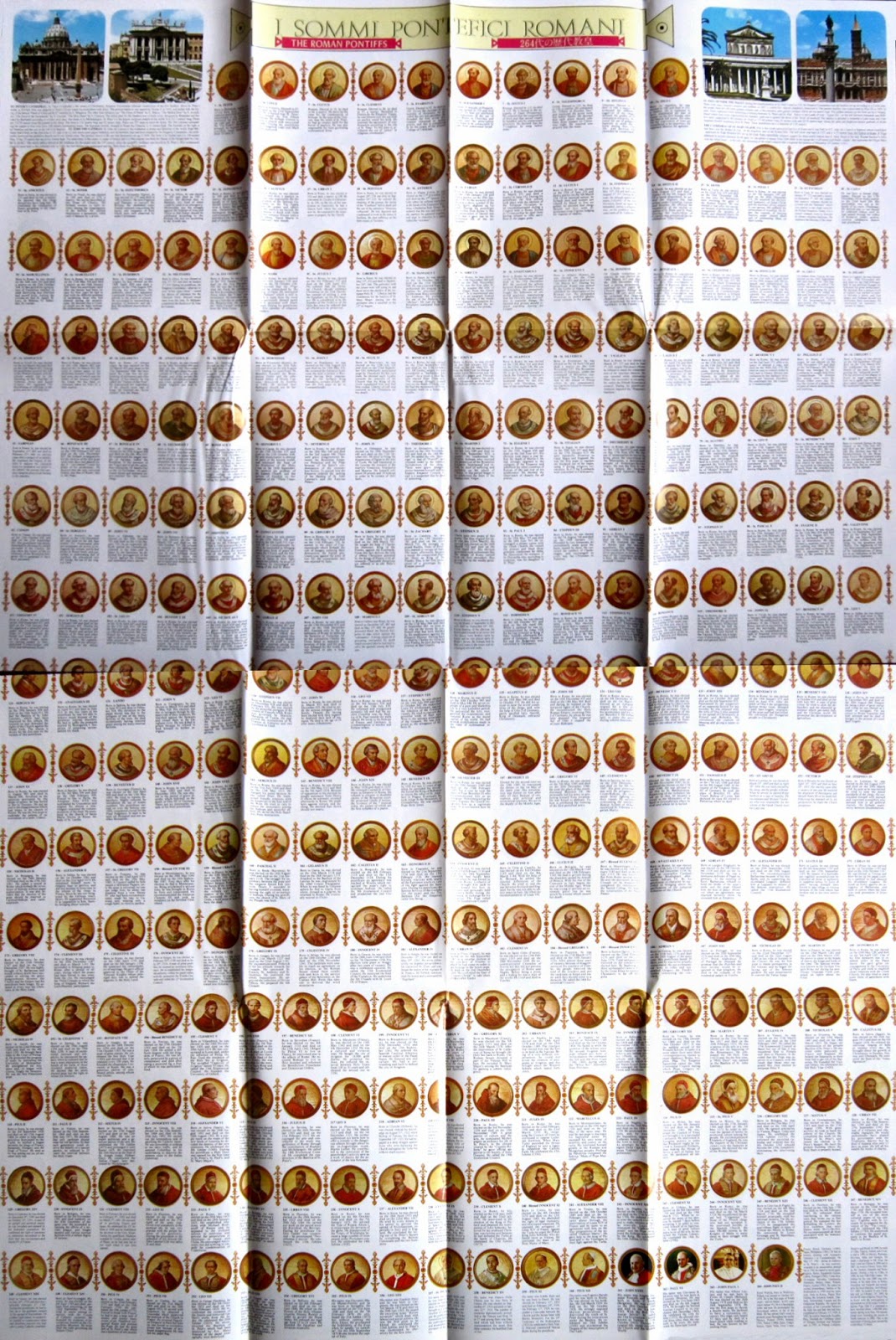
So we have our second new Pope since I bought my papal wallchart on a visit to Rome in March 2005 (you may have to open the image in its own window and zoom in to view it properly). But will Francis I be the last Pope ever? Probably not – although that’s the gist of a prophecy supposedly made by an Irish Archbishop way back in the 12th century. I’ve just been reading all about it in a short ebook by Oliver Hayes entitled The Papal Prophecies: St Malachy and the Doom of the Popes. The case turns out to be an excellent example of something I’ve always believed – that most “prophecies” tell you more about the times in which they originated than they do about the future.

The book starts with a biography of Saint Malachy, who fought his way (literally) to the position of Archbishop of Armagh in the 1130s. While this is all interesting and exciting stuff, it isn’t actually very relevant to the prophecies that bear his name – since they were almost certainly written long after his death. It’s true there were vague rumours that Malachy had experienced some kind of prophetic vision during a visit to Rome in 1139, but nothing was known about the details.

Then in 1590 everything changed. A Spanish Dominican scholar named Alphonsus Ciacconius claimed to have discovered an ancient parchment, bearing a series of cryptic phrases in Latin, in the Vatican archives in Rome. This was during the renaissance period, when people were just starting to develop a genuinely forensic approach to the study of historical documents. Ciacconius was one of the few people at the time who was versed in the new science of palaeography – the dating of old writings based on the materials, style and language employed. He announced that the parchment and its cryptic Latin phrases dated from the middle of the twelfth century.

Ciacconius showed the manuscript to a fellow scholar named Arnold de Wyon, and between them they attempted to decipher its cryptic message. Eventually they concluded that it was Saint Malachy’s account of his prophetic vision, and that each Latin phrase corresponded to a future Pope. In other words, it was a list of all the Popes that would be elected after the time of Malachy’s vision in 1139. The “Prophecy of the Popes” was first published by Wyon in 1595, together with an interpretation of its meaning.

In total, the list includes 112 Popes – the first 74 of which date from after the supposed time of Malachy’s vision, but before the discovery of the manuscript by Ciacconius. These 74 Popes are represented by short Latin phrases that relate—often by means of a verbal pun or metaphor—to the name or place of birth of the Pope in question. For example, the first item on the list, “Ex castro Tiberis” means “From a castle of the Tiber”, and is taken to refer to Pope Celestine II, who was elected in 1143 and was born in Città di Castello – a fortified town on the banks of the River Tiber. The only British-born Pope, Adrian IV, corresponds to the fifth item on the list, “De rure albo”– which literally means “from the white country”, but can be taken as a pun on Albion, the ancient poetic name for Britain.

After Wyon published the list in 1595, people were eager to see how each new Pope fitted the corresponding prophecy. Although ways were found to match the prophecy to the actuality, it became more and more obvious that there was a qualitative difference between the pre-publication fits and the post-publication ones. Very few of the post-publication matches took the form of a simple pun on a name or birthplace. Instead, they often referred to the general state of affairs at the time the Pope was elected, or to some action taken by him during his incumbency. By the late 17th century the discrepancy had become painfully obvious, and a number of Catholic scholars—Louis Moréri among them—realized that everything focused down to the pivotal year of 1590. That was the year that Ciacconius “discovered” the manuscript and pronounced it to be a work of the 12th century... and 1590 was also the year the prophecies suddenly switched from being right on target to being vague and woolly.

There was a succession of three different Popes in 1590. Sixtus V died in August to be replaced by Urban VII, who died the following month and was replaced by Gregory XIV. The prophecies for Sixtus V and Urban VII are good matches, but the prophecy for the next Pope didn’t match Gregory XIV at all. Moréri quickly realized this was the single most important prophecy in the whole list – the only one out of the 112 that really mattered. All the rest were window dressing.

The key prophecy—for the Pope to follow Urban VII—said “Ex antiquitate Urbis”, meaning “of the old city”. While that doesn’t mean much in the context of the actual successor, Gregory XIV, it’s a perfect match for one of the other cardinals who was in the running at that particular conclave. This was Girolamo Simoncelli, who had been born in Orvieto – the Latin name for which was Urbevetanum, meaning “the old city”! Simoncelli was the candidate favoured by the King of Spain, Philip II... who just happened to be the rich patron of Alphonsus Ciacconius – the Spanish scholar who “found” the prophecies at just the right moment, and vouched for their authenticity!

It seems almost certain that the Papal Prophecies attributed to Saint Malachy were a 16th century forgery. Whether the culprit was Alphonsus Ciacconius or someone else, the aim seems to have been political – to strengthen the case for one particular individual being elected Pope at one particular conclave. But to give the manuscript credibility, it couldn’t stop there. So 38 further prophecies—of no real interest to the perpetrator—were appended to the list. But even they had to end somewhere. It just happens that, if you go through the list ascribing each consecutive prophecy to each consecutive Pope, then the very last item on the list corresponds to... none other than Francis I, who was elected Pope just a few days ago.

This final prophecy is wordier than any of the others, and appropriately apocalyptic: “Peter the Roman, who will nourish the sheep in many tribulations; when they are finished, the city of seven hills will be destroyed, and the dreadful judge will judge his people.” Fortunately for the general sanity of the world, the “Prophecy of the Popes” hasn’t received anything like the same attention as the doom-laden utterances of Harold Camping, or the Mayan calendar fiasco of last year. I guess that’s because the sort of people who are most likely to be interested in end-of-the-world predictions—namely Protestants and New Agers—are also the least likely to be interested in anything to do with Popes!

The Papal Prophecies is published by Bretwalda Books, which makes Oliver Hayes a sort of colleague of mine. In fact Oliver is the main author of the Bretwalda Battles series, to which I’ve contributed half a dozen titles of my own. My latest ebook is all about The Destruction of Hiroshima... which I try to put in its proper historical context, without the overlay of wise-after-the-fact hindsight that is often found in discussions of the subject.

Sunday, 24 February 2013

Relics of the Knights Templar

In a previous post (Another Templar Head) I mentioned Juliet Faith’s book The Knights Templar in Somerset. While the Templars had churches in many other counties as well, Somerset is unique in having two particular relics—both depictions of heads—that were found in or near two of these churches. One is a wood carving and the other is a painting on a wood panel. This ties in with the idea, popular among amateur devotees of the Templars but derided by academics, that the Knights Templar were guardians of some mysterious secret which involved (among other things) the symbolic worship of a Head.

Now Juliet has written another book: Glastonbury, the Templars, and the Sovran Cloth: A New Perspective on the Grail Legends. People who instinctively groan when they hear the phrase “Templar Head” also groan when they hear “Holy Grail” or “Turin Shroud”. But the truth is that relics such as the Grail and the Shroud were major preoccupations of the mediaeval world. As I pointed out in The History of Biblical Literalism, the modern-day conception of Christianity as a text-based religion is really an invention of the Printing Press and the Protestant Reformation. Before then—in the time of the Knights Templar and earlier—the focus was more that of a European-style mystery religion... all about symbolism and ritual. Relics (and symbolic copies of relics) would have played a huge role, particularly those connected with the central “mystery” of Christianity – the crucifixion and resurrection of Christ.

Legends connecting Glastonbury with the Holy Grail can be traced back to the 12th century (at least some of the “legends” were probably the work of the monks at Glastonbury Abbey!). The Grail, of course, was supposed to have been the chalice used at the Last Supper, which subsequently caught the blood of the dying Christ. For mediaeval Christians, this would have been one of the most sought-after relics of all. Of equal importance was the burial shroud of Christ – which again would have been soaked in Christ’s blood. Without giving away too much of Juliet’s book, her central idea is that the Shroud would have been a kind of “Holy Grail” in itself, and the Templecombe panel painting may have been the lid of a vestment case designed to hold the original Shroud or a copy of it.

I think Juliet may be onto something here. No doubt “rational skeptics” will be utterly dismissive of the idea, but rational skepticism breaks down if you try to apply it to a culture that wasn’t rational in the way that modern scientific culture is. To my mind, the fact that veneration of relics played such an important part in mediaeval life, and that piety came before historical accuracy (in fact the very concept of “historical accuracy” is a post-mediaeval invention) make it very likely things like this would pop up in and around a major religious centre – which Glastonbury undoubtedly was in mediaeval times.

(Ahem) It may also be worth mentioning that my own book, Bloody British History: Somerset, has a chapter on “Secrets of the Knights Templar”, for which Juliet kindly provided a couple of images. As a result, she received a complimentary copy of the book, as seen in this photograph with the ruins of Glastonbury Abbey in the background.

Sunday, 25 November 2012

Saladin in Limbo

Another of my short ebooks has just come out – this one on the subject of The Battle of Arsuf, which was the turning point of the Third Crusade in 1191. The book doesn’t really have any significant Fortean content (despite having the Knights Templar in it), but there is an interesting fact that falls in the "Strange but True" category in the very first paragraph:
Yusuf ibn Ayyub (“Joseph, son of Job”) was born in Islamic Mesopotamia around the year 1137, and given the honorific title Salah ad-Din, meaning “Righteousness of the Faith”. To Europeans he became known as Saladin. Even among the Christians who were his sworn enemies, he had a reputation as a gallant and courageous warrior. A century after his death, the Italian poet Dante placed Saladin not in Hell but in the limbo of “virtuous non-Christians”, along with the great heroes of ancient Greece and Rome.
The Renaissance notion of Limbo was something I mentioned in an earlier post (Descent into Limbo). In the early days of Christianity, things were straightforwardly clear-cut: all non-Christians were uniformly wicked and automatically went to Hell. But by the Renaissance, Europeans were rediscovering the wisdom and depth of their pagan past, as embodied in the classical world of ancient Greece and Rome. So they came up with the notion of Limbo—neither Hell nor Heaven—where the virtuous men and women of pre-Christian times could reside in relative peace and comfort for eternity.

The most detailed description of Limbo can be found in Dante’s Divine Comedy, written in the early 1300s. Dante was an archetypal Renaissance Man, and had enormous respect for the pre-Christian culture of Europe. He took the opportunity to put all his favourite heroes and heroines from ancient Greece and Rome in Limbo – from fellow poets like Homer and Ovid to mythical heroes like Hector and Aeneas and noble Roman ladies like Cornelia Africana and Lucretia. And he lists more than a dozen philosophers, including Socrates, Plato, Diogenes, Anaxagoras, Zeno, Heraclitus, Euclid and Ptolemy – all of whom featured two centuries later in another Renaissance masterpiece, Raphael’s The School of Athens.

To his credit, Dante puts not only ancient Greeks and Romans in Limbo, but some recently deceased Islamic scholars as well. There is Averroes, who is also featured in The School of Athens—and died only a few decades before Dante was born—and an earlier Muslim philosopher named Avicenna. But the oddest inclusion of all is Saladin.

Saladin wasn’t a philosopher, although by all accounts he was a scholarly and learned individual who was famed for his wisdom and generosity. But first and foremost he was a military leader. Twenty-first century values notwithstanding, this wouldn’t by itself have been a block to being considered “virtuous” in the Middle Ages – Dante also honours Julius Caesar with a place in Limbo. But Caesar was a European, whereas Saladin fought against Europeans – and only a century or so before Dante was writing.

Saladin united the Islamic world against the Christian Crusaders, and set the stage for Islamic supremacy in the Middle East. So it’s no surprise that he is a great hero to Muslims, and that he is respected and revered by many modern-day historians. But it really is a surprise to find a 14th century Christian writer like Dante treating him with such honour. This strikes me as an extraordinarily enlightened view – even today, Westerners have great reluctance to say anything generous about their military opponents.

Needless to say, if you want the full details of Saladin’s role in the Third Crusade, you should read my ebook: Arsuf – 1191. This is my fifth contribution to the Bretwalda Battles series – I mentioned the first two in earlier posts (London versus the V-2 rockets and The Siege of Lachish). The other two are on non-Fortean subjects (Rolling Thunder
and Sinking the Bismarck) but well worth a read for anyone interested in military history.

Sunday, 9 September 2012

A Brief History of Tantric Sex

My interest in Tantric sex is purely theoretical. Like all my other theories, my theory of Tantric sex is ingenious and almost certainly wrong. One point that is emphasized by all modern writers on the subject is that Tantra stems from an ancient tradition. Up to a point, I’m sure that’s right. The word Tantra was certainly in use on the Indian subcontinent 2000 years ago, and encompassed a good deal of what would nowadays be called sacred sexuality. And the religious use of sexual imagery and rituals—not necessarily under the name of Tantra—was around for at least a thousand years before that. But in functional terms, I don’t think it had anything in common with present-day Tantra at all.

My theory is that Tantra underwent two massive reinventions: the first about 2000 years ago and the second within the last 50 years. If you go back to prehistoric times, I think people had a very confused idea of how the natural world worked. Their lives were dominated by things like droughts, disease and crop failures, and they desperately wanted to be able control these things but had no idea how to go about it. The most powerful thing that was within their control was sex—an act that seemed to create new life out of nothing. So they reasoned, illogically by modern standards, that performing the right kind of sexual rituals could have other “magical” effects as well. Prior to the Axial Age of circa 500 BC, when most modern religions have their origin, religious rituals—including sexual ones—were misguided attempts to control the natural world rather than having any kind of spiritual dimension (New Agers will disagree vehemently with this... but as I said, it’s just my theory and probably wrong).

The big change that started around 500BC, when the more mystical aspects of the Hindu-Buddhist, Graeco-Roman and Judaeo-Christian traditions have their roots, was the shift of religion away from superstitious ritual towards soteriology. Now “soteriology” is one of my favourite words, even though I don’t really know what it means. I use it to mean the idea that there are higher states of existence than those of everyday life, which can be attained through appropriate religious practices. If you sat down with a blank piece of paper, and tried to think up a list of “appropriate religious practices” to attain a higher state of existence, then all-night drug-fuelled sex orgies, or the visualization of animal-headed, multi-limbed deities copulating with each other, probably wouldn’t immediately spring to mind. But people had a long tradition of doing these things, albeit for completely different reasons, so (presumably because they enjoyed them) they decided to keep the sexual elements and redefine their function in soteriological terms. I suspect this happened in all the traditions—Judaeo-Christian, Graeco-Roman and Hindu-Buddhist—but it’s only in the last (and then only in a small minority of practitioners) that’s it’s survived to the present day.

The object shown on the left can be seen in the Victoria and Albert Museum in London. It isn’t exactly clear what’s going on, but it’s obviously sexual (and quite possibly illegal). According to the caption: “For Buddhist Tantric practitioners, the ass-headed protective deity Kharamukha Samvara is an embodiment of the enlightened state. The sexual imagery is a metaphor for enlightenment, with the male representing compassion and the female wisdom.” If you look closely, the “embodiment of the enlightened state” is wearing a necklace of human skulls, and trampling on two small human-like figures (cf. my earlier post on Tantric Buddhism). I think the imagery is far easier to understand if it originated in some ancient pagan magical superstition, and was later glossed over with a Buddhist “soteriological” interpretation.

I first encountered the idea of Tantric sex in 1980, when I was looking for a book on yoga (but I bought the book on Tantric sex anyway). In those days, it still had a strongly spiritual dimension, and interest was limited to the “hippie” mystical fringe. But since then the subject has snowballed to the extent that it is now a mainstream industry that everyone has heard of. But in today’s world, you can’t be mainstream and talk about spirituality – it’s a contradiction in terms. There’s a limit to the number of punters who are desperate to attain a higher level of spiritual awareness... and they tend to lead alternative lifestyles with limited disposable income for high-end workshops and one-on-one counselling sessions. On the other hand, there is a never-ending supply of well-to-do, middle-aged couples who want to liven up their sex lives. So modern Tantric practitioners tend to say things like “Tantra had its origins way back in the past when people believed in Gods and Goddesses, but many people nowadays are uncomfortable with such ideas so we can safely dispense with them.”

I’m not criticizing neo-Tantra per se – it’s probably more socially useful, less ludicrous and certainly no more cynical than the traditional form of Tantra. But why do people have to call it Tantra? Sacred Sex without the Sacred is just Sex!

Saturday, 17 March 2012

Saint Patrick of Glastonbury?

As with all the early saints, there are a lot of legends about Saint Patrick and a scarcity of facts. One of the few certain things is that he wasn’t Irish! He couldn’t have been, since he was a Christian, and the Irish he converted were all pagans!

There are plenty of legends connecting St Patrick with Glastonbury in Somerset. Some people even think he was born there! According to one well-established legend, the Pope sent him to Ireland as a missionary in the year 425. After converting the Irish to Christianity, he returned to Glastonbury Abbey in 433, where he became Abbot and eventually died in 472. He is reputed to have been buried alongside the altar.

[This isn't something I'm claiming to be true... I'm simply recounting a legend that people used to  believe  in the past. I'm not making it up -- see the display from the Museum of Somerset shown above!]

Nowadays, Glastonbury is a magnet for hippies, neo-pagans and New Agers, and it seems paradoxical to associate it with a Christian saint. Glastonbury’s shops are filled with books on religion—Buddhism, Witchcraft, Goddess Worship, Sacred Sexuality—but you won’t find many Bibles! While the ruined Abbey is a big tourist attraction, it's more often described as ‘mystical’, ‘mysterious’ or ‘magical’ than as a place of Christian worship. The Abbey was destroyed by King Henry VIII when he abolished the monasteries in the 1530s, but before that time it was the most magnificent building in the country. If you picture Chartres Cathedral transplanted into the Somerset Levels, you wouldn’t be far wrong.

During the Middle Ages, Glastonbury was the religious heart of Britain -- a place of pilgrimage comparable to Rome or Jerusalem. What was important in those days wasn’t what was true, but what people believed. And people believed a lot when it came to Glastonbury. Not only Saint Patrick, but countless other saints were supposed to have been buried there. According to the 12th century chronicler William of Malmesbury, "...nor is there any space in the building that is free of their ashes. So much so that the stone pavement, and indeed the sides of the altar itself, above and below, is crammed with the multitude of the relics. Rightly, therefore, it is called the heavenly sanctuary on earth, of so large a number of saints it is the repository."

Besides St Patrick, Glastonbury is associated with his successor St Benignus, and the presence of their shrines (or supposed shrines) made the Abbey a popular destination for Irish pilgrims for centuries. Around the year 710, a group of them led by St Indract were massacred by local soldiers, and their remains were added to those already interred in the Abbey.

One of the reasons Henry VIII broke with the Church of Rome was that he believed the British church was older and more valid! According to a widely believed legend, the Apostle Philip sent a group of twelve missionaries to Britain in 63 AD. The leader of the twelve was none other than Joseph of Arimathea—the man who, according to the Gospels, had allowed the body of Jesus to be interred in his own tomb. The twelve proto-monks were drawn towards Glastonbury, where a heavenly vision led them to found the Abbey!

Saturday, 4 February 2012

The History of Biblical Literalism

Here is another photograph I took on my recent visit to the British Museum. It’s one of the most famous items in the Museum -- the 11th tablet of the Gilgamesh epic. It recounts an ancient, and supposedly fictional, story that was popular in ancient Babylon and Assyria (this particular example comes from Nineveh in Assyria, and dates from the 7th century BC). The 11th tablet has become famous, or notorious, for its description of a great flood sent by the gods to destroy the world. A character named Utnapishtim is forewarned of the event, and he constructs a large boat in order to save as many living things as possible.

Undoubtedly the Hebrew scribes who were exiled in Babylon a hundred years later would have encountered writings such as this... and that, of course, brings us on to the thorny subject of Biblical Literalism. It dawned on me a few weeks ago that the notion that Christianity begins and ends with the Bible is a relatively recent invention. Christianity is 2000 years old, but Biblical Literalism (as a widespread concept) can be no more than 500 years old. Printing, in the context of European culture, was only invented in the 15th century, before which Bibles were rare and expensive hand-written manuscripts. They were written in Latin, too, so most people wouldn’t have been able to read them even if they’d got their hands on a copy.

In its early days, Christianity was typical of the religions of its time. Religions in those days were centred, not on writings, but on symbolism and ritual... a wide variety of rituals, but all of them in one way or another aimed at personal transformation. This was true, in broad terms, of the Mystery religions of Graeco-Roman Europe as well as the “Eastern” religions of Persia and India. While there are great differences of detail, the basic concept was much the same. Writings, if they existed, were for the priesthood, not the people... and usually they were meant for guidance only, not as a central focus of belief.

Early in the 5th century AD, St Augustine wrote a treatise called “The Literal Meaning of Genesis”... but he was arguing for a symbolic, spiritual interpretation of that work, not a literal interpretation in the modern sense. Augustine’s mother was a Christian, but in his early years he turned to another Mystery religion of the time, Manichaeism, before converting back to Christianity. So he was able to look at Christianity from an outsider’s perspective, and see that people who insisted on the word-for-word truth of the Bible were merely making themselves look stupid: “Usually, even a non-Christian knows something about the earth, the heavens, and the other elements of this world... If they find a Christian mistaken in a field which they themselves know well and hear him maintaining his foolish opinions about our books, how are they going to believe those books in matters concerning the resurrection of the dead, the hope of eternal life, and the kingdom of heaven, when they think their pages are full of falsehoods on facts which they themselves have learnt from experience and the light of reason?”

The notion that Christianity should be centred on the Bible, and not on its rituals, originated in 16th century Europe, as more and more people gained access to affordable copies of the Bible in a language they could understand. This was a brand new type of religion... one that belongs to a period in which books are common and everyone can read. That simply wasn’t the case when Christianity started out.

The English Puritans of the 16th and 17th century were amongst the earliest Biblical Literalists. They were persecuted by the established churches (both the Roman Catholic Church and the Church of England), and to escape this persecution many of them emigrated to America, where they were among the first European settlers. In some sense, therefore, America is founded on Biblical Literalism. That’s probably why most people in the English-speaking world today (atheists just as much as Christians) see Biblical Literalism as the “purest” form of Christianity. That may be true... but the fact remains it’s only a quarter the age of Christianity as a whole!

Saturday, 24 December 2011

The Mystic Nativity

Botticelli's Mystic Nativity is one of the best known paintings in the National Gallery in London. One of the reasons it's called "Mystic" is because the painting is full of symbolism taken from the Book of Revelation. This is stated explicitly in a Greek inscription at the top of the picture, together with the date it was painted: the year 1500. Now 1500 may not be quite as round a number as 1000 or 2000, but it was round enough to attract its share of "End of the World" prophecies -- including the Second Coming of Christ, which is what Botticelli was alluding to in this painting.

As well as its religious symbolism, The Mystic Nativity is important for its "mystical" artistic style, which had a major influence on British painting of the Victorian period -- in particular that of the Pre-Raphaelites (in the year 1500 Raphael was 17 years old whereas Botticelli was 55 -- so he was literally a pre-Raphaelite!).

At this point it would be logical to include an image of The Mystic Nativity, but it's such a hackneyed Christmas image that I won't bother (there's a good zoomable version on the National Gallery website). Instead, here is a less well-known Nativity painting in the Pre-Raphaelite style. This is a huge watercolour by Sir Edward Burne-Jones called The Star of Bethlehem, which was painted in 1890 for the Birmingham Museum and Art Gallery. To me this captures the essence of the word "mysticism" much better than the Botticelli version.