Search This Blog

Showing posts with label science fiction. Show all posts

Sunday, 12 May 2024

Fortean-themed music, from opera to metal

Prompted by some comments on a previous post, I thought I'd write something about "UFO-themed songs". But after looking into it, I decided there isn't really anything I can add to the many times it's been done before (even Wikipedia has a list of songs about close encounters with aliens). Instead, I've decided to focus on a selection of more substantial musical works (e.g. operas and concept albums, such as those pictured above) that fit my broad definition of "fortean". These include several less well-known items, including some I discovered while researching my two books about music - SofSFM (2020) and SofM (2023). Here's what I came up with, grouped under the 6 headings of Aliens, Ghosts, Atlantis, Esoteric Traditions, Science Fiction and Comics.

ALIENS

Christus Apollo (1969) by Jerry Goldsmith. An obscure work by a far-from-obscure composer, this was one of several interesting discoveries I made while writing SofSFM. It's a religious cantata with words by SF writer Ray Bradbury, portraying Christ as a spacefaring super-being known by different names on different planets.

Alien Encounter (1996) by Phil Thornton - a purely instrumental album with tracks including "Arrival of the Mothership" and "Visions from the Homeworld". It comes from one of my all-time favourite CD labels, New World Music, which was particularly popular in the 1990s. I've got quite a collection of these  - other artists on the label include Medwyn Goodall and Terry Oldfield (brother of Mike Oldfield).

GHOSTS

There's never been any shortage of operas with supernatural themes - several of them featured in my Fortean Opera post. Here are two more:
 
The Lighthouse (1980) by Peter Maxwell Davies - another discovery I made while writing SofSFM. It's based on the same real-world "Flannan Isle incident" as the 1977 Doctor Who serial "Horror of Fang Rock". In the latter, the mysterious disappearance of the lighthouse-keepers is down to an alien; in the opera, it's caused by a series of ghostly apparitions.

The Turn of the Screw (1954) by Benjamin Britten. This is based on the classic "psychological" ghost story of the same name by Henry James - but whereas the ghosts turn out to be imaginary in the original version, in the opera they're very real.

ATLANTIS

Eagle-eyed readers will notice that one of the CDs pictured above also featured in my recent post about Lemuria - and that's the 2004 album of that name by the symphonic metal band Therion. But there are two other albums worth mentioning in this category that I only have in intangible form in my Spotify library:

Atlantis (1969) by Sun Ra. A fascinating individual who claimed to come from the planet Saturn, Sun Ra featured prominently in SofSFM. But not all his albums are about outer space - this one has tracks called Mu, Lemuria, Yucatan and Bimini, as well as the really excellent 22-minute title track.

Atlantis Ascendant (2001) by Bal-Sagoth - another symphonic metal band, and definitely my favourite (their music always makes me think of a Masters of the Universe cartoon, for some reason). Their concept albums also have really great plots; according to Wikipedia, this one "centres on the exploits of a fictional 19th-century archaeologist and adventurer who has dedicated his life to the field of antediluvian anthropology".

ESOTERIC TRADITIONS


Voyage of the Acolyte (1975) by Steve Hackett - the esoteric tradition in this case being the Tarot. All the tracks are inspired by specific Tarot cards, such as "Hands of the Priestess", "The Hermit" and "Shadow of the Hierophant". There's also a Tarot connection in The Lighthouse, as PMD explains in the liner notes: "The structure is based on the Tower of the Tarot, whose number symbolism is present in all the music".

Tales from Topographic Oceans (1973) by Yes, based on Hindu mysticism. In its original form as a vinyl double album, each of the four sides comprised a single "movement" relating to the four categories of Hindu scripture: the shruti (revealing), the smriti (remembering), the puranas (ancients) and the tantras (rituals).

Zos Kia Cultus (2002) by Behemoth. A previously unsuspected music genre I discovered while writing SofM was what you might call "highbrow" metal, and of the bands I listened to, Behemoth was the one I liked best. This particular album is based on the occult writings of Austin Osman Spare, who I first heard of when he featured on the cover of Fortean Times in March 2001.

Masonic Music (1783-91) by Mozart. I mentioned last week that The Magic Flute was featured in my Fortean Opera post, one reason being its inclusion of a Masonic-style secret society. Mozart himself was a Freemason, and this CD contains several works incorporating Masonic ideas. One in particular, the "Little German Cantata" of 1791, must have seemed as blasphemous to some listeners as Goldsmith's Christus Apollo, with its reference to "the creator of the universe, whether named Jehovah, or God, or Fu, or Brahma" (Fu being a Chinese deity and Brahma a Hindu one).

Also featured in my Fortean Opera list was Wagner's Parsifal, which could equally fit here with its strange fusion of the Grail legend with the mystical writings of Schopenhauer. It features quite strongly in Philip K. Dick's novel VALIS (1981), which brings me neatly to the next item...

(Fortean) SCIENCE FICTION

VALIS (1987) by Tod Machover - a short opera based on Dick's novel. Most of PKD's writings are fortean to some extent, but none more so than the mishmash of metaphysics, religion, alien super-intelligence and conspiracy theories that is VALIS. As for the opera, it's discussed in some detail in SofSFM, so all I'll say here is that anything that combines Wagner and rock music has got to be worth a listen.

The Chronicle of the Black Sword (1985) by Hawkwind. There's always been a close connection between Hawkwind and the writings of Michael Moorcock, but this album (their best, in my opinion) has particularly strong fortean credentials, being based on the adventures of Moorcock's sword-and-sorcery hero, Elric of Melniboné.

(Fortean) COMICS

The Power Cosmic (1999) by Bal-Sagoth. No excuses for mentioning this band a second time, as even the album title reflects one of Marvel's more fortean superheroes, the Silver Surfer. He's also referenced, under his real name of Norrin Radd of Zenn La, in the song "The Scourge of the Fourth Celestial Host", together with several other Marvel characters, including Arishem of the Celestials - the archetypal "ancient alien".

Miss Anthropocene (2020) by Grimes. There were two reasons I sought this album out while writing SofM: (a) I was under instructions to include popular young artists, and (b) she'd spoken out in praise of AI in music, which was one of the topics in the last chapter of the book. I have to say I enjoyed her style much more than I expected, and was pleasantly surprised to find two songs inspired by the distinctly fortean comics that Jack Kirby did for DC in the 1970s: "Darkseid" and "New Gods".

While I could have found plenty more items to go in the preceding categories, that's not true here, as beyond those two albums I'm not aware of any other fortean comic-inspired music (unless you want to include "Grimly Fiendish" by The Damned). But there's a picture of Doctor Strange on the cover of the Pink Floyd album A Saucerful of Secrets (1968), and he's as fortean as superheroes get (see my post Master of the Mystic Arts). The picture, drawn by Marie Severin, is taken from Strange Tales #158, and it's quite hard to see unless you peer very closely. Here's a photograph I took of my CD version, where I've  contrast-enhanced the relevant part (and outlined it in red), to make it a little clearer:
 

Sunday, 28 April 2024

Colin Wilson, Philosopher of the Paranormal

Back in the 1970s, Colin Wilson was one of the big names of what might be called "mass-market forteana". But while I did borrow a copy of his 600-page blockbuster The Occult circa 1978, it was only much later that I started to discover just how interesting his ideas are. It began in 2001, when I bought a book by Fortean Times contributor Gary Lachman called Turn Off Your Mind: The Mystic Sixties and the Dark Side of the Age of Aquarius (which I'm sure everyone spotted in my recent shelfie post, towards the right-hand end of the middle shelf). Colin Wilson made an appearance in Lachman's book in the context of the H. P. Lovecraft revival of the 1960s - including the wonderfully surreal cover of Wilson's 1967 novel The Mind Parasites. As evidenced by the photo above, I bought a second-hand copy as soon as I could find one, as well as two later novels in the same vein, The Philosopher's Stone (1969) and The Space Vampires (1976).

The other paperback shown above is a non-fiction one, The Psychic Detectives (1984), which I bought in 2016 when I was researching my own book, Pseudoscience and Science Fiction. Here's what I said about Wilson there:
As his career progressed, he became increasingly fascinated with the world of strange powers. A recurrent theme throughout his fiction and non-fiction is that most people live a robotic existence far below their real potential.
That use of the word "robotic" brings me on to the main subject of this post, which is the Kindle book shown in the above photo - Gary Lachman's Beyond the Robot: The Life and Work of Colin Wilson (2016). I only became aware of it last month, when Gary posted the following on Facebook:
I've just heard that the paperback of Beyond the Robot, my book about Colin Wilson, is now out of print. If you are among the many who didn't buy a copy, there's still time to not get the Kindle edition too.
Since I'm a chronic sufferer from the "Why do friends never read my books?" syndrome, I clearly had to buy it immediately! I'm glad I did, as I found it a fascinating and information-packed read which got 5 out of 5 stars from me on Goodreads. However, this post isn't really a review of the book, so much as a summary of a few things I found particularly interesting from a fortean point of view.

To start with, Fortean Times (as well as some of the "Unconventions" they organized) makes several appearances in the book. At one point Lachman specifically mentions "writing pretty regularly for the Fortean Times", and after Colin Wilson's death in 2013 Gary's obituary of him appeared in FT 310 (the same issue as my review of a comic-strip book about particle physics, FWIW). Although I've never actually met Gary, I did spot him at a couple of Uncons - and, I think, in the audience at the "Aliens and the Imagination" event I mentioned on this blog in 2011. Way back in 1978, in the guise of his musical alter-ego Gary Valentine, Lachman also wrote Blondie's paranormal-themed hit "I’m Always Touched by Your Presence, Dear".

As for Colin Wilson himself, he only came on to fortean-type subjects a decade or so after he started writing. His original focus was on existential philosophy, and his first book on that subject, The Outsider, was published in 1956 when he was just 24. It received a lot of rave reviews, including one in The Observer - which Lachman describes as one of Britain's "highbrow Sunday papers" (which pleased me a lot, since they published a two-page feature by me just a couple of months ago).

In hindsight, it's not surprising that Wilson's own personal take on philosophy eventually led to an interest in the paranormal, since it's ultimately all about widening human consciousness beyond the normal trivialities of everyday life. That's why he was drawn to the Lovecraftian style of fiction - he had no time for the more mainstream kind of novelist "who, in the service of realism, simply portrays life as it is". Another fortean favourite who made an impression on Wilson was Aleister Crowley. According to Lachman, Crowley was the model for one of the characters in Wilson's early novel Man Without a Shadow (1963) - Carradoc Cunningham, an occultist and master of "sex magic". Apparently Wilson himself harboured interests along the latter lines, believing that sexual orgasm can unlock higher states of consciousness and "open the doors of perception".

When Wilson came to write about the paranormal - The Occult (1971) being his first and best-known, but far from only, book on the subject - he did so in a way that was almost diametrically opposed to the standard approach for the genre. As Lachman puts it:
If scientists and other skeptics were ever going to broaden their minds about the occult, then it had to be presented to them logically, in a way that made sense, not in a sensational "believe it or not" manner.
As with his first book about philosophy, Wilson's first book on the paranormal also got rave reviews. In part, this was because "highbrow" readers were far more open to such topics at that time than they are today. Referring to a favourable review that New Scientist gave of Wilson's follow-up book Mysteries (1978), Lachman says:
Such acclaim from a scientific publication for a book about the paranormal is unusual today, and shows that in the 1970s, the paranormal was treated with respect by many scientists, unlike in our more narrowly skeptical times.
Another thing I remember myself from those times, is that interest in fringe topics was much more wide-ranging and eclectic than it is today. The "paranormal", for example, meant a lot more than just ghosts and poltergeists. Listing some of the topics that Wilson covered in Mysteries, Lachman includes "plant telepathy, psychic surgery, transcendental meditation, biofeedback, Kirlian photography, multiple personality and synchronicity". All great stuff - makes me feel more nostalgic than ever for the 20th century!

Colin Wilson was an incredibly prolific author, and I kept noting down titles of books of his that I ought to seek out. The most intriguing-sounding of all is Atlantis and the Kingdom of the Neanderthals (2006) - something I should have known about already, as Wilson mentioned it in an article he himself wrote for Fortean Times, called "A 100,000-year-old Civilization?" It appeared in FT 272 in March 2011, and I have to admit I'd forgotten all about it (although I looked back at it just now, which is how I know it mentions the Atlantis book). In any case, I've already acquired my copy of Atlantis and the Kingdom of the Neanderthals from eBay, as you can see here:


Sunday, 7 April 2024

Fake Physics and Dubious Statistics


 With April Fools' Day last week, it brought to mind a book I wrote a few years ago called Fake Physics. Around a third of the books I've written weren't actually my idea, but originated in a suggestion from the editors - and Fake Physics is in this category. It arose when an editor at Springer Books drew my attention to the ArXiv website, which is normally home to serious physics papers but has a tradition of publishing spoof papers on the first day of April each year. Some of the more fortean-sounding examples include "On the Influence of the Illuminati in Astronomical Adaptive Optics" (2012), "Conspiratorial Cosmology: the Case against the Universe" (2013) and "Astrology in the Era of Exoplanets" (2016).

I chose the title Fake Physics to echo the "fake news" that everyone was talking about at the time, but it's very much about fakery for the purposes of entertainment rather than deception. The scope is made clearer in the book's subtitle, which is "Spoofs, Hoaxes and Fictitious Science". In the latter category are science-fictional creations ranging from the carefully explained (but entirely made-up) Blackett-Dirac equations of James Blish's Cities in Flight novels to the throwaway technobabble - "subspace field stress" and the like - of Star Trek.

As for hoaxes - in the world of academic physics, their most common purpose is to catch out gullible editors while amusing fellow scientists. These include such things as littering papers with references to popular culture from Star Wars to Rick and Morty, or using an AI-style computer program to generate convincing-looking technical jargon. As an example of the latter, specially created for this blog post, I used an online tool called MathGen to produce a paper on abstract mathematics by Charles Fort and H. P. Lovecraft. The result is 9 pages long, highly academic-looking and incomprehensible in a thoroughly realistic way. I won't inflict the whole thing on you, but I'll attach a screenshot of the opening to the bottom of this post.

Perhaps the most amusing items in Fake Physics are the numerous scientific spoofs, whether done specifically for April Fools' Day or not. These include an entire book called Mathematical Modelling of Zombies, published by the University of Ottawa Press in 2012 and featuring chapters with titles like "When Humans Strike Back: Adaptive Strategies for Zombie Attacks" and "An Evolvable Linear Representation for Simulating Government Policy in Zombie Outbreaks".

Even the most upmarket journals aren't above printing the occasional April Fool piece. A case in point is Nature, which Wikipedia describes as "one of the world's most-read and most prestigious academic journals". In April 2015 it printed a short article called "Here Be Dragons", which begins as follows:
Emerging evidence indicates that dragons can no longer be dismissed as creatures of legend and fantasy, and that anthropogenic effects on the world's climate may inadvertently be paving the way for the resurgence of these beasts.
The authors back up their claim with a graph - based on genuine, unaltered statistical data - showing a definite correlation between global temperature and the occurrence of dragons in fiction. This is an example of another category of "fakes" discussed in the book - ones that use valid data, but deliberately misinterpret it to humorous effect. There's a whole website devoted to such things - Tyler Viglen's Spurious Correlations - which is packed with bizarre relationships that his software has found while trawling through a vast database of statistical data. Here's an example, showing an indisputable correlation between UFO sightings in Massachusetts between 2011 and 2021, and patents granted to the Sony Corporation over the same period:

Despite the website's name, correlations like this aren't "spurious" - they're perfectly real. Where the error arises is in assuming (as is common among conspiracy theorists, for example) that, if two quantities are correlated, there must be a cause-and-effect relationship between them. As Viglen's strapline puts it, "correlation is not causation". If you go to the page where I found that graph, he gives a detailed explanation of what's shown, where the data came from, and what can and can't be deduced from it. You'll also notice that, just below the graph, he seems to imply that he's in the process of developing an AI that can fabricate its own explanations for all these correlations!

Finally, before I forget, here's the snippet from that maths paper by Fort and Lovecraft that I promised:


Sunday, 31 March 2024

Popular Culture in Fortean Times


In the comment thread to last week's post, I mentioned that Fortean Times occasionally touches on various aspects of popular culture, from cult TV and movies to comics and pop music. So I thought I'd do a quick run-through of a few examples today.

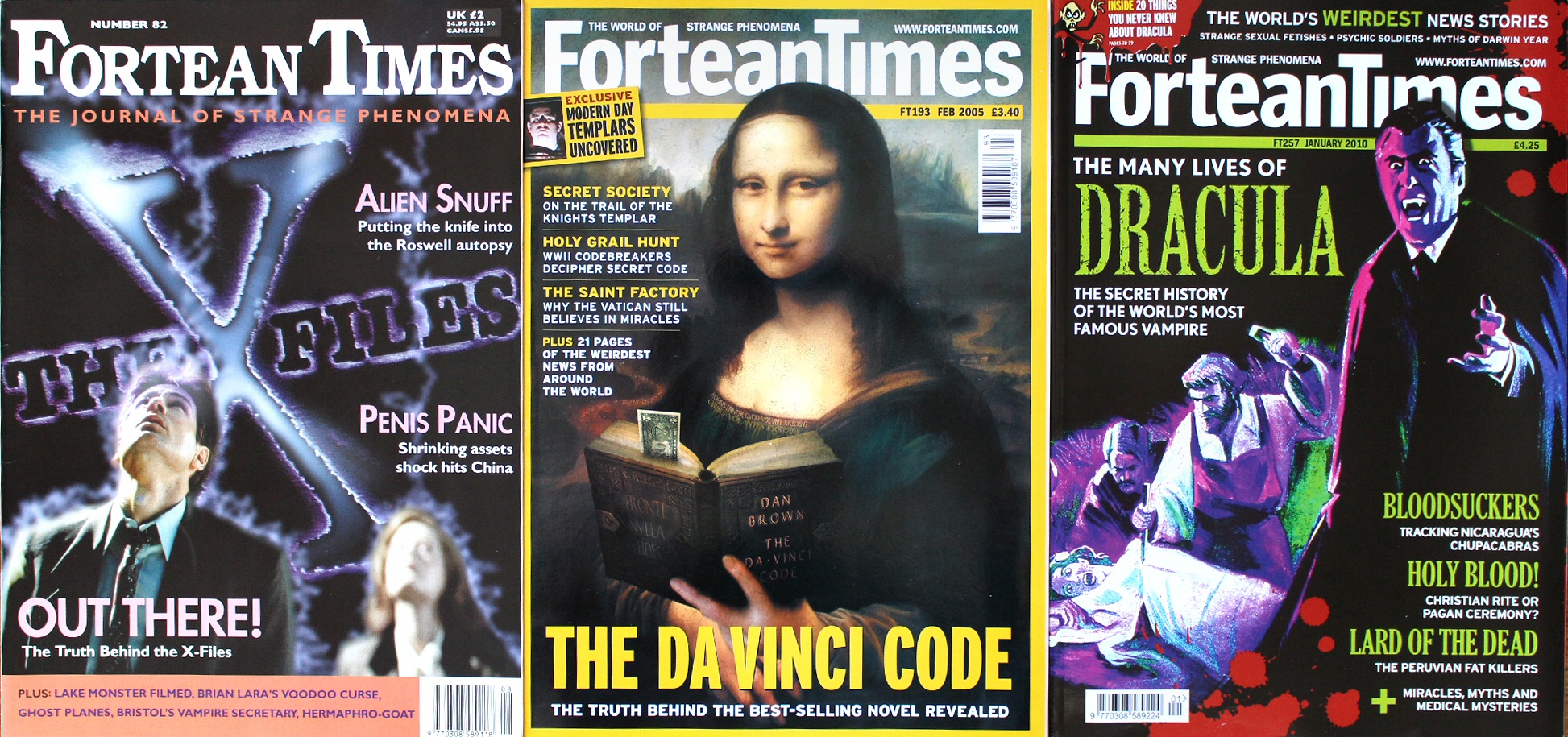
To start with some very obvious topics, there are the three shown above. The X-Files (FT 82, August 1995) was not only one of the most fortean TV shows of all time, but its first appearance in 1993 coincided with the wider distribution of FT to "mainstream" retailers like WH Smith, and almost certainly contributed to the magazine's popularity at that time. Around a decade later, Dan Brown's novel The Da Vinci Code (FT 193, March 2005) was a publishing phenomenon, bringing fringe theories that had previously been the realm of specialist writers (and FT contributors) like Lionel Fanthorpe and Lynn Picknett to a much wider audience. Just over a century earlier, Bram Stoker had done something similar in his novel Dracula - the title character of which went on to become one of the most recognisable and ubiquitous pop-culture icons of them all, as recounted in the cover feature of FT 257 (January 2010).

At a less obvious level, you can find references to popular culture in almost every issue of FT. Taking the one I discussed last week, for example - FT 73 from February/March 1994 - there's an interview with cult author William Gibson, generally credited as the originator of the cyberpunk genre. And I spotted something else in that issue, too: a book review by comics legend Alan Moore. I don't mean a review of one of his graphic novels - I mean a review written by him of someone else's work. Looking online, I see he actually did quite a few reviews for FT in those days - which pleases me enormously, as I've done over 40 of them myself. It's always nice to discover that you have something in common with a famous person!

Sticking with books and comics for a moment, here are three more covers that caught my eye. No apologies for a second appearance of The Da Vinci Code (FT 212 this time, from August 2006) - both because it's one of my favourite novels, and because I love the illustration on the cover. In addition to people like Picasso and Orson Welles, it features Da Vinci himself in the act of strangling Dan Brown! The middle cover (FT 256, December 2009) features Dennis Wheatley - best remembered today for The Devil Rides Out (the only one of his novels that I've read), although in his day he was Britain's most prolific author of occult fiction. Finally there's the only comics-themed cover I could find - FT 320 (November 2014), relating to the Fredric Wertham-inspired anti-comics paranoia than swept America in the 1950s.


I found a few shorter comic-related pieces on interior pages as well. The most interesting of these was an article in FT 277 (July 2011) called "The Morning of the Mutants", speculating that Stan Lee and/or Jack Kirby got the idea for the X-Men from the seminal (though now largely forgotten) fortean conspiracy book The Morning of the Magicians, written in 1960 by Louis Pauwels and Jacques Bergier. There's also a feature about Marvel Comics' Doctor Strange in FT 349 (January 2017, to tie in with the movie), which discusses the character's origin and fictional predecessors.

Regarding the "popular culture" of the mid-20th century, I can't resist mentioning a couple of pieces by myself - in fact the only two full-length feature articles I've had in FT. First there was "Fanthorpe's Fortean Fiction" (FT 297, February 2013) about the large number of mass-market paperback novels that Lionel Fanthorpe churned out in the late 1950s and early 60s. This was followed by "Astounding Science, Amazing Theories" (FT 355, July 2017), looking at fortean themes in the pulp science fiction magazines of the 1940s.

Pulp magazines were a huge part of popular culture in the first half of the 20th century, but - with a few notable exceptions - they're only of interest to die-hard fans today. Of those exceptions, perhaps the most important is H. P. Lovecraft, whose Cthulhu Mythos first took form in the pages of Weird Tales in the 1920s and 30s, before going on to develop a life of its own to rival that of Bram Stoker's Dracula. I found no fewer than three Lovecraft-inspired FT covers: FT 184 (June 2004), FT 369 (August 2018) and FT 390 (March 2020 - this one tying in with the movie adaptation of The Color Out of Space). Here they are:


As regards cult TV shows, I've already mentioned the most fortean of all, The X-Files - which not surprisingly made several further appearances after the one pictured at the top of this post (including FT 85 from February 1996, which had a rundown of all the fortean references in the show's first season). Three other TV-related covers are shown below, the middle of which - FT 215 from October 2006, celebrating 40 years of Star Trek - needs no introduction. The other two relate to the screenwriters (both with wider fortean interests than you might expect) behind two of Britain's most famous sci-fi icons: Kit Pedler, who created Doctor Who's second-most-famous villains, the Cybermen (FT 209, May 2006), and Nigel Kneale, creator of Professor Quatermass (FT 418, May 2022). The latter may no longer be a household name, but back in the 1950s he was really the first great TV sci-fi hero, in this country at least.


Turning to movies - I was spoiled for choice here, so I've picked out three covers that really speak for themselves. First there's a celebration of 50 years of Hammer Horror films (FT 223, June 2007), then a look at one of the mainstays of those films, Peter Cushing, on the 100th anniversary of his birth (FT 301, May 2013), and finally a 40-years-on retrospective about The Exorcist (FT 313, April 2014):

To be honest, my favourite thing about The Exorcist is the music - the snippet from Mike Oldfield's Tubular Bells that it uses, I mean - which brings me neatly onto the next subject. When I talk about "pop culture" on this blog, I most often mean fairly specialized things like pulp magazines, comics (from the pre-multimedia franchise days) and cult TV shows such as The X-Files. But to most people, pop culture means just one thing, and that's pop music. This is such a pervasive part of modern life that it's acquired a plethora of fortean connections - so much so that I'm going to split them into two distinct parts.

To start with, here are three cover features that deal with direct fortean influences on musicians. The first, from FT 88 back in July 1996, describes how various pop stars from David Bowie and Jimi Hendrix to Kate Bush and The Orb absorbed ufological and similar speculations into their music. Second, there's a somewhat more arcane take on the same subject by Ian Simmons (FT 244, January 2009), featuring the likes of Stockhausen and Sun Ra - a much-referenced source for my own book The Science of Sci-Fi Music. Finally, in the immediate wake of David Bowie's death, there was a cover feature about the numerous fortean influences on his work (FT 338, March 2016) - including the aforementioned Morning of the Magicians by Pauwels and Bergier.


Another aspect of pop music that's of fortean interest is the way weird conspiracy theories grow up around the subject. So to round off what I honestly believed would be a shorter-than-usual post when I started it, but has ended up as probably my longest ever - here are three cover features addressing this aspect. The one on the left (FT 166, January 2003) deals with the numerous legends and conspiracy theories associated with Elvis, while the one on the right (FT 384, October 2019) does much the same for the Beatles. As for the one in the middle (FT 258, February 2010), it concerns the notion that the "Illuminati" employ popular music - and the musicians themselves - to manipulate the thoughts, beliefs and behaviour of the general public. But that's not really a conspiracy theory, is it? I mean, if you substitute "global media" for "Illuminati", I'd say it's an indisputable fact.


Sunday, 25 February 2024

The Changing History (and Geography) of Lemuria


A peculiarity of certain fortean topics is the way the details develop and change over time. To pick an example, there's the legend (which, as we'll see, didn't even start out as a legend) of Lemuria. As lost continents go, it's far less well known to the general public than Atlantis, but just as intriguing to those in the know. It's been featured in at least a couple of Ancient Aliens episodes, in "They Came from the Pleiades" (2020) and "The Mystery of Mount Shasta" (2021).

In the first of these, we're informed that Lemuria was a now-sunken continent located in the Pacific, which Hawaiian folklore links to benevolent visitors from the Pleiades star cluster. In the later episode, we're told that survivors from Lemuria may still be living inside Mount Shasta - one of California's best known UFO hotspots. As with most things on the show, these ideas are wonderfully entertaining, and surprisingly credible-sounding if you restrict your knowledge of the subject to what you're being told by Tsoukalos, Pope, Childress et al. But as soon as you do a little independent research, things get a lot murkier (the Pleiades, for example, didn't even exist until the Earth was billions of years old and swarming with Cretaceous-era dinosaurs - so hardly a likely home for ancient astronauts).

My first encounter with Lemuria was probably in the Marvel Comics adaptation of Lin Carter's Thongor stories, though I've subsequently read the original 1965 Wizard of Lemuria novel, pictured above. A much more controversial novel was Richard Shaver's I Remember Lemuria (1945), which purported to be based on fact rather than fiction. My copy (edited by Ancient Aliens regular David Hatcher Childress under the title Lost Continents & the Hollow Earth) is also pictured above, together with a novel I've previously mentioned on this blog, Ron Goulart's Hello Lemuria Hello (1979). Also featured in the picture is the album Lemuria (2004) by symphonic metal band Therion.

In the lyrics of that album's title song, the name Lemuria is used interchangeably with Mu - as indeed it was on Ancient Aliens. But originally Mu and Lemuria were completely separate, and disentangling them involves going quite a way back into history. An excellent source in this context is the final book pictured above, Lost Continents (1954) by L Sprague de Camp. Best known as a fiction author, he turns his hand here to non-fiction - and does his background research far more conscientiously than Ancient Aliens ever bothers to.

The surprising fact, as I mentioned at the start, is that Lemuria didn't start out as a legend, whether in Hawaii, California or anywhere else. It began as a short-lived scientific hypothesis, developed in the latter half of the 19th century, to explain similarities between Mesozoic fossils found on the Indian subcontinent and in south-east Africa. The idea was that there used to be a land-bridge joining these two regions, stretching right across the Indian Ocean. Now mostly sunken, all that remained would have been the island of Madagascar - famous for its lemurs, from which the land-bridge got the name Lemuria.

You'll notice a couple of significant features here - first, that we're talking about a time millions of years before humans existed, and secondly that we're nowhere near the Pacific Ocean. What's more, we don't even need this hypothesis any more, because we know that, back in Mesozoic times, India was attached to southern Africa instead of being in its current position.

But instead of going away, the idea of Lemuria adapted and evolved. And it did so in a way that was peculiar to the late 19th and early 20th centuries. In those days, the notion that sensitive individuals could pick up valid information by psychic means - by going into a trance and "channelling" messages from spirit entities - was well accepted in certain quarters. And that's how a lot of the key facts about Lemuria came down to us.

One strand to the Lemurian story lies within the realm of Theosophy, whose complex and confusing teachings were largely derived through psychic means. In this context, here's a passage from de Camp's book that clearly foreshadows Ancient Aliens:
Beings from Venus, which had already developed a high civilization ... guided faltering humankind to the point where the Lemurians became capable of individual immortality and reincarnation.
Most Theosophists were content to leave Lemuria in its original setting of the Indian Ocean, but several American writers of the time endeavoured to move it to the more familiar (to them) locale of the Pacific Ocean. An important development in this context came in the form of a book, A Dweller on Two Planets (1894). A cynic might describe this as a work of fiction, but it's actually presented as the channelled autobiography of a spirit entity called Phylos the Tibetan. Here, too, the second planet in question is Venus, but Lemuria is now indisputably located in the Pacific - and the connection with California's Mount Shasta is also made for the first time.

The final step towards the modern "legend" of Lemuria came in the 1920s and 30s, with a series of books by James Churchward concerning a sunken continent called "Mu", which he proposed as a counterpart of Atlantis in the Pacific. Churchward's arguments were based (albeit shakily) on the interpretation of purely physical evidence, in contrast to the earlier mediumistic channellings relating to Lemuria - but the distinction didn't last long. The legend soon crystallized into the form most often encountered today - that Mu and Lemuria are alternative names for a single lost continent, situated in the Pacific Ocean and having strong links both with Mount Shasta in California and with benevolent aliens from outer space.

Since I love showing off my book collection, here are a couple of classics to round the post off - James Churchward's The Children of Mu (1931) and Ignatius Donnelly's Atlantis: The Antediluvian World (1882):


Monday, 5 February 2024

Googling Retro-Forteana

Bing Image Creator (prompt = "black hole dinosaur Large Hadron Collider")


 What do the following have in common: "supermassive black holes", "Large Hadron Collider", "big bang theory"? If you said they're all fashionable science topics that large numbers of people might search for on Google, then that's the answer I wanted. If you type any of those phrases into Google, then among the top 5 or so results you'll see one from the Space.com website which (if you click on it) includes my name as one of the co-authors. I only spotted this recently, and while it hardly amounts to "fame" (since no one ever notices the author's name in situations like this, except the author themselves), it did start me thinking.

Google is where this blog gets most of its visitors from, after an initially flurry from my RSS and social media followers (all six of them). The result can be anything from under 50 views (as with a couple of my most recent posts) to over 5,000 (in the case of my luckiest half dozen posts). Years ago I set up Google Search Console to keep track of the blog's search performance, and then promptly forgot all about it. But I just had another look at it, and tried typing some of its suggested search terms into Google to see how they fare (just to clarify my methodology: I used a desktop rather than mobile browser, in incognito mode so it didn't know who I was, and I'm only counting hits from Google's main list, not the differently formatted items such as sponsored links, images, Reddit, Quora etc).

Suffice to say the blog doesn't score well on anything a normal person is likely to search for! Of course, it comes top for "retro-forteana", but only because it's a name I made up myself. Of the terms suggested by Google Search Console, it only makes the top 5 for "esoteric mathematics", "dinosaurs in the 16th century" and "spooky action at a distance in German" - all of somewhat specialized interest, to say the least.

At the opposite extreme, the three examples from Space.com I gave earlier really are the kind of thing the general public might search for. Those particular articles were joint productions with other writers, but there are a few other (admittedly less search-worthy) topics where the Space.com result is all my own work, such as "What is a parsec?" and "Blue stars".

"Blue stars", in fact, is the first search term I found where my article comes right at the top of Google's results. But if you want something more fortean, try "Beginner's Guide to Time Travel". As a search term it's a little contrived, but it has the benefit (from my point of view) that Google's first non-sponsored result is my article of that title on Space.com's sister site LiveScience.

As well as this blog, I've got a website andrew-may.com which I'm also monitoring on Google Search Console. The only remotely popular search terms it does well on are "Astounding Science Fiction" (a pulp magazine of the 1940s and 50s, for which my site places around third in a Google search) and "Heart Sutra in Japanese" (a chanted text used in Zen Buddhism, for which Google puts me just inside the top 10).

If you expand the second of those to "Heart Sutra in Japanese with English subtitles", then Google puts me right at the top - not with the website this time, but a video I uploaded to YouTube just a few months ago. Despite its good search performance, this hasn't had many views yet - but give it time! A much older video of mine, "Dirac on Einstein" (which also comes top in a Google search) is now up to 127k views - the one and only time I've seen a six-figure number in any of my online statistics!

One final thing, which I wouldn't have mentioned (honest!) if I hadn't just spotted it in the Google Search Console data. But another term my website scores highly on is "Andrew May astrophysicist". I'm not sure which is more surprising  - that my website comes out at number 1 ahead of LinkedIn, Space.com, LiveScience, Twitter, Amazon, Icon Books and BBC Science Focus - or that all those other sites are referring to me as well, not someone else of the same name!

Bing Image Creator (prompt = "science fiction Heart Sutra astrophysics")

Wednesday, 3 January 2024

The Arid Lands - book review


 Ten years ago I reviewed Kate Kelly's first novel, Red Rock, in the January 2014 issue of Fortean Times. A fast-moving conspiracy thriller aimed at young adult readers, it was overflowing with great ideas - as this excerpt from my review shows:
The governments of the world are puppets controlled by a secretive, authoritarian space agency, which is hiding the truth about what lies on Mars while pursuing a sinister agenda of its own. There are hints of a powerful new form of energy ... pursued with equal vigour by our heroes and the evil space agency, while a mysterious order of Maltese monks will seemingly go to any lengths to prevent either party from succeeding.

Since then, I've reviewed two other novels by Kate Kelly, both on Goodreads: The Sleepers (2022), which is a conspiracy thriller aimed at an older audience, and more recently The Arid Lands (2023). The latter is less fortean than Red Rock but just as imaginative, so I thought I'd put an expanded version of my review here, where I can go into a little more detail on a couple of points (and even work in a bit of retro-forteana at the end).

While the first two books were issued by mainstream publishers, this one - a variation on the "climate-change dystopia" theme - is self-published (not because there's no market for this genre, but, I suspect, because the market is already saturated to breaking point). One interesting feature of the book is its cover - a literal rendering of an early scene from the novel, which Kate produced using an AI image creator. It was reading about her experiments in this area that prompted me to play around with AI image creation myself - something that's featured in several of my recent videos as well as a book cover  of my own.
 
As a thriller, The Arid Lands is just as intriguing and exciting as Red Rock and The Sleepers. Like them, it combines an original and well thought-out scenario with an intricate, fast-moving plot that never quite goes in the direction you expect it to. This story is set further in the future than its predecessors, at a time when war and climate change have significantly altered the geopolitical landscape. But the book cleverly avoids all the obvious clichés here. For one thing, the "Arid Lands" of the title have nothing to do with global climate change, but result instead from a purely local phenomenon (which, as I've just learned from Kate's blog, is based on a real historical occurrence).

Another cliché the book avoids is the idea of a "post-apocalyptic" future that's equally dire all over the planet. Instead, the global community has become highly fragmented, with some places maintaining a relatively comfortable 1950s-ish level of technology and social structure, while others have reverted to a pre-mediaeval subsistence culture. I'm not sure how credible this is, but I found it a fascinating scenario even so. In any case, there's no time to worry about whether it makes sense or not when our protagonist has just a few days to work out what's going on and save the world!

Another thing I mentioned in my Goodreads review (and which provides the retro-fortean connection I promised earlier) is the way the plotting echoes a particular video game genre I'm fond of, namely puzzle-focused "point-and-click" adventure games (which I've discussed previously on this blog). I've lost count of how many times such games feature a young female protagonist thrust into a totally unfamiliar environment in search of a missing friend or relative.

The point is, that's pretty much how The Arid Lands works. It's full of other standard adventure game tropes too, such as locked rooms we have to escape from, a posh walled house we have to covertly break into, characters who won't help us or give us information until we do something for them, and even a pile of garbage we have to hunt through in search of something useful. So if you're a fan of such games (or if you like this kind of storyline in general) you'll probably enjoy The Arid Lands just as much as I did.

The picture below shows three particularly fortean examples of the genre I'm talking about, from the days when I bought such games on disc rather than Steam. Two of them conform to the "female protagonist in search of missing relative" stereotype I mentioned earlier. The exception, NiBiRu: Age of Secrets, is the earliest of the three, dating from 2005. But it's pure retro-forteana, the title alluding to the hypothetical planet Nibiru associated with the ancient alien theories of Zecharia Sitchin, but here tied in with a Nazi plot to take over the world using an extraterrestrial artifact located inside a Mayan pyramid.

The first game I ever played in this genre was Secret Files: Tunguska (2006), which I assumed would be something like The X-Files. It is, in terms of subject matter - which includes alien artifacts, mind control, a secret Antarctic base and the eponymous Siberian impact event - but not in terms of characters, centring as it does on a young female motorcycle mechanic desperately searching for her father and other kidnapped scientists.

A young woman searching for a kidnapped relative - in this case an uncle who's an archaeologist - also features in Chronicles of Mystery: The Scorpio Ritual (2008). This begins with a prologue showing what appears to be the Knights Templar carrying the Ark of the Covenant - both eminently fortean themes, of course - but it turns out it's actually a different monastic order, the Knights Hospitaller, and a different, though equally powerful, artifact. Coincidentally, in light of what I said about Red Rock at the top of this post, much of the action takes place on the island of Malta (and these really are just coincidences - after I posted my Goodreads review, Kate told me she'd never played a point-and-click adventure in her life!).


Wednesday, 13 December 2023

The Fortean Influence on Science Fiction - book review


Pictured on the left above is my copy of the first issue of Unknown magazine, featuring Sinister Barrier by Eric Frank Russell - which I referred to as the first Fortean novel in a post on this blog back in 2011 (see also Pulp Forteana from 2014 for more on Russell). The book on the right, with the same picture on the cover, is a copy of Tanner F. Boyle's The Fortean Influence on Science Fiction, which Fortean Times sent me for review when it came out in 2021. My 5-star review duly appeared in FT 405, but having recently revived this blog it seems an obvious choice to reprint here. So without further ado, here it is:

With so much subject matter in common, from extraterrestrials and time travellers to ESP and alternate realities, it’s no surprise that the histories of forteana and SF are intertwined. Fortean Times, for example, might not exist if founding editor Bob Rickard hadn’t picked up the collected works of Charles Fort at an SF convention in the 1960s. The influence goes in the opposite direction too, from forteana to SF – and as the title indicates, that’s Tanner Boyle’s main focus in this book (though there’s a secondary theme too, which I’ll come to later).

It’s remarkable, given the high profile that SF enjoys today – and Fort’s relative obscurity – how much the genre owes to him. As Boyle says, “without Fort, SF’s development would have been radically different”. A similar sentiment was voiced by one of the giants of SF, Arthur C. Clarke, who spoke of the “tremendous impact” Fort’s writing had on the field. A classic biography of Fort, Prophet of the Unexplained, was written by SF author Damon Knight, who agreed that “Fort’s influence on other writers is incalculable”.

One reason for this influence is easy to trace. Early pulp magazine editors enthusiastically pushed Fort’s ideas at their readers and writers. Astounding Stories, for example, serialized the entirety of Fort’s third book, Lo!, in 1934. This was how many people, Clarke included, first encountered Fort. A subsequent editor of Astounding, John W. Campbell, described Fort’s writings as a “magnificent source-book and challenge to readers and writers of SF”, which “probably averages one SF or fantasy plot idea to the page”.

Interestingly, Fort himself started out as a fiction writer. Boyle describes one of his stories, “A Radical Corpuscle”, dating from 1906 – “involving a group of cells who become aware that they are living within another organism, a larger, cosmic body”. This seems to prefigure Fort’s suggestion that humanity is just a tiny part of a bigger picture, achieving its most striking form in his notion that “we are property”.

That quotation has inspired no end of SF stories. Among the first was Eric Frank Russell’s Sinister Barrier, whose appearance in Astounding’s sister magazine Unknown is illustrated on Boyle’s cover. As Bob Rickard has recounted (FT312:48-51), Russell was a key figure in the development of both forteana and SF, albeit one who is largely forgotten today. That’s hardly true of Russell’s younger protégé, Arthur C. Clarke, whose masterpiece 2001 a Space Odyssey is a more famous take on the “we are property” trope. For that matter, many of us first learned of fortean phenomena through Clarke’s Mysterious World TV shows in the 1980s.

Clarke is one of several authors that Boyle devotes a whole chapter to. Another is Philip K. Dick, much of whose work seems to come straight from a passage in Fort’s Book of the Damned: “Ours is a pseudo-existence, and all appearances in it partake of its essential fictitiousness.” Yet apart from a brief reference in an early story, “The Indefatigable Frog”, it’s not clear from Dick’s writing that he had any interest in Fort’s work per se. Fortunately, Boyle is able to set the record straight here. He quotes an email from Dick’s widow, Tessa, confirming that he “read and admired Fort’s work” and avidly consumed biographical material on Fort. Dick also corresponded with fortean author Brad Steiger in the wake of the “mystical experience” that led to his semi-autobiographical novel VALIS – which, as Boyle says, “does at many points read like a technologically updated rendition of Fort’s theories”.

A secondary theme running through the book concerns what Boyle dubs “maybe-fiction”, referring to imaginative speculations on SF-like subjects which are presented as the truth. An intriguing characteristic of maybe-fiction is the way different authors develop and build on each other’s ideas, creating what Boyle calls “a vast web of intertextuality”. The result, as well as being impressive enough to persuade believers, provides a handily exploitable framework for SF authors. A good example is the way alternative historical narratives created by writers like Erich von Daniken and Zecharia Sitchin – which Boyle describes as a “wellspring of creativity” – can inspire anything from Ridley Scott’s Prometheus to at least one Scooby-Doo plotline.

The boundary between fiction and maybe-fiction is a blurred one. When Charles Fort embarked on The Book of the Damned, he wrote that “I’ve given up fiction ... or in a way I haven’t. I’m convinced that everything is fiction, so here I am in the same old line”. By coincidence or otherwise, several of the most successful purveyors of maybe-fiction, from Donald Keyhoe and John Keel to Whitley Strieber and Jacques Vallée, also produced works of “real” SF.

All in all Boyle has produced an engrossing and eye-opening book, which is well-researched and painstakingly referenced, and written in much the same style as a Fortean Times article. Unfortunately it’s been packaged as an academic work, with a price tag to match (though the ebook is more affordable). But if your budget can handle it, and you’re interested in the parallel histories of forteana and SF, it’s definitely worth checking out.

Sunday, 9 October 2016

Pseudoscience and Science Fiction

It doesn’t seem that long ago (February and March this year) that I wrote a couple of posts featuring motley arrays of offbeat science fiction and pseudoscience books, which I described as research for a book I was writing. So I’m really pleased to be able to follow up those posts with the array of books pictured above – my author’s copies of Pseudoscience and Science Fiction, which has just been published by Springer. This is one of the world’s biggest academic publishers, based in Germany, and they really do have a very slick and streamlined system for getting books out quickly and to a very high professional standard.

I know what you’re thinking. Why should a prestigious academic publisher want to touch a book about such non-academic topics as pseudoscience and science fiction? Well, they do popular science books as well, and one of their ongoing lines is called Science and Fiction. Aimed at “science buffs, scientists and science fiction fans”, the series is a mixture of fiction (often written by professional scientists) and non-fiction. The latter primarily looks at the “real” science in science fiction, in a similar vein to some of Brian Clegg’s books (cf. From Science Fiction to Science Fact). But I felt there was a gap in the market that needed to be filled. What about the pseudoscience in science fiction? After all, pseudoscience is a lot more exciting – and much easier to understand – than real science, and hence much more fiction-friendly. On top of that, there are numerous examples of explicit interactions between science fiction and pseudoscience – much more than between either of those disciplines and academic science.

This is a subject I felt eminently qualified to write about. My house is filled with books, and perhaps two-thirds of them are science, pseudoscience or science fiction. Not to mention my vast collection of Fortean Times magazines, going back more than twenty years. I just searched the final text of Pseudoscience and Science Fiction for “Fortean Times”, and it appears 55 times in 180 pages! So I had great fun writing the book, and I really hope it will appeal to the target audience of “science buffs, scientists and science fiction fans”.

Here is the publisher’s blurb (I had nothing to do with the last paragraph!):
Aliens, flying saucers, ESP, the Bermuda Triangle, antigravity … are we talking about science fiction or pseudoscience? Sometimes it is difficult to tell the difference.

Both pseudoscience and science fiction (SF) are creative endeavours that have little in common with academic science, beyond the superficial trappings of jargon and subject matter. The most obvious difference between the two is that pseudoscience is presented as fact, not fiction. Yet like SF, and unlike real science, pseudoscience is driven by a desire to please an audience – in this case, people who “want to believe”. This has led to significant cross-fertilization between the two disciplines. SF authors often draw on “real” pseudoscientific theories to add verisimilitude to their stories, while on other occasions pseudoscience takes its cue from SF – the symbiotic relationship between ufology and Hollywood being a prime example of this.

This engagingly written, well researched and richly illustrated text explores a wide range of intriguing similarities and differences between pseudoscience and the fictional science found in SF.
For some reason the publishers put a 2017 date on the book, but don’t let that put you off – it’s out now. It’s available both as a paperback and an ebook, and there are lots of ways you can get hold of your copy. Here are a few links (the Amazon preview is particularly generous, if you want to get a flavour of the content and style of the book):

Sunday, 28 August 2016

Ron Goulart's Cheap Thrills

If you’ve come across the name Ron Goulart the chances are it was as a historian of 20th century popular culture – comics and pulp magazines in particular. But Goulart was a poacher as well as a gamekeeper, churning out over a hundred short and easy-to-read novels of his own (the small selection that I’ve read so far is shown above). One of his best-known non-fiction books is called Cheap Thrills (pictured below) – and the same phrase sums up his fiction too!
Ron Goulart was born at the height of the pulp era in 1933, and began his full-time writing career in the 1960s. His novels are an intriguing blend of the straightforward plots and larger-than-life characters of the thirties with a satirical take on the consumerism and hippie zeitgeist of the sixties. As far as I know he’s still alive, and I hope he won’t be too offended if I describe him as the late 20th century equivalent of a pulp magazine hack. His novels are all very short – typically 40 to 50,000 words – and were clearly written with the aim of meeting deadlines rather than getting onto award shortlists. All of them came out as paperback originals, and very few of them ever saw a second edition. Inevitably, the quality is variable – some of the ones I’ve read are pretty dire, but others are really very good.

A couple of years ago I wrote a long post about Goulart’s 1979 novel Hello Lemuria Hello. This is still by far my favourite of the ones I’ve read, both for its fortean themes and its “superhero” style protagonist – Jake Conger of the Wild Talents Division. I subsequently tracked down two other Jake Conger novels – A Talent for the Invisible (1973) and The Panchronicon Plot (1977). They’re both enjoyable, especially the latter, although much less fortean. The same is true of a couple of other offbeat “near future” (actually 2002) adventures I’ve read – Calling Dr. Patchwork (1978) and Hail Hibbler (1980) – which feature a husband-and-wife team of private investigators called Jake and Hildy Pace (Goulart seems to like the name “Jake” for protagonists – there is also Jake Cardigan in Tek War, which he ghost-wrote for William Shatner in 1989).

I also enjoyed the three Vampirella adaptations I read (he wrote six in all, but I’ve only got the ones that were reprinted in the UK). After Hello Lemuria Hello, these are probably the most fortean-themed of his novels that I’ve read. He’s also done a couple of other comic-book adaptations – Challengers of the Unknown (1977) and a Hulk novel called Stalker from the Stars (also 1977, co-written with Len Wein and Marv Wolfman under the pseudonym of Joseph Silva). I still need to track those down – along with Goulart’s novelization of that archetypally fortean movie, Capricorn One.

All the Goulart novels I’ve read (except the Vampirella adaptations) have the same basic plot. They start with the protagonist(s) reluctantly accepting an assignment to track down some nefarious criminal or criminals. They’re given an initial lead, which in due course puts them onto a second lead, and so on through half a dozen wacky and often outright comical scenes until the final showdown. This is a perfectly good plot structure, as long as the hero is constantly racing against the clock, falling into traps, getting double-crossed, chasing after red herrings, etc, etc. In Goulart’s best novels, that’s exactly what happens ... but in some of the others he forgets to do this, and the protagonist sails through the story with no real obstacles to overcome. The result in these cases is inevitably dull, no matter how original and imaginative the incidental details are.

I’ve been looking for a pattern, to give me a better idea what to look out for in future. Based on my experience so far, the novels that involve series characters (either Goulart’s own creations or franchise characters) and are set here on Earth are all pretty good. Novels set in Goulart’s fictitious Barnum system (of which I’ve read three – The Fire-Eater, Shaggy Planet and Flux) were rather dull and forgettable in my opinion – as was the one that was set on Earth with a non-recurring protagonist (After Things Fell Apart). I suspect in reality it’s not as clear-cut as this, and – as with 1930s pulp fiction – you just have to accept that some of the novels are good and some are bad.

The dozen books pictured at the top of this post were purchased second-hand on various occasions over the last ten years. The one in the bottom right – the embarrassingly-titled Hail Hibbler – came from a paperback book fair in 2009. It contains a hastily scrawled signature on the title page, which I assume is Ron Goulart’s autograph:

Sunday, 21 August 2016

Tales of the Damned

Pictured above is Tales of the Damned: An Anthology of Fortean Horror – the latest title from the Fortean Fiction imprint of CFZ Publishing (with a specially painted cover by Anthony Wallis). Edited by the CFZ’s zoological director Richard Freeman, the book contains 25 stories all of which, in their distinctive and original ways, are variations on the theme of “fortean horror”. The book has been years in the making – I only became involved in the very late stages when I was offered the roles of copy editor and type setter. These are long and laborious tasks that should be avoided unless they’re well remunerated ... or the book is so good it’s a privilege to be involved with it. In this instance it was definitely the latter!

The book’s unique selling point is that a significant proportion of the stories are written by authors who specialize in Fortean non-fiction rather than fiction – including Richard himself, Corinna Downes, Rebecca Lang, Lars Thomas, Neil Arnold, Andy Roberts and Dr Karl Shuker. But there are plenty of established fiction writers too, including Nick Walters, Mark Clapham, Kate Kelly, Chris Lambert and Hannah Kate. No fewer than four of the contributors (two in each category) are important enough to have their own Wikipedia entries: Richard Freeman. Karl Shuker, Nick Walters and Mark Clapham.

I really can’t overstate how good this collection is. The general standard of the fiction is much higher than I’d expected, and at least a couple of the stories are potential award winners. Unfortunately, since I just told you I was involved in the book’s production, the cynics among you may think “well, he’s bound to say it’s good, isn’t he?” So all I can suggest is that you buy the book and read it from cover to cover ... and if you find a story that’s badly written, or unoriginal, or sloppily researched, or with a plot that doesn’t hang together or an ending that’s unsatisfying – then you’ll have to tell me, because I must have missed it.

You can see the contents list on the back cover of the book, reproduced below (yes, there’s a story by me in it – but don’t let that put you off). If you’re on Facebook, please consider liking the Tales of the Damned page – you can read a number of short excerpts from the book there, and more will be added in future.

Finally, here are a couple of links to find the book on Amazon:

Sunday, 12 June 2016

18th Century Electrostatic Flying Machine

Here is an interesting book illustration I came across a few days ago. When I first saw it I had no idea what it was meant to depict, but having done a bit of research it turns out to be really quite remarkable. I’m surprised it doesn’t crop up more often in histories of science fiction – or of ufology and “ancient aliens” for that matter.

It’s the frontispiece from a French-language novel called Le Philosophe sans Prétention (The Unpretentious Philosopher), written by Louis-Guillaume de la Folie and published in 1775. The original French edition can be found on the Internet Archive, although I don’t think it’s ever been translated into English. However, I did find the following summary on Google Books:
This strange but rather wonderful work concerns a visitor from the planet Mercury called Ormisais who flies to Earth in an electrically powered sky-chariot, which he breaks by crash-landing it on Earth. Aided by an Earthling named Nadir, Ormisais searches for materials to mend his spacecraft. [A. Roberts: The History of Science Fiction (2006), p. 79]
It’s worth remembering just how long ago 1775 was. The first manned flight – in a Montgolfier hot-air balloon – was still eight years in the future. Apart from lighter-than-air balloons, the only other means of controlled flight known at the time involved aerodynamic lift (birds, kites etc). “Electricity” in those days meant static electricity – electricity in the modern sense of a flowing electric current wasn’t really discovered until the 19th century.

After a bit of searching within the French text, I found the following on page 30: “I saw two glass globes three feet in diameter, mounted above a small seat” (a French writer measuring things in feet – that shows how old it is!). Presumably the glass spheres somehow collected or stored the static electricity. The next page describes the globes “turning with a prodigious rapidity” – and from the picture it looks like they’re coupled to some sort of gear arrangement to control the craft’s motion.

Of course it could never work – but then it’s only a novel, not an engineering treatise. It’s interesting to see state-of-the-art science (in this case electrostatics) invoked as hand-waving technobabble, in just the same way that a modern-day science fiction writer might use wormholes or quantum entanglement!

Sunday, 22 May 2016

I already said that AGES ago

There’s nothing more frustrating than saying something clever, being completely ignored, and then years later someone else says exactly the same thing. That’s always happening to me. A case in point was the above article on the BBC website last week. It’s about how E. M. Forster’s short story “The Machine Stops” from 1909 seems to foreshadow the world of social media, with its depiction of a dystopian future where people interact with each other via technology rather than face-to-face. But I made exactly the same point as long ago as 24 January 2011, in what was only the third post on this blog.

The post was called Wikipedia Prophecy, and in the last five years and four months it has amassed a grand total of 48 page views. In it, I said that Forster’s story “can be read today as an amusing satire on the World Wide Web, and on social networking sites such as Facebook in particular” – which is essentially what the BBC article says. However, as the title of my post indicates, I made another connection they missed – with Wikipedia’s strict (and to my mind frighteningly fascist) policy of “No Original Research”, which is also a central tenet of the future world envisaged by Forster.

A later post I wrote on a similar subject was The End of Books, about Octave Uzanne’s short story of that title from 1895. That post has fared better, with a total of 647 page views (above average for this blog). However, I can’t resist repeating this illustration by Albert Robida, which shows a group of earphone-wearing commuters on a metro train. When you realize that Queen Victoria was still on the throne when the picture was drawn, it really is astonishingly prophetic.

Sunday, 10 April 2016

Who was Kirk Allen?

One of the chapters in Nick Redfern’s Science Fiction Secrets is called “The Strange World of Kirk Allen”. I’m fairly sure I’d read about this case somewhere before, though I can’t remember where. It was originally written up in 1954, under the title “The Jet-Propelled Couch”, by a psychologist named Robert Lindner. It concerns a client who was sent to him for treatment several years earlier – a young man whose identity is hidden behind the pseudonym “Kirk Allen”.

Taken at face value, it’s a fascinating – and rather scary – case. At the time Lindner met him, Kirk Allen was working as a physicist on an ultra-secret government project – from the timing it might even have been the Manhattan Project. But Allen wasn’t the sort of person you’d want to see anywhere near an atom bomb. At the age of 14 he came across a series of science fiction books, whose larger-than-life hero had the same name as him (whatever his real name was). Allen became obsessed with the books, convincing himself they were accounts of real adventures he was going to have in the future. But it was only after he started working at the government lab that things got seriously weird. He discovered he could teleport to this alternate existence where he was “lord of a planet in an interplanetary empire”.

Fortunately Lindner managed to cure Allen of his delusion, by pretending to go along with it and making him see how ridiculous it was. No-one has ever worked out for certain who Kirk Allen was, but according to one theory he was a man named Paul Linebarger – who went on to write science fiction himself under the pen-name of Cordwainer Smith.

The full version of “The Jet-Propelled Couch” can be read online – Part 1 here and Part 2 here. Both parts are 13 pages long, but there’s a lot of psychological padding. If you’re in a hurry, the important bits can be found on pages 1, 6, 7, 11, 12 and 13 of Part 1 and pages 1, 8, 10, 11 and 12 of Part 2. Forteans will be particularly interested in page 12 of Part 1, where Allen wonders whether he has “what Charles Fort called a wild talent”!

Reading through Lindner’s account, there are a couple of fairly obvious problems with it (this is why I used the phrase “at face value”). Firstly, he was based in Baltimore – so why on Earth would he have a client who worked at Los Alamos, 1500 miles away? Secondly, he says that Allen was born in 1918, which would mean it was 1932 when he encountered the series of science fiction books featuring the hero who shared his name. But there were almost no SF books in 1932. The only possibility I can think of is the Barsoom series by Edgar Rice Burroughs, featuring the hero John Carter (a common enough name – or even commoner if just one of those names was shared). But the Barsoom novels are all set on Mars, whereas Kirk Allen’s adventures take him on “an expedition to a planet in another galaxy” and into contact with “the Intergalactic Institute”. Stories with that sort of scope did turn up later in the 1930s, but only in the form of magazine serials.

[As an aside, I can’t resist pointing out that if Kirk Allen was his real name, not a pseudonym, then the larger-than-life hero he identified with might have been Captain Kirk of Star Trek. But since Star Trek didn’t appear until more than a decade after “The Jet-Propelled Couch”, that would require time travel as well as space travel.]

Another article I found very interesting (and which clarifies some of the issues I just mentioned) is “Behind the Jet-Propelled Couch” by Alan Elms – another psychologist who happens to be a strong advocate of the “Cordwainer Smith” theory. The most important thing I learned from his article is that when psychologists write up case studies for publication, they don’t just hide their client behind a pseudonym. They change every little detail that might be taken as pointing at the client’s true identity. So in the case of Kirk Allen, there is no way he could have been a physicist who worked at the Manhattan Project, because the hints pointing in that direction are too strong. Similarly, it’s extremely unlikely that he shared one or both his names with a science fiction hero – which again is too clearly hinted at to be true. On her website, Cordwainer Smith’s daughter mentions another investigator who “examined another one of Lindner’s stories, figured out who the person actually was, and found out that Lindner fictionalized the stories far more than you might think”.

So I don’t think Kirk Allen’s fantasy world was based on any specific book or series. It seems more likely that, having immersed himself in SF from an early age, he created his own intergalactic scenario out of his own imagination. And reading “The Jet-Propelled Couch” it really was one heck of a scenario and one heck of an imagination. That makes it even more believable that after he’d rid himself of his delusion, “Kirk Allen” went on to become a successful science fiction writer.

Elms makes a pretty good case for Kirk Allen being Paul Linebarger, aka Cordwainer Smith. Linebarger wasn’t a Manhattan Project physicist – but he served as an intelligence officer during the war, which is almost as sensitive. Conspiracy theorists will be gratified to see where Elms says one of his informants “implied that I was reaching for secret government stuff and had better back off”.

I read half a dozen Cordwainer Smith stories back in the 1970s, when I used to read a lot of SF anthologies. They’re highly imaginative, galactic in scale … and distinctly weird. Take the picture below, for example. It’s the cover of an anthology I read when I was still at school: Spectrum 4, edited by Kingsley Amis and Robert Conquest. You might assume the image is an exercise in Daliesque surrealism… but actually it’s an objective depiction of a “A Planet Named Shayol” by Cordwainer Smith.