Search This Blog

Showing posts with label Pulp magazines. Show all posts

Sunday, 31 March 2024

Popular Culture in Fortean Times


In the comment thread to last week's post, I mentioned that Fortean Times occasionally touches on various aspects of popular culture, from cult TV and movies to comics and pop music. So I thought I'd do a quick run-through of a few examples today.

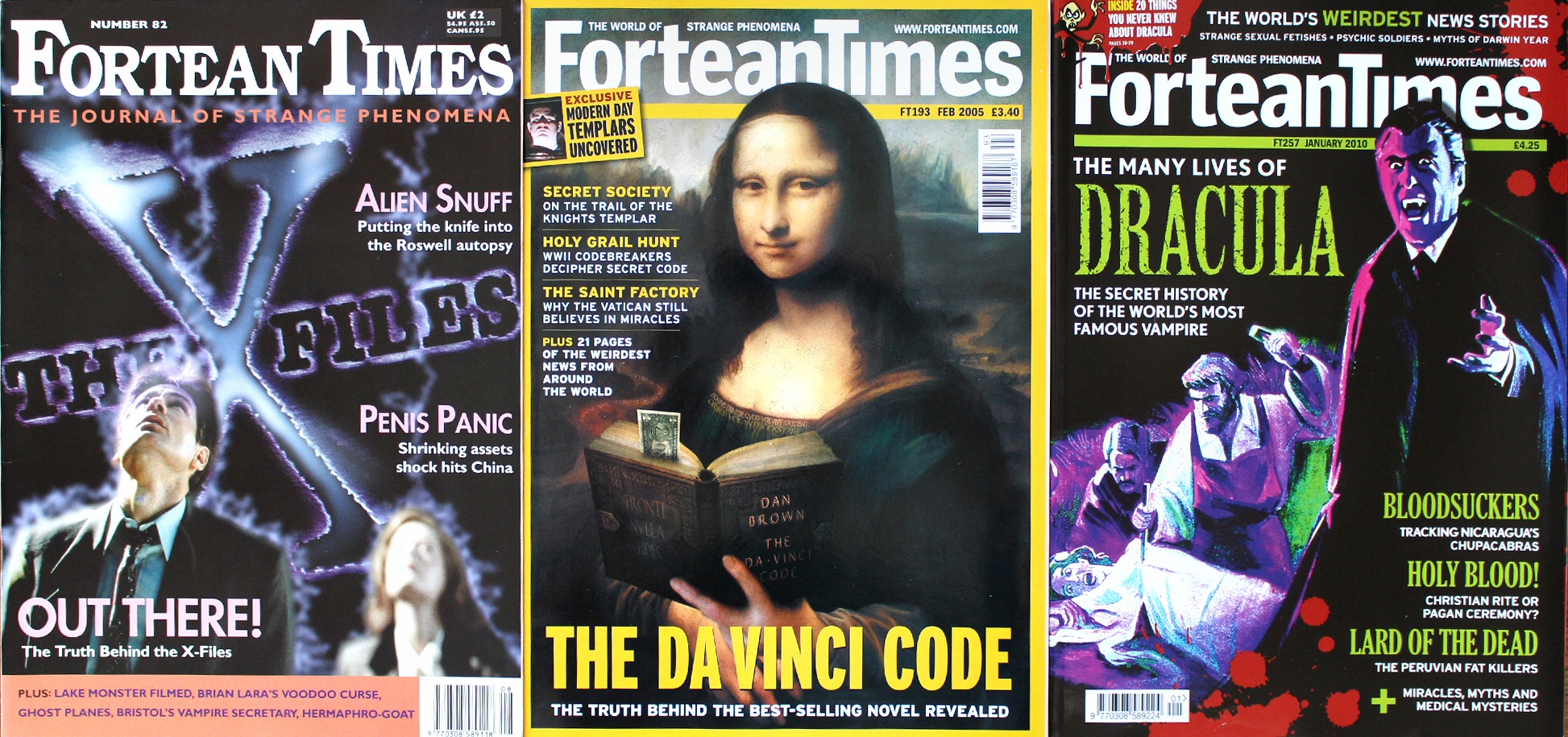
To start with some very obvious topics, there are the three shown above. The X-Files (FT 82, August 1995) was not only one of the most fortean TV shows of all time, but its first appearance in 1993 coincided with the wider distribution of FT to "mainstream" retailers like WH Smith, and almost certainly contributed to the magazine's popularity at that time. Around a decade later, Dan Brown's novel The Da Vinci Code (FT 193, March 2005) was a publishing phenomenon, bringing fringe theories that had previously been the realm of specialist writers (and FT contributors) like Lionel Fanthorpe and Lynn Picknett to a much wider audience. Just over a century earlier, Bram Stoker had done something similar in his novel Dracula - the title character of which went on to become one of the most recognisable and ubiquitous pop-culture icons of them all, as recounted in the cover feature of FT 257 (January 2010).

At a less obvious level, you can find references to popular culture in almost every issue of FT. Taking the one I discussed last week, for example - FT 73 from February/March 1994 - there's an interview with cult author William Gibson, generally credited as the originator of the cyberpunk genre. And I spotted something else in that issue, too: a book review by comics legend Alan Moore. I don't mean a review of one of his graphic novels - I mean a review written by him of someone else's work. Looking online, I see he actually did quite a few reviews for FT in those days - which pleases me enormously, as I've done over 40 of them myself. It's always nice to discover that you have something in common with a famous person!

Sticking with books and comics for a moment, here are three more covers that caught my eye. No apologies for a second appearance of The Da Vinci Code (FT 212 this time, from August 2006) - both because it's one of my favourite novels, and because I love the illustration on the cover. In addition to people like Picasso and Orson Welles, it features Da Vinci himself in the act of strangling Dan Brown! The middle cover (FT 256, December 2009) features Dennis Wheatley - best remembered today for The Devil Rides Out (the only one of his novels that I've read), although in his day he was Britain's most prolific author of occult fiction. Finally there's the only comics-themed cover I could find - FT 320 (November 2014), relating to the Fredric Wertham-inspired anti-comics paranoia than swept America in the 1950s.


I found a few shorter comic-related pieces on interior pages as well. The most interesting of these was an article in FT 277 (July 2011) called "The Morning of the Mutants", speculating that Stan Lee and/or Jack Kirby got the idea for the X-Men from the seminal (though now largely forgotten) fortean conspiracy book The Morning of the Magicians, written in 1960 by Louis Pauwels and Jacques Bergier. There's also a feature about Marvel Comics' Doctor Strange in FT 349 (January 2017, to tie in with the movie), which discusses the character's origin and fictional predecessors.

Regarding the "popular culture" of the mid-20th century, I can't resist mentioning a couple of pieces by myself - in fact the only two full-length feature articles I've had in FT. First there was "Fanthorpe's Fortean Fiction" (FT 297, February 2013) about the large number of mass-market paperback novels that Lionel Fanthorpe churned out in the late 1950s and early 60s. This was followed by "Astounding Science, Amazing Theories" (FT 355, July 2017), looking at fortean themes in the pulp science fiction magazines of the 1940s.

Pulp magazines were a huge part of popular culture in the first half of the 20th century, but - with a few notable exceptions - they're only of interest to die-hard fans today. Of those exceptions, perhaps the most important is H. P. Lovecraft, whose Cthulhu Mythos first took form in the pages of Weird Tales in the 1920s and 30s, before going on to develop a life of its own to rival that of Bram Stoker's Dracula. I found no fewer than three Lovecraft-inspired FT covers: FT 184 (June 2004), FT 369 (August 2018) and FT 390 (March 2020 - this one tying in with the movie adaptation of The Color Out of Space). Here they are:


As regards cult TV shows, I've already mentioned the most fortean of all, The X-Files - which not surprisingly made several further appearances after the one pictured at the top of this post (including FT 85 from February 1996, which had a rundown of all the fortean references in the show's first season). Three other TV-related covers are shown below, the middle of which - FT 215 from October 2006, celebrating 40 years of Star Trek - needs no introduction. The other two relate to the screenwriters (both with wider fortean interests than you might expect) behind two of Britain's most famous sci-fi icons: Kit Pedler, who created Doctor Who's second-most-famous villains, the Cybermen (FT 209, May 2006), and Nigel Kneale, creator of Professor Quatermass (FT 418, May 2022). The latter may no longer be a household name, but back in the 1950s he was really the first great TV sci-fi hero, in this country at least.


Turning to movies - I was spoiled for choice here, so I've picked out three covers that really speak for themselves. First there's a celebration of 50 years of Hammer Horror films (FT 223, June 2007), then a look at one of the mainstays of those films, Peter Cushing, on the 100th anniversary of his birth (FT 301, May 2013), and finally a 40-years-on retrospective about The Exorcist (FT 313, April 2014):

To be honest, my favourite thing about The Exorcist is the music - the snippet from Mike Oldfield's Tubular Bells that it uses, I mean - which brings me neatly onto the next subject. When I talk about "pop culture" on this blog, I most often mean fairly specialized things like pulp magazines, comics (from the pre-multimedia franchise days) and cult TV shows such as The X-Files. But to most people, pop culture means just one thing, and that's pop music. This is such a pervasive part of modern life that it's acquired a plethora of fortean connections - so much so that I'm going to split them into two distinct parts.

To start with, here are three cover features that deal with direct fortean influences on musicians. The first, from FT 88 back in July 1996, describes how various pop stars from David Bowie and Jimi Hendrix to Kate Bush and The Orb absorbed ufological and similar speculations into their music. Second, there's a somewhat more arcane take on the same subject by Ian Simmons (FT 244, January 2009), featuring the likes of Stockhausen and Sun Ra - a much-referenced source for my own book The Science of Sci-Fi Music. Finally, in the immediate wake of David Bowie's death, there was a cover feature about the numerous fortean influences on his work (FT 338, March 2016) - including the aforementioned Morning of the Magicians by Pauwels and Bergier.


Another aspect of pop music that's of fortean interest is the way weird conspiracy theories grow up around the subject. So to round off what I honestly believed would be a shorter-than-usual post when I started it, but has ended up as probably my longest ever - here are three cover features addressing this aspect. The one on the left (FT 166, January 2003) deals with the numerous legends and conspiracy theories associated with Elvis, while the one on the right (FT 384, October 2019) does much the same for the Beatles. As for the one in the middle (FT 258, February 2010), it concerns the notion that the "Illuminati" employ popular music - and the musicians themselves - to manipulate the thoughts, beliefs and behaviour of the general public. But that's not really a conspiracy theory, is it? I mean, if you substitute "global media" for "Illuminati", I'd say it's an indisputable fact.


Wednesday, 13 December 2023

The Fortean Influence on Science Fiction - book review


Pictured on the left above is my copy of the first issue of Unknown magazine, featuring Sinister Barrier by Eric Frank Russell - which I referred to as the first Fortean novel in a post on this blog back in 2011 (see also Pulp Forteana from 2014 for more on Russell). The book on the right, with the same picture on the cover, is a copy of Tanner F. Boyle's The Fortean Influence on Science Fiction, which Fortean Times sent me for review when it came out in 2021. My 5-star review duly appeared in FT 405, but having recently revived this blog it seems an obvious choice to reprint here. So without further ado, here it is:

With so much subject matter in common, from extraterrestrials and time travellers to ESP and alternate realities, it’s no surprise that the histories of forteana and SF are intertwined. Fortean Times, for example, might not exist if founding editor Bob Rickard hadn’t picked up the collected works of Charles Fort at an SF convention in the 1960s. The influence goes in the opposite direction too, from forteana to SF – and as the title indicates, that’s Tanner Boyle’s main focus in this book (though there’s a secondary theme too, which I’ll come to later).

It’s remarkable, given the high profile that SF enjoys today – and Fort’s relative obscurity – how much the genre owes to him. As Boyle says, “without Fort, SF’s development would have been radically different”. A similar sentiment was voiced by one of the giants of SF, Arthur C. Clarke, who spoke of the “tremendous impact” Fort’s writing had on the field. A classic biography of Fort, Prophet of the Unexplained, was written by SF author Damon Knight, who agreed that “Fort’s influence on other writers is incalculable”.

One reason for this influence is easy to trace. Early pulp magazine editors enthusiastically pushed Fort’s ideas at their readers and writers. Astounding Stories, for example, serialized the entirety of Fort’s third book, Lo!, in 1934. This was how many people, Clarke included, first encountered Fort. A subsequent editor of Astounding, John W. Campbell, described Fort’s writings as a “magnificent source-book and challenge to readers and writers of SF”, which “probably averages one SF or fantasy plot idea to the page”.

Interestingly, Fort himself started out as a fiction writer. Boyle describes one of his stories, “A Radical Corpuscle”, dating from 1906 – “involving a group of cells who become aware that they are living within another organism, a larger, cosmic body”. This seems to prefigure Fort’s suggestion that humanity is just a tiny part of a bigger picture, achieving its most striking form in his notion that “we are property”.

That quotation has inspired no end of SF stories. Among the first was Eric Frank Russell’s Sinister Barrier, whose appearance in Astounding’s sister magazine Unknown is illustrated on Boyle’s cover. As Bob Rickard has recounted (FT312:48-51), Russell was a key figure in the development of both forteana and SF, albeit one who is largely forgotten today. That’s hardly true of Russell’s younger protégé, Arthur C. Clarke, whose masterpiece 2001 a Space Odyssey is a more famous take on the “we are property” trope. For that matter, many of us first learned of fortean phenomena through Clarke’s Mysterious World TV shows in the 1980s.

Clarke is one of several authors that Boyle devotes a whole chapter to. Another is Philip K. Dick, much of whose work seems to come straight from a passage in Fort’s Book of the Damned: “Ours is a pseudo-existence, and all appearances in it partake of its essential fictitiousness.” Yet apart from a brief reference in an early story, “The Indefatigable Frog”, it’s not clear from Dick’s writing that he had any interest in Fort’s work per se. Fortunately, Boyle is able to set the record straight here. He quotes an email from Dick’s widow, Tessa, confirming that he “read and admired Fort’s work” and avidly consumed biographical material on Fort. Dick also corresponded with fortean author Brad Steiger in the wake of the “mystical experience” that led to his semi-autobiographical novel VALIS – which, as Boyle says, “does at many points read like a technologically updated rendition of Fort’s theories”.

A secondary theme running through the book concerns what Boyle dubs “maybe-fiction”, referring to imaginative speculations on SF-like subjects which are presented as the truth. An intriguing characteristic of maybe-fiction is the way different authors develop and build on each other’s ideas, creating what Boyle calls “a vast web of intertextuality”. The result, as well as being impressive enough to persuade believers, provides a handily exploitable framework for SF authors. A good example is the way alternative historical narratives created by writers like Erich von Daniken and Zecharia Sitchin – which Boyle describes as a “wellspring of creativity” – can inspire anything from Ridley Scott’s Prometheus to at least one Scooby-Doo plotline.

The boundary between fiction and maybe-fiction is a blurred one. When Charles Fort embarked on The Book of the Damned, he wrote that “I’ve given up fiction ... or in a way I haven’t. I’m convinced that everything is fiction, so here I am in the same old line”. By coincidence or otherwise, several of the most successful purveyors of maybe-fiction, from Donald Keyhoe and John Keel to Whitley Strieber and Jacques Vallée, also produced works of “real” SF.

All in all Boyle has produced an engrossing and eye-opening book, which is well-researched and painstakingly referenced, and written in much the same style as a Fortean Times article. Unfortunately it’s been packaged as an academic work, with a price tag to match (though the ebook is more affordable). But if your budget can handle it, and you’re interested in the parallel histories of forteana and SF, it’s definitely worth checking out.

Sunday, 28 August 2016

Ron Goulart's Cheap Thrills

If you’ve come across the name Ron Goulart the chances are it was as a historian of 20th century popular culture – comics and pulp magazines in particular. But Goulart was a poacher as well as a gamekeeper, churning out over a hundred short and easy-to-read novels of his own (the small selection that I’ve read so far is shown above). One of his best-known non-fiction books is called Cheap Thrills (pictured below) – and the same phrase sums up his fiction too!
Ron Goulart was born at the height of the pulp era in 1933, and began his full-time writing career in the 1960s. His novels are an intriguing blend of the straightforward plots and larger-than-life characters of the thirties with a satirical take on the consumerism and hippie zeitgeist of the sixties. As far as I know he’s still alive, and I hope he won’t be too offended if I describe him as the late 20th century equivalent of a pulp magazine hack. His novels are all very short – typically 40 to 50,000 words – and were clearly written with the aim of meeting deadlines rather than getting onto award shortlists. All of them came out as paperback originals, and very few of them ever saw a second edition. Inevitably, the quality is variable – some of the ones I’ve read are pretty dire, but others are really very good.

A couple of years ago I wrote a long post about Goulart’s 1979 novel Hello Lemuria Hello. This is still by far my favourite of the ones I’ve read, both for its fortean themes and its “superhero” style protagonist – Jake Conger of the Wild Talents Division. I subsequently tracked down two other Jake Conger novels – A Talent for the Invisible (1973) and The Panchronicon Plot (1977). They’re both enjoyable, especially the latter, although much less fortean. The same is true of a couple of other offbeat “near future” (actually 2002) adventures I’ve read – Calling Dr. Patchwork (1978) and Hail Hibbler (1980) – which feature a husband-and-wife team of private investigators called Jake and Hildy Pace (Goulart seems to like the name “Jake” for protagonists – there is also Jake Cardigan in Tek War, which he ghost-wrote for William Shatner in 1989).

I also enjoyed the three Vampirella adaptations I read (he wrote six in all, but I’ve only got the ones that were reprinted in the UK). After Hello Lemuria Hello, these are probably the most fortean-themed of his novels that I’ve read. He’s also done a couple of other comic-book adaptations – Challengers of the Unknown (1977) and a Hulk novel called Stalker from the Stars (also 1977, co-written with Len Wein and Marv Wolfman under the pseudonym of Joseph Silva). I still need to track those down – along with Goulart’s novelization of that archetypally fortean movie, Capricorn One.

All the Goulart novels I’ve read (except the Vampirella adaptations) have the same basic plot. They start with the protagonist(s) reluctantly accepting an assignment to track down some nefarious criminal or criminals. They’re given an initial lead, which in due course puts them onto a second lead, and so on through half a dozen wacky and often outright comical scenes until the final showdown. This is a perfectly good plot structure, as long as the hero is constantly racing against the clock, falling into traps, getting double-crossed, chasing after red herrings, etc, etc. In Goulart’s best novels, that’s exactly what happens ... but in some of the others he forgets to do this, and the protagonist sails through the story with no real obstacles to overcome. The result in these cases is inevitably dull, no matter how original and imaginative the incidental details are.

I’ve been looking for a pattern, to give me a better idea what to look out for in future. Based on my experience so far, the novels that involve series characters (either Goulart’s own creations or franchise characters) and are set here on Earth are all pretty good. Novels set in Goulart’s fictitious Barnum system (of which I’ve read three – The Fire-Eater, Shaggy Planet and Flux) were rather dull and forgettable in my opinion – as was the one that was set on Earth with a non-recurring protagonist (After Things Fell Apart). I suspect in reality it’s not as clear-cut as this, and – as with 1930s pulp fiction – you just have to accept that some of the novels are good and some are bad.

The dozen books pictured at the top of this post were purchased second-hand on various occasions over the last ten years. The one in the bottom right – the embarrassingly-titled Hail Hibbler – came from a paperback book fair in 2009. It contains a hastily scrawled signature on the title page, which I assume is Ron Goulart’s autograph:

Sunday, 3 January 2016

The Writer’s Secret

In the comment thread after my Who Remembers Guru? post last summer, I mentioned that I wanted to try my hand at creating a similar “comic strip collage” using public domain images. A few weeks later I did a sort of trial run with the cover image for Jill Trent and the Flying Saucer Mystery, but with plenty of idle time over the Christmas break I thought I’d try something a little more ambitious.

I had a look round for a suitable idea, and came across this unpublished poem I wrote several years ago:
A world-renowned writer named Blott
Said of genres, “I’ve written the lot:
From horror and mystery
To fantastical history
And all of them have the same plot!”
Turning this into a Guru-style cartoon wasn’t as easy as I thought. There are thousands of free images on the web, but finding ones that fit (both thematically and stylistically) was harder than I’d expected. Also, the last line caused problems because it doesn’t have a natural visual interpretation. A fairly obvious idea did spring to mind, but I couldn’t use it on account of the “no porn” clause in Blogger’s terms and conditions. So I decided to go with a more abstract notion instead.

Sunday, 22 November 2015

Tarzan versus Doc Savage

In my post about Jane Gallion last month, I mentioned in passing that the “pornographic” Essex House imprint published several novels by Philip José Farmer in the late sixties. By coincidence, on my visit to London a week later I saw one of these – A Feast Unknown – on sale in a second-hand shop. It was only a couple of pounds, and according to the blurb it featured a character based on my favourite pulp hero, Doc Savage, so I snapped it up. This particular copy is a mass market paperback from 1975, with no content advisory or age restriction, so I guess it’s heavily expurgated compared to the original Essex House version. Nevertheless it’s a really good novel – and quite a Fortean one too, with an unusual variation on the “Secret Rulers of the World” theme.

The book is set in the swinging sixties, when it was written. The first-person narrator is Lord Grandrith – an English aristocrat dividing his time between estates in Africa and the Lake District. He’s supposed to have been the “real-life” person on whom Edgar Rice Burroughs based the fictional character of Tarzan, who flourished circa 1912 – 1940. The name that Burroughs used was Lord Greystoke, but in A Feast Unknown Lord Greystoke is merely a near-neighbour of Grandrith’s estate in Cumbria (there is an amusing scene in which Grandrith accidentally demolishes a huge statue of Tarzan, which the locals have erected as a tourist attraction in the village of Greystoke, by crashing an Aston Martin DB4 into it). Although Grandrith is almost 80, he looks 50 years younger – and is likely to stay that way for thousands of years to come – thanks to a Faustian deal he made with a shadowy group of near-immortals called “The Nine”.

The deal involves being given regular shots of an “Elixir of Life”, in return for carrying out various tasks on behalf of the Nine when ordered to do so. At any given moment the Nine have hundreds, if not thousands, of such servants working for them – others include Grandrith’s wife Clio (presumably the inspiration behind the “Jane” of fiction). The Nine are master manipulators – not just of world history but of their servants too. At the start of the novel, Grandrith is deliberately put on a collision course with another servant of the Nine – one Doctor Caliban, the “real-life” inspiration behind Doc Savage (“A writer of pulps had somehow learned something of his strange rearing and training, his extraordinary, perhaps unique, qualities and abilities… The writer had used Caliban as the basis for a character, under another name, of course, in a series of wild science-fictional adventures, most of which were the result of his imagination.)

The oldest members of the Nine are supposed to be at least 30,000 years old, and to have given rise to various legends of pagan gods and goddesses. This may sound like a hackneyed idea, but Farmer’s version struck me as distinctly different – and very clever – in one important way. Normally these manipulative, all-powerful, long-established Illuminati-type groups are assumed to be either (a) extraterrestrials, (b) terrestrial but non-human (e.g. shape-shifting reptilians) or (c) survivors of some ancient but highly advanced civilization from Atlantis or Lemuria. All these theories take a far-fetched idea and convolve it with something even more far-fetched. Farmer’s brilliant twist is to start with that one far-fetched idea (a 30,000-year-old secret society) and combine it with the mainstream academic picture of what Homo Sapiens was like 30,000 years ago.

To palaeontologists and anthropologists, that was still the Palaeolithic era, or Old Stone Age. In spite of anything misty-eyed New Agers might want to believe, human society in those days was intensely hierarchical, patriarchal, ignorant, superstitious and brutal. In other words, pretty much the way Illuminati-believers imagine “They” would like it to be today. So put that way, Farmer’s set-up makes a lot of sense. The most shocking scene in the book (one of the most repulsive scenes I’ve ever encountered in a mass-market paperback novel) involves ritual genital mutilation and cannibalism. Yet if there were secret rites dating back to Palaeolithic times, that’s probably the kind of thing they’d be.

The narrative adheres to the time-honoured “crossover” formula, whereby the two heroes spend most of the novel fighting each other, before finally realizing they ought to team up against their common enemy (who set them up in the first place). Because it’s told from Grandrith’s point of view, that means that for most of the story the “Doc Savage” character is presented as a bad guy. His very name, Caliban, is taken from the monstrous villain in Shakespeare’s Tempest (for a comic-book version of which, see my post from two weeks ago). Nevertheless, Farmer does eventually explain how such a villainous name got attached to someone who is essentially a “Super Boy Scout”.

The shop where I bought A Feast Unknown was 30th Century Comics in Putney. My next stop was The Book and Comic Exchange in Notting Hill, where I bought a reduced-price replica edition of the first Doc Savage novel, The Man of Bronze (pictured below). Although I’ve read more than a dozen Doc Savage books, I’d never got round to reading this one – until now! The plot revolves around a hidden city in Central America, where the inhabitants speak the all-but-dead language of the ancient Maya. Thanks to Doc’s enormous erudition, though, he’s able to converse with them in that language. Impressive as that may be, in A Feast Unknown Lord Grandrith (who has a PhD in linguistics from the university of Berlin) goes a step further – he can understand “Ursprache, the parent language of the Indo-Europeans”, as spoken by the 30,000-year old members of the Nine!

Sunday, 15 November 2015

The Case of the Little Green Men

I found another book to add to my Charles Fort in Fiction list. The last addition was Anthony Boucher’s 1942 murder mystery Rocket to the Morgue, and this new one is another murder mystery – The Case of the Little Green Men by Mack Reynolds. Originally published in 1951, it’s now available as an ebook – either from the UK Kindle store, where I got it, or from the US Kindle store, and probably other places as well.

Like Rocket to the Morgue, The Case of the Little Green Men is set against a backdrop of science fiction fandom – which was significantly larger and better established in 1951 than it was in 1942. Boucher’s novel included a passing mention of the third Worldcon, held in Denver in 1941 and attended by just 90 people. The latter part of The Case of the Little Green Men – including the second of its two murders – takes place at the tenth Worldcon in 1952, which was still a year in the future when the book came out (the actual 1952 Worldcon took place in Chicago and had 870 attendees). Any murder set at a sci-fi convention is bound to involve cosplay, and this one is no exception. The villain is dressed as a six-limbed purple Martian – “the godawfullest costume of the convention”.

The Case of the Little Green Men isn’t science fiction. The novel’s title comes from the fact that it starts with the first-person narrator – a private detective with a reputation for mediocrity – being hired to find evidence of extraterrestrials living among the human population. “Little Green Men” is a pejorative term used by the hero and other skeptical characters, but the actual idea is that the aliens are shape-shifters who can make themselves indistinguishable from humans. The investigation was never meant to be taken seriously – it started out as a joke item for the convention. Nevertheless, some people do seem to take it seriously… and after a while it provides our protagonist with a good excuse to stick his nose into the murder case (there’s a nice touch of realism in that, unlike most fictional private eyes, he wouldn’t dare investigate a murder openly for fear of antagonizing the police).

The reference to Charles Fort comes when one of the more serious of the UFO-believers is trying to persuade the hero that there really might be extraterrestrials on Earth:
He came back with a heavy book and handed it to me. I looked at the title: The Books of Charles Fort. “What’s this?” I asked him. “Isn't Fort the screwball that tells all about the rains of frogs and that sort of crap?”
“That's hardly a proper description of Charles Fort,” he said stiffly. “Fort has gathered material for decades in an attempt to show that modern science is too smug, too hypocritical – and too ignorant. He made a hobby, a lifetime work, of gathering evidence of phenomena that modern science has as yet been unable to explain.”
Not surprisingly the novel also includes references to quite a few SF writers, including four who are particular favourites of mine: A. E. van Vogt, Henry Kuttner, Fredric Brown and Eric Frank Russell. The last-named is perhaps best known for his explicitly Fortean novel, Sinister Barrier. As I mentioned in a previous post, I’m the proud owner of the original issue of Unknown magazine (March 1939) in which Sinister Barrier first appeared. I paid £25 for it – considerably more than the cover price of 20 cents. Apparently that’s always been the case! Here is another excerpt from The Case of the Little Green Men, where the protagonist is trying to blend in with the real fans in the dealers’ hall:
I picked up one of the publications and thumbed through it. It was pretty well worn, the date was 1939, the cover was gruesome, and the title of the magazine was Unknown. I asked “What’s the price on this?” reaching in my pocket for some change. I figured that I’d look more authentic wandering around the hall if I was carrying a magazine with me.
”Three dollars,” he told me.
I glared at him indignantly. “You batty? This magazine is falling apart; it’s more than ten years old.”
He took it from my hand with as little gentleness as was consistent with the magazine’s condition and glared back. “That’s the issue in which Sinister Barrier was first –.”
”All right, all right,” I cut him off. “Keep it.” I got on to the next table before he assaulted me.
All in all I really enjoyed The Case of the Little Green Men. It’s the first novel I’ve read by Mack Reynolds, although over the years I’ve read quite a few shorter works by him. When I scoured my bookshelves a couple of days ago I found eight stories by him in various anthologies and magazines. The most Fortean of these is a short-short called “I’m a Stranger Here Myself”, which takes the form of a conversation between two undercover aliens, from different planets, who bump into each other in a café in Morocco.

All the other Reynolds stories I’ve read are Cold War thrillers, with a strong focus on the Communist-Capitalist battle of wits, sometimes with a science fiction twist. One of them (illustrated below) even has aliens in it! It’s called “Combat”, and I read it in the February 1961 issue of Analog magazine (British edition). It’s not a great story, but it makes nostalgic reading if you hanker after the simpler world of the Cold War period. The essence of the story is that the aliens choose to land their spaceship in the middle of Moscow, which confuses the heck out of the Americans (who assumed they would land in the world’s most advanced country).

Although the story is dated in many ways, some of its sentiments are as valid as ever. Here is a striking quote from the second page of the story: “The best men our universities could turn out went into advertising, show business and sales – while the best men the Russians and Chinese could turn out were going into science and industry. The height of achievement over there is to be elected to the Academy of Sciences. Our young people call scientists eggheads, and their height of achievement is to become a TV singer or a movie star.”

After 55 years, the depressing thing isn’t that things haven’t changed – but that they have changed. What applied to the United States then applies to pretty much the whole planet now!

Sunday, 4 October 2015

Pulp Sleaze

A few weeks ago I received a gift code to spend on the U.S. Amazon site, so I decided to buy something archetypally American in the form of a replica edition of Vice Squad Detective from 1935. This is arguably the sleaziest pulp magazine ever published. According to the FictionMags database, “it is believed that most copies were seized by police prior to distribution” (I assume this was the work of the vice squad, operating with or without deliberate irony). There’s nothing Fortean about the magazine’s contents, but since I’ve run out of blog ideas and it’s definitely retro, I’ll go ahead with a brief review of it.

The archetypal sleazy pulps were Spicy Detective, Spicy Adventure and Spicy Mystery (as you can see from the photo above, I’ve already got replica editions of one issue of each of these). The basic concept was to combine traditional pulp genres with large quantities of female nudity (or near nudity) – on the covers, in the interior artwork (of which there was a generous amount) and in the stories themselves. Spicy Detective first appeared in April 1934, and the formula proved so popular with readers that it was soon followed by other Spicy titles from the same publisher (aptly known as Culture Publications), as well as competitors with titles like Sizzling Detective Mysteries. As the popularity of such magazines grew, they inevitably came to the attention of people who hate to see other people enjoying themselves – resulting in police raids, prosecutions and calls for increased censorship. As Peter Haining wrote in The Classic Era of the American Pulp Magazine, by 1938 “nudity was being cut out and the bras were going back on”.

Reading Vice Squad Detective today it’s not obvious where all the moral outrage came from. The police are always portrayed as heroes, while drug dealers, pimps and gangsters are portrayed as villains. Descriptions of female nudity tend to be short and vague, not long and detailed. Descriptions of sexual intercourse are likewise brief, and only ever a background activity observed by a POV character. Protagonists do their fair share of kissing and anatomy-squeezing, but they never get as far as actual shagging. Characters who indulge in violence against women invariably end up dead. Women are never portrayed as nymphomaniacs – all the villains, whether male or female, are motivated by greed rather than lust. Two of the stories contain seemingly “sinister” ethnic stereotypes, but in both cases the character in question turns out to be one of the good guys, and the real villain is a white male. Vice Squad Detective may not be Sunday School material, but it’s a lot less morally objectionable than a lot of low-end fiction today.

The magazine contains 12 short stories, all about 10 pages long. In terms of quality, it’s comparable to any other pulp of this period – approximately a third of the stories are really quite good, a third are OK and a third are pretty awful. My favourite story also happens to have the best title – “The Amazing Case of the Blonde Dope Queen”, by J. P. Carroll. It’s a well written story, with interesting characters and a nice twist at the end. Other decent stories (also with good titles!) are “The Nudist Gym Death Riddle” by Jack Gray, “The Call Girl Murder Mystery” by Peter Abbott and “Marijuana Vice Trap” by L. S. Worth. This last one is rather clunkily written, but makes a very strong point. The rich college kids who indulge in all-night sex and drug orgies may be doing it for kicks, but the middle-aged men who sell them the drugs, photograph them in compromising situations and blackmail them into stealing from their parents aren’t interested in kicks at all – just in making money.

Possibly “Marijuana Vice Trap” wasn’t considered a particularly offensive story anyway, because it was reprinted as the cover story of another magazine, Pep Tec Tales, in April 1937. The following issue of that magazine has another of the Vice Squad Detective stories on the cover – “The Pajama Party Killer” by Don Lawrence.

The last story in Vice Squad Detective is “The Beach Racket Murder” by Tom Pennell. On the penultimate page of that story, I was interested to see the hero refer to the villain as “deader than the Republican party”. In hindsight that’s not a particularly good choice of simile, but it does provide food for thought. Wouldn’t the world be a different place if Nixon, Reagan and the two Bushes had never made it into the White House?

Sunday, 30 August 2015

The Number of the Beast

Over the years I’ve read a dozen or so books by Robert A. Heinlein, including novels and short story collections, but I wouldn’t count myself as a Heinlein fan. And The Number of the Beast – a huge, 556-page novel he wrote when he was over 70 – is really a book for die-hard fans only. It’s got a reputation as a dull and slow-moving novel, overloaded with Heinlein in-jokes and self-references. On the other hand, its basic premise is pretty fascinating – so I picked up a second-hand copy for a couple of pounds when I saw it in a bookshop earlier this year. I just got round to reading it – and while I can’t pretend it was an enjoyable experience, it was thought-provoking enough to be worth a blog post (plus I can’t think of anything else to write about this week).

The idea of “the number of the beast” – 6 6 6 – comes from the Book of Revelation. It’s one of the few things in the Bible that even non-Christians (and Satanists, for that matter) agree is quite cool. It’s normally rendered as “six hundred and sixty-six”, but in Heinlein’s novel it’s “six to the power of six to the power of six”. Written like that it’s mathematically ambiguous. 66 is 46656, but there’s a big difference between 466566 and 646656. Heinlein makes it clear that he means the first of these, which he multiplies out as 10,314,424,798,490,535,546,171,949,056. That may look like a big number, but the second number is MUCH bigger. It starts with 223,872 followed by another 36,300 digits. I guess the reason Heinlein didn’t go for that one is because it would have taken at least 20 pages to write out in full!

In the novel, the significance of 6^6^6 comes from a six-dimensional theory of space-time developed by one of the four main protagonists. It’s supposedly the number of different universes “possibly accessible to us either by rotation or translation”. That’s pure technobabble, of course, but it’s an excellent starting premise for a science fiction novel. Unfortunately, however, Heinlein’s narrative doesn’t go the way most SF readers would expect it to.

That much was science – now for the philosophy. I like playing with words just as much as I like playing with numbers – especially if they’re really big words. There are three lovely big words on the back cover of the book – “Multiperson Pantheistic Solipsism” (that’s one of the reasons I had to buy it). Solipsism is the philosophical theory that the human mind creates its own reality. Pantheism, strictly speaking, is the theological belief that God is all-pervasive throughout the universe. But coupled with solipsism I guess you could substitute “the human mind” for “God”. The third big word, multiperson, is self-explanatory – the relevance here being that the book has four protagonists who are very much in tune with each other. Putting it all together, “Multiperson Pantheistic Solipsism” means that a whole universe can be created as a mental projection by a group of like-minded people.

This still sounds like a good idea – although closer to fantasy than science fiction – but again Heinlein doesn’t handle it the way most people would expect. I’d read in several places that the “universes” the characters create are based on pulp fiction, which immediately creates certain expectations in the reader’s mind. Even Wikipedia says “The novel lies somewhere between parody and homage in its deliberate use of the style of the 1930s pulp novels”. Having read the book I have to say that’s just plain wrong.

At its peak in the 1930s and 40s, pulp fiction encompassed a whole range of genres. The most popular of these were hardboiled crime (as typified by Black Mask magazine), supernatural fantasy (typified by Weird Tales), the “hero” pulps (e.g. The Shadow and Doc Savage) and the nascent genre of science fiction (pioneered by Amazing Stories, followed by various similarly titled magazines such as Astounding).

Near the start of The Number of the Beast, the protagonists do get into a brief discussion of pulp magazines – including Weird Tales, The Shadow, Black Mask and Astounding. But that’s pretty much it. When they start visiting “fictional” universes, only one of them has its roots in a pulp magazine. That’s a fairly brief episode involving E. E. “Doc” Smith’s Lensman characters, who originally appeared in the pages of Astounding. As for tough-talking private eyes like Race Williams or Dan Turner, Robert E. Howard’s Conan of Cimmeria, Doc Savage and his trusty aides... there’s no sign of any of them.

The fact is, regardless of what Wikipedia says, The Number of the Beast isn’t even close to being a parody of 1930s pulp fiction. Instead, the dominant thread running through the fictional universes is children’s literature – classic books like The Wizard of Oz, Alice in Wonderland, Princess of Mars and Gulliver’s Travels.

They may not be pulp fiction, but these books are still essentially escapist adventures, with some very basic tropes in common. First and foremost is the idea of conflict. Typically this means protagonists versus villain – either the protagonists are desperately trying to stop the villain doing something bad, or the villain is trying to prevent them doing something good. Even if the story doesn’t have a human villain, it needs an impending natural disaster or other impersonal force to provide the same impetus and sense of urgency. The protagonists shouldn’t have time to catch their breath, let alone do any of the trivial little things you and I spend most of the day doing. If there’s a romantic subplot, then its course can’t be allowed to run smooth. That bit about living happily ever after comes at the end of the story, not the beginning.

Heinlein turns all of that on its head. If you think about it, in a universe governed by Multiperson Pantheistic Solipsism, he pretty much has to. I mean, if you created a universe out of pure thought, you’d give yourself an easy time too, wouldn’t you? Consequently the book is devoid of any sense of urgency. It’s the only novel I’ve read where the protagonists spend most of their time cleaning their teeth, taking a bath, deciding what to wear, eating breakfast, getting a good night’s sleep... and having long conversations in which everyone agrees with everyone else. They carefully plan what they’re going to do next, then do it in their own sweet time. On the rare occasions they come across anything resembling an obstacle or hindrance, they deal with it in half a page, then get back to eating, sleeping and agreeing with each other.

The result is a long and boring book, in which the protagonists thoroughly enjoy themselves but the reader doesn’t. That’s the exact opposite of a traditional escapist novel – it’s more like peeking in on someone else’s daydream. Maybe it is all a dream, in fact. The first two sections are called “The Mandarin’s Butterfly” and “The Butterfly’s Mandarin” – presumably a reference to a story told by the Chinese philosopher Chuang Chou:
Once upon a time, I dreamt I was a butterfly, fluttering hither and thither... conscious only of my happiness as a butterfly, unaware that I was Chou. Soon I awaked, and there I was, veritably myself again. Now I do not know whether I was then a man dreaming I was a butterfly, or whether I am now a butterfly, dreaming I am a man.

Sunday, 23 August 2015

Rocket to the Morgue

While I was writing last week’s post about L. Ron Hubbard I suddenly remembered a novel called Rocket to the Morgue, in which one of the characters is based on Hubbard. I bought the copy pictured above (second-hand, as you can tell from the condition) in 2008, and was impressed enough to write about it at the time. It should have featured in my post about Charles Fort in Fiction, since it belongs to the select group of novels that mention Fort by name, but I managed to miss it out. So I thought I’d rectify the omission now.

Rocket to the Morgue was written by a man named William White, and originally appeared in 1942 under the pen-name of H. H. Holmes. White is better known by another pseudonym, Anthony Boucher, which he used on a number of classic short stories including “The Compleat Werewolf” and “The Quest for Saint Aquin”, and as founding editor of The Magazine of Fantasy and Science Fiction. The paperback reprint of Rocket to the Morgue has the name Anthony Boucher on the cover.

The novel is essentially a murder mystery, although that’s secondary to the real interest of the book. The action takes place against the backdrop of science fiction fandom – and prodom – as it existed at the time the book was written. No real-world authors make an appearance, but even Wikipedia acknowledges that many of the characters are based on real people. Most of these will be pretty obscure to modern-day readers – the main exceptions are Robert A. Heinlein (who features as “Austin Carter”) and L. Ron Hubbard (“Vance Wimpole” – described by one of the other characters as “an eccentric, a madman if you will”). Somewhat confusingly, there is also a passing reference to another writer named “René Lafayette”, which as mentioned last week was a pseudonym used by Hubbard.

As an aside, it’s worth emphasizing just how different the world of 1942 was. L. Ron Hubbard was a pulp writer, pure and simple. Scientology and Dianetics still lay in the future, and Hubbard’s name would have meant nothing to the general public. Science fiction fandom would have been equally obscure. There were no blockbuster sci-fi movies in 1942, and the cutting edge of the genre still lay in the pulp magazines. Although the novel is full of characters who conform to the modern stereotype of the science fiction geek, that stereotype would have been unknown to most readers when the book first came out.

The most Fortean character in the book isn’t a science fiction author – he’s a rocket scientist. His name is Hugo Chantrelle, and it’s a mishap with one of his rocket tests that gives the book its title (and is illustrated, in stylised form, on the cover). But Chantrelle is more than just a scientist: “The time-dreams of Dunne, the extra-sensory perception of Rhine, the sea serpents of Gould, all these held his interests far more than any research conducted by the Institute. He was inevitably a member of the Fortean Society of America, and had his own file of unbelievable incidents eventually to be published as a supplement to the works of Charles Fort.”

Surprising as it may seem, Chantrelle too is based on a real person – Jack Parsons, who was one of the founders of NASA’s Jet Propulsion Laboratory. Like his fictional counterpart, Parsons was no ordinary scientist. He was on friendly terms with the real-life L. Ron Hubbard, and with the notorious occultist Aleister Crowley. One of my all-time favourite Fortean Times covers (FT132, pictured below) described him as “Playboy, antichrist and missile messiah”. Here are a few selected passages from the article about Parsons in that issue:

  • Before each test launch, he was in the habit of invoking Aleister Crowley’s Hymn to Pan, the wild horned god of fertility. Parsons was an active member of the California Agape Lodge of the sex magical group Ordo Templi Orientis, and in letters addressed the Great Beast as “Most Beloved Father”.
  • He practised “sex magic” but was so lacking in occult disciplines that his early workings more resembled early free-love orgies than anything else. Outside of these “religious” activities, Parsons was an incorrigible womaniser, who also blithely styled himself the Antichrist.
  • In August 1945, on leave from his less than spectacular naval career, Scientology founder L. Ron Hubbard was introduced to Parsons. Jack was impressed by Ron’s exuberance and energy and wrote in a letter to Crowley: “I deduced that he is in direct touch with some higher intelligence... He is the most Thelemic person I have ever met and is in complete accord with our own principles”.
  • In January 1946, the two commenced a long and complex magical ritual called the “Babalon Working”. This was intended to create nothing less than an elemental being. As far as Parsons was concerned, the invocation worked. The elemental turned up two weeks later in the form of the beautiful blue-eyed, red-haired Marjorie Elizabeth Cameron.
  • In April 1946, Parsons, Cameron and Hubbard, acting as scribe, attempted the second part of the Babalon Working, which was intended to raise a “moonchild” in the manner described in Crowley’s novel of the same name, with Cameron the vessel for Parsons’ magical seed. The mundane world intruded, however, and the tricky Hubbard, despite his intense and apparently sincere involvement with the Babalon working, vanished with $10,000 of Parsons’ money.

Sunday, 16 August 2015

The Pulp Fiction of L. Ron Hubbard

L. Ron Hubbard is most famous (or notorious) as the founder of the Church of Scientology. People may also be aware that he wrote a series of blockbuster sci-fi novels called Mission Earth in his later years. What is less well known is that between 1935 and 1950 he was a prolific writer of escapist adventures for various pulp magazines.

Over the years I’ve read ten of Hubbard’s pulp stories – three short novels, one novella and six shorter works – most of which originated in Astounding Science Fiction and Unknown Worlds. Hubbard’s contributions were well below the best those magazines had to offer (which came from the likes of A.E. van Vogt, Henry Kuttner, Isaac Asimov and Eric Frank Russell)... but on the other hand they’re not the worthless trash that Hubbard’s detractors might expect. Interestingly, in light of his subsequent career, none of the stories I’ve read had any philosophy in them (which may seem an unusual thing to expect in pulp fiction – but it was Astounding magazine that first published van Vogt’s Null-A novels, which are replete with references to Korzybskian General Semantics).

The particular book which prompted this blog post was Slaves of Sleep (top left in the photograph above), which was one of my one-pound purchases at the Bookbarn shop a few weeks ago (see Old Books of the Fortean Kind). The paperback dates from 1967, but the story originally appeared in the July 1939 issue of Unknown. This makes it the earliest long work by Hubbard that I’ve read, and it also struck me as the weakest. It’s basically the sort of blank-check wish-fulfilment fantasy that any starting-out writer might try their hand at. The protagonist is a weedy young nebbish who suddenly (thanks to a genie being let out of a bottle) finds himself transported to an astral dream-world in the persona of a powerful, all-action hero. It’s one of those archetypal themes that every writer is going to handle differently, but I don’t think Hubbard made as much of its potential as he might have ( L. Sprague de Camp did much better justice to the same basic idea in his novella “Solomon’s Stone”, which appeared a few years later in the June 1942 issue of Unknown).

Continuing chronologically (in the order the stories were written, not the order I read them) the next in sequence is Typewriter in the Sky, which appeared in Unknown in two parts in November and December 1940. In one sense this is very similar to Slaves of Sleep – insofar as the protagonist finds himself suddenly transported to a swashbuckling life on another plane of existence – but in another sense it’s far more interesting. Instead of the “other plane” being a dream-world (yawn), it’s a fictional narrative that’s being churned out in real-time by a friend of the hero, who happens to be a hack writer. He is desperately pounding away on his typewriter in an attempt to finish his latest trashy novel, Blood and Loot (the one the protagonist is trapped in), in time to meet the publisher’s deadline. This makes Typewriter in the Sky one of the few examples of pulp metafiction!

Besides these two short novels, I’ve read one other story by Hubbard from Unknown Worlds – a novella called “The Case of the Friendly Corpse”. It originally appeared in the August 1941 issue, but as you can see from the photograph I read it in the British reprint edition for Spring 1947. Yet again this has the protagonist miraculously transported to another plane of existence. In this case it’s a wacky parallel world where he’s a student – not of Ancient Languages as he was in this world – but of Satanic Sciences! Unlike the two previously mentioned stories, this one is played for laughs – and I found it by far the most enjoyable of the three.

Of the various short stories I’ve read by Hubbard, the most memorable were the ones featuring a space-travelling medic called Ole Doc Methuselah and his alien assistant, Hippocrates. These stories (of which I’ve read three) were published in Astounding between 1947 and 1949, under the pseudonym René Lafayette. The only one that made the cover was “Plague” in the April 1949 issue, pictured bottom right in the photograph.

Next in chronological sequence comes the science fiction novel Return to Tomorrow. The paperback (pictured in the middle of the bottom row) was published in 1954, but the novel originally appeared as a two-part serial in Astounding in February and March 1950, under the title “To the Stars”. As space adventures go it’s depressingly downbeat stuff, but it’s notable for one thing in particular. Unlike most science fiction it acknowledges the existence of relativistic time dilation, even including the mathematical formula for it: Tv = T0 √ 1 – v2/ c2 , where T0 is Earth-time and Tv is ship time. In fact this equation is the whole point of the novel (and the reason it’s so downbeat) – the crew travel so close to c that each time they return to Earth (a few months later subjective time) everyone they met last time is either dead or senile.

As I said at the start, Hubbard is best known as the founder of Scientology, which has its roots in a non-fiction book he wrote in 1950 called Dianetics: The Modern Science of Mental Health. To coincide with its publication, Astounding magazine ran a 40-page article by Hubbard called “Dianetics: The Evolution of a Science” in the May 1950 issue. My copy, which is pictured bottom left in the photograph. was purchased a dozen or so years ago in a London shop – for around 4 pounds, if I remember correctly. Last year I saw a copy of the same magazine on one of the dealer tables at a science fiction convention for ten times that price. Maybe the dealer was a scientologist!

Sunday, 19 July 2015

Satirical Superheroes

Michel Parry produced a number of science fiction anthologies in the 1970s, including the one pictured above – Superheroes, dating from 1978. When I saw it in a second-hand shop a few weeks ago I decided to buy it for two reasons – the intriguing cover, and the fact that the back cover blurb (the book was bagged, so I couldn’t look inside) mentioned that one of the contributing authors was the famous Fortean writer John A. Keel (who popularized Mothman and the Men in Black, as well as the “ultraterrestrial” theory of UFOs). I didn’t have high hopes of the book (for some reason superheroes don’t translate well from comics to prose fiction) – but it turned out to be better than I’d expected.

The cover doesn’t relate to any of the stories in the book, but it’s certainly eyecatching. It’s obviously an amalgam of various Marvel heroes – Spider-Man’s mask, Thor’s helmet and hair, and Captain America’s boots and shield. The rest of the costume appears to be modelled on the 1970s Captain Marvel, which seems an odd choice because it’s a lot less iconic than the other three. The globe symbol on the costume and shield is the logo of Sphere Books – one of the more downmarket British paperback imprints of the time, who published the anthology.

As to the stories themselves – the first half of the book is taken up with three pulp novelettes dating from the early 1940s, including one that first appeared in Martin Goodman’s Marvel Tales magazine (a sister publication to the original incarnation of Marvel Comics). These are followed by nine shorter and more recent stories – four reprints (including Keel’s contribution) from the 1960s and early 70s, and six stories original to this anthology. Most of the latter are by “authors” that have no other entries in the Internet Speculative Fiction Database – suggesting they may be pseudonyms of the editor himself. That’s a shame, because there were plenty of well-qualified authors around who would have contributed something if asked. Two names that come to mind are Ron Goulart (who was a historian of comic books as well as a prolific science fiction author) and Gerard F. Conway (better known as Marvel scripter Gerry Conway).

John A. Keel’s contribution is “Satyr-Man”. It isn’t a self-contained story but the first chapter of a novel, The Fickle Finger of Fate, which was originally published in 1966. The excerpt is very good, though – so much so that I sought out a copy of the novel on eBay and ordered it right away! Keel’s story is tongue-in-cheek satire, which is also true of many of the other stories in the book. This reinforces what I said at the beginning, that it’s rare to find a prose fiction story that deals with superheroes in exactly the same way as a comic book. There are a few “serious” stories in the collection – but although they deal with super-powered humans, they’re not superheroes in the sense of having costumes and secret identities etc. The only exception to this rule – and my second favourite story in the book, after Keel’s – is “The Awesome Menace of the Polarizer” by George Alec Effinger. Although it doesn’t take itself too seriously, Efffinger’s story is far from being an outright comedy, and it has a first-class plot featuring a real superhero and a real supervillain.

The other thing that’s worth mentioning is the shop where I bought the book. It’s in Putney (which is a bit out of my way, which is why I’d never been there before) and it’s called 30th Century Comics. That’s an excellent name for a shop, but it would be more accurate to call it “Mid-20th Century Comics”, because their entire stock seems to date from the 1940s to 1970s. It’s also unusual among comic shops in that it sells British back issues as well as American, and it has a large stock of pre-1960 American comics. The downside is that almost nothing is priced below £10! That’s why I restricted myself to buying paperbacks, which were a lot more affordable. Nevertheless, I was sorely tempted by their unique “Alan Class Printing Plate Sets” – which not only contain a 1960s-vintage Alan Class comic (often featuring Marvel reprints) but also the original lead plates that were used to print the cover of that comic!

Sunday, 14 June 2015

An Astounding Prediction

Astounding Science Fiction started life as a pulp magazine, but by the latter half of the 1940s it had moved upmarket. It was printed on thinner, better quality paper in a smaller paperback-style format. The covers, as you can see from the examples above, were considerably less garish than pulp magazines of the period such as Planet Stories. Astounding’s writers tended to be more thoughtful and sophisticated than their pulp counterparts, too – and so were its readers, to judge from some of the letters printed in the magazine. Perhaps the most famous of these appeared in the November 1948 issue (the one with The Players of Null-A on the cover). I’ve written about it before, in Science Fiction Prophecy – but that was 12 years ago now, and it’s bang on topic for this blog, so I thought I’d mention it again.

The letter in question was written by Richard A. Hoen of the University Club in Buffalo, New York. When I wrote the first piece I knew nothing at all about him, but according to an obituary that appeared in 2010, he was a 20-year old student when he wrote his famous letter. At first sight it was nothing special – just his personal ratings and a few other comments on the stories that featured in a particular issue of the magazine. A lot of “letters to the editor” took that format. The extraordinary thing in Hoen’s case was that the issue he was critiquing was the one dated November 1949 – exactly 12 months after the issue his letter appeared in!

Spookily enough, when November 1949 duly came around, that month’s Astounding bore an uncanny resemblance to Hoen’s description of it. But that wasn’t because of any great precognitive powers – or the possession of a time machine – on Hoen’s part. If that had been the case, then the match between his description and actuality would have been perfect, or nearly so – but in fact there are several major discrepancies. Basically the match is as close as the magazine’s editor, John W. Campbell, Jr., could make it!

Or maybe Hoen “saw” some slightly alternative version of the future. Maybe that was what Campbell was thinking when he printed Hoen’s letter in 1948. His comment at that time was: “Hm-m-m – he must be off on another time-track. ‘Fraid it’s not THIS November ‘49.” But by the time November 1949 came around, Campbell was pretty close to being able to put the issue together the way Hoen had described it. His editorial in that issue, “Science Fiction Prophecy”, makes the point that certain types of prophecy, once they’ve been made, have a tendency to be self-fulfilling: “Generally, a desirable, practically attainable idea, suggested in prophecy, has a chance of forcing itself into reality by its very existence. Like, for example, this particular issue of Astounding Science Fiction.”

So what aspects of his prediction did Hoen “get right”? Quite a few, as it turns out. All three short stories listed by Hoen are there in the actual magazine: “Final Command” by A. E. van Vogt, “Over the Top” by Lester del Rey and “Finished” by L. Sprague de Camp. So is the novelette, “What Dead Men Tell” by Theodore Sturgeon.

Hoen mentions two non-fiction articles, by R. S. Richardson and Willy Ley. There’s nothing in the actual magazine by Willy Ley, but there is an article by R. S. Richardson – although on a different subject from the one mentioned by Hoen.

Hoen scored another near-miss in one of the magazine’s two serialized stories – “Gulf” (part 1 of 2) by Robert A. Heinlein. Hoen doesn’t say the story is serialized, and he gives the author’s byline as Anson MacDonald – although he also refers to him as R. A. Mac H., so it’s clear he meant the story to be written by Heinlein (“Anson MacDonald” was a pseudonym Heinlein used earlier in his career).

Hoen describes the November 1949 cover as being the work of Hubert Rogers, which it is. As you can see from the photograph above, the cover story is “...And Now You Don’t” by Isaac Asimov. This again is a serial, the first of three parts, which was subsequently published in book form as the final two-thirds of Second Foundation (the first third, “Now You See It...” appeared in the January 1948 issue, seen in the bottom left of the photograph).

But Hoen doesn’t mention Asimov at all in his letter. In his version of the magazine, the cover story is “We Hail” by Don A. Stuart – a pseudonym that Campbell himself used on a number of stories back in the 1930s. You might imagine this would be the easiest part of the prophecy for Campbell to make come true, yet he didn’t. Maybe, as a full-time editor, he just didn’t have the time or inclination to write a story himself!

The actual cover story, by Asimov, contains an interesting bit of “prophecy” itself. On the penultimate page of this instalment, one of the characters exclaims “What the black holes of Space are you d...doing aboard this ship?” There’s nothing odd about that, you might think, because black holes are among the most outlandish and exotic things to be found in outer space. But the use of the term “black hole” in this context only dates from the 1960s! Anyone encountering the phrase in the book version of Second Foundation may imagine it’s a later editorial change, but as you can see from the picture below it was there in the original 1949 magazine!

Sunday, 1 February 2015

Anthology Nostalgia

Nostalgia is a subjective thing. It’s not just a function of time period (e.g. 60s, 70s or 80s) but also how old you happened to be at the time. This struck me recently when I was looking at some so-called “Eighties nostalgia” blogs on Tumblr, which were all about toys, games and children’s TV. Personally, I associate those with the 1960s rather than the 80s, by which time I was in my twenties. To me, 1980s nostalgia means things like Dallas, Miami Vice, Arnold Schwarzenegger and Traci Lords.

But the height of nostalgia for me is not the 60s or 80s but the 70s – my teenage years. During this period I went through a number of fanatical interests, from amateur radio and Marvel Comics to astronomy and science fiction. In those days, the latter usually meant short stories and novelettes rather than blockbuster novels and movies. At least two-thirds of the SF books I read during the 70s were multi-author anthologies. Wherever possible I bought imported U.S. paperbacks, for the perfectly logical reason that they smelled better than British ones (I mean a lot better – almost as good as comics).

Seven of the books pictured in the photograph above are my original copies from the 70s (Nova 2 and Dangerous Visions 2 are signed by their respective authors, Harry Harrison and Harlan Ellison). The odd one out is the battered-looking one in the bottom right-hand corner – Omega, edited by Roger Elwood. I bought it online last week on a nostalgic impulse. It wasn’t a completely random choice, though – I noticed that several of the stories had a potentially Fortean sound to them:
  • “Amfortas” by Laurence M. Janifer. Amfortas is a character in Wagner’s most Fortean opera, Parsifal (the science-fictional aspects of which I’ve discussed elsewhere). The story starts with a quote from the opera, but it only has a tenuous relation to the plot – which is pretty Fortean in its own right, about a transplant recipient who takes on the personality of the donor.
  • “Beast in View” by Miriam Allen de Ford isn’t Fortean in itself (it’s about how to deal with a murderer in a futuristic crime-free society), but the author is. She was mentioned by Charles Fort himself in New Lands (“Miriam Allen de Ford has sent me an account of her own observations”) and in Wild Talents (“Clipping sent to me by Miriam Allen de Ford of San Francisco”).
  • “Symposium” by R. A. Lafferty consists of philosophical musings by semi-sentient building-blocks in a futuristic child’s toy box. When one of the blocks, labelled with an archaic mediaeval letter, is told “You just don’t fit in!” it replies “You can’t get rid of the awkward. It does not really dispose of a thing to call it Fortean.” Lafferty was one of the most frequently anthologized authors during the period we’re talking about, and his stories often mention Charles Fort (as Daniel Petersen pointed out in a comment to my blog post about Charles Fort in Fiction).
  • “Running Around” by Barry N. Malzberg is about a loser who decides to commit suicide by the paradoxical method of travelling back in time to kill his grandfather (and then his father, when that doesn’t work). Like Lafferty, Malzberg was a regular contributor to these anthologies, and another of my favourites at the time (both for his offbeat writing style and his propensity for sex scenes – he’s one of the authors I was trying to parody in Six Dimensional Sex).
  • “After King Kong Fell” by Philip José Farmer is the only story in the book that I’d already read in another anthology. It’s basically an eyewitness recollection of King Kong’s rampage in New York by someone who was just a child at the time. On re-reading it, I noticed a few things that would have gone over my head when I read it back in 1976 – such as the cameo appearances by pulp heroes Doc Savage and the Shadow. Also I can see now that the calculation of the length of King Kong’s penis (which fascinated my 18-year-old self) is based on a misapplication of the square-cube law... although I suspect that was intentional on Farmer’s part, for humorous effect.

Sunday, 11 January 2015

Fortean Aspects of the Flying Disks

Here’s a historical oddity I found by accident last week. It’s an article from the June 1948 issue of the pulp magazine Amazing Stories entitled “Fortean Aspects of the Flying Disks”. It appeared just a year after the term “flying saucer” was coined, in the wake of the Kenneth Arnold sighting (at the time this was the defining event in ufology, rather than Roswell – which as I’ve discussed elsewhere was strangely ignored despite being in the public domain).

The Amazing article must have been one of the first to link the UFO phenomenon with the word “Fortean”. Interestingly, this seems to have been a minority view at the time. Today, the idea that UFOs are “Fortean” (in the sense of extraterrestrial, or at any rate beyond the understanding of science) is probably the first thing that springs to most people’s minds. But in those days, the prevailing view seems to have been that they were some sort of military technology produced here on Earth. The author refutes this explanation by pointing out that, as recorded in the writings of Charles Fort, similar things were seen in the skies long before they could possibly have been produced by human technology.

The author, by the way, was one “Marx Kaye” – which according to the Internet Speculative Fiction Database was the pseudonym of a little-known science fiction author named S. J. Byrne. You can read the article online at the Internet Archive (it starts on page 154 of the magazine). In fact that’s where I read it. I do own a few issues of Amazing Stories from the late 1940s, because of my interest in the Shaver Mystery, but not this particular one.

There is, of course, a close connection between the Shaver Mystery and the early days of ufology, in the person of Amazing’s editor Ray Palmer. As I wrote in The Mystery of Flight 19 : “... Palmer wasn’t completely satisfied with the Shaver paradigm and was ready to abandon it if something better came along. And in 1948, that's exactly what happened, when Palmer became one of the first to jump on the Flying Saucer bandwagon!”

You can see the transition starting to take place before your eyes, if you read Palmer’s editorial at the start of the issue containing the Marx Kaye article. In fact, I found Palmer’s take on the subject far more interesting - from a historical perspective – than Kaye’s. Again, you can read it for yourself (page 6 of the magazine), but here are a few quotes:
  • Now that science has proved in so sensational a manner at least two phases of the Shaver Mystery, we have a prediction to make. We predict, based on evidence now in this editor’s possession, that it will be definitely proved that space ships are visiting the earth right now.
  • The question arises, if space ships do visit the Earth, is it a matter of “national security” and may we talk about it? [...] Perhaps in wartime, our military would clamp down on all talk concerning military matters. But right now we aren’t at war with anybody, and we, in America, have the right of free speech and can talk about anything we please.
  • For the benefit of those readers who are under the impression that there was a censorship on the now famous flying saucers, that’s just plain poppycock. There never was any censorship (other than that of individual newspaper editors who “laid off” of a subject that was beginning to look ridiculous).
  • For more than twenty years we [i.e. science fiction magazines] have been talking about space ships, and maybe we’re right at last! But “authorities” who will get the first reports of the mysterious craft, when they appear, will think there is a “leak” if they read any old issue of Amazing Stories at all! Moral: More “authorities” ought to read science fiction – they won’t be so surprised by logical developments as they develop.
Unfortunately there aren’t any UFO-related pictures in this issue of Amazing, but here is a Fortean image of a different kind from the back cover – the apparition of an exotic city in the sky that was seen over Alaska in 1887:

Sunday, 28 December 2014

Retro-Fortean Answers

Here are the answers to last week’s Retro-Fortean Crossword. Wherever possible the clues were based on previous blog posts – in which case I’ve included a link to the relevant post.

ACROSS

1. AMBROSE Bierce, who vanished without a trace in December 1913 (See The Ambrose Collector)

5. Generic term for a mystery animal: CRYPTID (As in the Cryptid Casebook series – see The Science of Bigfoot for my contribution to the series)

9. Nickname of Raymond A. Palmer, pulp magazine editor who popularized the Shaver Mystery: RAP (My copy of the special “Shaver Mystery” issue of Amazing Stories, dated June 1947, can be seen in the photograph above)

10. “The EERIEST Ruined Dawn World”, short story by Fritz Leiber

11. Secretive organization that Edward Snowden used to work for: NSA (As featured in Satire and the Internet)

12. Fictional country which is the source of Doc Savage’s wealth: HIDALGO (The Doc Savage trade paperback pictured above includes a comic-book adaptation of Doc’s origin story, set in Hidalgo)

13. “POST HOC ergo propter hoc”, a logical fallacy popular with some conspiracy theorists

14. A short 16 mm film clip from 1967 purportedly showing Bigfoot: PATTERSON-GIMLIN (See Patterson-Gimlin Film Fake or Fact)

19. Village in the South of France reputedly associated with a great mystical secret: RENNES-LE-CHATEAU (See The Devil of Rennes-le-Chateau)

21. Ankh, cross and pentagram, for example: SYMBOLS

24. A Runic alphabet: FUTHARK

27. LEN Wein, creator of Wolverine and Swamp Thing (My copy of Wolverine’s first appearance was featured in The Marvel Age of Comics)

28. Hard to pin down, like many Fortean phenomena: ELUSIVE

29. Like a UFO, but not unidentified: IFO

30. An unexplained event: ANOMALY

31. SHANNON McMahon, X-Files super-soldier played by Lucy Lawless

DOWN

1. Early type of UFO widely reported across America during the 1890s: AIRSHIP

2. Bigfoot, for example: BIPED

3. Denny O’NEIL, author of The Shadow 1941: Hitler’s Astrologer (See Hitler’s Astrologer)

4. If the Gunpowder Plot was a False Flag operation, this person may have engineered it: EARL OF SALISBURY (As described in my Conspiracy History book)

5. A famous Fortean mystery from Barbados: CREEPING COFFINS (See Creeping Coffins)

6. Himalayan giant apes (real or imaginary): YETIS

7. Enigmatic alien creature in Philip K. Dick’s novel A Maze of Death: TENCH (My copy, which I originally read in 1980, is pictured above)

8. A type of scientific analysis applied to Bigfoot and Richard III: DNA SCAN (See Bigfoot, Richard III and Outsider Science)

15. The TEN Lost Tribes of Israel

16. The Third EYE, by T. Lobsang Rampa

17. IRA Levin, author of Rosemary’s Baby and The Stepford Wives

18. First name of JFK’s alleged assassin: LEE

19. A water nymph in Slavic mythology RUSALKA (As mentioned in my novelette The Mechanical Gorilla)

20. Pulp magazine which featured Eric Frank Russell’s Sinister Barrier in its first issue: UNKNOWN (See Sinister Barrier: the first Fortean novel and Pulp Forteana)

22. Planet ruled by Ming the Merciless in Flash Gordon’s universe: MONGO

23. The Magic Flute or The Flying Dutchman, for example: OPERA (See Fortean Opera)

25. Huge volcanic eruption which may have been responsible for the Atlantis legend: THERA

26. Entity from another planet: ALIEN