Andrew May's Forteana Blog, focusing on the weirder fringes of history (and other old-fashioned stuff)
Search This Blog
Sunday, 12 May 2024
Fortean-themed music, from opera to metal
ALIENS
Christus Apollo (1969) by Jerry Goldsmith. An obscure work by a far-from-obscure composer, this was one of several interesting discoveries I made while writing SofSFM. It's a religious cantata with words by SF writer Ray Bradbury, portraying Christ as a spacefaring super-being known by different names on different planets.
Alien Encounter (1996) by Phil Thornton - a purely instrumental album with tracks including "Arrival of the Mothership" and "Visions from the Homeworld". It comes from one of my all-time favourite CD labels, New World Music, which was particularly popular in the 1990s. I've got quite a collection of these - other artists on the label include Medwyn Goodall and Terry Oldfield (brother of Mike Oldfield).
GHOSTS
There's never been any shortage of operas with supernatural themes - several of them featured in my Fortean Opera post. Here are two more:
The Lighthouse (1980) by Peter Maxwell Davies - another discovery I made while writing SofSFM. It's based on the same real-world "Flannan Isle incident" as the 1977 Doctor Who serial "Horror of Fang Rock". In the latter, the mysterious disappearance of the lighthouse-keepers is down to an alien; in the opera, it's caused by a series of ghostly apparitions.
The Turn of the Screw (1954) by Benjamin Britten. This is based on the classic "psychological" ghost story of the same name by Henry James - but whereas the ghosts turn out to be imaginary in the original version, in the opera they're very real.
ATLANTIS
Eagle-eyed readers will notice that one of the CDs pictured above also featured in my recent post about Lemuria - and that's the 2004 album of that name by the symphonic metal band Therion. But there are two other albums worth mentioning in this category that I only have in intangible form in my Spotify library:
Atlantis (1969) by Sun Ra. A fascinating individual who claimed to come from the planet Saturn, Sun Ra featured prominently in SofSFM. But not all his albums are about outer space - this one has tracks called Mu, Lemuria, Yucatan and Bimini, as well as the really excellent 22-minute title track.
Atlantis Ascendant (2001) by Bal-Sagoth - another symphonic metal band, and definitely my favourite (their music always makes me think of a Masters of the Universe cartoon, for some reason). Their concept albums also have really great plots; according to Wikipedia, this one "centres on the exploits of a fictional 19th-century archaeologist and adventurer who has dedicated his life to the field of antediluvian anthropology".
ESOTERIC TRADITIONS
Voyage of the Acolyte (1975) by Steve Hackett - the esoteric tradition in this case being the Tarot. All the tracks are inspired by specific Tarot cards, such as "Hands of the Priestess", "The Hermit" and "Shadow of the Hierophant". There's also a Tarot connection in The Lighthouse, as PMD explains in the liner notes: "The structure is based on the Tower of the Tarot, whose number symbolism is present in all the music".
Tales from Topographic Oceans (1973) by Yes, based on Hindu mysticism. In its original form as a vinyl double album, each of the four sides comprised a single "movement" relating to the four categories of Hindu scripture: the shruti (revealing), the smriti (remembering), the puranas (ancients) and the tantras (rituals).
Zos Kia Cultus (2002) by Behemoth. A previously unsuspected music genre I discovered while writing SofM was what you might call "highbrow" metal, and of the bands I listened to, Behemoth was the one I liked best. This particular album is based on the occult writings of Austin Osman Spare, who I first heard of when he featured on the cover of Fortean Times in March 2001.
Masonic Music (1783-91) by Mozart. I mentioned last week that The Magic Flute was featured in my Fortean Opera post, one reason being its inclusion of a Masonic-style secret society. Mozart himself was a Freemason, and this CD contains several works incorporating Masonic ideas. One in particular, the "Little German Cantata" of 1791, must have seemed as blasphemous to some listeners as Goldsmith's Christus Apollo, with its reference to "the creator of the universe, whether named Jehovah, or God, or Fu, or Brahma" (Fu being a Chinese deity and Brahma a Hindu one).
Also featured in my Fortean Opera list was Wagner's Parsifal, which could equally fit here with its strange fusion of the Grail legend with the mystical writings of Schopenhauer. It features quite strongly in Philip K. Dick's novel VALIS (1981), which brings me neatly to the next item...
(Fortean) SCIENCE FICTION
VALIS (1987) by Tod Machover - a short opera based on Dick's novel. Most of PKD's writings are fortean to some extent, but none more so than the mishmash of metaphysics, religion, alien super-intelligence and conspiracy theories that is VALIS. As for the opera, it's discussed in some detail in SofSFM, so all I'll say here is that anything that combines Wagner and rock music has got to be worth a listen.
The Chronicle of the Black Sword (1985) by Hawkwind. There's always been a close connection between Hawkwind and the writings of Michael Moorcock, but this album (their best, in my opinion) has particularly strong fortean credentials, being based on the adventures of Moorcock's sword-and-sorcery hero, Elric of Melniboné.
(Fortean) COMICS
The Power Cosmic (1999) by Bal-Sagoth. No excuses for mentioning this band a second time, as even the album title reflects one of Marvel's more fortean superheroes, the Silver Surfer. He's also referenced, under his real name of Norrin Radd of Zenn La, in the song "The Scourge of the Fourth Celestial Host", together with several other Marvel characters, including Arishem of the Celestials - the archetypal "ancient alien".
Miss Anthropocene (2020) by Grimes. There were two reasons I sought this album out while writing SofM: (a) I was under instructions to include popular young artists, and (b) she'd spoken out in praise of AI in music, which was one of the topics in the last chapter of the book. I have to say I enjoyed her style much more than I expected, and was pleasantly surprised to find two songs inspired by the distinctly fortean comics that Jack Kirby did for DC in the 1970s: "Darkseid" and "New Gods".
While I could have found plenty more items to go in the preceding categories, that's not true here, as beyond those two albums I'm not aware of any other fortean comic-inspired music (unless you want to include "Grimly Fiendish" by The Damned). But there's a picture of Doctor Strange on the cover of the Pink Floyd album A Saucerful of Secrets (1968), and he's as fortean as superheroes get (see my post Master of the Mystic Arts). The picture, drawn by Marie Severin, is taken from Strange Tales #158, and it's quite hard to see unless you peer very closely. Here's a photograph I took of my CD version, where I've contrast-enhanced the relevant part (and outlined it in red), to make it a little clearer:
Sunday, 5 May 2024
More (free) AI creativity tools
The above may not be great comic-book art, but it's passable enough, and (with a couple of caveats I'll come to later) I created it with a single mouse-click on a website where I didn't even have to log in, let alone pay any money. And until I press "Publish" on this post, no one but me has ever seen it before. Even after a year of playing around with AI software, this still strikes me as incredibly cool (and even slightly frightening, if you stop to think about all the implications).
This particular page came from the Comic Factory website, one of two new AI discoveries I want to talk about in this post. First, however, I thought I'd summarize a few things I've written elsewhere about the "creative" use of AI. This is becoming a major hobby of mine, and I suspect it will feature increasingly often on this blog. Don't worry, though - all the applications I'm going to talk about have at least a tenuously fortean connection.
To start with, there's the article I wrote for Fortean Times last year called "AI, Art and Forteana" (FT 433, July 2023). This included a couple of imaginative fabrications from Bing's AI chatbot: first, an account of the Roswell Incident written in the unmistakable style of Charles Fort (who actually died 15 years before Roswell), and then a (hopefully entirely fictitious) conspiracy theory about Fortean Times itself.
The magazine article also contains two pieces of artwork courtesy of Bing's Image Creator. One takes the form of a two-page comic (with each of the panels having been generated separately, and then put together and captioned by myself), which also turned up in a guest post I did for Kid Robson's "Crivens" blog called Nostalgia Meets Modern Technology.
The other piece of art included in my FT article was "an engraving in the distinctive style of William Hogarth, 'proving' that he witnessed a UFO hovering over the streets of London in the 1730s". The same image also appears in a long post I did on my professional blog, 6 experiments in creative AI. As the title suggests, the "Hogarth" image was just one of several experiments discussed in that post - to read about the others, just click on the link.
Although I've occasionally found Bing's chatbot useful as an "ideas generator", the most impressive use I've found for it is in writing song lyrics, which it's surprisingly good at. I've put a couple of examples on YouTube:
- Zen Matrix - a mystical/hippie song that I think is really great (so you probably won't click on it)
- Demonic Tarot - my attempt at a "blackened death metal" song in the style of Behemoth, which really isn't very good (so you probably will click on it)
As well as AI-generated lyrics, both those videos use AI-created artwork - as do most of the recent videos on my YouTube channel. And as for this blog - you can see how often I've used Bing's Image Creator by looking at "AI art" in the tag cloud in the right-hand sidebar.
Besides being free, Bing Image Creator is also impressively high quality. But it has disadvantages, too - the biggest being that it has no memory from one image to the next. This limits its usefulness in creating comics - hence my decision to check out the AI Comic Factory. To ensure full consistency of characters and locations you need to set up a paid account, but there's a free "playground" where you can try it out without doing that.
The prompt box says "story", which seems to invite you to type quite a lot, but I just settled for a two-word prompt, "ancient aliens". The resulting artwork is noticeably less sophisticated than Bing, but it does have the advantage of being laid out like a comic - and, despite being the free version, having some vague continuity from one panel to the next.
There were just a couple of things I didn't like: the page had a broad 4:5 aspect ratio, rather than the 2:3 of a normal comic, and one panel was in a jarringly different style from the others. So, to produce the version you see at the top of this post, I deleted the dodgy panel and rearranged the others into the correct aspect ratio. But contrary to what you might think, I'm not responsible for the clumsily cropped right-hand edge of the lower panels. That was the computer's fault, and it looks like a bug to me (as opposed to the "unreadable" text captions, which I don't think are a bug, but just placeholders to add your own words).
While I won't be signing up for a Comic Factory account, I still think it's great that they let you play around with the free version (which it's best to do first thing in the morning UK time, before the server slows down as more people start to use it).
A point that was raised in the comment thread to my aforementioned Crivens post was the role of AI in creating last year's "new" Beatles song, "Now and Then". Specifically, AI was used to separate John Lennon's voice from the instrumental accompaniment on a demo tape. This brings me to the second thing I wanted to talk about in this post - because, as of a few weeks ago, exactly the same functionality is now available to anyone, free of charge, as part of a new toolkit called OpenVINO for Audacity.
I've tried a few experiments with this already, including Ozzy Osbourne singing "Paranoid" with the band muted and replaced by a classical string quartet, and a groovy Sgt Peppery remix of "A Hard Day's Night". Unfortunately, copyright laws mean the wider world is never going to hear them! Instead, you'll have to settle for my electronic remix of the Queen of the Night from Mozart's Magic Flute - the fortean credentials of which I discussed in a 2013 post on Fortean Opera (I scarcely need to add that the image in the video is c/o Bing Image Creator):
Sunday, 31 March 2024
Popular Culture in Fortean Times
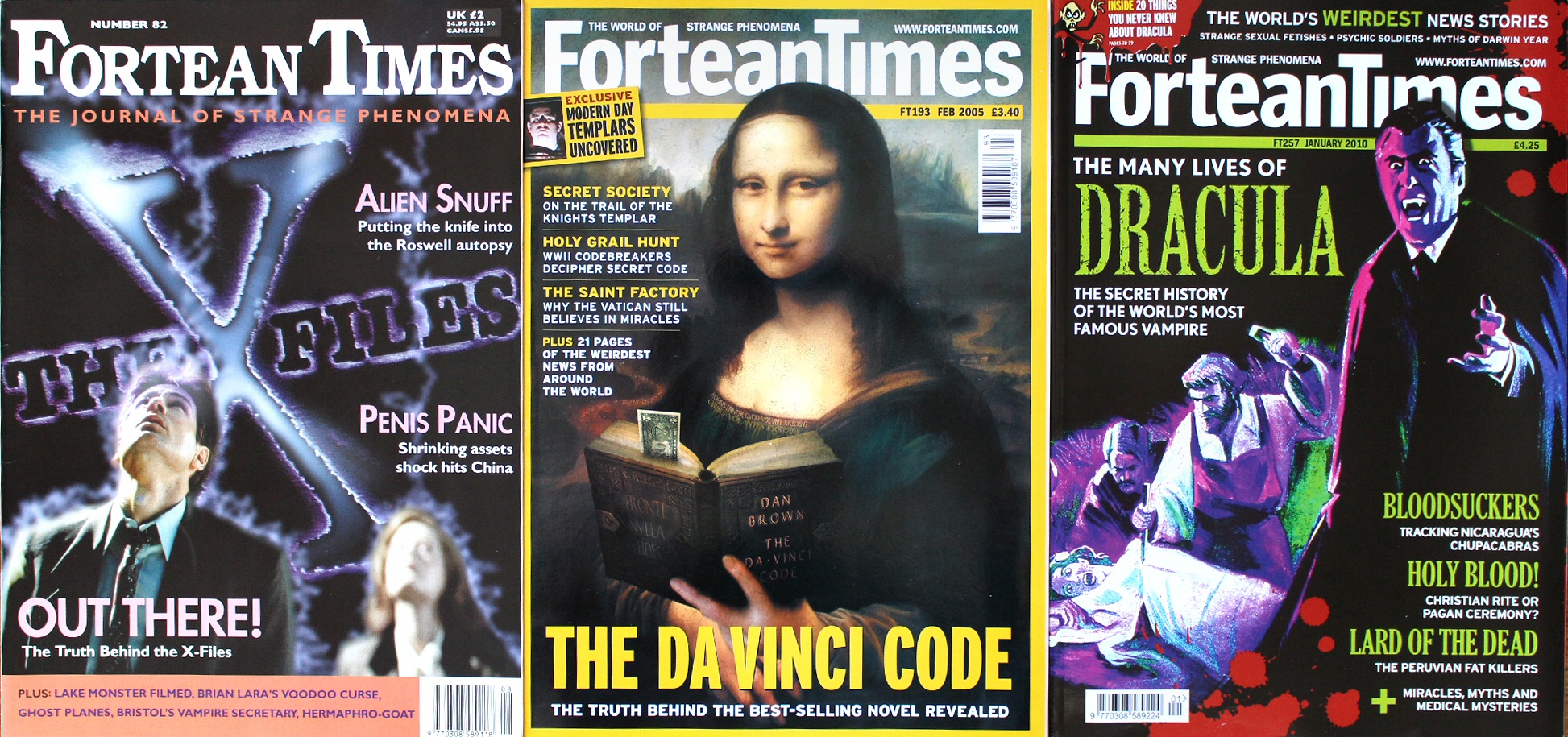
In the comment thread to last week's post, I mentioned that Fortean Times occasionally touches on various aspects of popular culture, from cult TV and movies to comics and pop music. So I thought I'd do a quick run-through of a few examples today.
To start with some very obvious topics, there are the three shown above. The X-Files (FT 82, August 1995) was not only one of the most fortean TV shows of all time, but its first appearance in 1993 coincided with the wider distribution of FT to "mainstream" retailers like WH Smith, and almost certainly contributed to the magazine's popularity at that time. Around a decade later, Dan Brown's novel The Da Vinci Code (FT 193, March 2005) was a publishing phenomenon, bringing fringe theories that had previously been the realm of specialist writers (and FT contributors) like Lionel Fanthorpe and Lynn Picknett to a much wider audience. Just over a century earlier, Bram Stoker had done something similar in his novel Dracula - the title character of which went on to become one of the most recognisable and ubiquitous pop-culture icons of them all, as recounted in the cover feature of FT 257 (January 2010).
At a less obvious level, you can find references to popular culture in almost every issue of FT. Taking the one I discussed last week, for example - FT 73 from February/March 1994 - there's an interview with cult author William Gibson, generally credited as the originator of the cyberpunk genre. And I spotted something else in that issue, too: a book review by comics legend Alan Moore. I don't mean a review of one of his graphic novels - I mean a review written by him of someone else's work. Looking online, I see he actually did quite a few reviews for FT in those days - which pleases me enormously, as I've done over 40 of them myself. It's always nice to discover that you have something in common with a famous person!
Sticking with books and comics for a moment, here are three more covers that caught my eye. No apologies for a second appearance of The Da Vinci Code (FT 212 this time, from August 2006) - both because it's one of my favourite novels, and because I love the illustration on the cover. In addition to people like Picasso and Orson Welles, it features Da Vinci himself in the act of strangling Dan Brown! The middle cover (FT 256, December 2009) features Dennis Wheatley - best remembered today for The Devil Rides Out (the only one of his novels that I've read), although in his day he was Britain's most prolific author of occult fiction. Finally there's the only comics-themed cover I could find - FT 320 (November 2014), relating to the Fredric Wertham-inspired anti-comics paranoia than swept America in the 1950s.
I found a few shorter comic-related pieces on interior pages as well. The most interesting of these was an article in FT 277 (July 2011) called "The Morning of the Mutants", speculating that Stan Lee and/or Jack Kirby got the idea for the X-Men from the seminal (though now largely forgotten) fortean conspiracy book The Morning of the Magicians, written in 1960 by Louis Pauwels and Jacques Bergier. There's also a feature about Marvel Comics' Doctor Strange in FT 349 (January 2017, to tie in with the movie), which discusses the character's origin and fictional predecessors.
Regarding the "popular culture" of the mid-20th century, I can't resist mentioning a couple of pieces by myself - in fact the only two full-length feature articles I've had in FT. First there was "Fanthorpe's Fortean Fiction" (FT 297, February 2013) about the large number of mass-market paperback novels that Lionel Fanthorpe churned out in the late 1950s and early 60s. This was followed by "Astounding Science, Amazing Theories" (FT 355, July 2017), looking at fortean themes in the pulp science fiction magazines of the 1940s.
Pulp magazines were a huge part of popular culture in the first half of the 20th century, but - with a few notable exceptions - they're only of interest to die-hard fans today. Of those exceptions, perhaps the most important is H. P. Lovecraft, whose Cthulhu Mythos first took form in the pages of Weird Tales in the 1920s and 30s, before going on to develop a life of its own to rival that of Bram Stoker's Dracula. I found no fewer than three Lovecraft-inspired FT covers: FT 184 (June 2004), FT 369 (August 2018) and FT 390 (March 2020 - this one tying in with the movie adaptation of The Color Out of Space). Here they are:
As regards cult TV shows, I've already mentioned the most fortean of all, The X-Files - which not surprisingly made several further appearances after the one pictured at the top of this post (including FT 85 from February 1996, which had a rundown of all the fortean references in the show's first season). Three other TV-related covers are shown below, the middle of which - FT 215 from October 2006, celebrating 40 years of Star Trek - needs no introduction. The other two relate to the screenwriters (both with wider fortean interests than you might expect) behind two of Britain's most famous sci-fi icons: Kit Pedler, who created Doctor Who's second-most-famous villains, the Cybermen (FT 209, May 2006), and Nigel Kneale, creator of Professor Quatermass (FT 418, May 2022). The latter may no longer be a household name, but back in the 1950s he was really the first great TV sci-fi hero, in this country at least.
Turning to movies - I was spoiled for choice here, so I've picked out three covers that really speak for themselves. First there's a celebration of 50 years of Hammer Horror films (FT 223, June 2007), then a look at one of the mainstays of those films, Peter Cushing, on the 100th anniversary of his birth (FT 301, May 2013), and finally a 40-years-on retrospective about The Exorcist (FT 313, April 2014):
To be honest, my favourite thing about The Exorcist is the music - the snippet from Mike Oldfield's Tubular Bells that it uses, I mean - which brings me neatly onto the next subject. When I talk about "pop culture" on this blog, I most often mean fairly specialized things like pulp magazines, comics (from the pre-multimedia franchise days) and cult TV shows such as The X-Files. But to most people, pop culture means just one thing, and that's pop music. This is such a pervasive part of modern life that it's acquired a plethora of fortean connections - so much so that I'm going to split them into two distinct parts.
To start with, here are three cover features that deal with direct fortean influences on musicians. The first, from FT 88 back in July 1996, describes how various pop stars from David Bowie and Jimi Hendrix to Kate Bush and The Orb absorbed ufological and similar speculations into their music. Second, there's a somewhat more arcane take on the same subject by Ian Simmons (FT 244, January 2009), featuring the likes of Stockhausen and Sun Ra - a much-referenced source for my own book The Science of Sci-Fi Music. Finally, in the immediate wake of David Bowie's death, there was a cover feature about the numerous fortean influences on his work (FT 338, March 2016) - including the aforementioned Morning of the Magicians by Pauwels and Bergier.
Another aspect of pop music that's of fortean interest is the way weird conspiracy theories grow up around the subject. So to round off what I honestly believed would be a shorter-than-usual post when I started it, but has ended up as probably my longest ever - here are three cover features addressing this aspect. The one on the left (FT 166, January 2003) deals with the numerous legends and conspiracy theories associated with Elvis, while the one on the right (FT 384, October 2019) does much the same for the Beatles. As for the one in the middle (FT 258, February 2010), it concerns the notion that the "Illuminati" employ popular music - and the musicians themselves - to manipulate the thoughts, beliefs and behaviour of the general public. But that's not really a conspiracy theory, is it? I mean, if you substitute "global media" for "Illuminati", I'd say it's an indisputable fact.
Thursday, 11 January 2024
A few rare (non-existent, actually) Fortean comics
With a little help from Bing's AI image creator, here's a selection of retro-fortean comics of the "never really existed but should have" variety. To start with, pictured above are two issues of The Fortean Four, in their original 1970s incarnation on the left, and the 1990s reboot on the right.
I thought the AI understood "1990s comic-book style" much better than "1970s", so I stuck with 1990s for subsequent attempts. After all, 1990s is still pretty "retro" to most people, even though it doesn't always seem like it to me!
Next up, a couple of issues of another non-existent super-team, The Ufologists. To me, the word "ufologist" conjures up a particular image that isn't terribly flattering (not quite a synonym of "ineffectual fantasist", but somewhere along those lines). So rather than using my own mental image, I went for something closer to the way I imagine ufologists picture themselves. Here's the result:
The AI tool I use has the great advantage of being free, but it does have a number of limitations compared to its more expensive rivals. For one thing it only produces square images, so they have to be stretched or cropped to fit the space available. Another problem is that it has no memory from one image to another, so you can't ask it to draw the same group of characters a second time. So I was pleasantly surprised that the two Ufologists covers could almost portray the same trio of protagonists (allowing for a change of cover artist).
Perhaps the biggest problem (mental health wise) with having a free tool that can produce any picture you ask for, all in a matter of seconds, is forcing yourself to stop playing with it! With a major effort of self-discipline, though, I limited myself to just one more experiment - The Bigfoot Hunters, pictured below. Again, there's a kind of consistency between the two images, particularly in the way Bigfoot himself is portrayed (and, at a pinch, you could say the solitary human character in the second image is the same as the central figure from the first one).
Sunday, 26 November 2023
50 Years of Fortean Times
Having got this blog back up and running, my next problem was to think of new things to write about. Since this month sees the 50th anniversary of the first issue of Fortean Times, it seems an obvious place to start.
Actually the magazine only carried the name "Fortean Times" from issue 16 onwards - prior to that, it was simply called The News. When its first issue appeared in November 1973, I was just short of 16 - i.e. old enough to have been interested in it if I'd known about it, but as it happened I was blissfully unaware of it. I believe the magazine's founding editor, Bob Rickard, was a member of the Birmingham Science Fiction Group, which I also joined around that time, so maybe I saw him there without knowing it (though I did get a brief but nice email from Bob many years later, as documented further down this post).
[Just as an aside before I forget - I did have one encounter at the BSFG with someone who, though now forgotten, was a big name in the fortean world at the time. This was Professor John Taylor, who was one of the first mainstream scientists to carry out laboratory experiments on Uri Geller and other people who displayed seemingly ESP-like powers. I attended a talk by him at the BSFG in April 1976.]
In common, I suspect, with many other people, I only really became aware of FT's existence in the early 1990s, after copies started to be distributed more widely to British newsagents. My first few issues (starting with #67 in February 1993, more than 30 years ago) are shown at the top of this post. Notice that the magazine's covers - by the brilliant and inimitable Hunt Emerson - were a lot livelier and more colourful in those days than they are today!
Over the years, I've made enough appearances in Fortean Times to consider myself a "regular contributor" to the magazine. To keep track of them (for myself if no one else), I've put a list of contributions on my website. So far they amount to 18 articles - mainly 1 or 2 page Forum pieces - and 46 book reviews, as well as 12 "letters to the editor", the first of them appearing way back in January 2001. But my personal high point came in June 2019, when FT printed David Clarke's interview with me about my time working in the Ministry of Defence (when I was peripherally involved in their UFO/UAP research). Here it is, complete with a photograph of me talking to a Russian scientist in Red Square (top picture on the right-hand page):
Returning to the subject of FT founder Bob Rickard, he's been mentioned quite a few times in previous posts on this blog, including a couple in the context of comic-book homages. The first (Fortean Agent of SHIELD) actually predates the founding of Fortean Times, coming from issue 12 of Marvel's Nick Fury, Agent of SHIELD, cover-dated May 1969. That particular issue's creators, Steve Parkhouse and Barry Windsor-Smith, were friends of Bob at the time and named one of the story's characters "Robert Rickard" after him.
The other comic-book connection I wrote about, in The Department of Fortean Events, relates to a 2000 AD story called "Shamballa", featuring the Judge Anderson character. Written by Alan Grant and Arthur Ranson, the story is reprinted in book form in Judge Anderson: The Psi Files volume 02. As I explained in that earlier post, "Doc Rickard" - an obvious homage to FT's founder - is a paranormal researcher at the "Department of Fortean Events" (which doesn't really exist, but ought to).
I mentioned earlier that I once received an email from Bob Rickard, and I'll get onto that now. Back in February 2011, I put a short video clip on YouTube showing a scene from a video game which namechecks FT. It's from a Sam & Max episode called "Night of the Raving Dead", in which Sam, inspecting a complicated-looking piece of equipment, says "I'd bet my lifetime subscription to the Fortean Times that that's an alchemy machine".
I sent the video link to FT editors David Sutton and Paul Sieveking, and one of them must have forwarded it to Bob - because shortly afterwards I received an email from him saying "Great - my kids loved the first Sam & Max adventures". Here's the clip in question:
There's another connection between FT and video games that I'm aware of, which I mentioned on my other blog in May 2017, shortly after this one went into hiatus. It's a cameo appearance by a (sadly fictitious) magazine called Freaky Times, in the game Barrow Hill: The Dark Path by my favourite team of adventure game developers, Matt Clark and Jonathan Boakes. In case the magazine's oddly familiar cover design isn't enough of a giveaway, Jonathan himself once described it as "a little nod to the Fortean Times". Here's his cover mock-up from the game:
Tuesday, 21 November 2023
Is Anyone Out There?
It seems a fair enough question, as it's 7 years since I last updated this blog, so I'll be interested to see (from the viewing stats and any comments that may come in) if anyone actually sees this post. I've been far from idle in those years - I've had 5 more books published by Springer and another 5 by Icon Books, as well as writing over 70 magazine articles - mainly for How It Works (where I've contributed to almost every issue for more than four years now) but also Fortean Times, All About Space and even (my most "up-market" moment) BBC Science Focus magazine. I never actually stopped blogging, but only in the form of relatively brief announcements on my writing blog.
I've recently become a great fan of Bing's AI tools. For example, just now I typed in "A humorous UFO or alien themed cartoon that could be captioned Is Anyone Out There?" - and was presented with the picture at the top of this post. I didn't ask it to include a speech bubble, but it did anyway (its spelling was a bit off, but all the right letters were there so I just had to rearrange them).
Although I've drifted away somewhat from Forteana in the last few years, I still contribute to Fortean Times occasionally - including an article about AI and creativity in July this year. That was also the subject of the longest post I've done on my other blog, as well as a guest post I did for Kid Robson's comics blog. I was very grateful to Kid for the chance to do this (together with another guest post showing off some of my 1970s Marvel comics) as it started me thinking about the possibility of resurrecting this blog.
When I came to dust it off today, I was embarrassed to see no fewer than 18 comments (spread over the last 7 years) still awaiting moderation. I assumed the system would automatically notify me of these, but apparently that's not the case (I've now belatedly found where you have to tell it to do this in the settings). So apologies to all those people who had to wait years for their comments to appear!
Sunday, 4 September 2016
Superheroes, Funny Animals and Sequential Art (circa 1600)
The Skimmington Frieze
This large plaster frieze (pictured at the top of this post) is one of the most distinctive features of the Great Hall at Montacute House. At first glance it looks like a single panel, but actually it’s an early example of “sequential art”, telling an amusing rustic story in two scenes. In the left half, you can see a wife hitting her hapless husband over the head with a shoe (she must have brought this along specially for the purpose, since she already has shoes on both feet!). It seems she caught him drunk in charge of the baby – which he’s still holding onto, despite all those kegs of beer he’s been working his way through. The scene is witnessed by the man’s neighbour, who proceeds to rat on him to the rest of the village. The second scene, on the right, shows the unfortunate husband being paraded through the streets in a form of ritual humiliation known as a Skimmington ride (for the background to this obscure bit of West Country folklore, see the Dark Dorset website).
Two Left Hands
The picture above shows another plaster carving at Montacute House, this one an overmantel in one of the bedrooms. Like the Skimmington Frieze, this dates from the time the house was built – but it shows a more “mainstream” subject in the form of a Biblical scene (the praying figure is meant to be King David). Nevertheless, it’s still very naïve in its execution. The cherub on the left clearly has two right hands, while the one on the right (though it’s not quite as obvious) has two left hands! As Kid Robson has pointed out (here and here and here), the “two left hands” syndrome is one that occasionally afflicted Marvel Comics artist Jack Kirby.
Hunky Punks
Moving to the exterior of Montacute House, and looking up at the parapet running around the roof, you can see a lot of strange little animals sitting on it (a couple of examples can be seen in the following photograph). The technical term for these is “hunky punks”, which according to Wikipedia is a local dialect word for a grotesque stone carving. Hunky punks are most often seen on churches, but Montacute has them as well. Montacute’s hunky punks take the form of rather cute-looking animals – either chimeras (combinations of different animals) or completely imaginary species. Presumably they were the 17th century equivalent of funny cartoon animals!
The Nine Worthies
High up on the East Front of Montacute House, you can see the statues of nine figures in armour (see images below). These represent the Nine Worthies – great military leaders of history and legend, including three from classical Greece and Rome (Hector, Alexander the Great and Julius Caesar), three from Hebrew tradition (Joshua, King David and Judas Maccabeus) and three from European Christendom (King Arthur, Charlemagne and Godfrey of Bouillon). The Nine Worthies were popular throughout Europe (see their Wikipedia article) and can be thought of as a kind of crusading super-team – a bit like a mediaeval version of the Avengers!
Sunday, 28 August 2016
Ron Goulart's Cheap Thrills
Ron Goulart was born at the height of the pulp era in 1933, and began his full-time writing career in the 1960s. His novels are an intriguing blend of the straightforward plots and larger-than-life characters of the thirties with a satirical take on the consumerism and hippie zeitgeist of the sixties. As far as I know he’s still alive, and I hope he won’t be too offended if I describe him as the late 20th century equivalent of a pulp magazine hack. His novels are all very short – typically 40 to 50,000 words – and were clearly written with the aim of meeting deadlines rather than getting onto award shortlists. All of them came out as paperback originals, and very few of them ever saw a second edition. Inevitably, the quality is variable – some of the ones I’ve read are pretty dire, but others are really very good.
A couple of years ago I wrote a long post about Goulart’s 1979 novel Hello Lemuria Hello. This is still by far my favourite of the ones I’ve read, both for its fortean themes and its “superhero” style protagonist – Jake Conger of the Wild Talents Division. I subsequently tracked down two other Jake Conger novels – A Talent for the Invisible (1973) and The Panchronicon Plot (1977). They’re both enjoyable, especially the latter, although much less fortean. The same is true of a couple of other offbeat “near future” (actually 2002) adventures I’ve read – Calling Dr. Patchwork (1978) and Hail Hibbler (1980) – which feature a husband-and-wife team of private investigators called Jake and Hildy Pace (Goulart seems to like the name “Jake” for protagonists – there is also Jake Cardigan in Tek War, which he ghost-wrote for William Shatner in 1989).
I also enjoyed the three Vampirella adaptations I read (he wrote six in all, but I’ve only got the ones that were reprinted in the UK). After Hello Lemuria Hello, these are probably the most fortean-themed of his novels that I’ve read. He’s also done a couple of other comic-book adaptations – Challengers of the Unknown (1977) and a Hulk novel called Stalker from the Stars (also 1977, co-written with Len Wein and Marv Wolfman under the pseudonym of Joseph Silva). I still need to track those down – along with Goulart’s novelization of that archetypally fortean movie, Capricorn One.
All the Goulart novels I’ve read (except the Vampirella adaptations) have the same basic plot. They start with the protagonist(s) reluctantly accepting an assignment to track down some nefarious criminal or criminals. They’re given an initial lead, which in due course puts them onto a second lead, and so on through half a dozen wacky and often outright comical scenes until the final showdown. This is a perfectly good plot structure, as long as the hero is constantly racing against the clock, falling into traps, getting double-crossed, chasing after red herrings, etc, etc. In Goulart’s best novels, that’s exactly what happens ... but in some of the others he forgets to do this, and the protagonist sails through the story with no real obstacles to overcome. The result in these cases is inevitably dull, no matter how original and imaginative the incidental details are.
I’ve been looking for a pattern, to give me a better idea what to look out for in future. Based on my experience so far, the novels that involve series characters (either Goulart’s own creations or franchise characters) and are set here on Earth are all pretty good. Novels set in Goulart’s fictitious Barnum system (of which I’ve read three – The Fire-Eater, Shaggy Planet and Flux) were rather dull and forgettable in my opinion – as was the one that was set on Earth with a non-recurring protagonist (After Things Fell Apart). I suspect in reality it’s not as clear-cut as this, and – as with 1930s pulp fiction – you just have to accept that some of the novels are good and some are bad.
The dozen books pictured at the top of this post were purchased second-hand on various occasions over the last ten years. The one in the bottom right – the embarrassingly-titled Hail Hibbler – came from a paperback book fair in 2009. It contains a hastily scrawled signature on the title page, which I assume is Ron Goulart’s autograph:
Sunday, 26 June 2016
WHAAM!
Roy Lichtenstein was a controversial artist, because so many of his paintings copied the layout of published comic-book panels (for numerous examples, see this page). But I think it’s wrong to belittle his work for this reason. Yes, it’s a shame that the original artist goes uncredited, but the artistic medium, display context, gigantic size and sheer painstaking precision of Lichtenstein’s works make them totally different from the original (a fact that isn’t always clear when you see small side-by-side comparisons on a web page). In any case, the comic-book industry is much more relaxed about the "swiping" of panel layouts than it is about, say, the unlicensed use of lucrative franchise characters.
The display caption to WHAAM! states that it is “based on an image from All American Men of War published by DC comics in 1962”. But looking at its Wikipedia entry the situation is a little more complicated than that. The basic layout (including the words “I pressed the fire control and ahead of me rockets blazed through the sky” and the sound effect “WHAAM”) does indeed come from a single panel in All American Men of War #89. However, the American aircraft in that panel is clearly a jet – probably a Korean-vintage F-86 Sabre. The plane in Lichtenstein’s painting looks more like a P-51 Mustang – and Wikipedia makes a good case for that being taken from a panel in the following issue, #90. Lichtenstein’s victim aircraft is noticeably different from either of those panels – Wikipedia suggests it comes from #89 again, but from a different story in that issue. Whatever sources Lichtenstein used, I still think the result is one of the greatest works of art of the 20th century.
As regards the new Switch House, I have to confess that most of the items on display went over my head. For the most part I mean that figuratively, but the small object pictured below was literally over my head ... because it was hanging from the ceiling in one of the rooms (sorry it’s out-of-focus – my camera was on maximum digital zoom). Regular readers will know I have an uncanny ability to spot things that “look a bit like a dick” (see for example this statue of Balzac or these 1940s comic-book aliens). The work pictured below is a sculpture by Louise Bourgeois entitled Fillette, which is French for “little girl”. I guess that’s what it’s meant to depict ... but it still looks like a dick to me.
Sunday, 20 March 2016
More Research
As you can see, I managed to get hold of one of the two missing issues from the near-complete run of Skull the Slayer I acquired this time last year. I spotted the missing issue on a shopping trip to London last week, which also yielded four of the books shown in the photo. The other two books were bought online, while the DVDs came from my local HMV store.
In broad terms, the book is about the crossover of ideas between science fiction and Fortean-style speculation. I picked that subject partly because I already know a bit about it, but mainly because it’s the perfect excuse to indulge in lots of lowbrow “research material” of the kind pictured above!
Sunday, 28 February 2016
Green-skinned nostalgia
The earliest of the three items is the paperback book, published by New English Library in 1967. It contains black & white reprints from the original (1962) Hulk comic and from Tales to Astonish. According to the copyright page, it was previously issued in the USA by Lancer Books. I think I acquired my copy in 1970, possibly in a “swap” with a schoolfriend. At one time I also had a similar Spider-Man paperback, but I couldn’t find it when I looked for it last week.
The medallion is inscribed “The Incredible Hulk – World’s Strongest Mortal” with a copyright date of 1974. I probably bought it that year – via mail order from The Mighty World of Marvel or another British Marvel comic. It came in the form of a bolo tie – a type of neckwear that was briefly popular around that time (Isaac Asimov was wearing one when I saw him in Birmingham in June 1974). You can see it in the photo at the bottom of this post, which also shows the “tails” side of the medallion. This depicts Bruce Banner transforming into the Hulk, together with the quote "Within each of us, ofttimes, there dwells a mighty raging fury”.
The third item in the top picture is a Hulk video game for the Commodore 64. This is dated 1984, but I didn’t get my C64 until the following year, which must have been when I bought the game. By that time I was working in Oxford as a postdoctoral research assistant, running computer simulations on a “grown-up” computer (a VAX 11/780 – which invokes a completely different type of nostalgia). According to the user guide, the game features Doctor Strange and Ant-Man (Henry Pym) as well as the Hulk. The background info mentions that “Among Pym’s more dubious accomplishments was the creation of the mad robot Ultron” … which is perfectly true, of course (despite any nonsense the youth of today might believe about Ultron being created by Tony Stark).
Sunday, 7 February 2016
Planet of Vampires
As you can see from the masthead, they were the product of the short-lived Atlas/Seaboard company I mentioned in The Department of Fortean Events last year. This was set up as a direct competitor to Marvel (see the whole fascinating story here), and had some good things going for it (to quote Wikipedia: “Atlas/Seaboard offered some of the highest rates in the industry, plus return of artwork to artists and author rights to original character creations”). Possibly 10 or 20 years later, with the proliferation of “direct market” comic speciality shops, Atlas might have taken off… but in the newsstand-dominated world of 1975 it collapsed after a few months.
My memory from the time is that Atlas/Seaboard comics were OK but not great. That’s certainly true of the Devilina magazine I mentioned in the earlier post, and of Rich Buckler’s Demon Hunter #1 which I bought at the same time. By coincidence, just as I was buying these comics last weekend, Kid Robson’s blog was in the middle of a complete cover gallery of Atlas/Seaboard titles (Part 1 – Part 2 – Part 3 – Part 4 – Part 5 – Part 6 – Part 7). The consensus that emerged in the comment threads was that Atlas tried too hard to copy what Marvel was doing at the time, without being original enough.
In the case of Planet of Vampires, I can’t deny that’s the impression the cover gives. At the time the first issue came out (February 1975) Marvel had several vampire-themed titles (Tomb of Dracula, Vampire Tales, Morbius the Living Vampire) as well as a Planet of the Apes magazine. But apart from the title and the covers (which are misleading, as I’ll get to in a moment) Planet of Vampires really has nothing in common with any of these. In my opinion, it’s much closer to “grown up” science fiction than any of them. If I had to liken it to a Marvel series of that period it would be Skull the Slayer (which actually dates from later in 1975) – but only in the general sense that it’s about a group of ordinary, flawed humans caught up in a “world they never made”.
The story is set in 2010, 35 years in the future from 1975. Issue #1 opens with a spaceship crew returning to Earth after spending several years in orbit around Mars. While they were away World War Three broke out, and they haven’t heard anything from Earth since. They land in New York to find the survivors divided into two factions – super-rich capitalists who were able to take refuge in a vast dome, and ordinary people who live a ragged existence outside (and seem to be more interested in gang warfare than anything else). Initially there are five astronauts (not six as it says on the cover), but almost immediately the token “middle-aged scientist with a beard” is killed off, leaving just two male-female couples (one white, one black).
After the introductory scenes, the story turns into a pretty intelligent dystopian adventure, with the astronauts persuading the gang leaders to forget their differences and team up against the common enemy – the Domies. It’s important to stress that the latter aren’t “vampires” in any literal sense. They aren’t undead, they don’t have fangs and they don’t dress up in gothic clothes. It’s true they harvest blood on an industrial scale, but they do it in laboratories, not by biting necks. The war saw the widespread use of biological weapons, to which people outside the dome developed an immunity. As a result, their blood contains antibodies which the non-immune Domies need whenever they venture outside their closed environment. The blood of the Mars astronauts, who escaped exposure to the toxins, is considered even more valuable.
If they awarded a Pulitzer Prize for dumbing down, then the cover of issue #2 would win it. It depicts a cliché comic-book vampire doing a cliché comic-book vampire thing. This bears only the most tenuous relationship to the actual scene inside the comic, which goes like this:
Sunday, 24 January 2016
Arrgh! Bigfoot
As it turns out, the cover (by Alfredo Alcala) is by far the best thing about the comic – not just for the layout, but for the promise of an intriguing “Bigfoot-hunting” scenario. Unfortunately the cover bears very little relation to the interior story – “Beauty and the Bigfoot”, written by Don Glut and drawn by Mike Sekowsky (as you can see from the sample below, the setting and characters – and artistic style – are completely different).
The story (just 7 pages long) is a slight one, about a Bigfoot falling in love with a human female. The latter, despite already being married, quite enjoys the situation. While the set-up has distinct possibilities, the Comics Code stamp on the cover means that Bigfoot has to keep his trousers on (probably the only time you’ll ever see Bigfoot wearing trousers, in fact). The only positive thing I can say about “Beauty and the Bigfoot” is that it’s better than the other two stories in the comic (“Rat Reborn” and “The Mummy Walks” – the latter being a recycled political satire from the 1950s that wouldn’t have made much sense in 1975, let alone now).
I still think it’s a great cover, though.
Sunday, 3 January 2016
The Writer’s Secret
I had a look round for a suitable idea, and came across this unpublished poem I wrote several years ago:
A world-renowned writer named BlottTurning this into a Guru-style cartoon wasn’t as easy as I thought. There are thousands of free images on the web, but finding ones that fit (both thematically and stylistically) was harder than I’d expected. Also, the last line caused problems because it doesn’t have a natural visual interpretation. A fairly obvious idea did spring to mind, but I couldn’t use it on account of the “no porn” clause in Blogger’s terms and conditions. So I decided to go with a more abstract notion instead.
Said of genres, “I’ve written the lot:
From horror and mystery
To fantastical history
And all of them have the same plot!”
Sunday, 20 December 2015
Man-Gods from Beyond the Stars
Text items in comic magazines are often highly skippable, but in this case they’re arguably the best bit. The longest of them is a ten-page article by Ed Summer which is surprisingly well-informed and well-balanced. He makes it clear that “In Europe, von Daniken’s book was one of many others on the same topic”, and devotes half a page to the work of Charles Fort. He points out that von Daniken often has a cavalier attitude to facts (such as the weight of pyramid blocks) and to established scholarship (such as Thor Heyerdahl’s work on the Easter Island statues). He also raises an interesting question: What would future archaeologists think if they unearthed a buried hoard of Spider-Man and Fantastic Four comics? Would they imagine they portrayed real events, or “determine that it is a symbolic code for some mystic achievement that mankind as a whole must strive for?”
As well as that main article, there are a couple of biographical pages about Erich von Daniken and – perhaps best of all – a four-page bibliography of “The Books of the Gods” … by von Daniken, Charles Fort, Robert Charroux, W. Raymond Drake, Andrew Tomas, Brinsley LePoer Trench and many others.
Coming back to the cover, which is what led me to buy the magazine in the first place – “Man-Gods from Beyond the Stars” is the main, 37-page comic feature. That striking cover image is by Neal Adams, but the interior art is by Alex Nino, whose style is a little too impressionistic for my taste. The script, by Doug Moench, is also something of a struggle due to his excessive fondness for Big Words (“The cybernetic deciphering of their language into terms perceivable by us does not dictate reciprocating translation of our speech to them”).
I found the story disappointing for another reason too. For me, one of the big attractions of the Ancient Alien hypothesis (regardless of its validity) is the prevalence of exotic settings, such as the Egypt of the Pharaohs, the middle-east of Biblical times, or the pre-Columbian cultures of the Americas. But “Man-Gods from Beyond the Stars” misses out on all that by going for a much earlier time period, in which humans dressed in animal skins co-exist with woolly mammoths and sabre-tooth cats. The result isn’t a bad story, but it’s not an especially memorable one either.
Having said that, the story does contain a couple of thought-provoking ideas. First, there’s a conflict between one of the aliens, who enjoys being treated like a god, and the rest of the crew who want to adhere to a Star Trek style “prime directive” of non-interference. That raises the interesting prospect that if our ancestors did interact with alien visitors, then maybe the ones they interacted with weren’t at the top of the ethical scale!
The story’s other provocative idea doesn’t hold water scientifically, but it’s a clever piece of post-Vietnam political satire. It turns out that von Daniken was right when he suggested that homo sapiens resulted from alien genetic engineering – but it took place on a distant planet, for the purpose of creating an army of semi-mindless soldiers to serve as cannon fodder in an interplanetary war. When the war was over, the leftover soldiers were no longer needed so they were quietly dumped on Earth.
The magazine contains a second story, just ten pages long (possibly a last-minute filler, because it doesn’t appear on the contents page). It’s called “Good Lord!”, and it’s written by Marv Wolfman and illustrated by Dave Cockrum. Personally I found both the script and the artwork a lot more enjoyable than the main feature. This one is set in the future, following a group of space travellers as they search alien planets for “God” … with disastrous consequences. The story is outrageously over the top, and about as dark as dark humour gets.
I can’t really talk about comic books and Ancient Aliens without at least a brief mention of Jack Kirby’s The Eternals. The series premiered in 1976, a year after “Man-Gods from Beyond the Stars”. By that time, at the urbane and sophisticated age of 18, I’m afraid that Kirby’s style (both artwork and dialogue) struck me as embarrassingly old-fashioned and childish, so I never read The Eternals at the time. However, in another example of “faux-nostalgia” I bought second-hand copies of the first few issues in the 1990s. Here are the covers of the first, featuring “The Tomb of the Space Gods!” and the second, “More Fantastic than Chariots of the Gods!”
Sunday, 8 November 2015
The Department of Fortean Events
Doc Rickard is the old man seen talking to Judge Anderson in the excerpt above. She seeks his assistance after the world is hit by a sudden spate of Fortean events – including stigmatics in Rome, phantom hounds in London, a Manticore in Jakarta and a Bunyip in Australia. There are references to Doris Stokes, the Turin Shroud and the Tower of Babel, while Anderson herself witnesses a “pre-Columbian meteorite” break apart to reveal a living a toad entombed inside it. The villains of the story are called “deros” – degenerate human beings who live in underground caves and tunnels. The word “dero” is an obvious reference to the Shaver Mystery, although Shaver’s deros were huge, obese and sexually decadent, whereas the deros in the comic are more zombie-like – dressed in rags and physically emaciated.
There are several other stories in the collection besides Shamballa, including another very Fortean one called Childhood’s End. This has no connection to Arthur C. Clarke’s novel of the same name, but it does have the Face on Mars, ancient aliens and references to Zecharia Sitchin’s theory of Anunnaki and Nephilim. And the art, by Kevin Walker, portrays a much sexier-looking Judge Anderson than Arthur Ranson’s version.
Although I found the stories interesting, I can’t say I really enjoyed them. I was never a big fan of Fleetway comics – for some reason they always struck me as gloomy and political (even when they weren’t). It’s all a matter of personal taste… and as far as comics are concerned, personal taste usually boils down to what you thought was cool when you were 15 or 16. Which brings me to another purchase I made in London last week – the first issue of a black-and-white horror anthology called Devilina, from Atlas-Seaboard comics.
I wouldn’t be surprised if you’ve never heard of Atlas-Seaboard comics. They were only active for a few months during 1975, but that just happened to coincide with the peak of my interest in comics fandom – and the new company created a huge buzz at the time (the whole story of Atlas-Seaboard is a fascinating one – here’s an excellent article on the subject). Most of their output consisted of colour comics aimed at challenging Marvel (which were the ones I bought at the time) – but they also produced a few black and white titles to rival Warren magazines such as Creepy, Eerie… and Vampirella, which is where Devilina comes in.
Having finally bought it 40 years after it came out, I really enjoyed Devilina #1. It’s fairly typical of horror anthologies of that vintage, both in terms of stories and artwork. It has its share of Fortean themes, too, with a story about people being reincarnated in animal form, another about a man who becomes convinced his life is controlled by aliens, and a nice moral tale about a mermaid taking revenge on a group of sailors who gang-raped her (and then saving the man who saved her). And as shown below, there’s a neat adaptation of Shakespeare’s Tempest (probably his most Fortean play – see my short ebook Paranormal Shakespeare
Sunday, 1 November 2015
A Very Odd Picture
It’s not every day you see the founder of a major world religion working in a comic book studio, so imagine my surprise when I saw this picture in the British Museum yesterday, which depicts not one but two of them doing just that. The caption reads: “Nakamura Hikaru (born 1984): Buddha and Jesus drawing manga, cover artwork for Saint Oniisan vol. 10. This artwork for the front cover of a manga book depicts Buddha creating his own manga, helped by Jesus.”
I know almost nothing about manga comics, but Nakamura Hikaru is described as a “young and very popular manga artist who specialises in comedy.” Apparently Saint Oniisan is her best-selling title, with weekly sales around 30,000 (which would have been a relatively low figure back in the heyday of comics in the mid-20th century, but much higher today when fewer people read comics). As far as I can tell, the series deals with the comic adventures of Jesus and the Buddha as they attempt to pass themselves off as ordinary people in modern-day Tokyo. The caption goes on to say “The playful depiction of the founders of two world religions as youthful men on holiday in Japan has achieved cult status. The two divine beings negotiate the ups and downs of their life together in a humble flat in suburban Tokyo. The series explores dilemmas in everyday life with visual gags, puns and word play.”
The current display in the British Museum focuses on the work of three manga artists of different generations, Nakamura Hikaru being the youngest. As well as the cover image, several black and white pages from Saint Oniisan are also on display (see example below). There is also a short interview with Hikaru in which she says “I was surprised by the positive reactions to my manga. I received letters from religious specialists, university professors, Buddhist priests and Christian clergy. I have also had requests to use my manga in universities for teaching purposes.”