Search This Blog

Showing posts with label William Hogarth. Show all posts

Sunday, 5 May 2024

More (free) AI creativity tools


The above may not be great comic-book art, but it's passable enough, and (with a couple of caveats I'll come to later) I created it with a single mouse-click on a website where I didn't even have to log in, let alone pay any money. And until I press "Publish" on this post, no one but me has ever seen it before. Even after a year of playing around with AI software, this still strikes me as incredibly cool (and even slightly frightening, if you stop to think about all the implications).

This particular page came from the Comic Factory website, one of two new AI discoveries I want to talk about in this post. First, however, I thought I'd summarize a few things I've written elsewhere about the "creative" use of AI. This is becoming a major hobby of mine, and I suspect it will feature increasingly often on this blog. Don't worry, though - all the applications I'm going to talk about have at least a tenuously fortean connection.

To start with, there's the article I wrote for Fortean Times last year called "AI, Art and Forteana" (FT 433, July 2023). This included a couple of imaginative fabrications from Bing's AI chatbot: first, an account of the Roswell Incident written in the unmistakable style of Charles Fort (who actually died 15 years before Roswell), and then a (hopefully entirely fictitious) conspiracy theory about Fortean Times itself.

The magazine article also contains two pieces of artwork courtesy of Bing's Image Creator. One takes the form of a two-page comic (with each of the panels having been generated separately, and then put together and captioned by myself), which also turned up in a guest post I did for Kid Robson's "Crivens" blog called Nostalgia Meets Modern Technology.

The other piece of art included in my FT article was "an engraving in the distinctive style of William Hogarth, 'proving' that he witnessed a UFO hovering over the streets of London in the 1730s". The same image also appears in a long post I did on my professional blog, 6 experiments in creative AI. As the title suggests, the "Hogarth" image was just one of several experiments discussed in that post - to read about the others, just click on the link.

Although I've occasionally found Bing's chatbot useful as an "ideas generator", the most impressive use I've found for it is in writing song lyrics, which it's surprisingly good at. I've put a couple of examples on YouTube:

  • Zen Matrix - a mystical/hippie song that I think is really great (so you probably won't click on it)
  • Demonic Tarot - my attempt at a "blackened death metal" song in the style of Behemoth, which really isn't very good (so you probably will click on it)

As well as AI-generated lyrics, both those videos use AI-created artwork - as do most of the recent videos on my YouTube channel. And as for this blog - you can see how often I've used Bing's Image Creator by looking at "AI art" in the tag cloud in the right-hand sidebar.

Besides being free, Bing Image Creator is also impressively high quality. But it has disadvantages, too - the biggest being that it has no memory from one image to the next. This limits its usefulness in creating comics - hence my decision to check out the AI Comic Factory. To ensure full consistency of characters and locations you need to set up a paid account, but there's a free "playground" where you can try it out without doing that.

The prompt box says "story", which seems to invite you to type quite a lot, but I just settled for a two-word prompt, "ancient aliens". The resulting artwork is noticeably less sophisticated than Bing, but it does have the advantage of being laid out like a comic - and, despite being the free version, having some vague continuity from one panel to the next.

There were just a couple of things I didn't like: the page had a broad 4:5 aspect ratio, rather than the 2:3 of a normal comic, and one panel was in a jarringly different style from the others. So, to produce the version you see at the top of this post, I deleted the dodgy panel and rearranged the others into the correct aspect ratio. But contrary to what you might think, I'm not responsible for the clumsily cropped right-hand edge of the lower panels. That was the computer's fault, and it looks like a bug to me (as opposed to the "unreadable" text captions, which I don't think are a bug, but just placeholders to add your own words).

While I won't be signing up for a Comic Factory account, I still think it's great that they let you play around with the free version (which it's best to do first thing in the morning UK time, before the server slows down as more people start to use it).

A point that was raised in the comment thread to my aforementioned Crivens post was the role of AI in creating last year's "new" Beatles song, "Now and Then". Specifically, AI was used to separate John Lennon's voice from the instrumental accompaniment on a demo tape. This brings me to the second thing I wanted to talk about in this post - because, as of a few weeks ago, exactly the same functionality is now available to anyone, free of charge, as part of a new toolkit called OpenVINO for Audacity.

I've tried a few experiments with this already, including Ozzy Osbourne singing "Paranoid" with the band muted and replaced by a classical string quartet, and a groovy Sgt Peppery remix of "A Hard Day's Night". Unfortunately, copyright laws mean the wider world is never going to hear them! Instead, you'll have to settle for my electronic remix of the Queen of the Night from Mozart's Magic Flute - the fortean credentials of which I discussed in a 2013 post on Fortean Opera (I scarcely need to add that the image in the video is c/o Bing Image Creator):

Incidentally, I'm always puzzled as to why some of my YouTube videos do much better than others in terms of views. For example, the totally brilliant Very Model of a Modern UFOlogist has only collected 20 views in the 2 weeks since I posted it, and "Zen Matrix", which I also like, has had a mere 56 views in 11 months. On the other hand, "The Doctor Who Theme in the Style of Handel", which I did at the suggestion of regular follower Colin Jones a month ago, has had a very respectable 460 views in that time - and now my version of Mozart's Queen of the Night is already well past 400 views only four days after posting it. Oh well, I guess it's just that "Doctor Who" and "Mozart" are more popular search terms than "Zen" and "UFOlogist".

Sunday, 19 June 2016

The Hell-Fire Club

The evocatively named Hell-Fire Caves in West Wycombe were originally excavated for a very practical reason – to quarry chalk for a new road to neighbouring High Wycombe. But the person behind the project, Sir Francis Dashwood, had the tunnels carved in a strange symbolic design (see top left picture), somewhat reminiscent of a modern-day crop formation. The caves were finished in 1752, and for the next ten years they served as the meeting place of Dashwood’s mysterious “Hell-Fire Club”.

I wrote about the Hell-Fire Caves on a previous occasion, using a picture that Paul Jackson sent me (and Paul has written about the site on his own blog). But I finally got around to visiting the caves myself last week, so I can show some of my own photos!

Actually “the Hell-Fire Club” seems to have been a pejorative term applied by outsiders – Dashwood and company actually referred to themselves as “The Knights of St Francis of Wycombe” (or sometimes “Friars” rather than “Knights”). Many of them were prominent poets, politicians and doctors – Dashwood himself was Chancellor of the Exchequer at one point. Other famous members included the Earl of Sandwich (who served as First Lord of the Admiralty, as well as inventing the sandwich) and the great painter and cartoonist William Hogarth (who is fortean enough to have appeared on this blog at least four times – here and here and here and here). Benjamin Franklin, one of America’s Founding Fathers, wasn’t a member of the club but is known to have visited the caves on more than one occasion (as depicted in the bottom right photo).

The caves contain a strange mixture of Christianity (as in the references to St Francis and Friars) and pre-Christian mythology (such as the statue of Venus that can be seen in the bottom left photo). The final chamber has the pagan-sounding name of “The Inner Temple”, and is located some hundred metres directly below the Christian church on top of the hill. Undoubtedly this helped give rise to the various rumours of “satanic” goings-on at the Hell-Fire Club. Personally, I’m increasingly sceptical about this – remember it was a time when the God-fearing masses believed anyone who read a book other than the Bible was a closet Satanist. Instead, I think Dashwood and his circle were just indulging in fashionable romantic fantasies about Graeco-Roman culture (a bit like the Stourhead temples I wrote about last year, which also date from the 1750s).

Normally when I hear about a “family mausoleum” in a churchyard I think of something comparable in size to my garden shed. Dashwood’s mausoleum, which he built on the hill directly above the Hell-Fire caves around the same time, is more like a small fortress:

Sunday, 9 August 2015

Cambridge Oddities

Cambridge is one of the few tourist hotspots that it actually makes sense to visit in August. There are crowds of tourists, of course, but that’s offset by the fact that there aren’t any undergraduates (and if you stay in your old college, you don’t have to share the lavatorial facilities with half a dozen barely housetrained students). That’s why I decided to spend a couple of nostalgic days there last week. Here is a quick rundown of some of the more unusual sights in the town:

One of the oldest buildings in Cambridge, dating from circa 1130, is the Round Church opposite St John’s College. Round churches are often associated with the Knights Templar (as with the Temple Church in London), but this one seems to have been built by a lesser known order, active at the same time, called the “Fraternity of the Holy Sepulchre”.
As I mentioned a few months ago in Isaac Newton and me, I spent my undergraduate years at Trinity College – as did Newton himself. Standing outside his old rooms in Great Court is an apple tree, pictured below. There probably wasn’t an apple tree there in Newton’s time (it’s clear from his account of the falling apple that it took place at his home in Lincolnshire), but Newton did keep a small private garden on this plot of land. He also had a large wooden shed which he used as a laboratory for his alchemical experiments – it may have been here, or inside Great Court itself.

(For more about Newton and alchemy, see my book Isaac Newton: Pocket Giants).
Sometimes erroneously associated with Newton, but actually nothing to do with him, is the Mathematical Bridge at the back of Queens’ College. The present bridge is the third to occupy this site, all using same timber-framed design. The first was built in 1748; this one dates from 1905. The mathematical nature of the bridge lies in the ingenious way the wooden ribs are arranged so that “each member is in compression with little or no bending moment”.
Cambridge has seen more than its fair share of scientific discoveries, and even one of the pubs claims to have played a part in one of them! Outside the Eagle in Bene’t Street there is a plaque that reads:
DNA Double Helix 1953: “The Secret of Life”. For decades the Eagle was the local pub for scientists from the nearby Cavendish Laboratory. It was here on February 28th 1953 that Francis Crick and James Watson first announced their discovery of how DNA carries genetic information.
One of the newer oddities in Cambridge is the Corpus Clock, dating from 2008 and belonging to Corpus Christi College. It stands at the end of Bene’t Street right opposite King’s College, giving it one of the highest tourist footfalls in England. The clock is unusual for several reasons: it has circles of LEDs instead of hands, and it only tells the correct time every five minutes (the rest of the time it runs erratically fast or slow). It also has a monstrous, animated insect called a Chronophage squatting on top of it.
It was somewhere near Corpus Christi College, back in the 16th century, that a man named Thomas Hobson used to rent out horses from a large livery stable. Although he had dozens of horses, customers always had to take whichever horse he wanted to hire out next. This gave rise to the phrase “Hobson’s Choice” – still used today to mean “no choice at all”. In his old age, Hobson helped to set up a new water supply to the town, which became known as “Hobson’s Conduit”. Cambridge doesn’t seem to have a monument to Hobson’s Choice, but it does have one to Hobson’s Conduit – on the corner of Lensfield Road and Trumpington Street:
From a Fortean point of view, the Haunted Bookshop – tucked away in a narrow alley called St Edward’s Passage – sounds highly promising. I had visions of shelves packed with occult and paranormal books – or horror fiction, at the very least. Unfortunately, however, the stock turned out to be predominantly antiquarian children’s books. The name comes from the fact that the building (previously an alehouse) is supposed to have its own ghost in the form of an occasionally glimpsed “White Lady”.
Cambridge has numerous free museums, of which by far the largest is the Fitzwilliam Museum on Trumpington Street. The quirkiest thing I spotted there was a pair of paintings by William Hogarth called Before and After, dating from 1731. At first sight they look innocuous enough – partly because the eye (my eye, anyhow) tends to be drawn to the girl rather than the bloke. But the latter is worth a second look in both pictures. In Before there is the distinct hint of a “bulge in his trousers” (I’m quoting from the official blurb), while in After “the man’s unbuttoned breeches reveal a tuft of pubic hair and his penis, chafed red from its exertions”. Sleazy stuff for the genteel 18th century!

Here’s Before...
... and After:

Sunday, 23 February 2014

Satan, Sin and Death

The dramatic scene depicted above is the work of the 18th century painter and engraver William Hogarth. This particular engraving is based on a painting he produced circa 1735-40, but it’s easier to see what’s going on in this black-and-white version. It’s a scene from Milton’s Paradise Lost in which Satan, en route from Hell to Earth, encounters two strange figures guarding the Gates of Hell:

Before the gates there sat on either side a formidable Shape. The one seemed woman to the waist, and fair, but ended foul in many a scaly fold, voluminous and vast – a serpent armed with mortal sting. [...] The other Shape – if shape it might be called, that shape had none distinguishable in member, joint, or limb. Or substance might be called that shadow seemed, for each seemed either. Black it stood as Night, fierce as ten Furies, terrible as Hell, and shook a dreadful dart.

The first figure is the personification of Sin, while the second figure is Death. It’s interesting that Satan himself is portrayed in relatively heroic form, although his facial features look more monstrous in the original painted version than in this engraving.

“Satan, Sin and Death” is an unusual departure for Hogarth, most of whose works are satirical in nature (see for example Paranormal investigation, 18th century style and Another historical myth-conception). Hogarthian satire was pretty gentle stuff, aimed at broad social classes rather than at specific individuals. By the end of the 18th century, however, all that had changed – and political caricatures were every bit as viciously ad hominem as they are today.

James Gillray (1756 – 1815) was one of the first great political cartoonists. His own variation on the theme of “Sin, Death and the Devil”, dating from 1792, is shown below. Death is represented by the Prime Minister of the time, William Pitt the Younger, while the Devil is Pitt’s Lord Chancellor, Baron Thurlow. They are separated by the figure of Sin in the person of Queen Charlotte, the wife of King George III. Even today, the depiction of the present Queen in such an unflattering way would be frowned on in some quarters (although Conspiracy Theorists might detect a resemblance between Her Majesty and Milton’s personification of Sin, in that both of them are half reptilian).
William Blake (mentioned previously in A 19th Century Contactee and Reinventing Ezekiel's Wheel) was born the year after Gillray. He had something of an obsession with Milton’s Paradise Lost, producing at least 30 illustrations based on it. The earlier of Blake’s two versions of “Satan, Sin and Death” (circa 1807) is depicted below. Like Hogarth, Blake makes the figure of Satan look surprisingly heroic... while his version of Death is a semi-transparent ghost.

Sunday, 10 November 2013

Hoaxes in the Age of Reason

Judging from Alex Boese’s excellent book The Museum of Hoaxes, the 18th century was something of a golden age for that particular art form. It’s probably no accident that this coincided with the so-called “Age of Reason”, sandwiched between the witch-burning Puritanism of the 17th century and the Gothic romanticism of the 19th. A hoax works best when the victims think of themselves as sophisticated, logically-minded intellectuals!
I was reminded of two of the most famous hoaxes of the 18th century by this picture I saw on the British Museum website. You may spot the reason immediately – but if not, bear with me and everything will become clear in the end. The picture dates from 1771, and shows a central figure wearing female dress while adorned with distinctly male accessories, including a sword and Masonic regalia (the picture is subtitled “The Female Freemason”). The subject is the Chevalier d'Eon, whose gender was much disputed – living first as a man, and then from middle age onwards as a woman.

Nowadays this would be seen as a transgender issue, but in the 18th century that simply wasn’t an option. Whether you were a man or a woman was simply a question of anatomy, and if you claimed to be one when you were actually the other then you were perpetrating a hoax. As it happened, d’Eon claimed to be anatomically female, but was eventually revealed by post-mortem examination to be anatomically male. So to that extent, the skeptics – like the creator of this print – were right.

You can tell the artist considered d’Eon to be a hoaxer from the two pictures he’s drawn hanging on the wall. These depict two of the most notorious London-based hoaxes of the 18th century. The picture hanging on the left shows Mary Toft allegedly giving birth to rabbits. This isn’t an exact reproduction of William Hogarth’s Cunicularii, which I described some time ago in Paranormal investigation, 18th century style, but it’s the same subject. As I described in that earlier post, the hoax was particularly aimed at “supposedly intelligent and educated individuals who ‘want to believe’... and hence are easily duped by hoaxers.”

The picture hanging on the right side of the d’Eon portrait depicts the “Great Bottle Hoax” of 1749. This was the result of a wager between the Duke of Portland and the Earl of Chesterfield regarding the gullibility of the public. The Duke claimed he could advertise a patently absurd feat – that a man was capable of squeezing himself into a quart bottle – and still fill a London theatre with people prepared to hand over cash to see it. The (non) event took place at the New Theatre in Haymarket, and the Duke won his bet easily – every seat in the house was sold, and many people had to stand or were turned away. I’ve seen conflicting descriptions of the ensuing events. Some say the curtains simply remained closed, while others say a man appeared, showed the audience a bottle, thanked them for their money, and promptly left. What all accounts agree on is the riot that followed – some versions even end with the complete destruction of the theatre!

You can read more about the Mary Toft case, the Great Bottle Hoax and other examples of 18th century hoaxes on the Museum of Hoaxes website.

Sunday, 5 May 2013

The Frieze of Parnassus

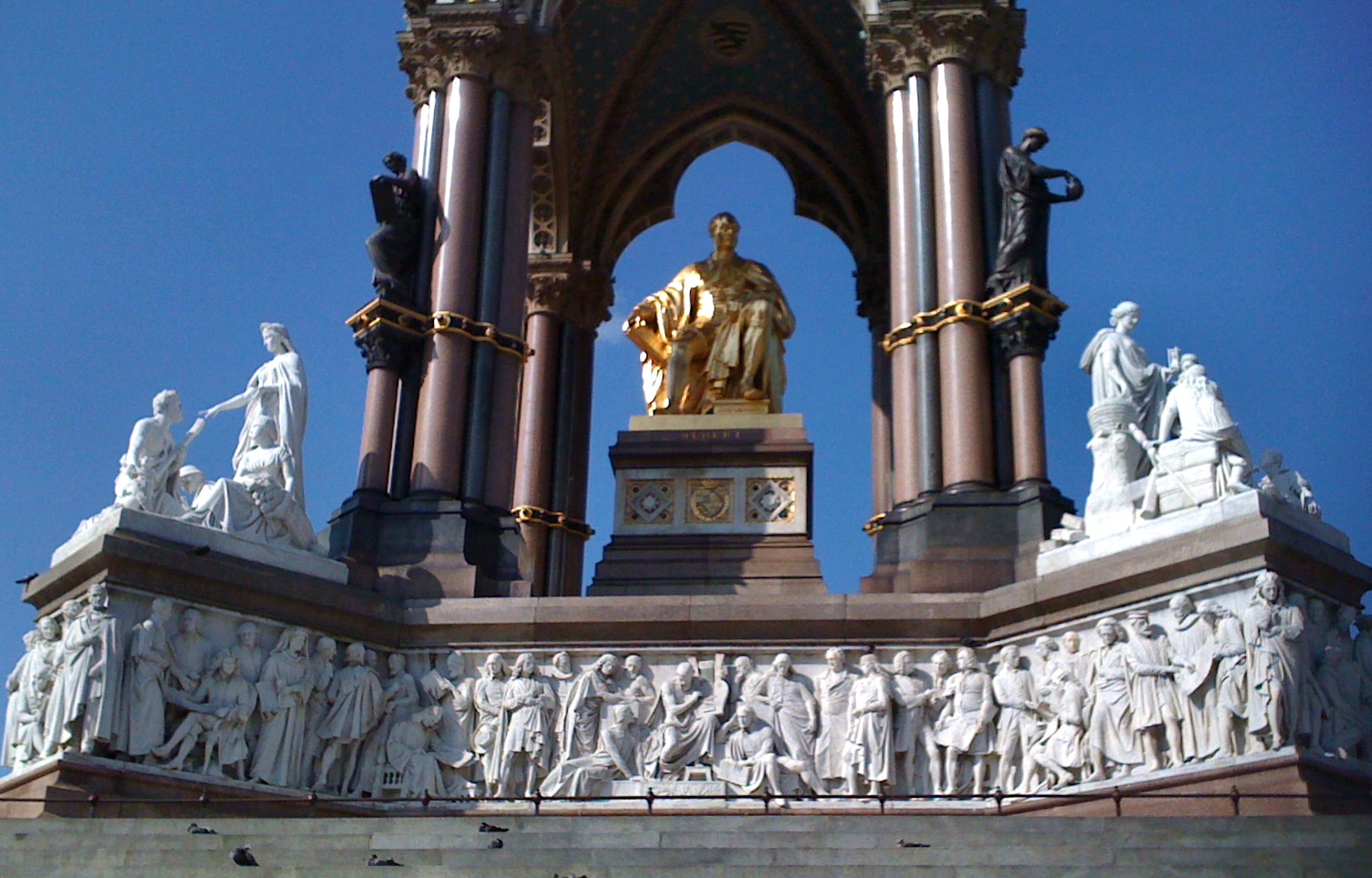
The Albert Memorial in Kensington Gardens isn’t London’s most popular tourist attraction. When it was erected in 1872 it was the height of fashionable good taste, but within a few decades it had become a symbol of bad taste... and has remained so ever since. Personally I love high Victorian Gothic architecture, but I know I’m in a minority so I won’t go on about it.

The central focus of the Albert Memorial is, of course, the huge seated figure of Prince Albert (the consort of Queen Victoria). But there are many other sculptures that deserve (but rarely get) close scrutiny. In particular there’s the Frieze of Parnassus that surrounds the base of the memorial. This depicts 160-plus historical figures from the world of the Arts. Although it’s not obvious from my photograph, each of the figures is identified by name – the Wikipedia article has clearer photographs and a full list of names.

When faced with lists like this, it’s inevitable that questions of the “why didn’t they include X?” variety spring to mind. Of course, the figures are necessarily drawn from the limited range of cultures familiar to mid-19th century Londoners – the ancient world of Egypt, Greece and Rome, and the post-renaissance world of Western Europe. In addition, the figures are limited to five specific categories – Poets, Musicians, Painters, Sculptors and Architects. But even within these constraints there are some notable omissions. I thought it would be interesting to go through all the people I’ve mentioned in previous posts who meet the basic criteria, and see which of them are included and which aren’t.

POETS

There aren’t as many poets depicted as you might expect. This is because they share the south side of the frieze (that’s the one in my photograph) with musicians.

Shakespeare is one of only three English poets to make it onto the frieze. He featured previously in connection with the authorship question and the ghost in Hamlet. If you’re interested in the latter, then watch this space – there’s more paranormal Shakespeare in the pipeline.

Alexander Pope (who featured in Angels in Machines last year) is a good example of someone who ought to be on the frieze but isn’t. The only post-Shakespeare English poet who does make the cut is John Milton, who was mentioned in passing in The Great Pyramid, and other British inventions – due to his rather nutty suggestion that the Greek philosopher Pythagoras got all his ideas from the ancient Britons. Oddly, Pythagoras appears on the frieze as a “poet” too, four places to the left of Milton.

Two of Britain’s greatest poets, Samuel Taylor Coleridge (featured in The Person from Porlock and The Ancient Mariner) and Lord Byron (featured in The Year Without a Summer) don’t make it onto the frieze, whereas Goethe and Schiller – two German poets of the same period – do.

Of the other non-English poets depicted on the frieze, Homer was featured in Space Odyssey and Dante in Dante’s Divine Comic Book.

MUSICIANS

Haydn, Mozart and Weber are the only three composers featured in Fortean Opera who died before the Frieze of Parnassus was created – and they are all on it.

Four of the composers mentioned in Philip K. Dick, music critic meet the same criterion – but only three of them are on the frieze. Bach, Mozart (again) and Beethoven made it, but Schubert didn’t.

PAINTERS

Botticelli, who featured in The Mystic Nativity, is conspicuously absent from the Frieze of Parnassus. This is odd because, as I said in that post, Botticelli “had a major influence on British painting of the Victorian period”. It’s even stranger that Botticelli’s more obscure contemporary Ghirlandaio is on the frieze.

Looking at the various omissions – Pope, Byron, Coleridge, Schubert, Botticelli – it strikes me they are all purveyors of what might be called “accessible” art. Maybe they weren’t considered sufficiently heavyweight to be commemorated in stone!

That’s certainly not true of the other great figures of the Florentine Renaissance—Leonardo da Vinci, Raphael and Michelangelo—who are all there on the frieze. In fact Michelangelo makes two appearances, both as a painter and as a sculptor! Both Michelangelo and Leonardo were featured in The Da Vinci Code and medieval symbolism, with Michelangelo also cropping up in A sixteenth century dinosaur and Leonardo in Underground Art and Crashed UFO in London. Raphael featured in my post about The School of Athens (which also mentions Pythagoras, referred to earlier).

Bellini was the subject of Descent into Limbo, and Mantegna was also mentioned in that post. Both Bellini and Mantegna are shown on the frieze.

The only other Italian artist I remember featuring is Agostino Carracci, in Bacchus and Ariadne. If you look back at that distinctly R-rated post, you won’t be surprised to learn the Victorians didn’t include Agostino in their frieze. However, Agostino’s brother Annibale Carracci (mentioned in the same post) did make the cut.

Vermeer (who featured in Chasing Vermeer... and Charles Fort) isn’t on the frieze – possibly because he falls in the “too accessible” category. But I was pleased to see that Hogarth – the epitome of accessible art – is right up there on the Frieze of Parnassus. Hogarth featured in Paranormal investigation, 18th century style and Another historical myth-conception.

Turner (who featured in Enigmatic Art) is on the frieze, but needless to say his populist contemporary John Martin (featured in Art and Archaeology) isn’t. Incidentally, one of Martin’s most characteristic works is “Joshua commanding the Sun to stand still upon Gibeon” (1816). I recently came across another version of the same scene that Martin painted in 1848 in a more Turneresque style. They’re both reproduced here (1816 top and 1848 bottom) so you can decide which you like best (I think they’re both great pictures).

SCULPTORS

I can only remember mentioning a sculptor once – that was Donatello in Alien simulacrum, one of my very first blog posts. Anyway, Donatello is there on the Frieze of Parnassus.

ARCHITECTS

As far as the Frieze of Parnassus is concerned, the “architects” of the ancient world aren’t really architects but patrons of architecture – the people who commissioned the buildings, rather than the people who designed them (the identities of the latter being lost in the mists of time). So, for example, “Cheops” is depicted as the architect of the Great Pyramid. Interest in Egyptology was still relatively new when the Albert Memorial was built, and the great wave of pyramidiocy that swept over the English-speaking world came later (see The Great Pyramid, and other British inventions, already mentioned above).

One of the oddest inclusions is Sennacherib, who would have been best known in Victorian times as the villain of a popular poem by Lord Byron (who unlike Sennacherib didn’t make it onto the Frieze of Parnassus). Presumably Sennacherib was considered the “architect” of the city of Nineveh, which had only recently been unearthed by archaeologists when the Albert Memorial was built. Sennacherib was mentioned in my posts on The Bible's Excluded Middle, Gods of the Bible and The Siege of Lachish... the last being about my ebook of the same title (which will tell you all you need to know about Sennacherib, should you choose to buy it).

Sunday, 14 October 2012

Another historical myth-conception

A recent Mensa newsletter contained a letter from Malcolm Burn in which he says “History itself (or rather, the version of history which most people who are not professional historians think they know) is full of [...] myths. Sometimes people become so attached to them that, even when an historian has explained to them why a particular story is a myth, they dismiss the true version and still cling to the old familiar one.” I couldn’t have put it better myself – this is an old hobby-horse of mine. I mentioned it most recently in Chronological Snobbery. But the example given by Malcolm is one I hadn’t realized was a mythconception – I have to admit I always believed it myself!

The essence of the “myth” is that when the British government switched from the Julian to Gregorian calendar in 1752, entailing the skipping of 11 days, hordes of ordinary people took to the streets with placards demanding “Give us back our eleven days”. Like many historical myths, people are inclined to believe this because it’s amusing, and it’s always presented as hard fact. But when you stop to think about it, the idea is pretty ludicrous. Why should “ordinary people” be so bothered by such an abstract item of government policy? According to Malcolm’s letter, the case has been thoroughly debunked by a historian named Robert Poole, who hasn’t found a single shred of evidence for popular protests on the subject anywhere in Britain during the course of 1752. Ordinary people are by and large sensible – they protest about things like taxes and working conditions, not calendar reform!

The true origin of the phrase “Give us our eleven days” makes a lot more sense when you know the context. I’ve mentioned the great artist William Hogarth before (Paranormal investigation, 18th century style). There is no-one before or since quite like Hogarth. He produced fine-art paintings and engravings which, rather than dealing with the usual timeless subjects of high art, were satirical treatments of the fashions and politics of his time. The closest comparison in modern terms is with a satirical cartoonist, although few modern-day cartoonists can expect to be remembered 250 years after their death, as Hogarth is.

In 1754—two years after the calendar change—Hogarth produced a series of paintings called Humours of an Election. The aim was to make fun of the various goings on behind the scenes at a parliamentary election – an easy target for satire in those days just as it is today. The first picture in the series, "An Election Entertainment", shows a gathering of the Whigs (liberals) while their rivals the Tories (conservatives) cause trouble outside. The characters depicted in the scene aren’t “ordinary people”—as the “eleven days” protesters are imagined to be in the mythical version of events—but hard-line party faithful. They don’t think like “ordinary people” – they’re only interested in bringing down the other party. So there on the floor, amidst the Whig gathering, is a placard saying “Give us our eleven days” – the significance being that the calendar reform two years earlier was the work of the Tories.

What Hogarth is doing is satirizing the way members of one political party will mindlessly oppose each and every policy of their opponents. The idea is that, if the Whigs had won the election, they would have reversed the Tory decision to switch to the Gregorian calendar. But that has nothing to do with the real world – it just came out of Hogarth’s imagination. Perhaps it’s a testament to his satirical genius that people continue to believe it really happened to this very day!

Tuesday, 2 August 2011

Paranormal investigation, 18th century style

From a Fortean point of view, the artist William Hogarth (1697-1764) is best known for his satirical print "Credulity, Superstition, and Fanaticism" -- one of his last works, dating from 1762. As discussed in issue 202 of Fortean Times (October 2005), the actual target of the satire was the new religion of Methodism, but (presumably because Methodists were seen as particularly credulous) the picture contains references to several popular paranormal phenomena of the time. These include the Cock Lane ghost, the phantom Drummer of Tedworth and the hoax perpetrated by Mary Toft -- a young woman who, back in the 1720s, convinced a lot of people that she regularly gave birth to live rabbits.

There is an earlier and less well-known work by Hogarth depicting Mary Toft, which he produced in 1726 when she was at the height of her fame. Although it's not a great work of art, there is at least one sense in which the earlier picture is more interesting than the later one. Rather than Methodists (who have always struck me as rather harmless) Hogarth's satire is directed at supposedly intelligent and educated individuals who "want to believe"... and hence are easily duped by hoaxers.
The title of the print is Cunicularii, as can be seen in the lower middle caption (you may need to click on the picture to enlarge it). Now "Cunicularii" is actually Latin for "rabbits"... but, since none of Hogarth's other prints have Latin names, it's safe to assume he chose this title because (in the timeless tradition of British anatomical humour) it "sounds a bit rude". The subtitle is "The Wise Men of Godliman in Consultation" -- the fictitious town of "Godliman" being similar (but not actionably similar) to Godalming in Surrey, where Mary Toft lived. The quotation "They held their talents most adroit / For any mystical exploit" is paraphrased from Samuel Butler's 17th century poem Hudibras... but it could be the motto of paranormal investigators in any century!

The three Wise Men attending at the birth (not an original idea, of course) are labelled A, B and C:
  • Wise Man A is captioned as "The Dancing Master or Preternatural Anatomist", and he is exclaiming "A Great Birth!"
  • Wise Man B, "An Occult Philosopher searching into the depth of things", is pictured with his hand up the subject's skirt, saying "It pouts, it swells, it spreads, it comes!"
  • Wise Man C, who is exclaiming "A Sooterkin!" is labelled "The Sooterkin Doctor Astonished".
The last of the three may cause a puzzled frown, because you thought the woman was giving birth to rabbits, not sooterkins... and come to that, what's a sooterkin? But in those days it was just like it is today -- if you get three paranormal believers in a room together, you will hear three different explanations for the same phenomenon! A sooterkin, in the folklore of the time, was a small, furry, non-human creature that some women were supposed to give birth to spontaneously. The legend arose in Germany and the Low Countries, so possibly "sooterkin" is a corruption of "Pseudokind" (German Kind meaning "child", as in Wunderkind).