Search This Blog

Showing posts with label retrospective. Show all posts

Monday, 5 February 2024

Googling Retro-Forteana

Bing Image Creator (prompt = "black hole dinosaur Large Hadron Collider")


 What do the following have in common: "supermassive black holes", "Large Hadron Collider", "big bang theory"? If you said they're all fashionable science topics that large numbers of people might search for on Google, then that's the answer I wanted. If you type any of those phrases into Google, then among the top 5 or so results you'll see one from the Space.com website which (if you click on it) includes my name as one of the co-authors. I only spotted this recently, and while it hardly amounts to "fame" (since no one ever notices the author's name in situations like this, except the author themselves), it did start me thinking.

Google is where this blog gets most of its visitors from, after an initially flurry from my RSS and social media followers (all six of them). The result can be anything from under 50 views (as with a couple of my most recent posts) to over 5,000 (in the case of my luckiest half dozen posts). Years ago I set up Google Search Console to keep track of the blog's search performance, and then promptly forgot all about it. But I just had another look at it, and tried typing some of its suggested search terms into Google to see how they fare (just to clarify my methodology: I used a desktop rather than mobile browser, in incognito mode so it didn't know who I was, and I'm only counting hits from Google's main list, not the differently formatted items such as sponsored links, images, Reddit, Quora etc).

Suffice to say the blog doesn't score well on anything a normal person is likely to search for! Of course, it comes top for "retro-forteana", but only because it's a name I made up myself. Of the terms suggested by Google Search Console, it only makes the top 5 for "esoteric mathematics", "dinosaurs in the 16th century" and "spooky action at a distance in German" - all of somewhat specialized interest, to say the least.

At the opposite extreme, the three examples from Space.com I gave earlier really are the kind of thing the general public might search for. Those particular articles were joint productions with other writers, but there are a few other (admittedly less search-worthy) topics where the Space.com result is all my own work, such as "What is a parsec?" and "Blue stars".

"Blue stars", in fact, is the first search term I found where my article comes right at the top of Google's results. But if you want something more fortean, try "Beginner's Guide to Time Travel". As a search term it's a little contrived, but it has the benefit (from my point of view) that Google's first non-sponsored result is my article of that title on Space.com's sister site LiveScience.

As well as this blog, I've got a website andrew-may.com which I'm also monitoring on Google Search Console. The only remotely popular search terms it does well on are "Astounding Science Fiction" (a pulp magazine of the 1940s and 50s, for which my site places around third in a Google search) and "Heart Sutra in Japanese" (a chanted text used in Zen Buddhism, for which Google puts me just inside the top 10).

If you expand the second of those to "Heart Sutra in Japanese with English subtitles", then Google puts me right at the top - not with the website this time, but a video I uploaded to YouTube just a few months ago. Despite its good search performance, this hasn't had many views yet - but give it time! A much older video of mine, "Dirac on Einstein" (which also comes top in a Google search) is now up to 127k views - the one and only time I've seen a six-figure number in any of my online statistics!

One final thing, which I wouldn't have mentioned (honest!) if I hadn't just spotted it in the Google Search Console data. But another term my website scores highly on is "Andrew May astrophysicist". I'm not sure which is more surprising  - that my website comes out at number 1 ahead of LinkedIn, Space.com, LiveScience, Twitter, Amazon, Icon Books and BBC Science Focus - or that all those other sites are referring to me as well, not someone else of the same name!

Bing Image Creator (prompt = "science fiction Heart Sutra astrophysics")

Sunday, 22 May 2016

I already said that AGES ago

There’s nothing more frustrating than saying something clever, being completely ignored, and then years later someone else says exactly the same thing. That’s always happening to me. A case in point was the above article on the BBC website last week. It’s about how E. M. Forster’s short story “The Machine Stops” from 1909 seems to foreshadow the world of social media, with its depiction of a dystopian future where people interact with each other via technology rather than face-to-face. But I made exactly the same point as long ago as 24 January 2011, in what was only the third post on this blog.

The post was called Wikipedia Prophecy, and in the last five years and four months it has amassed a grand total of 48 page views. In it, I said that Forster’s story “can be read today as an amusing satire on the World Wide Web, and on social networking sites such as Facebook in particular” – which is essentially what the BBC article says. However, as the title of my post indicates, I made another connection they missed – with Wikipedia’s strict (and to my mind frighteningly fascist) policy of “No Original Research”, which is also a central tenet of the future world envisaged by Forster.

A later post I wrote on a similar subject was The End of Books, about Octave Uzanne’s short story of that title from 1895. That post has fared better, with a total of 647 page views (above average for this blog). However, I can’t resist repeating this illustration by Albert Robida, which shows a group of earphone-wearing commuters on a metro train. When you realize that Queen Victoria was still on the throne when the picture was drawn, it really is astonishingly prophetic.

Sunday, 17 January 2016

Five Years

I started this blog five years ago this week, in January 2011. In that first year I averaged just over two posts per week, then from the second year onwards I’ve managed one post per week. When I started, the blog was (with one exception) the only non-fiction, non-technical writing I’d ever done. Since 2012, however, I’ve written four non-fiction books and co-written a fifth, as well as 12 short ebooks and about a hundred non-fiction articles for magazines, other websites etc. In its first year this blog got around 40,000 page-views, then about 60,000 in the second year and 90,000 in each of the third and fourth years, dropping to around 80,000 in the fifth year.

That suggests the blog has passed its peak, but the graph above paints an even more depressing picture. It shows the total all-time views per post, with the posts arranged in chronological order. Clearly the posts that are getting most of the views all came from the first 18 months! Of course there’s going to be a bias towards older posts, because they’ve been around longer, but the effect is a lot more dramatic than that. I suspect there is also a positive feedback loop involved – the more people click on a particular Google search result, the higher it appears in subsequent search listings, hence getting even more clicks.

Another trend, which I’ve suspected for some time but only just confirmed, is that there is a strong anti-correlation between the posts that I personally like best and the ones that get most clicks. In broad terms, the post topics can be divided into the following six categories:

  • “Retro-Forteana” – i.e. nostalgic posts about Fortean-related books and comics from the second half of the 20th century.
  • “Original Content” – generally plugs for my own books and other writings, plus creative efforts such as stories, drawings, videos and puzzles.
  • “Places Visited” – posts based on places I’ve visited recently, or things I’ve seen in museums (this category also includes a number of posts I did on behalf of Paul Jackson, before he started his Random Encounters blog in June 2012)
  • “Science” – offbeat aspects of real science (not pseudoscience)
  • “Historical” – oddities from the first half of the 20th century or earlier (unless they fall in the “Places Visited” category)
  • “Contemporary” – i.e. Fortean subjects of current popularity, such as Roswell, Bigfoot and Conspiracy Theories (and not much else).

As you can see from the first graph below, the posts which reflect a personal perspective (the first two categories, and to a lesser degree the third and fourth) are systematically less popular than the ones “anyone could write”. The second graph shows that, over time, I’ve tended to do progressively more of the posts I enjoy writing and fewer of the ones people seem to want to read.

In a way, this is symptomatic of something I noticed a couple of years ago. When I started writing, I carefully read various pieces of advice for new writers. One sentiment that cropped up again and again ran along the lines of “be original”, “say something new” or “find your own voice”. That sounds sensible enough – and it’s pleasantly reassuring, because it’s what most “amateur” writers instinctively want to do – but the truth is that it’s the worst possible advice. What most readers, publishers and booksellers are looking for is familiarity, not originality. If you want to be a professional writer with a large and stable audience, that’s the advice you need to follow. As for amateur writers, who are determined to be original and “speak in their own voice”, there’s only one piece of advice worth listening to: Don’t give up the day job.


Sunday, 8 June 2014

Fortean Nostalgia

This blog has been going for three and a half years now, since January 2011. When I started I wasn’t sure exactly what I was going to be writing about, so I gave it the broad-ranging title of “Forteana”. But there are dozens of similarly titled blogs and websites on the internet, and most of them deal with the hot topics of contemporary Forteana much better than this one. The last time I talked about a current news story was in March last year (Bigfoot, Richard III and Outsider Science)... and even that story had its roots in the 15th century!

I may be the last person to notice this, but this blog is stuck firmly in the past. In recent months I’ve written about old UFOs (The First UFO Hoaxers), old Bigfoot videos (Patterson-Gimlin Film: Fake or Fact?), old comics (Hitler's Astrologer; Fortean Comics; Fortean Agent of SHIELD), old pulp magazines (Pulp Forteana; The Fortean Fiction of Robert E. Howard), old poltergeists (Creeping Coffins), old works of art (Monsters, Mystery and a Monkey; Satan, Sin and Death), old pornography (Two Geeks, a Chicken and Bigfoot), old poetry (The Waste Land), old TV shows (Cult TV and Autoerotic Asphyxiation)... and even plain old history (The Lost Tomb of King Arthur; Iron Age Oddities; Devon's Underground Secrets).

So I’ve changed the blog title to Retro-Forteana. That’s a more accurate description of the content, and (because it’s such an unfashionable subject) it isn’t likely to get confused with anyone else’s blog. It also means I can indulge in my penchant for nostalgia without feeling too guilty about it!

As you can see from the photograph at the top of the post, much of my nostalgia (as far as Fortean writings are concerned, anyway) is focused on the 1990s. One reason for this, as mentioned in Anomalous Progress last year, is that was the decade when I first started reading seriously about the subject. So perhaps it’s not surprising that I have a soft spot for the Forteana of the nineties, just as I have a soft spot for comics of the sixties and seventies (cf. The Marvel Age of Comics).

But there’s another reason why I’ve tended to lose interest in the ongoing Fortean soap opera since the end of the 20th century. The open-minded sense of wonder that used to characterize the subject has been all but swept away by anti-establishment cynicism. It’s now generally accepted that the U.S. government knows the truth about everything from Bigfoot and UFOs to ESP and Free Energy... and is systematically hiding that truth from the public at large. To me, that’s a depressing thought. It means the only really efficient way to research Fortean subjects is to become President of the United States... and since I’m not a U.S. citizen, that option isn’t open to me.

What’s that you say? Barack Obama isn’t a U.S. citizen either?! And they’re hiding THAT from the public as well?!! My goodness, we live in a complicated world!

Sunday, 13 April 2014

The Promethean Galaxy

The Promethean Galaxy was the first book I ever wrote, way back in 1990. In fact it was the first non-fiction I ever wrote, apart from scientific papers. I tried it on a few publishers at the time, but they all said the same thing – that it didn’t fit into any of their categories. The book wasn’t popular science or philosophy or literary criticism or popular culture, but a weird mixture of all the above. It was a bit like this blog, in other words!

The original version of the book was 30,000 words long, but I tightened it up to 18,000 words in 2004 and self-published it as an ebook. I noticed a few days ago that some kind and discerning person just bought a copy from Amazon, which is what brought it back to mind. Who says self-published books never sell?

“The Promethean Galaxy” is a quote from a comic book – Jack Kirby’s New Gods #5, from 1971. Although I was a 13-year old comic reader at the time, I didn't buy that particular issue, or any of Jack Kirby’s 1970s titles for that matter. I didn’t want to be seen with them – they looked childish and old-fashioned to my sophisticated teenage tastes! It was only in 1989 that I bought a complete set of New Gods reprints and decided they were really very good. So it was all fresh in my mind when I sat down in front of my very first PC to write The Promethean Galaxy in 1990.

I managed to squeeze a lot of other cool stuff into the book, too, and then added a few more items to the mix when I revised it in 2004. Here is a list I made on the latter occasion:

...... Astounding Science Fiction and Isaac Asimov ...... Astral travel and astrology ...... Charles Fort and Erich von Daniken ...... Einstein and General Relativity ...... Jack Kirby and The New Gods ...... Kant, Schopenhauer, Nietzsche and Jung ...... Linguistic relativism and the Sapir-Whorf hypothesis ...... Parapsychology and UFOs ...... Philip K. Dick and Gnosticism ...... Quantum entanglement and emergent phenomena ...... Shakespeare and Tom Stoppard ...... Sir Francis Bacon and Sir Isaac Newton ...... Star Trek and The Matrix ...... Tennyson, Shelley, Voltaire and Wagner ...... The Many Worlds Hypothesis and hyperspace ...... Thomas Kuhn and paradigm shifts ...... Warp drives and wormholes ......

– or as I said a moment ago, pretty much like this blog!

Let’s see if I can keep the ball rolling and sell more than that one copy. Here are a few links so you can choose your favourite format:
... and here is the book’s blurb:
Planet Earth is a constituent part of the Galaxy, but only a microscopically small part – a tiny chunk of rock. Like Prometheus, we are chained to this rock, and constrained to view the Galaxy from this one perspective only. Why should we be interested in the Galaxy in the first place, and – with such a restricted viewpoint – how can we ever hope to learn anything about it? These questions are addressed in this book, which draws on an eclectic heritage of science, philosophy, mysticism, poetry and fiction.

Sunday, 9 March 2014

Post-Fortean Meta-Complexity

This is yet another nostalgic post about something that no longer exists – although in this case it only ceased to exist last week.

I originally set up my website www.andrew-may.com in 2001, long before blogs and social media took off. In those days, a personal presence on the web took the form of a “home page”. These were often very opinionated and idiosyncratic – or mine was, at least. I realized some time ago, soon after I started this blog, that online fashions have changed. A blog is a good place to be opinionated and idiosyncratic, but a personal website – for people who still need one – ought to be slicker and more professional-looking.

I put off making the change as long as I could, but last week I was migrated from my old Windows server to a new Linux host, so I took the opportunity to do a complete overhaul. Hopefully the new site looks more serious and less cranky than the old one. Essentially it’s just an online bibliography now, although there are some links to older stuff in the small print at the bottom.

One of the things I’ve ditched is the name of the old site, “Post-Fortean Meta-Complexity”. This was meant to be a pastiche of the numerous postmodern academic disciplines that were trendy at the time. I thought it was a really good title (and I still do), but it sounds rather dated now. The name wasn’t just random – it actually meant something. If “Fortean” means taking a non-judgmental interest in offbeat facts and occurrences, then “Post-Fortean” applies the same approach to offbeat theories and ideas!

With the help of the Wayback Machine, I had a look back at some of the earliest versions of the website. The screenshot above isn’t from the very first version, but it was the first version that looked the way I wanted it to.

Some of the early content is still there on the website if you dig deep enough. Down at the bottom of the current site there’s a link that says “Archive” (there are also links to two other old sites of mine, Zen Dynamics and Astounding Science Fiction). Most of the early stuff is about Buddhism and Philip K. Dick, for some reason. There’s an interesting list of Metaphysical Quotations from the novels of Philip K Dick that I’d forgotten all about. There’s also an article that touches on the connections between PKD, the Buddha and Richard Wagner!

I had a few problems with case-sensitive filenames and encoding errors (apostrophes and hyphens not rendering correctly) when I moved to the Linux server. I think I’ve cleared these up now, but let me know if you encounter any problems with the new site.

Sunday, 12 May 2013

200 Years of Forteana

This is the 200th post on the Forteana blog. That doesn’t mean it’s been running for 200 years (or even 200 weeks), but I still thought it would be fun to list a few highlights from the last two centuries of Forteana:

1813: Birth of Richard Wagner. Many years later (1980 to be precise), Roy Thomas used Wagner’s Der Ring Des Nibelungen as the story arc for issues 294 to 300 of The Mighty Thor – as recounted in A Wagnerian Thor.

1816: The Year Without a Summer, when Byron wrote his apocalyptic poem Darkness and Mary Shelley started work on Frankenstein.

1817: Birth of Hargrave Jennings, who went on to become an enthusiastic proponent of Phallicism – A Victorian Theology of Everything (see also Phascinating Phacts).

1819: The British Museum purchases its first ichthyosaur fossil, from a 20-year-old girl named Mary Anning – who, if legend is to be believed, was a rather dim-witted child until she was struck by lightning (see On the Diverse Benefits of being Struck by Lightning).

1821: Premiere of Weber’s opera Der Freischütz – a “pact with the devil” story and a classic example of Fortean Opera.

1827: Death of William Blake – artist, poet, mystic... and A 19th Century Contactee?

1829: The satirical artist William Heath produces a print entitled March of the Intellect, depicting what appears to be An Intercontinental Rapid Transit System.

1832: Birth of Charles Dodgson, who wrote under the pen-name of Lewis Carroll. His works for children (such as Alice in Wonderland) are still remembered today, while his books on mathematics are almost forgotten – see Sea Serpents, Logic and Lewis Carroll.

1844: The term Lisztomania is coined by the poet Heinrich Heine, to describe the hysterical behaviour of certain females in response to performances by Franz Liszt.

1847: The British archaeologist Austen Henry Layard explores the ruins of the ancient Assyrian city of Nineveh, discovering among other things a huge wall carving depicting The Siege of Lachish – now on display in the British Museum (and the subject of an ebook by myself).

1848: The poet Tennyson, on a visit to Cornwall, sees King Arthur's Stone – which later inspires him to write Idylls of the King.

1856: Death of William Buckland: an early Fortean experimenter, who subjected a common piece of folklore—the idea of “toads trapped inside solid rock” —to practical test.

1861: Death of Prince Albert, the consort of Queen Victoria, who was subsequently commemorated in the Albert Memorial... and The Frieze of Parnassus.

1871: The Scottish physicist James Clerk Maxwell proposes a “thought experiment” involving one of the few demonic entities acceptable to modern science: Maxwell’s Demon.

1872: The German astrophysicist Karl Zöllner is the first person to suggest that the universe we live in may be non-Euclidean – a major step towards Inventing the Fourth Dimension.

1874: Birth of Charles Fort, who besides giving his name to this blog is the subject of a minor subdivision of imaginative literature – Charles Fort in Fiction.

1885: H. Rider Haggard produces his most famous novel, King Solomon's Mines – which includes an interesting take on the subject of Travellers from the Stars.

1887: Abbé Saunière embarks on a number of extravagant renovations to the church at Rennes-le-Chateau... including The Devil of Rennes-le-Chateau.

1895: Publication of The End of Books – a short story written by Octave Uzanne and illustrated by Albert Robida, containing a surprisingly prescient vision of iPods and audiobooks.
1896: Aubrey Beardsley produces an appropriately surreal illustration of “The Cave of Spleen” from Alexander Pope’s The Rape of the Lock... complete with Angels in Machines.

1906: Birth of John Dickson Carr, one of the best (and most Fortean) mystery novelists of the 20th century – as described in A Trip to the Witches' Sabbath and Simulacra in fiction.

1909: Publication of The Machine Stops by E. M. Forster. With a century of hindsight, this can be read as a satire on social networking... and, with its firm insistence on “No Original Research”, a Wikipedia Prophecy.

1914: Socrates Scholfield of Providence, Rhode Island is granted U.S. patent 1,087,186 for a device to demonstrate the relationship between the Supreme Being and His Creation – The Double Helix of God.

1918: Publication of The Gate of Remembrance by Frederick Bligh Bond, revealing how his recent excavations at Glastonbury Abbey had been an exercise in Psychic archaeology.

1924: A British Air Ministry memorandum states that Germany is in possession of “an apparatus from which rays (or electric waves) can be projected to a height causing aeroplane engines to break down” – just one of many instances of Death Rays of the 1920s and 30s.

1926: Father Ronald A. Knox broadcasts an outrageously over-the-top comedy programme about rioting in London, which the press promptly hypes up into The First Radio Hoax.

1935: The May issue of Doc Savage magazine contains a painstakingly detailed description of a telephone answering machine, before such things even existed – an example of Futuristic gadgets of the 1930s.

1939: The first issue of a new pulp magazine, called Unknown, hits the stands in March. Complete in this issue is Eric Frank Russell’s Sinister Barrier: the first Fortean novel.

1942: An inscription bearing this date, in the cuneiform script of ancient Assyria, can be found in an underground mine-working in Wiltshire – The Bomb-Proof Museum.

1943: Accurately reported in an anonymous phone call on 25 May, but not actually occurring until 4 July – The Strange Death of General Sikorski.

1944: On 8 September, the first of more than a thousand V-2 rockets is launched against the city of London – as recounted in London versus the V-2 rockets (and also the subject of an ebook by myself).

1945: In December, five US Navy torpedo bombers go missing in the Bermuda Triangle, soon followed by a search aircraft looking for them. By August of the following year, paranormal explanations of The Mystery of Flight 19 are already being put forward.

1948: Time for another mystery – less well-known than the Bermuda Triangle, but arguably more intriguing – The Tamam Shud Mystery.

1950: Publication of Gerald Heard’s The Riddle of the Flying Saucers, the first non-fiction English-language book to deal with the subject... and one most people have never heard of. Read all about it in UFOs: the forgotten book.

1958: The second issue of Harvey Comics’ Race for the Moon contains a story by Jack Kirby entitled The Face on Mars ... thirty years before Mark Carlotto drew the world’s attention to that particular feature of the Martian landscape.
1960: As Che Guevara made a brief appearance at a rally in Havana, Alberto Korda took a quick photograph, which he later dubbed Guerrillero HeroicoThe portrait with a life of its own.

1961: Three weeks after Soviet Cosmonaut Yuri Gagarin orbits the Earth in Vostok 1, American astronaut Alan Shepard is lobbed three hundred miles downrange from Florida on the end of a 1953-vintage short-range ballistic missile, in history’s most blatant example of a Hyperbolic Orbit (“hyperbolic” in the sense of “greatly exaggerated”).

1962: The British UFO Research Association (BUFORA) holds its first meeting in September – as remembered with nostalgia in September 2012, marking Fifty Years of British UFO Research.

1965: The British science fiction author John Brunner writes a glowing piece in New Worlds magazine, drawing attention to a then little-known author by the name of Philip K. Dick – as recorded in Philip K. Dick - two early British viewpoints (see also John Brunner: a British Philip K. Dick?).

1968: The September/October issue of Flying Saucer Review contains, among other things, a circuit diagram for an electronic UFO detector that anyone who wants to can build for themselves.

1973: Uri Geller gives such a persuasive performance on the Dimbleby Talk-In that Professor John Taylor, brought in as a skeptical scientist, becomes a paranormal believer right there in front of the TV cameras. I chose this as the first of my five Fortean Events that Shook the World.

1981: Stephen Hawking and other prominent scientists convene at Castel Gandolfo, the Pope's Summer Residence, for a study week on Cosmology and Fundamental Physics organized by the Vatican's Pontifical Academy of Sciences – as described in Vatican Cosmology.

1992: Nick Pope, newly arrived at the UFO Desk in MOD Main Building, is interviewed by the MOD’s house journal (this was before anyone in the UFO community had heard his name). I kept the clipping for a few years, then threw it away – which is a pity, because it would probably be worth millions today (or maybe not). See Nick Pope at the MOD for this and more Popean anecdotes.

1997: At a meeting with a group of physicists and cosmologists, the Dalai Lama declares himself to be open-minded on the subject of alien encounters – as recounted in The Dalai Lama, quantum physics and UFOs.

2001: The European Space Agency sets up the ITSF (Innovative Technologies from Science Fiction) database – Novel space technologies from such great thinkers as Arthur C. Clarke, Larry Niven, Robert A. Heinlein and Isaac Asimov.

2005: The original (and much missed) Hierophant made his last appearance in the January issue of Fortean Times. For the low-down on the over-educated, bad-tempered, humourless impostor who tried to take his place, see The Hierophant Mystery.

2006: The bizarre Da Vinci Code trial, presided over by a judge who clearly knew more about the subject matter of Dan Brown’s novel than the author himself did (and who embedded a code of his own in his final judgment) was the fifth and last of my Fortean Events that Shook the World.

2011: At the Institute of Biomedical Problems in Moscow, the six-man crew of the MARS-500 mission enters orbit around the red planet after eight months in space... an echo in the real-world of the recurring sci-fi theme of Phony space missions.

2013: February sees two major announcements about DNA results – one of which is widely applauded while the other... isn’t. It’s all explained in Bigfoot, Richard III and Outsider Science.

Sunday, 5 May 2013

The Frieze of Parnassus

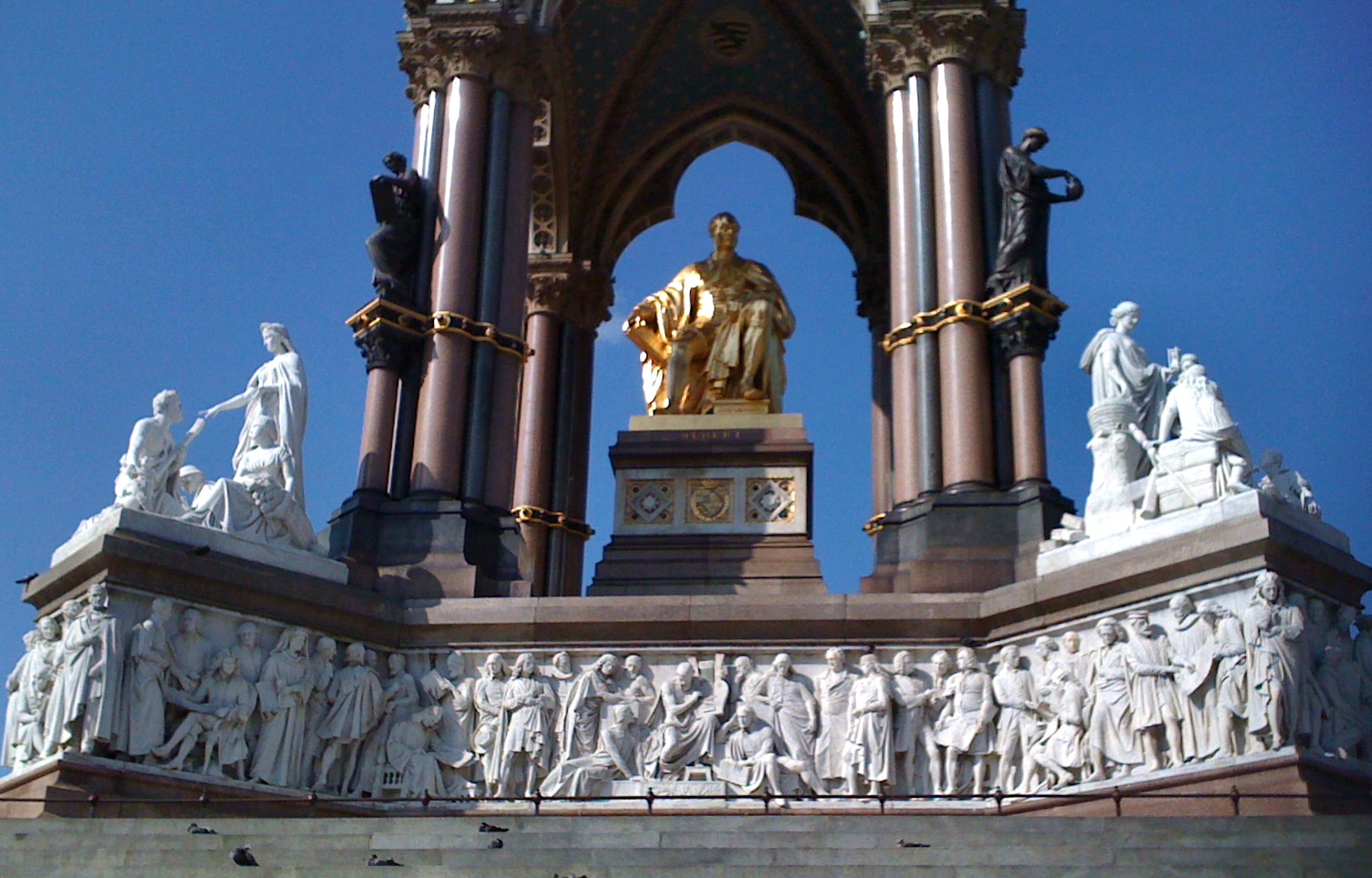
The Albert Memorial in Kensington Gardens isn’t London’s most popular tourist attraction. When it was erected in 1872 it was the height of fashionable good taste, but within a few decades it had become a symbol of bad taste... and has remained so ever since. Personally I love high Victorian Gothic architecture, but I know I’m in a minority so I won’t go on about it.

The central focus of the Albert Memorial is, of course, the huge seated figure of Prince Albert (the consort of Queen Victoria). But there are many other sculptures that deserve (but rarely get) close scrutiny. In particular there’s the Frieze of Parnassus that surrounds the base of the memorial. This depicts 160-plus historical figures from the world of the Arts. Although it’s not obvious from my photograph, each of the figures is identified by name – the Wikipedia article has clearer photographs and a full list of names.

When faced with lists like this, it’s inevitable that questions of the “why didn’t they include X?” variety spring to mind. Of course, the figures are necessarily drawn from the limited range of cultures familiar to mid-19th century Londoners – the ancient world of Egypt, Greece and Rome, and the post-renaissance world of Western Europe. In addition, the figures are limited to five specific categories – Poets, Musicians, Painters, Sculptors and Architects. But even within these constraints there are some notable omissions. I thought it would be interesting to go through all the people I’ve mentioned in previous posts who meet the basic criteria, and see which of them are included and which aren’t.

POETS

There aren’t as many poets depicted as you might expect. This is because they share the south side of the frieze (that’s the one in my photograph) with musicians.

Shakespeare is one of only three English poets to make it onto the frieze. He featured previously in connection with the authorship question and the ghost in Hamlet. If you’re interested in the latter, then watch this space – there’s more paranormal Shakespeare in the pipeline.

Alexander Pope (who featured in Angels in Machines last year) is a good example of someone who ought to be on the frieze but isn’t. The only post-Shakespeare English poet who does make the cut is John Milton, who was mentioned in passing in The Great Pyramid, and other British inventions – due to his rather nutty suggestion that the Greek philosopher Pythagoras got all his ideas from the ancient Britons. Oddly, Pythagoras appears on the frieze as a “poet” too, four places to the left of Milton.

Two of Britain’s greatest poets, Samuel Taylor Coleridge (featured in The Person from Porlock and The Ancient Mariner) and Lord Byron (featured in The Year Without a Summer) don’t make it onto the frieze, whereas Goethe and Schiller – two German poets of the same period – do.

Of the other non-English poets depicted on the frieze, Homer was featured in Space Odyssey and Dante in Dante’s Divine Comic Book.

MUSICIANS

Haydn, Mozart and Weber are the only three composers featured in Fortean Opera who died before the Frieze of Parnassus was created – and they are all on it.

Four of the composers mentioned in Philip K. Dick, music critic meet the same criterion – but only three of them are on the frieze. Bach, Mozart (again) and Beethoven made it, but Schubert didn’t.

PAINTERS

Botticelli, who featured in The Mystic Nativity, is conspicuously absent from the Frieze of Parnassus. This is odd because, as I said in that post, Botticelli “had a major influence on British painting of the Victorian period”. It’s even stranger that Botticelli’s more obscure contemporary Ghirlandaio is on the frieze.

Looking at the various omissions – Pope, Byron, Coleridge, Schubert, Botticelli – it strikes me they are all purveyors of what might be called “accessible” art. Maybe they weren’t considered sufficiently heavyweight to be commemorated in stone!

That’s certainly not true of the other great figures of the Florentine Renaissance—Leonardo da Vinci, Raphael and Michelangelo—who are all there on the frieze. In fact Michelangelo makes two appearances, both as a painter and as a sculptor! Both Michelangelo and Leonardo were featured in The Da Vinci Code and medieval symbolism, with Michelangelo also cropping up in A sixteenth century dinosaur and Leonardo in Underground Art and Crashed UFO in London. Raphael featured in my post about The School of Athens (which also mentions Pythagoras, referred to earlier).

Bellini was the subject of Descent into Limbo, and Mantegna was also mentioned in that post. Both Bellini and Mantegna are shown on the frieze.

The only other Italian artist I remember featuring is Agostino Carracci, in Bacchus and Ariadne. If you look back at that distinctly R-rated post, you won’t be surprised to learn the Victorians didn’t include Agostino in their frieze. However, Agostino’s brother Annibale Carracci (mentioned in the same post) did make the cut.

Vermeer (who featured in Chasing Vermeer... and Charles Fort) isn’t on the frieze – possibly because he falls in the “too accessible” category. But I was pleased to see that Hogarth – the epitome of accessible art – is right up there on the Frieze of Parnassus. Hogarth featured in Paranormal investigation, 18th century style and Another historical myth-conception.

Turner (who featured in Enigmatic Art) is on the frieze, but needless to say his populist contemporary John Martin (featured in Art and Archaeology) isn’t. Incidentally, one of Martin’s most characteristic works is “Joshua commanding the Sun to stand still upon Gibeon” (1816). I recently came across another version of the same scene that Martin painted in 1848 in a more Turneresque style. They’re both reproduced here (1816 top and 1848 bottom) so you can decide which you like best (I think they’re both great pictures).

SCULPTORS

I can only remember mentioning a sculptor once – that was Donatello in Alien simulacrum, one of my very first blog posts. Anyway, Donatello is there on the Frieze of Parnassus.

ARCHITECTS

As far as the Frieze of Parnassus is concerned, the “architects” of the ancient world aren’t really architects but patrons of architecture – the people who commissioned the buildings, rather than the people who designed them (the identities of the latter being lost in the mists of time). So, for example, “Cheops” is depicted as the architect of the Great Pyramid. Interest in Egyptology was still relatively new when the Albert Memorial was built, and the great wave of pyramidiocy that swept over the English-speaking world came later (see The Great Pyramid, and other British inventions, already mentioned above).

One of the oddest inclusions is Sennacherib, who would have been best known in Victorian times as the villain of a popular poem by Lord Byron (who unlike Sennacherib didn’t make it onto the Frieze of Parnassus). Presumably Sennacherib was considered the “architect” of the city of Nineveh, which had only recently been unearthed by archaeologists when the Albert Memorial was built. Sennacherib was mentioned in my posts on The Bible's Excluded Middle, Gods of the Bible and The Siege of Lachish... the last being about my ebook of the same title (which will tell you all you need to know about Sennacherib, should you choose to buy it).

Sunday, 20 January 2013

Forteana Blog 2nd Annual Report

This blog has been going for two years now! The most visible change over the past 12 months is that I changed the name from “Forteana” to “Andrew May’s Forteana Blog”. This may look like blatant self-aggrandizement, which it would be if I imagined that adding my name to the blog’s title would cause people to take it more seriously rather than less seriously. Actually it was the exact opposite – I realized from comments that were being posted that some people expected the blog to be an authoritative and impartial source of information, and then they got angry when they found it wasn’t. The last straw was when someone accused me of being a troll on my own blog! So I changed the name to reflect the fact that what you get here is me, not some would-be rival to Wikipedia.

Another reason for the name change is that over the last year I’ve been trying my hand at writing on non-Fortean subjects, such as my book Bloody British History: Somerset (left) which came out in September. I wanted to be able to mention such writing without being accused of going off topic – hence “Andrew May” gets equal billing to “Forteana” in the blog title. As it is, I haven’t really gone in for the hard sell as much as I ought to – I just don’t have the perseverance, ego or thick skin required to be a successful writer!

This time last year I’d done 130 posts and had 47,000 page views. I’m now up to 180 posts and 107,000 page views. So the rate of posting is down (to essentially one per week) but the number of views per post is definitely up. By far the most successful post I’ve ever done is my annotated version of Raphael’s School of Athens, which continues to get hundreds of referrals from Google every month... nothing else comes close. That one wasn’t even a particularly Fortean subject, and I had to make an effort to come up with Fortean connections for the various individuals depicted. In light of the post’s unexpected popularity, I wish I hadn’t bothered with the Fortean angle at all, and just played it straight!

When I started this blog (and I suspect this is true of most first-time bloggers) I was only thinking a few months ahead, for which I had plenty of material. Since then it’s got steadily harder and harder to think of new ideas that are up to standard and “on topic”. The trick, of course, is in thinking of a format for the blog that is effortlessly self-perpetuating. This is exactly what my former colleague and long-time fellow Fortean Paul Jackson did when he started his own blog, Random Encounters with the Unusual, last June. Paul describes this as “a repository for the oddities that me and Mrs J have encountered on our travels, which we find interesting or amusing in some way”... the result is definitely worth adding to your RSS reader if you haven’t already.

I did one guest post for Paul during the year, on Somerset’s WW2 Oddities, and another guest post for the Sevagram blog, devoted to the works of A.E. van Vogt, on the subject of Unravelling van Vogt's Fix-Up Novels. Other blogs I contribute regularly to are Jon Downes’s CFZ blog, where I do a twice-weekly “Words from the Wild Frontier” post, as well as the Lyme Regis Museum blog (currently hosted on Blogger but soon to move to the main Museum website). Also last year I started to do occasional posts for the Montacute House blog – including several folklore/mythology-related subjects that could easily have been at home on this blog, such as The Skimmington Ride, A Devilish Candlestick, Montacute's Hunky Punks and The Nine Worthies.

Sunday, 29 January 2012

Annual Report

The Forteana blog has survived its first year! When I started it in January 2011, it was only meant as a quick test to work out how to use Blogger... hence the rather unimaginative title. But since then I’ve done 130 posts, on a wide range of topics including (clockwise from top left): unusual museums, weirdness in renaissance art, out-of-place aliens, folklore, cryptozoology, retro-futuristic science, ancient civilizations and witchcraft.

Much to my surprise, I see that I’ve had 47,000 page views -- an average of 360 views per post. So a big “Thank You” to everyone who reads the site and links to it... especially Patrick Huyghe and Rick Stokes at The Anomalist, who are by far my most consistent referrers! I’m also grateful to the various people who’ve supplied me with material when I was in danger of running out of ideas... particularly Paul Jackson, who has travelled the world in search of photographs for the blog (or more accurately, he’s travelled the world taking photographs, which he’s then kindly let me post on the blog).

An obvious mistake to make when starting a blog is to post all your good material early on, before anyone has started reading it. That’s what I did, and it’s meant that some posts that were really interesting (in my biased opinion) have languished with virtually no page views. In this context, I could mention: Dinosaur Orbit, Precogging Philip K. Dick, Nick Pope at the MOD, Seth Shostak on SETI and Cosmic Geometry in the West Country.

Several of the earliest posts were based on letters that I’d sent to Fortean Times over the years, but were never printed. These included The Da Vinci Code and Mediaeval Symbolism, The Great Moon Hoax and Alien Simulacrum (left). As I mentioned a couple of weeks ago, my success rate at FT has shot up over the last few months -- I’ve even got a full-page “Forum” article in the current issue. I’m getting very bigheaded about this -- I’ve just set up a new web page to keep track of my appearances in Fortean Times!