Search This Blog

Showing posts with label H. P. Lovecraft. Show all posts

Sunday, 28 April 2024

Colin Wilson, Philosopher of the Paranormal

Back in the 1970s, Colin Wilson was one of the big names of what might be called "mass-market forteana". But while I did borrow a copy of his 600-page blockbuster The Occult circa 1978, it was only much later that I started to discover just how interesting his ideas are. It began in 2001, when I bought a book by Fortean Times contributor Gary Lachman called Turn Off Your Mind: The Mystic Sixties and the Dark Side of the Age of Aquarius (which I'm sure everyone spotted in my recent shelfie post, towards the right-hand end of the middle shelf). Colin Wilson made an appearance in Lachman's book in the context of the H. P. Lovecraft revival of the 1960s - including the wonderfully surreal cover of Wilson's 1967 novel The Mind Parasites. As evidenced by the photo above, I bought a second-hand copy as soon as I could find one, as well as two later novels in the same vein, The Philosopher's Stone (1969) and The Space Vampires (1976).

The other paperback shown above is a non-fiction one, The Psychic Detectives (1984), which I bought in 2016 when I was researching my own book, Pseudoscience and Science Fiction. Here's what I said about Wilson there:
As his career progressed, he became increasingly fascinated with the world of strange powers. A recurrent theme throughout his fiction and non-fiction is that most people live a robotic existence far below their real potential.
That use of the word "robotic" brings me on to the main subject of this post, which is the Kindle book shown in the above photo - Gary Lachman's Beyond the Robot: The Life and Work of Colin Wilson (2016). I only became aware of it last month, when Gary posted the following on Facebook:
I've just heard that the paperback of Beyond the Robot, my book about Colin Wilson, is now out of print. If you are among the many who didn't buy a copy, there's still time to not get the Kindle edition too.
Since I'm a chronic sufferer from the "Why do friends never read my books?" syndrome, I clearly had to buy it immediately! I'm glad I did, as I found it a fascinating and information-packed read which got 5 out of 5 stars from me on Goodreads. However, this post isn't really a review of the book, so much as a summary of a few things I found particularly interesting from a fortean point of view.

To start with, Fortean Times (as well as some of the "Unconventions" they organized) makes several appearances in the book. At one point Lachman specifically mentions "writing pretty regularly for the Fortean Times", and after Colin Wilson's death in 2013 Gary's obituary of him appeared in FT 310 (the same issue as my review of a comic-strip book about particle physics, FWIW). Although I've never actually met Gary, I did spot him at a couple of Uncons - and, I think, in the audience at the "Aliens and the Imagination" event I mentioned on this blog in 2011. Way back in 1978, in the guise of his musical alter-ego Gary Valentine, Lachman also wrote Blondie's paranormal-themed hit "I’m Always Touched by Your Presence, Dear".

As for Colin Wilson himself, he only came on to fortean-type subjects a decade or so after he started writing. His original focus was on existential philosophy, and his first book on that subject, The Outsider, was published in 1956 when he was just 24. It received a lot of rave reviews, including one in The Observer - which Lachman describes as one of Britain's "highbrow Sunday papers" (which pleased me a lot, since they published a two-page feature by me just a couple of months ago).

In hindsight, it's not surprising that Wilson's own personal take on philosophy eventually led to an interest in the paranormal, since it's ultimately all about widening human consciousness beyond the normal trivialities of everyday life. That's why he was drawn to the Lovecraftian style of fiction - he had no time for the more mainstream kind of novelist "who, in the service of realism, simply portrays life as it is". Another fortean favourite who made an impression on Wilson was Aleister Crowley. According to Lachman, Crowley was the model for one of the characters in Wilson's early novel Man Without a Shadow (1963) - Carradoc Cunningham, an occultist and master of "sex magic". Apparently Wilson himself harboured interests along the latter lines, believing that sexual orgasm can unlock higher states of consciousness and "open the doors of perception".

When Wilson came to write about the paranormal - The Occult (1971) being his first and best-known, but far from only, book on the subject - he did so in a way that was almost diametrically opposed to the standard approach for the genre. As Lachman puts it:
If scientists and other skeptics were ever going to broaden their minds about the occult, then it had to be presented to them logically, in a way that made sense, not in a sensational "believe it or not" manner.
As with his first book about philosophy, Wilson's first book on the paranormal also got rave reviews. In part, this was because "highbrow" readers were far more open to such topics at that time than they are today. Referring to a favourable review that New Scientist gave of Wilson's follow-up book Mysteries (1978), Lachman says:
Such acclaim from a scientific publication for a book about the paranormal is unusual today, and shows that in the 1970s, the paranormal was treated with respect by many scientists, unlike in our more narrowly skeptical times.
Another thing I remember myself from those times, is that interest in fringe topics was much more wide-ranging and eclectic than it is today. The "paranormal", for example, meant a lot more than just ghosts and poltergeists. Listing some of the topics that Wilson covered in Mysteries, Lachman includes "plant telepathy, psychic surgery, transcendental meditation, biofeedback, Kirlian photography, multiple personality and synchronicity". All great stuff - makes me feel more nostalgic than ever for the 20th century!

Colin Wilson was an incredibly prolific author, and I kept noting down titles of books of his that I ought to seek out. The most intriguing-sounding of all is Atlantis and the Kingdom of the Neanderthals (2006) - something I should have known about already, as Wilson mentioned it in an article he himself wrote for Fortean Times, called "A 100,000-year-old Civilization?" It appeared in FT 272 in March 2011, and I have to admit I'd forgotten all about it (although I looked back at it just now, which is how I know it mentions the Atlantis book). In any case, I've already acquired my copy of Atlantis and the Kingdom of the Neanderthals from eBay, as you can see here:


Sunday, 31 March 2024

Popular Culture in Fortean Times


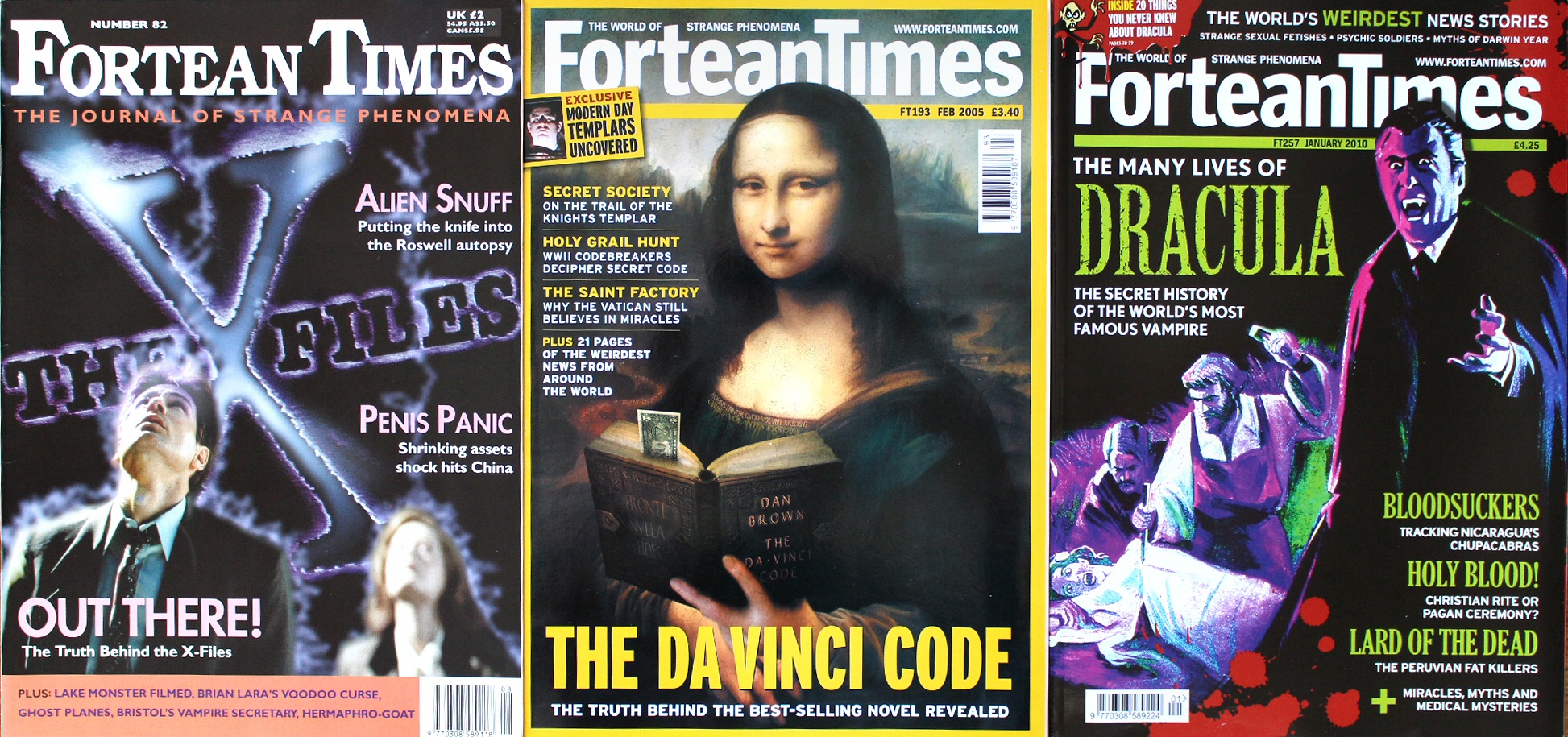
In the comment thread to last week's post, I mentioned that Fortean Times occasionally touches on various aspects of popular culture, from cult TV and movies to comics and pop music. So I thought I'd do a quick run-through of a few examples today.

To start with some very obvious topics, there are the three shown above. The X-Files (FT 82, August 1995) was not only one of the most fortean TV shows of all time, but its first appearance in 1993 coincided with the wider distribution of FT to "mainstream" retailers like WH Smith, and almost certainly contributed to the magazine's popularity at that time. Around a decade later, Dan Brown's novel The Da Vinci Code (FT 193, March 2005) was a publishing phenomenon, bringing fringe theories that had previously been the realm of specialist writers (and FT contributors) like Lionel Fanthorpe and Lynn Picknett to a much wider audience. Just over a century earlier, Bram Stoker had done something similar in his novel Dracula - the title character of which went on to become one of the most recognisable and ubiquitous pop-culture icons of them all, as recounted in the cover feature of FT 257 (January 2010).

At a less obvious level, you can find references to popular culture in almost every issue of FT. Taking the one I discussed last week, for example - FT 73 from February/March 1994 - there's an interview with cult author William Gibson, generally credited as the originator of the cyberpunk genre. And I spotted something else in that issue, too: a book review by comics legend Alan Moore. I don't mean a review of one of his graphic novels - I mean a review written by him of someone else's work. Looking online, I see he actually did quite a few reviews for FT in those days - which pleases me enormously, as I've done over 40 of them myself. It's always nice to discover that you have something in common with a famous person!

Sticking with books and comics for a moment, here are three more covers that caught my eye. No apologies for a second appearance of The Da Vinci Code (FT 212 this time, from August 2006) - both because it's one of my favourite novels, and because I love the illustration on the cover. In addition to people like Picasso and Orson Welles, it features Da Vinci himself in the act of strangling Dan Brown! The middle cover (FT 256, December 2009) features Dennis Wheatley - best remembered today for The Devil Rides Out (the only one of his novels that I've read), although in his day he was Britain's most prolific author of occult fiction. Finally there's the only comics-themed cover I could find - FT 320 (November 2014), relating to the Fredric Wertham-inspired anti-comics paranoia than swept America in the 1950s.


I found a few shorter comic-related pieces on interior pages as well. The most interesting of these was an article in FT 277 (July 2011) called "The Morning of the Mutants", speculating that Stan Lee and/or Jack Kirby got the idea for the X-Men from the seminal (though now largely forgotten) fortean conspiracy book The Morning of the Magicians, written in 1960 by Louis Pauwels and Jacques Bergier. There's also a feature about Marvel Comics' Doctor Strange in FT 349 (January 2017, to tie in with the movie), which discusses the character's origin and fictional predecessors.

Regarding the "popular culture" of the mid-20th century, I can't resist mentioning a couple of pieces by myself - in fact the only two full-length feature articles I've had in FT. First there was "Fanthorpe's Fortean Fiction" (FT 297, February 2013) about the large number of mass-market paperback novels that Lionel Fanthorpe churned out in the late 1950s and early 60s. This was followed by "Astounding Science, Amazing Theories" (FT 355, July 2017), looking at fortean themes in the pulp science fiction magazines of the 1940s.

Pulp magazines were a huge part of popular culture in the first half of the 20th century, but - with a few notable exceptions - they're only of interest to die-hard fans today. Of those exceptions, perhaps the most important is H. P. Lovecraft, whose Cthulhu Mythos first took form in the pages of Weird Tales in the 1920s and 30s, before going on to develop a life of its own to rival that of Bram Stoker's Dracula. I found no fewer than three Lovecraft-inspired FT covers: FT 184 (June 2004), FT 369 (August 2018) and FT 390 (March 2020 - this one tying in with the movie adaptation of The Color Out of Space). Here they are:


As regards cult TV shows, I've already mentioned the most fortean of all, The X-Files - which not surprisingly made several further appearances after the one pictured at the top of this post (including FT 85 from February 1996, which had a rundown of all the fortean references in the show's first season). Three other TV-related covers are shown below, the middle of which - FT 215 from October 2006, celebrating 40 years of Star Trek - needs no introduction. The other two relate to the screenwriters (both with wider fortean interests than you might expect) behind two of Britain's most famous sci-fi icons: Kit Pedler, who created Doctor Who's second-most-famous villains, the Cybermen (FT 209, May 2006), and Nigel Kneale, creator of Professor Quatermass (FT 418, May 2022). The latter may no longer be a household name, but back in the 1950s he was really the first great TV sci-fi hero, in this country at least.


Turning to movies - I was spoiled for choice here, so I've picked out three covers that really speak for themselves. First there's a celebration of 50 years of Hammer Horror films (FT 223, June 2007), then a look at one of the mainstays of those films, Peter Cushing, on the 100th anniversary of his birth (FT 301, May 2013), and finally a 40-years-on retrospective about The Exorcist (FT 313, April 2014):

To be honest, my favourite thing about The Exorcist is the music - the snippet from Mike Oldfield's Tubular Bells that it uses, I mean - which brings me neatly onto the next subject. When I talk about "pop culture" on this blog, I most often mean fairly specialized things like pulp magazines, comics (from the pre-multimedia franchise days) and cult TV shows such as The X-Files. But to most people, pop culture means just one thing, and that's pop music. This is such a pervasive part of modern life that it's acquired a plethora of fortean connections - so much so that I'm going to split them into two distinct parts.

To start with, here are three cover features that deal with direct fortean influences on musicians. The first, from FT 88 back in July 1996, describes how various pop stars from David Bowie and Jimi Hendrix to Kate Bush and The Orb absorbed ufological and similar speculations into their music. Second, there's a somewhat more arcane take on the same subject by Ian Simmons (FT 244, January 2009), featuring the likes of Stockhausen and Sun Ra - a much-referenced source for my own book The Science of Sci-Fi Music. Finally, in the immediate wake of David Bowie's death, there was a cover feature about the numerous fortean influences on his work (FT 338, March 2016) - including the aforementioned Morning of the Magicians by Pauwels and Bergier.


Another aspect of pop music that's of fortean interest is the way weird conspiracy theories grow up around the subject. So to round off what I honestly believed would be a shorter-than-usual post when I started it, but has ended up as probably my longest ever - here are three cover features addressing this aspect. The one on the left (FT 166, January 2003) deals with the numerous legends and conspiracy theories associated with Elvis, while the one on the right (FT 384, October 2019) does much the same for the Beatles. As for the one in the middle (FT 258, February 2010), it concerns the notion that the "Illuminati" employ popular music - and the musicians themselves - to manipulate the thoughts, beliefs and behaviour of the general public. But that's not really a conspiracy theory, is it? I mean, if you substitute "global media" for "Illuminati", I'd say it's an indisputable fact.


Sunday, 5 June 2016

The House of the Screaming Skull

“The Screaming Skull” is the title of a Hollywood movie from 1958, a short story first published in 1908, and a rather dubious legend that can be traced back to Victorian times. The short story was set in Cornwall and the film somewhere in the United States, but the legend comes from Bettiscombe Manor in Dorset. That’s only about six miles from where I live, but it isn’t open to the public, and it’s quite a distance from the main road, so I’d never actually seen it till last week. I felt rather awkward gawping at what is obviously just a private house (even if it’s a famously haunted one), so I carefully kept to the public footpath and managed to grab the appropriately cryptic view shown above.

The legend of Bettiscombe’s screaming skull is one of Dorset’s best known ghost stories. In their book Dark Dorset, Robert Newland and Mark North devote no less than 17 pages to it. As is often the case, the legend seems to have evolved with each telling. The first reference to an old skull being kept at the manor house dates from 1847, but it wasn’t described as “screaming”, and it wasn’t associated with a ghost. Quite the opposite, in fact – “While this skull is kept here no ghost will ever infest Bettiscombe House”.

In 1872, the lawyer and amateur folklorist John Udal repeated the story of a skull being kept in the house out of superstition, and added that “the legend runs that it belonged to a faithful black servant of an early possessor of the property”. Just over a decade later, in 1883, the daughter of a British Museum researcher accompanied her father to the house, and picked up a much more detailed version of the story. The servant “had declared before his death that his spirit would not rest unless his body was taken to his native land and buried there”. Ignoring the warning, they buried him in the local churchyard – “then the haunting began; fearful screams proceeded from the grave”. The body was dug up and the skull brought into the house, but “the reputation of the screaming skull of Bettiscombe House remains unimpaired”. This was the first written reference to “screaming” in connection with the skull.

Around 1900, John Udal was posted to the Leeward Islands in the Caribbean. By chance, he came across a plantation that had been founded by “John Pinney, son of Azariah Pinney, formerly of Bettiscombe”. Udal also learned that one of the early plantation workers had been given the slave-name Bettiscombe – and immediately leapt to the conclusion that this was the “black servant” associated with the legend of the screaming skull. Most modern accounts of the Bettiscombe legend take this association for granted, without mentioning the shaky foundations on which it is based (except Wikipedia, of course, which gleefully tells us that “In 1963 a professor of human and comparative anatomy at the Royal College of Surgeons stated that the skull was not that of a black man but that of a European female aged between twenty-five and thirty”).

The reason I decided to go and look at Bettiscombe Manor was that I recently came across the movie version of The Screaming Skull on a public domain movie site (I’d already read the short story a few years ago). It’s often said that the film is based on the story, and the story is based on the legend … but beyond the phrase “screaming skull” there’s really no similarity between the three versions. The short story (written by F. Marion Crawford, and originally published in two parts in Collier’s Magazine in 1908) is really quite clever, although it’s narrated in an old-fashioned way. In contrast the movie comes across as atrociously bad, but that’s largely due to its low budget and amateurish direction. If you can get all the way to the end without falling asleep, the underlying storyline is actually quite good.

Partly as an excuse to show a couple of downmarket paperback covers (which as regular readers know, I can never resist), here are two items of related trivia:
  • The part of Dorset in which Bettiscombe is situated is called Marshwood Vale (in fact I parked the car in the village of Marshwood itself). This boasts a very tenuous connection with H. P. Lovecraft, courtesy of John Brunner’s 1992 short story “Concerning the Forthcoming Inexpensive Paperback Translation of the Necronomicon of Abdul Alhazred” – in which he transposes two of Lovecraft’s infamous New England towns to the Dorset countryside. Brunner’s version has “the small town of Arkham overlooking Marshwood Vale in the county of Dorset, England”, while Dunwich is “a parish whose boundaries adjoin those of Arkham”. The story is reprinted in Robert M. Price’s Necronomicon anthology pictured below.
  • The anthology in which I read F. Marion Crawford’s “The Screaming Skull” was The 4th Mayflower Book of Black Magic Stories, also pictured below. The longest story in the book is James Blish’s werewolf-themed novella “There Shall Be No Darkness”, originally written in 1950. Much later, in 1974, this story was adapted as The Beast Must Die by Amicus Productions – often seen as an inferior competitor to Hammer Films. This is one of their best films, though – pretty faithful to Blish’s original plotline, and with plenty of added seventies grooviness.

Sunday, 4 January 2015

The Museum of the Future

The Museum of the Future is a new collection of 20 short stories, published by Jon Downes at CFZ Press under the “Fortean Fiction” imprint. I included the blurb in my Books, plural post last month, but here it is again:
Twenty tales of High Strangeness featuring conspiracy theorists, mad scientists, hippies, geeks and miscellaneous weirdos: A group of Cambridge academics investigate a crashed UFO... An outcast scientist discovers the secret of anti-gravity... A paranormal author finds himself prime suspect in the Case of the Purloined Poe... A student has a bewildering vision of the future... Four New Agers are regressed back to their past lives... An engineer invents a new way to spy on the competition... A viewer gets too deeply involved in a TV cop show... A young woman battles the spies, aliens and perverts that only she can see... and a dozen more stories!
Most of the stories were written because I was looking for an entertaining way of getting a particular idea across. As a result there’s quite a mix of styles and genres. There’s some science fiction, some adventure, some mystery and some horror. At least half the stories have a humorous element to them, and several are parodies of a specific style. I guess if I had to stick a label on the collection it would be “Fortean satire”.

There’s an account of the Rennes-le-Chateau mystery in the style of an M. R. James ghost story, and of the Rendlesham UFO incident in the style of a pulp adventure. There’s Roswell-style paranoia, transplanted backward in time from the Cold War to the period just before the First World War. There’s H. P. Lovecraft’s “Call of Cthulhu” retold in the style of Philip K. Dick. And there’s a murder mystery featuring homeopathy, Tesla coils and other internet-age wackiness.

The title story, “Museum of the Future”, is very short – but it’s retold five times. It’s a vision of the British Museum in the year 2012, as envisaged in 1912, 1932, 1952, 1972 and 1992. The basic plot is pretty much the same, but the background details are different every time. Not surprisingly, these reflect the political preoccupations of the time the story was written!

The Museum of the Future is published as a paperback (ISBN 978-1-909488-23-6), which I believe can be ordered from “all good bookshops” or via any of the Amazon sites. It’s also available as an ebook, but only in Kindle format (so my apologies to regular reader Colin and anyone else who may buy their ebooks elsewhere). Here are a few links:

Friday, 2 May 2014

Fortean Comics

The latest issue of Fortean Times (FT314) has a distinctly comics-related flavour. The cover story is about “real-life superheroes” – vigilantes who fight crime while dressed in colourful costumes (I used to think that possessing some kind of super-power was a necessary prerequisite for calling yourself a superhero, but apparently not – a colourful costume is all you need).

There’s also a two-page preview of a new exhibition at the British Library, Comics Unmasked, which focuses on the “subversive side of British comics”. By and large (having led a sheltered life) I missed out on most of this subversive stuff, although I did see a copy of Oz Magazine, with the pornographic “Rupert Bear” story, that was surreptitiously passed round at school. I had no idea at the time that it was just Rupert’s head pasted onto a completely unrelated comic strip by Robert Crumb. More significantly, I had no idea until I read this issue of FT that one of the three editors who were convicted of obscenity at the Old Bailey, over the very issue of Oz that contained the Rupert cartoon, is now the publisher of Fortean Times! His name is Felix Dennis, and if you read the small print inside FT it says “Published by Dennis Publishing”.

Comic-book fans would be well advised to read the small print of this particular issue, since the editorial credits look like they were penned by Stan (The Man) Lee himself! You’ve got Delirious David Sutton, Bombastic Bob Rickard, Peerless Paul Sieveking, Ever-Loving Etienne Gilfillan, Valiant Val Stevenson and Heroic Hunt Emerson! And that last one really is a comic book legend!

FT has other connections with comics, and sadly one of them is reflected in the 4-page obituary of Steve Moore in this issue. Steve is best known as a comic-book author, but he was also one of the first contributors to FT back in the 1970s. It was only after his untimely death that I discovered that, even earlier in his career, Steve used to work for “Power Comics” – the 1960s black-and-white reprints that first got me into superhero comics (as recounted in The Marvel Age of Comics). I learned about the Power Comics connection from the tribute to Steve Moore on Kid Robson’s blog... although the same photo from Fantastic #50 is also included in the obituary in FT.

In my “Marvel Age of Comics” post I mentioned that I was a big fan of Nick Fury, Agent of S.H.I.E.L.D. circa 1969. That doesn’t mean I had every issue, though. In those days there were often gaps in the American comics that made it onto British newsstands, and one of several issues I missed was #12. Apparently (according to the editorial in FT314, and confirmed by Comic Vine) that issue included a villainous HYDRA agent named Robert Rickard! Although the first issue of FT was still several years in the future, “Bombastic Bob Rickard” was an acquaintance of young British comics creators Barry Windsor-Smith and Steve Parkhouse. And if you look back at the previously linked Comic Vine entry, you will see that the issue in question is credited to none other than Barry Windsor-Smith and Steve Parkhouse!

So if Bob Rickard can appear in comics, what about Charles Fort himself? Ever since I did my Charles Fort in Fiction post last year, I’ve been meaning to do a similar thing for “Charles Fort in Comics”... although to be honest I’m only aware of two (pictured at the top of this post).

Fort: Prophet of the Unexplained originally appeared in 2002 as a 4-issue miniseries from Dark Horse, although it’s now available as a single volume. The story is set in New York in 1899, when Fort would have been just 25. It’s not really what I would call a Fortean story – more like a Steampunk version of The X-Files, in which the title character shares his name and physical appearance with the real-life Fort but little else (his fictional wife is named Agnes, for example, rather than Anna). His young sidekick is a 9-year old H.P. Lovecraft (who of course lived in Providence R.I. at the time, not New York).

A couple of years ago I discovered that Fort also made a cameo appearance in the first issue of The Searchers, published by Caliber Comics in 1996 – so I got hold of a copy on eBay. The story is basically set in the present, but it includes a ten-page flashback to 1896. Fort is the central figure in the flashback, in which he convenes a meeting in the British Museum of all the leading writers of escapist fiction – Arthur Conan Doyle, Jules Verne, Edgar Rice Burroughs, H. Rider Haggard and H.G. Wells. This is a promising idea, but it’s really only a brief scene before the action shifts back to the present day.

Dorset-based readers might be interested in another piece of trivia, by the way – just prior to the flashback scene there is a brief glimpse of a signpost pointing to Dorchester and Weymouth!

Sunday, 23 March 2014

Phallic Obsession

Around this time last year I decided to try my hand at writing a horror story in the style of H.P. Lovecraft. What does that mean, exactly? The most obvious characteristics of Lovecraftian horror are an adjective-laden prose style and plentiful references to the Cthulhu mythos. I wanted to avoid both those things, partly because they’ve already been done to death by better writers, and partly because there are other aspects of Lovecraft’s work that interest me more. There’s a bookish, first-person narrator nervously recounting past events that had a shattering effect on his nerves. There’s the fragile line that separates madness from reality. And there’s Lovecraft’s central conceit – almost unique in horror fiction – that the ultimate horror lies in the realization of the total insignificance of the human condition.

The most horrifying form of madness is the paranoid delusion – for example the not-uncommon notion that the upper levels of human society have been infiltrated by reptilian shape-shifters. I don’t mean that it’s horrifying because it might be true (although some people might feel that way), but because it’s absolutely impossible to convince a deluded individual that their delusion isn’t true. The safest way to preserve your own sanity is to have nothing to do with people expounding such views.

But what if the person in question can give you something you want? I pictured the story’s villain as a female academic who – after “discovering” the existence of the reptilians and consequent pointlessness of human existence – dedicates her life to sex, drugs and a museum full of penises (this was around the time I wrote the blog post about Phascinating Phacts). The narrator would be a naïve young heterosexual male who was chasing after the woman for... well, for obvious reasons.

That was the way I wrote the first draft, but I wasn’t really happy with it. The fact that some scenes had the hero lusting after the villain diluted the horror of his situation. The breakthrough came several months later when Chinese Alchemy was accepted by JMS Books, and I started wondering what else I could send them. They’re specialists in LGBT fiction, so I couldn’t send them “Madness in the Museum” (as it was called at the time) because the hero wasn’t gay. Or was he?

Suddenly it all came together. If the hero was gay, and drawn to the female villain because of a mutual interest rather than sexual attraction, it would avoid the emotional U-turns that messed up the original version. It also added an extra dimension to the “Phallic Obsession” that became the story’s new title. And it allowed me to introduce a few humorous scenes into the story, as well as a much more dramatic climactic scene. The final published version is quite short (7500 words), but I think it hangs together pretty well. And they’ve given it a brilliant cover!

Phallic Obsession is a mere $2.99 from Amazon and other ebook retailers. British readers can get it from the UK Kindle store for just £1.85.

Sunday, 5 January 2014

The Fortean Fiction of Robert E. Howard

For many people, the work of Robert E. Howard begins and ends with his most famous character, Conan – seen here in Savage Sword of Conan #7 (I dug the magazine out intending to photograph the classic cover by Boris Vallejo, then I decided I liked this frontispiece by Vicente Alcazar better). However, Howard’s Conan stories only represent a small fraction of the fiction he published in his lifetime. He contributed to numerous pulp magazines, but his most distinctive work appeared in Weird Tales between the late 1920s and late 30s... the very period the same magazine was publishing the most distinctive work by Howard’s slightly older contemporary H.P. Lovecraft. Although the writing style of the two men was very different, some of their preoccupations were surprisingly similar, and bordering on paranoia (a word that is often used as a pejorative, but we Forteans know better).

“Man was not always master of the earth—and is he now?” That’s a recurring theme in Lovecraft’s fiction, but the quote actually comes from a short story by Robert E. Howard (“The Black Stone”, which I’ll get to later). The same idea is at the heart of much internet paranoia today, particularly the kind that talks about shape-shifting reptilians infiltrating the corridors of power. That idea became widespread in the 1990s, but it’s present in fully fledged form in Howard’s novelette “The Shadow Kingdom”, published in Weird Tales in August 1929. This features a predecessor of Conan named Kull – an Atlantean warrior who becomes king of an ancient country called Valusia. He soon discovers that the Valusian court is riddled with non-human shape-shifters called Serpent Men, who are surreptitiously killing key officials and taking their place: “For as he watched, Tu’s face became strangely dim and unreal; the features mingled and merged in a seemingly impossible manner. Then, like a fading mask of fog, the face suddenly vanished and in its stead gaped and leered a monstrous serpent’s head... He plucked forth his sword and gazed more closely at the nameless thing that had been known as Tu, chief councillor. Save for the reptilian head, the thing was the exact counterpart of a man.”

The idea of an ancient race of malignant, humanoid reptiles (possibly the remnants of those from “The Shadow Kingdom”) appears in another story by Howard set in much more recent times, during the Roman occupation of Britain. This is “Worms of the Earth”, from the November 1932 Weird Tales, which August Derleth considered to be Howard’s best story. By this point the snake-like reptiles (“worm” is used figuratively) have withdrawn from human contact and live in underground caves. In a series of bizarre episodes the hero, a Pictish leader named Bran Mak Morn, tries to force the “worms” to do his bidding by stealing an object they worship called the Black Stone.

This isn’t the same Black Stone as the one in the story of that title I quoted from earlier. The latter, published in Weird Tales in November 1931, is one of Howard’s most Lovecraftian stories. It’s set in the present day, and the first-person narrator is a bookish academic – not Howard’s usual musclebound protagonist! However, rather than being set in New England, like most of Lovecraft’s own fiction, “The Black Stone” takes place in a part of Hungary that was invaded by Suleiman the Magnificent in the 16th century... where the narrator encounters “a curious legend of a strange deity which the witch-people of Xuthltan were said to have invoked with chants and wild rituals of flagellation and slaughter”. As in any Lovecraftian story worthy of the name, the deity in question turns out to be a surviving representative of an ancient, inhuman race.

In “The Black Stone”, Xuthltan is the old name of a village in Hungary where unspeakable goings-on used to go on. But that’s not the only Xuthltan. In “The Fire of Asshurbanipal”, set in the modern-day Middle East, Xuthltan is described as having been “a magician at the court of Asshurbanipal” (cf. From Sardanapalus to Ashurbanipal), who acquired a gemstone of terrifying power that had its origins in the very depths of Hell. This story was published posthumously in Weird Tales in December 1936, six months after Howard shot himself (and I really wish he hadn’t done that).

Most of Howard’s stories have exotic settings – usually foreign countries, and often distant times in the past. But some, like “The Black Stone” and “The Fire of Asshurbanipal” are set in his own time, and a few are even set in the southern United States where he lived. Another posthumous story, “Pigeons from Hell” (Weird Tales May 1938) is a good example of this. Despite the silly-sounding title, it’s one of the best stories in the “voodoo” subgenre of horror fiction that I’ve ever come across.

Another Fortean theme that Howard returned to on several occasions is the “were-creature”. An intriguingly non-supernatural version – in this case a were-leopard – can be found in “Black Talons”, from the December 1933 issue of Strange Detective Stories: “A leopard man! I learned of them when I was on the West Coast [of Africa]. He belongs to a native cult which worships the leopard. They take a male infant and subject his head to pressure, to make it deformed; and he is brought up to believe that the spirit of a leopard inhabits his body.”

Another story with a cryptozoological twist is “Rogues in the House” (Weird Tales, January 1934), one of the more light-hearted of the Conan stories. The villain is a pet-gone-bad called Thak, whose erstwhile owner says of him “Some would call him an ape, but he is almost as different from a real ape as he is different from a real man. His people dwell far to the east, in the mountains that fringe the eastern frontiers of Zamora. There are not many of them; but, if they are not exterminated, I believe they will become human beings in perhaps a hundred thousand years. They are in the formative stage; they are neither apes, as their remote ancestors were, nor men, as their remote descendants may be. They dwell in the high crags of well-nigh inaccessible mountains, knowing nothing of fire or the making of shelter or garments, or the use of weapons. Yet they have a language of a sort, consisting mainly of grunts and clicks.”

Sounds like a Yeti to me!

Sunday, 10 March 2013

Charles Fort in Fiction

At the end of February, Nick Redfern wrote a blog post about The Lurker at the Threshold – a novel that is purportedly by “H.P. Lovecraft and August Derleth”, although it’s generally considered to be almost pure Derleth, worked up from just a brief fragment by Lovecraft that was discovered after his death. Like Agatha Christie’s N or M, which I mentioned a couple of weeks ago, The Lurker at the Threshold is a book I’d had sitting unread on the shelf for years. I was finally prompted to read it by Nick’s very positive words about it... and particularly because he mentioned that it “cites the work and books of Charles Fort”.

I happen to have a special fascination with that small and exclusive sub-genre of fiction which mentions Charles Fort by name... if for no other reason than that the first few times I ever came across Fort’s name was in works of fiction. I can’t be absolutely sure, but I think the very first time was in a short story by R.A. Lafferty called “Nor Limestone Islands”, which was part of an anthology entitled Universe 1 that was published in 1971, although I read it in 1977 (I know, because I used to write down the title of every book I read and the year I read it... in fact, I still do). Often when a fiction writer namedrops Fort it’s just to say “look, weird things really do happen” – but Lafferty’s “Nor Limestone Islands” is a genuinely Fortean tale. The limestone islands in question are islands in the sky, from which mysterious things sometimes fall to earth. And you can’t get more Fortean than that.

As a general rule, the notion of “citing a reference” is much commoner in non-fiction than in fiction. One prominent exception to this rule is H.P. Lovecraft, whose fiction is often packed with citations. Sometimes the works cited are themselves fictitious, such as the Pnakotic Manuscripts or the infamous Necronomicon, but often they are real works – the books of Charles Fort among them. So it’s no surprise that August Derleth—who was a master of imitation—copied this aspect of Lovecraft’s fiction in The Lurker at the Threshold and some of his other Lovecraftian pastiches. But H.P. Lovecraft wasn’t the only writer that Derleth strove to imitate – he also wrote numerous Sherlock Holmes pastiches featuring his own Holmesian detective, Solar Pons... and Charles Fort is mentioned in at least one of these stories too!

Over on my website devoted to Astounding Science Fiction magazine, there’s a page entitled Charles Fort and Astounding. This was originally intended to describe appearances of Fort’s own work, and discussions thereof, in that magazine. However, as time went on I started to add in any other allusions I found to Fort in various works of fiction. Since the resulting list is hidden away in a fairly obscure location, I thought I’d reproduce it here (in slightly abbreviated form):
  • Two or three fanatical extremists went so far as to hint at possible meanings in the ancient Indian tales which gave the hidden beings a non-terrestrial origin; citing the extravagant books of Charles Fort with their claims that voyagers from other worlds and outer space have often visited the earth. (H.P. Lovecraft: “The Whisperer in Darkness”, from Weird Tales, August 1931)
  • If there are extra-terrestrial races further advanced than ourselves, why haven’t they visited us already? Charles Fort gave me what may well be the answer. He said “I think we’re property”. (Eric Frank Russell: “Sinister Barrier”, from Unknown, March 1939)
  • A very large, though usually suppressed, body of occurrences antipodally contradictory to the total scientific knowledge of mankind, which occur daily in all parts of the world, some of which have been collected and chronicled in two remarkable books by a comparative unknown named Charles Fort—The Book of the Damned and New Lands. (H P Lovecraft and August Derleth: The Lurker at the Threshold, Arkham House 1945)
  • Charles Fort was one of those who came closest to guessing, or knowing the mysteries contained in the artificial cave world beneath this Earth’s surface. He thought that we were ‘fished for’, or that the possibility existed that we were fished for.... Before the reader dismisses the question with “ridiculous!” let him read any of the daily papers of the past few years, or the books of Charles Fort for literally thousands of unexplained ‘disappearances’. (Richard Shaver and Bob McKenna: “The Return of Sathanas”, from Amazing Stories, November 1946)
  • He believed that science, orthodox science, especially astronomy and meteorology, was screwy, that it had gone off the beam somewhere and led us astray. He gathered facts—mostly in the form of news clippings from everywhere—of things that didn’t fit in with the current opinions of the scientists and are therefore ignored or explained away. Rains of frogs, rains of fishes, mysterious appearances and disappearances, werewolves, spaceships, sea serpents, earthquakes and meteors... Take something that happened comparatively recently—this flying disk business. That would have been meat and drink for Charles Fort. (Fredric Brown: Compliments of a Fiend, Dutton 1950)
  • Yet Fort himself assuredly made exciting reading, as Danny found out directly afterward at the public library. He could see why writers loved the man. He wrote in a continuous and highly poetic display of verbal fireworks, superbly controlled, intricately balanced, witty and evocative at once... But his explanations for the things he had observed, collected at second hand, or simply collated were deliberately outrageous. Every now and then Danny found in one or another of Fort’s four books a glimmering trail toward something useful—and every time Fort took the developing insight and stood it on its head. (James Blish: Jack of Eagles, Greenberg 1952)
  • The fictions of H P Lovecraft had, it seemed to me, the same relation to truth as the facts, so inexplicable to science, reported by Charles Fort. (August Derleth: “The Seal of R’lyeh”, from The Mask of Cthulhu, Arkham House 1958)
  • She had seen photographs of Fort. He was a big bear-like man, rather shy, and boasting of a brown, walrus moustache. His eyes peered out at the world from behind thick glasses. Those who knew him said his apartment was filled with shoe boxes crammed with notes and clippings.... His fourth book was called “Lo!” The title was suggested by his old friend Tiffany Thayer, because, he said, astronomers are for ever calculating and pointing to the sky where they figure a new star should be, and then saying “Lo”, and there is nothing whatever to be seen where they point. (Lionel Fanthorpe, writing as John E Muller: The X-Machine, Badger Books SF-74, 1963)
  • Ah, there was a man! There was a man who knew how to doubt, and what to doubt! Fort was a rebel; like all rebels he was impetuous and he probably went too far in a number of directions, but basically, what he said and did was good—which takes us back to what we were saying earlier—Truth cannot hurt the truth. (Lionel Fanthorpe, writing as Bron Fane: UFO 517, Badger Books SF-115, 1965)
  • I suddenly had a definite suspicion that Karel had gone insane. In my youth, I had read the books of Charles Fort, with their suggestions of giants, fairies and floating continents. But Fort’s extraordinary farragoes of sense and nonsense have an air of humorous exaggeration. Karel Weissman’s ideas sounded as mad as Fort’s, but they were obviously advanced in all seriousness. (Colin Wilson: The Mind Parasites, Panther Books 1969)
  • We haven’t the exact citation of this. It’s from Charles Fort or from one of his imitators. It’s of a scientist who refused to believe that several pieces of limestone had fallen from the sky, even though two farmers had seen them fall. They could not have fallen from the sky, the scientist said, because there is no limestone in the sky. (R. A. Lafferty: “Nor Limestone Islands”, from Universe 1, Ace Books 1971)
  • A favourite gambit of investigators, like Charles Fort, of curious, unexplained facts: that of strange, motiveless disappearances... as vanishings into ‘holes in space’ or into other dimensions, or some such phenomenal ‘openings’ in time and space. (August Derleth: “The Adventure of the Missing Tenants”, from Chronicles of Solar Pons, Robson Books 1975)
  • Orthodox science ignores these events, of course. They don’t fit into the scheme anywhere, so they can’t have happened... All that Charles Fort did to earn your scorn, my dear, was simply collect reports from perfectly respectable sources—annual registers, weather reviews, meteorological reports. He never invented a damn thing. (Ian Watson: Miracle Visitors, Gollancz 1978)

Sunday, 3 February 2013

Fortean Opera

I recently came across this gothically surreal image, which illustrates an early 19th century opera called Der Freischütz. Reading up about this, it turns out to be quite a Fortean opera, which started me thinking. A Google search for “Fortean opera” turns up nothing of relevance, so I decided it was time to rectify the situation. Two or three titles sprang to mind, in addition to Der Freischütz, and some further research turned up a few others. In the end I came up with the following list (in chronological order of composition):

Il Mondo della Luna (The World of the Moon) by Haydn (1777). As the title suggests, this opera features a trip to the Moon and an encounter with its inhabitants. That wouldn’t be particularly Fortean... except that the “aliens” are fakes and the journey to the Moon is all a big hoax. As such, Il Mondo della Luna is probably the first opera ever written about a fake Moon landing – all the way back in 1777! It isn’t a well-known work (Haydn is more famous for his symphonies than his operas), but I found this clip on YouTube from a recent performance in New York. It looks quite jolly!

Die Zauberflöte (The Magic Flute) by Mozart (1791). This is a famously nutty opera that turns fairy tale conventions on their head. It begins with the hero, Prince Tamino, running away from a giant snake and fainting with fright. He is saved by three young women, followers of the Queen of the Night, who give him a magic flute and a mission to rescue the Queen’s daughter Pamina from a man named Sarastro. And why is this Fortean? Because it’s all a lie! When Tamino eventually catches up with Sarastro, it turns out he isn’t a villain at all, but a wise priest of Isis and Osiris (I should have mentioned this takes place in ancient Egypt). It’s true that Sarastro abducted Pamina, but only to free her from her mother’s clutches. He was keeping her safe so she could marry Tamino... but only after the latter has proved himself worthy by undergoing an arcane, Masonic-style initiation ritual. Strange as it may seem, he is assisted in this task by his magic flute, which was given to him by the evil Queen of the Night... who incidentally also steals the show.

Der Freischütz (The Freeshooter) by Weber (1821). This is a Pact with the Devil story.... the specific pact in this instance relating to the manufacture of magic bullets which always hit their target. The catch is that the seventh and last bullet does what the Devil—or rather the demon Samiel—wants it to... after which he takes your soul as per the standard agreement. The picture above illustrates the Wolf’s Glen scene, in which the magic bullets are forged while various spirits and demons look on. The whole scene is viewable on YouTube in two parts, here and here.

Der Fliegende Holländer (The Flying Dutchman) by Wagner (1843). The tale of the Flying Dutchman is a distinctly Fortean piece of folklore, about an old, ghostly ship that is occasionally glimpsed by sailors, its captain having been cursed to sail the seas forever. The original legend dates from the 17th century, but the opera turns it into a characteristically 19th century gothic romance. This is very early Wagner, and he went on to bigger and better things. It’s always struck me that, if the only thing that was known about Wagner was his operatic subject-matter, he would be considered an archetypal New Ager! You’ve got Celtic legends in Tristan und Isolde, the Holy Grail in Parsifal and paganism in the Ring – including this awesome invocation of the Earth Goddess!

La Nonne Sanglante (The Bleeding Nun) by Gounod (1854). Writing about Matthew Lewis’s novel The Monk (1796), H. P. Lovecraft wrote “In the sub-plot where the Marquis de las Cisternas meets the spectre of his erring ancestress, The Bleeding Nun, there are many enormously potent strokes; notably the visit of the animated corpse to the Marquis's bedside, and the cabalistic ritual whereby the Wandering Jew helps him to fathom and banish his dead tormentor.” This sounds like a great idea for an opera, but unfortunately Gounod’s attempt at it was a complete flop. Interestingly, the libretto was also offered to Gounod’s great contemporary Verdi, but he turned it down. If he hadn’t, The Bleeding Nun might have been up there with Rigoletto, Aida and La Traviata!

The Makropulos Case by Janáček (1926). I watched a production of this on a portable black and white TV when I was a student more than 30 years ago, and even then it occurred to me that it’s one of the few operas where the plot actually makes sense. The central character is a young woman named Emilia Marty, who takes an interest in a legal case that has been running for a century – and who talks about events of the 1820s as if she had been there. It gradually emerges that she’s lived for hundreds of years, using various different names all having the initials EM. But there’s an explanation for this which makes perfect sense. Anyone who is familiar with the story of John Dee and Edward Kelley will know that the Holy Roman Emperor Rudolf II (1552 – 1612) was obsessed with alchemy and the search for eternal life. Rudolf was based in Prague, which is where The Makropulos Case is set (Janáček was a Czech composer). When an alchemist named Hieronymus Makropulos offered Rudolf a life-extending potion, the Emperor asked him to test it on the alchemist’s daughter, Elina Makropulos, first. This caused her to fall into a coma, and the Emperor changed his mind about using the potion... but when Elina woke up a week later she discovered she had stopped aging! Hence her survival into the 20th century.

Wagner Dream by Jonathan Harvey (2007). Richard Wagner died of a heart attack in February 1883, at the age of 69. But, according to this opera, he didn’t give up without a Tibetan Book of the Dead style struggle. He was just embarking on his last opera, Die Sieger, and he argues with his spirit guide Vairochana that he ought to be allowed to go back and finish it. Wagner Dream is an opera within an opera (Wagner’s opera Die Sieger, as imagined by Harvey, framed inside Harvey’s own opera about Wagner’s battle against death). Die Sieger is set in ancient India, where the Buddha is busy setting up his community of monks. The hero is a young monk named Ananda who is trying to persuade the Buddha to allow women to join the monastic order. But isn’t that a bit far-fetched? Wagner may have been into a few New Age beliefs like Paganism and Celtic mythology, but surely not Buddhism? And feminist Buddhism at that? But it’s all true. Back in the 1850s, Wagner really did write a synopsis of Die Sieger along exactly these lines, and he really did return to the idea shortly before his death. I was aware of that (it’s mentioned by Philip K. Dick in VALIS, and in turn I referred to it in my Worldcon talk about Parsifal as Proto-SF)... but I’ve only just found out about Wagner Dream. Now I’m kicking myself that I missed its London performance last year – although there is a short clip of an earlier Dutch production on YouTube.

Friday, 30 September 2011

Gods of the Bible

The religion of the Bible is emphatically monotheistic. But no culture exists in isolation, and the ancient Hebrews and early Christians rubbed shoulders with other civilizations that were less frugal in their choice of deities. The New Testament, written in the early days of the Roman Empire, makes several references to well-known gods and goddesses of the then-thriving European pagan tradition -- such as Jupiter/Zeus, Mercury/Hermes and Diana/Artemis.

In contrast, the pagan deities of the Old Testament are far less familiar, coming as they do from long-dead civilizations. Perhaps the most famous of them is Dagon, if only because H. P. Lovecraft invented a modern-day "Esoteric Order of Dagon" in The Shadow over Innsmouth. In the Bible, Dagon is the chief god of the Philistines -- who are the arch-enemies of the Israelites in several Old Testament books. In chapter 5 of the first book of Samuel, the Philistines capture the Ark of the Covenant and place it inside the Temple of Dagon at Ashdod... where the Ark proceeds to wreak havoc on Dagon's statue! Many centuries later, the same Temple of Dagon was finally destroyed in chapter 10 of the first book of Maccabees (as depicted in the accompanying detail from an engraving by Gustave Doré).

"Dagon" was also the name of an Assyrian god, who may or may not have been connected with the Philistine god of the same name. The Assyrian Dagon had the head of a fish... which is probably where HPL got his inspiration for the denizens of Innsmouth! This version of Dagon is closely related to another Assyrian deity, Nisroch, who is depicted with the head of an eagle. Nisroch is mentioned in the Bible, in the context of the assassination of the Assyrian king Sennacherib (a historically documented event that occurred in 681 BC). According to 2 Kings 19, the assassination took place while Sennacherib was praying to the god Nisroch.

Of all the references to pagan gods in the Bible, by far the most frequently mentioned is Baal -- which was probably just a generic word for "pagan god" (the name sometimes appears in the plural, Baalim). But the record for the most gods in one place goes to verses 30 and 31 of 2 Kings 17: Succoth-benoth, Nergal, Ashima, Nibhaz, Tartak, Adrammelech and Anammelech. These deities come from a variety of different cultures, all of which were forcibly resettled by the Assyrians in Northern Israel during the late 8th century BC.

While most of the "false" gods and goddesses mentioned in the Bible were associated with outsiders, some of them were worshipped by the Hebrews themselves. King Solomon is reported to have placed idols of Ashtoreth, Chemosh, Milcom and Molech in the temple at Jerusalem (1 Kings 11), where they remained for centuries until they were destroyed by King Josiah (2 Kings 23).

The names of many of the Bible's pagan deities -- such as Baal, Dagon, Ashtoreth, Nisroch, Molech, Chemosh, Nergal and Adrammelech -- were appropriated by mediaeval occultists as the names of demons, and they regularly feature in "demonologies" of the period. More surprisingly, many of the names also turn up as "fallen angels" in Paradise Lost, by the Puritan poet John Milton. The English Puritans hated idolatry (and they destroyed countless works of art to prove it), so one might expect them to dismiss the objects of idolatry as fictitious deities existing only in the minds of their misguided worshippers. Instead, Milton chose to give them validity by suggesting they have a solid existence... albeit as Lords of Hell!

Sunday, 18 September 2011

The Ancient Mariner

On a recent trip to the North Somerset coast, I came across this rather unlikely statue of a man with a dead albatross hanging around his neck. Obviously it depicts the Ancient Mariner, from the poem by Samuel Taylor Coleridge, but what's it doing in the small fishing village of Watchet? The answer is simply that Coleridge used to live in this part of the world... in fact Watchet is only a few miles from the place where he had his famous encounter with The Person from Porlock.

As mentioned in my Porlock piece, Coleridge was a bit of an opium-head... a fact worth bearing in mind when trying to make sense of The Ancient Mariner. It reads almost like something from the pages of Weird Tales magazine -- a far cry from the cosy "gothic horror" that was all the rage when the poem was written in 1798. The Ancient Mariner is a tale of supernatural horror, but there's nothing cosy or familiar about it. Even H.P. Lovecraft remarked on its "sinister daemonism".

As in Lovecraft's own At the Mountains of Madness, the horror in Coleridge's poem emanates from the Antarctic regions. And it's something much less tangible than an albatross. The Mariner's shipmates hung the bird around his neck as punishment for shooting it, because they thought it was a friendly spirit that had brought them good fortune. This was mere superstition, of course, and the bird was really just a bird. Unfortunately, it was a bird that happened to be a particular favorite of an immaterial (and distinctly unfriendly) creature that inhabited the South Pole... and that's when the weirdness really starts! As Coleridge says in a side-note: "A spirit had followed them; one of the invisible inhabitants of this planet, neither departed souls nor angels; concerning whom the learned Jew, Josephus, and the Platonic Constantinopolitan, Michael Psellus, may be consulted. They are very numerous, and there is no climate or element without one or more."

Here Coleridge is using a trick that Lovecraft later made his own -- hitting the reader with a mixture of real and spurious references in order to add verisimilitude to his tale. Josephus, of course, was a famous historian who wrote on a great number of subjects... although immaterial spirits of the Earth wasn't one of them! On the other hand, the less well-known Michael Psellus did produce a treatise called De Operatione Daemonium in the 11th century, which does indeed describe ethereal spirits of the kind imagined by Coleridge.

The polar daemon dispatches a couple of avatars in a spectral ship to deal with the hapless crew, all of whom are slain except for the Ancient Mariner. The latter seems condemned to a slow death in the freezing, windless ocean, while the eyes of his dead crewmates continue to stare accusingly at him. Unexpectedly, Heaven comes to his rescue (for the simple, and typically bizarre, reason that he manages to look on a writhing mass of sea-snakes with something less than utter revulsion). The corpses of the crewmen are reanimated... but not with their own, now departed souls, but with angelic spirits.

There is one final bit of weirdness. As the ship speeds homewards at an unimaginable pace, there is still no trace of a breeze. A disembodied voice asks "But why drives on that ship so fast, without or wave or wind?"... to which a second voice answers "The air is cut away before, and closes from behind." That sounds very much like the mode of operation of William Heath's "Grand Vacuum Tube" described in An Intercontinental Rapid Transit System (1829)!

Sunday, 27 February 2011

The Daemon of Tedworth

The picture above was taken by Paul Jackson while out for a walk yesterday near his home in Wiltshire. It shows Tedworth House, which was the scene of one of the best documented poltergeist cases of the seventeenth century. At that time, the house was owned by a man named Mompesson, who had a dispute in 1662 with a vagrant who had been a drummer in Cromwell's army -- resulting in the latter being sent to prison. While the drummer was incarcerated, Mompesson's house was subjected to a barrage of unexplained phenomena ranging from drummings and other noises to sulphurous smells, strange lights and objects being hurled around. These phenomena were blamed on the drummer, who was said to have used witchcraft to summon an evil spirit, or daemon -- hence the case has become known as "the Drummer of Tedworth" or "the Daemon of Tedworth".

The Tedworth case features prominently in Joseph Glanvill's book Saducismus Triumphatus: Full and Plain Evidence Concerning Witches and Apparitions, published posthumously in 1681. A facsimile of the first volume of this work is available online, but unfortunately the Tedworth "Case Study" appears in Volume 2!

However, there is a brief mention of the Tedworth Daemon in the publisher's introduction to Volume 1 (see extract on the left), in which he complains bitterly about skeptical non-believers... whom he refers to picturesquely as "Exploders of Apparitions and Witches".

Glanvill's book has another claim to fame, in that it was one of the shudderingly blasphemous tomes referred to by H .P. Lovecraft. Aficionados of HPL will be familiar with the way he scattered book references (both real and fictitious) throughout his stories. The following is taken from "The Festival" (1925):

"...I saw that the books were hoary and mouldy, and that they included old Morryster's wild Marvells of Science, the terrible Saducismus Triumphatus of Joseph Glanvill, published in 1681, the shocking Daemonolatreia of Remigius, printed in 1595 at Lyons, and worst of all, the unmentionable Necronomicon of the mad Arab Abdul Alhazred..."

The Daemonolatreia is a real book like the Saducismus, while "old Morryster's Marvells of Science" was invented by Ambrose Bierce in his short story "The Man and the Snake" (1890)... and the Necronomicon, of course, is Lovecraft's own most notorious invention.

POSTSCRIPT 1/3/11... Further searching has uncovered an online copy of the second volume of the Saducismus, courtesy of Cornell University. The start of the Tedworth account can be found here. The following quote, referring to the attitude of skeptics, is particularly amusing: "But 'twas bad logick to conclude in matters of fact from a single negative, and such a one against numerous affirmatives... By the same way of reasoning, I may infer that there were never any robberies done on Salisbury Plain, Hounslow Heath, or the other noted places, because I have often travelled all those ways, and yet was never robbed; and the Spaniard inferred well that said there was no Sun in England, because he had been six weeks here, and never saw it."