Search This Blog

Showing posts with label Fortean Times. Show all posts

Sunday, 5 May 2024

More (free) AI creativity tools


The above may not be great comic-book art, but it's passable enough, and (with a couple of caveats I'll come to later) I created it with a single mouse-click on a website where I didn't even have to log in, let alone pay any money. And until I press "Publish" on this post, no one but me has ever seen it before. Even after a year of playing around with AI software, this still strikes me as incredibly cool (and even slightly frightening, if you stop to think about all the implications).

This particular page came from the Comic Factory website, one of two new AI discoveries I want to talk about in this post. First, however, I thought I'd summarize a few things I've written elsewhere about the "creative" use of AI. This is becoming a major hobby of mine, and I suspect it will feature increasingly often on this blog. Don't worry, though - all the applications I'm going to talk about have at least a tenuously fortean connection.

To start with, there's the article I wrote for Fortean Times last year called "AI, Art and Forteana" (FT 433, July 2023). This included a couple of imaginative fabrications from Bing's AI chatbot: first, an account of the Roswell Incident written in the unmistakable style of Charles Fort (who actually died 15 years before Roswell), and then a (hopefully entirely fictitious) conspiracy theory about Fortean Times itself.

The magazine article also contains two pieces of artwork courtesy of Bing's Image Creator. One takes the form of a two-page comic (with each of the panels having been generated separately, and then put together and captioned by myself), which also turned up in a guest post I did for Kid Robson's "Crivens" blog called Nostalgia Meets Modern Technology.

The other piece of art included in my FT article was "an engraving in the distinctive style of William Hogarth, 'proving' that he witnessed a UFO hovering over the streets of London in the 1730s". The same image also appears in a long post I did on my professional blog, 6 experiments in creative AI. As the title suggests, the "Hogarth" image was just one of several experiments discussed in that post - to read about the others, just click on the link.

Although I've occasionally found Bing's chatbot useful as an "ideas generator", the most impressive use I've found for it is in writing song lyrics, which it's surprisingly good at. I've put a couple of examples on YouTube:

  • Zen Matrix - a mystical/hippie song that I think is really great (so you probably won't click on it)
  • Demonic Tarot - my attempt at a "blackened death metal" song in the style of Behemoth, which really isn't very good (so you probably will click on it)

As well as AI-generated lyrics, both those videos use AI-created artwork - as do most of the recent videos on my YouTube channel. And as for this blog - you can see how often I've used Bing's Image Creator by looking at "AI art" in the tag cloud in the right-hand sidebar.

Besides being free, Bing Image Creator is also impressively high quality. But it has disadvantages, too - the biggest being that it has no memory from one image to the next. This limits its usefulness in creating comics - hence my decision to check out the AI Comic Factory. To ensure full consistency of characters and locations you need to set up a paid account, but there's a free "playground" where you can try it out without doing that.

The prompt box says "story", which seems to invite you to type quite a lot, but I just settled for a two-word prompt, "ancient aliens". The resulting artwork is noticeably less sophisticated than Bing, but it does have the advantage of being laid out like a comic - and, despite being the free version, having some vague continuity from one panel to the next.

There were just a couple of things I didn't like: the page had a broad 4:5 aspect ratio, rather than the 2:3 of a normal comic, and one panel was in a jarringly different style from the others. So, to produce the version you see at the top of this post, I deleted the dodgy panel and rearranged the others into the correct aspect ratio. But contrary to what you might think, I'm not responsible for the clumsily cropped right-hand edge of the lower panels. That was the computer's fault, and it looks like a bug to me (as opposed to the "unreadable" text captions, which I don't think are a bug, but just placeholders to add your own words).

While I won't be signing up for a Comic Factory account, I still think it's great that they let you play around with the free version (which it's best to do first thing in the morning UK time, before the server slows down as more people start to use it).

A point that was raised in the comment thread to my aforementioned Crivens post was the role of AI in creating last year's "new" Beatles song, "Now and Then". Specifically, AI was used to separate John Lennon's voice from the instrumental accompaniment on a demo tape. This brings me to the second thing I wanted to talk about in this post - because, as of a few weeks ago, exactly the same functionality is now available to anyone, free of charge, as part of a new toolkit called OpenVINO for Audacity.

I've tried a few experiments with this already, including Ozzy Osbourne singing "Paranoid" with the band muted and replaced by a classical string quartet, and a groovy Sgt Peppery remix of "A Hard Day's Night". Unfortunately, copyright laws mean the wider world is never going to hear them! Instead, you'll have to settle for my electronic remix of the Queen of the Night from Mozart's Magic Flute - the fortean credentials of which I discussed in a 2013 post on Fortean Opera (I scarcely need to add that the image in the video is c/o Bing Image Creator):

Incidentally, I'm always puzzled as to why some of my YouTube videos do much better than others in terms of views. For example, the totally brilliant Very Model of a Modern UFOlogist has only collected 20 views in the 2 weeks since I posted it, and "Zen Matrix", which I also like, has had a mere 56 views in 11 months. On the other hand, "The Doctor Who Theme in the Style of Handel", which I did at the suggestion of regular follower Colin Jones a month ago, has had a very respectable 460 views in that time - and now my version of Mozart's Queen of the Night is already well past 400 views only four days after posting it. Oh well, I guess it's just that "Doctor Who" and "Mozart" are more popular search terms than "Zen" and "UFOlogist".

Sunday, 28 April 2024

Colin Wilson, Philosopher of the Paranormal

Back in the 1970s, Colin Wilson was one of the big names of what might be called "mass-market forteana". But while I did borrow a copy of his 600-page blockbuster The Occult circa 1978, it was only much later that I started to discover just how interesting his ideas are. It began in 2001, when I bought a book by Fortean Times contributor Gary Lachman called Turn Off Your Mind: The Mystic Sixties and the Dark Side of the Age of Aquarius (which I'm sure everyone spotted in my recent shelfie post, towards the right-hand end of the middle shelf). Colin Wilson made an appearance in Lachman's book in the context of the H. P. Lovecraft revival of the 1960s - including the wonderfully surreal cover of Wilson's 1967 novel The Mind Parasites. As evidenced by the photo above, I bought a second-hand copy as soon as I could find one, as well as two later novels in the same vein, The Philosopher's Stone (1969) and The Space Vampires (1976).

The other paperback shown above is a non-fiction one, The Psychic Detectives (1984), which I bought in 2016 when I was researching my own book, Pseudoscience and Science Fiction. Here's what I said about Wilson there:
As his career progressed, he became increasingly fascinated with the world of strange powers. A recurrent theme throughout his fiction and non-fiction is that most people live a robotic existence far below their real potential.
That use of the word "robotic" brings me on to the main subject of this post, which is the Kindle book shown in the above photo - Gary Lachman's Beyond the Robot: The Life and Work of Colin Wilson (2016). I only became aware of it last month, when Gary posted the following on Facebook:
I've just heard that the paperback of Beyond the Robot, my book about Colin Wilson, is now out of print. If you are among the many who didn't buy a copy, there's still time to not get the Kindle edition too.
Since I'm a chronic sufferer from the "Why do friends never read my books?" syndrome, I clearly had to buy it immediately! I'm glad I did, as I found it a fascinating and information-packed read which got 5 out of 5 stars from me on Goodreads. However, this post isn't really a review of the book, so much as a summary of a few things I found particularly interesting from a fortean point of view.

To start with, Fortean Times (as well as some of the "Unconventions" they organized) makes several appearances in the book. At one point Lachman specifically mentions "writing pretty regularly for the Fortean Times", and after Colin Wilson's death in 2013 Gary's obituary of him appeared in FT 310 (the same issue as my review of a comic-strip book about particle physics, FWIW). Although I've never actually met Gary, I did spot him at a couple of Uncons - and, I think, in the audience at the "Aliens and the Imagination" event I mentioned on this blog in 2011. Way back in 1978, in the guise of his musical alter-ego Gary Valentine, Lachman also wrote Blondie's paranormal-themed hit "I’m Always Touched by Your Presence, Dear".

As for Colin Wilson himself, he only came on to fortean-type subjects a decade or so after he started writing. His original focus was on existential philosophy, and his first book on that subject, The Outsider, was published in 1956 when he was just 24. It received a lot of rave reviews, including one in The Observer - which Lachman describes as one of Britain's "highbrow Sunday papers" (which pleased me a lot, since they published a two-page feature by me just a couple of months ago).

In hindsight, it's not surprising that Wilson's own personal take on philosophy eventually led to an interest in the paranormal, since it's ultimately all about widening human consciousness beyond the normal trivialities of everyday life. That's why he was drawn to the Lovecraftian style of fiction - he had no time for the more mainstream kind of novelist "who, in the service of realism, simply portrays life as it is". Another fortean favourite who made an impression on Wilson was Aleister Crowley. According to Lachman, Crowley was the model for one of the characters in Wilson's early novel Man Without a Shadow (1963) - Carradoc Cunningham, an occultist and master of "sex magic". Apparently Wilson himself harboured interests along the latter lines, believing that sexual orgasm can unlock higher states of consciousness and "open the doors of perception".

When Wilson came to write about the paranormal - The Occult (1971) being his first and best-known, but far from only, book on the subject - he did so in a way that was almost diametrically opposed to the standard approach for the genre. As Lachman puts it:
If scientists and other skeptics were ever going to broaden their minds about the occult, then it had to be presented to them logically, in a way that made sense, not in a sensational "believe it or not" manner.
As with his first book about philosophy, Wilson's first book on the paranormal also got rave reviews. In part, this was because "highbrow" readers were far more open to such topics at that time than they are today. Referring to a favourable review that New Scientist gave of Wilson's follow-up book Mysteries (1978), Lachman says:
Such acclaim from a scientific publication for a book about the paranormal is unusual today, and shows that in the 1970s, the paranormal was treated with respect by many scientists, unlike in our more narrowly skeptical times.
Another thing I remember myself from those times, is that interest in fringe topics was much more wide-ranging and eclectic than it is today. The "paranormal", for example, meant a lot more than just ghosts and poltergeists. Listing some of the topics that Wilson covered in Mysteries, Lachman includes "plant telepathy, psychic surgery, transcendental meditation, biofeedback, Kirlian photography, multiple personality and synchronicity". All great stuff - makes me feel more nostalgic than ever for the 20th century!

Colin Wilson was an incredibly prolific author, and I kept noting down titles of books of his that I ought to seek out. The most intriguing-sounding of all is Atlantis and the Kingdom of the Neanderthals (2006) - something I should have known about already, as Wilson mentioned it in an article he himself wrote for Fortean Times, called "A 100,000-year-old Civilization?" It appeared in FT 272 in March 2011, and I have to admit I'd forgotten all about it (although I looked back at it just now, which is how I know it mentions the Atlantis book). In any case, I've already acquired my copy of Atlantis and the Kingdom of the Neanderthals from eBay, as you can see here:


Sunday, 31 March 2024

Popular Culture in Fortean Times


In the comment thread to last week's post, I mentioned that Fortean Times occasionally touches on various aspects of popular culture, from cult TV and movies to comics and pop music. So I thought I'd do a quick run-through of a few examples today.

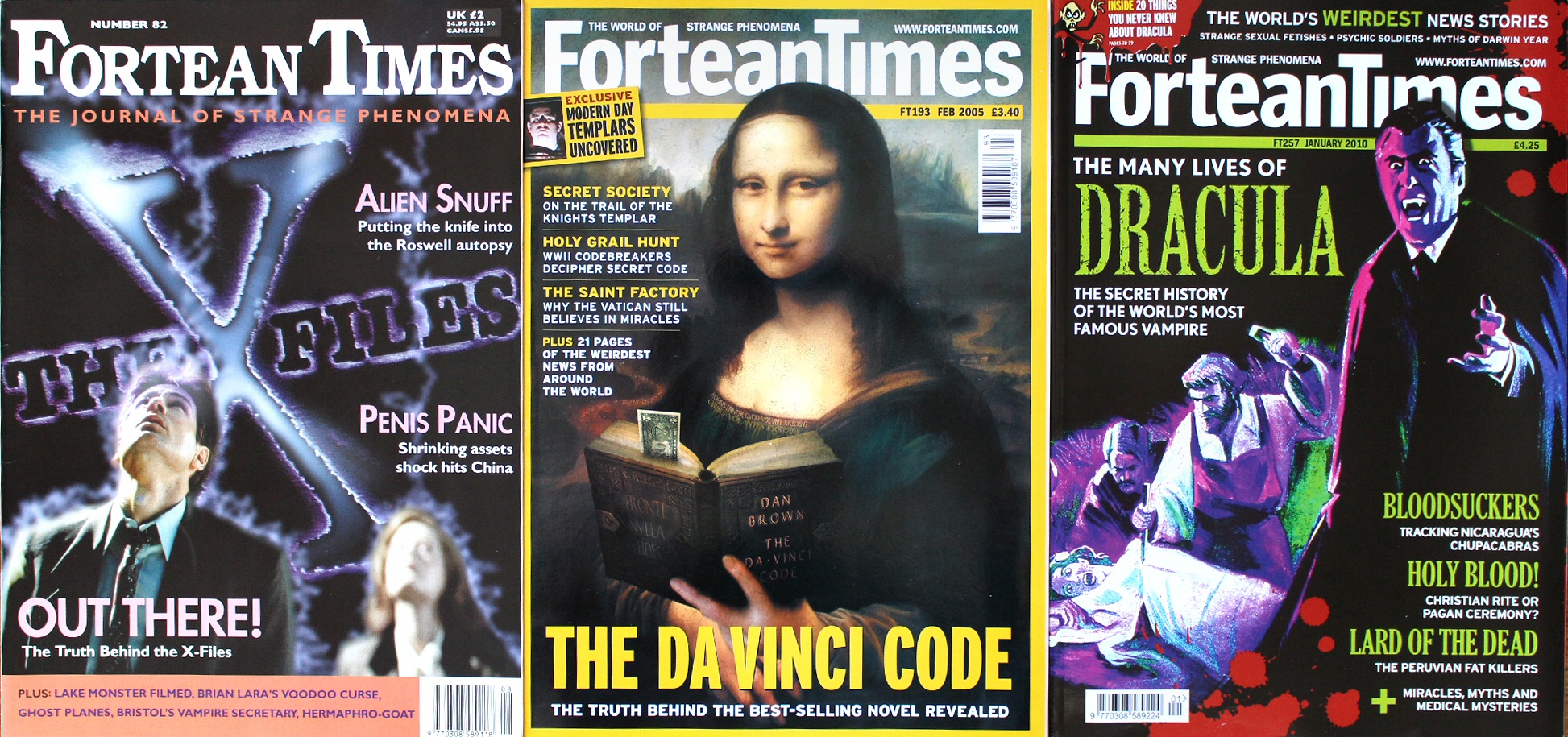
To start with some very obvious topics, there are the three shown above. The X-Files (FT 82, August 1995) was not only one of the most fortean TV shows of all time, but its first appearance in 1993 coincided with the wider distribution of FT to "mainstream" retailers like WH Smith, and almost certainly contributed to the magazine's popularity at that time. Around a decade later, Dan Brown's novel The Da Vinci Code (FT 193, March 2005) was a publishing phenomenon, bringing fringe theories that had previously been the realm of specialist writers (and FT contributors) like Lionel Fanthorpe and Lynn Picknett to a much wider audience. Just over a century earlier, Bram Stoker had done something similar in his novel Dracula - the title character of which went on to become one of the most recognisable and ubiquitous pop-culture icons of them all, as recounted in the cover feature of FT 257 (January 2010).

At a less obvious level, you can find references to popular culture in almost every issue of FT. Taking the one I discussed last week, for example - FT 73 from February/March 1994 - there's an interview with cult author William Gibson, generally credited as the originator of the cyberpunk genre. And I spotted something else in that issue, too: a book review by comics legend Alan Moore. I don't mean a review of one of his graphic novels - I mean a review written by him of someone else's work. Looking online, I see he actually did quite a few reviews for FT in those days - which pleases me enormously, as I've done over 40 of them myself. It's always nice to discover that you have something in common with a famous person!

Sticking with books and comics for a moment, here are three more covers that caught my eye. No apologies for a second appearance of The Da Vinci Code (FT 212 this time, from August 2006) - both because it's one of my favourite novels, and because I love the illustration on the cover. In addition to people like Picasso and Orson Welles, it features Da Vinci himself in the act of strangling Dan Brown! The middle cover (FT 256, December 2009) features Dennis Wheatley - best remembered today for The Devil Rides Out (the only one of his novels that I've read), although in his day he was Britain's most prolific author of occult fiction. Finally there's the only comics-themed cover I could find - FT 320 (November 2014), relating to the Fredric Wertham-inspired anti-comics paranoia than swept America in the 1950s.


I found a few shorter comic-related pieces on interior pages as well. The most interesting of these was an article in FT 277 (July 2011) called "The Morning of the Mutants", speculating that Stan Lee and/or Jack Kirby got the idea for the X-Men from the seminal (though now largely forgotten) fortean conspiracy book The Morning of the Magicians, written in 1960 by Louis Pauwels and Jacques Bergier. There's also a feature about Marvel Comics' Doctor Strange in FT 349 (January 2017, to tie in with the movie), which discusses the character's origin and fictional predecessors.

Regarding the "popular culture" of the mid-20th century, I can't resist mentioning a couple of pieces by myself - in fact the only two full-length feature articles I've had in FT. First there was "Fanthorpe's Fortean Fiction" (FT 297, February 2013) about the large number of mass-market paperback novels that Lionel Fanthorpe churned out in the late 1950s and early 60s. This was followed by "Astounding Science, Amazing Theories" (FT 355, July 2017), looking at fortean themes in the pulp science fiction magazines of the 1940s.

Pulp magazines were a huge part of popular culture in the first half of the 20th century, but - with a few notable exceptions - they're only of interest to die-hard fans today. Of those exceptions, perhaps the most important is H. P. Lovecraft, whose Cthulhu Mythos first took form in the pages of Weird Tales in the 1920s and 30s, before going on to develop a life of its own to rival that of Bram Stoker's Dracula. I found no fewer than three Lovecraft-inspired FT covers: FT 184 (June 2004), FT 369 (August 2018) and FT 390 (March 2020 - this one tying in with the movie adaptation of The Color Out of Space). Here they are:


As regards cult TV shows, I've already mentioned the most fortean of all, The X-Files - which not surprisingly made several further appearances after the one pictured at the top of this post (including FT 85 from February 1996, which had a rundown of all the fortean references in the show's first season). Three other TV-related covers are shown below, the middle of which - FT 215 from October 2006, celebrating 40 years of Star Trek - needs no introduction. The other two relate to the screenwriters (both with wider fortean interests than you might expect) behind two of Britain's most famous sci-fi icons: Kit Pedler, who created Doctor Who's second-most-famous villains, the Cybermen (FT 209, May 2006), and Nigel Kneale, creator of Professor Quatermass (FT 418, May 2022). The latter may no longer be a household name, but back in the 1950s he was really the first great TV sci-fi hero, in this country at least.


Turning to movies - I was spoiled for choice here, so I've picked out three covers that really speak for themselves. First there's a celebration of 50 years of Hammer Horror films (FT 223, June 2007), then a look at one of the mainstays of those films, Peter Cushing, on the 100th anniversary of his birth (FT 301, May 2013), and finally a 40-years-on retrospective about The Exorcist (FT 313, April 2014):

To be honest, my favourite thing about The Exorcist is the music - the snippet from Mike Oldfield's Tubular Bells that it uses, I mean - which brings me neatly onto the next subject. When I talk about "pop culture" on this blog, I most often mean fairly specialized things like pulp magazines, comics (from the pre-multimedia franchise days) and cult TV shows such as The X-Files. But to most people, pop culture means just one thing, and that's pop music. This is such a pervasive part of modern life that it's acquired a plethora of fortean connections - so much so that I'm going to split them into two distinct parts.

To start with, here are three cover features that deal with direct fortean influences on musicians. The first, from FT 88 back in July 1996, describes how various pop stars from David Bowie and Jimi Hendrix to Kate Bush and The Orb absorbed ufological and similar speculations into their music. Second, there's a somewhat more arcane take on the same subject by Ian Simmons (FT 244, January 2009), featuring the likes of Stockhausen and Sun Ra - a much-referenced source for my own book The Science of Sci-Fi Music. Finally, in the immediate wake of David Bowie's death, there was a cover feature about the numerous fortean influences on his work (FT 338, March 2016) - including the aforementioned Morning of the Magicians by Pauwels and Bergier.


Another aspect of pop music that's of fortean interest is the way weird conspiracy theories grow up around the subject. So to round off what I honestly believed would be a shorter-than-usual post when I started it, but has ended up as probably my longest ever - here are three cover features addressing this aspect. The one on the left (FT 166, January 2003) deals with the numerous legends and conspiracy theories associated with Elvis, while the one on the right (FT 384, October 2019) does much the same for the Beatles. As for the one in the middle (FT 258, February 2010), it concerns the notion that the "Illuminati" employ popular music - and the musicians themselves - to manipulate the thoughts, beliefs and behaviour of the general public. But that's not really a conspiracy theory, is it? I mean, if you substitute "global media" for "Illuminati", I'd say it's an indisputable fact.


Saturday, 23 March 2024

30 years ago in the Forteanverse


I decided to dig down close to the bottom of my Fortean Times collection to have a look back at issue 73 from February/March 1994, 30 years ago. As you can see from the picture above, its eyecatching cover features an enormous shark that's apparently crashed down from the skies into a suburban house. That's something that would undoubtedly have caught the attention of Charles Fort himself, who was fascinated by reports of fish (usually much smaller ones than this) falling from the sky. But this one, of course, is a fake - made from fibreglass, and created as an artistic statement in 1986. Located in the Oxford suburb of Headington, there's a lot more to be said about this shark - but fortunately I don't have to, because there's a detailed account of it on Paul Jackson's blog Random Encounters with the Unusual, together with several pictures Paul took himself in 2016. You can find his blog post here.

Opening the magazine and turning to the editorial, there's an item that really brings home just how much the world has changed in the last 30 years:
We now have an e-mail address on Internet ... which will mean nothing to those without a modem, but everything to the very strange people who cruise the computer bulletin-board and news services.
I'd forgotten until I read that, but there really was a time when anyone who used the internet was considered "very strange"!

As for the fortean content of the magazine, less has changed than you might think. One of the main features deals with phantom hitch-hikers and similar roadside ghosts, while another concerns rumours of large, out-of-place animals (such as the alleged Beast of Bodmin) roaming the British countryside. Those are exactly the kind of "modern folklore" stories that still loom large in the pages of FT today.

The magazine also contains the results of a reader survey, which I found particularly interesting for a subsection of questions about conspiracy theories. Thinking back, I was only just becoming dimly aware of the existence of such things in 1994 (largely thanks to FT itself), and I'd guess the majority of the wider population had never even encountered the concept yet. But FT readers were clearly way ahead of the game. Regarding belief in high-level conspiracies to suppress the truth about various subjects, here are some of the results:
  • Inventions that would undermine big business and government - 64.3%
  • Crashed UFOs being studied by the military - 52.3%
  • International conspiracies above government level, e.g. Illuminati - 39.6%

Towards the end of the magazine, my eye was caught by a rather dubious-looking ad for "2-way mirrors". On looking closer, I saw that the same firm was offering other equally questionable items such as skeleton keys and electronic bugging equipment, as well as advice on how to beat slot machines and avoid paying TV licence fees, parking fines, road tax etc. Somehow I doubt that a similar ad would be allowed today! So for posterity's sake, here it is (just to be on the safe side, I've blacked out all the company details):


Tuesday, 13 February 2024

Mainstream Media vs Fringe


Unlike some people who write on fortean topics, I don't see the mainstream media as an arch-villain. I used "vs" in the title of this post to mean "as contrasted with", rather than "fighting to the death against". Anyway, you can't get much more mainstream than the Observer and the Guardian, which are among Britain's most prestigious Sunday and daily newspapers respectively (particularly, I suspect, among more thoughtful and well-educated readers).

So I was enormously pleased when the Observer printed a two-page feature about space telescopes by me in last weekend's edition (as shown in the picture above), and then the same article was also posted for a much larger audience on the Guardian website under the title Cosmic Time Machines. That's undoubtedly the high point of my writing career to date, easily beating my appearance in BBC Science Focus magazine which I showed off about a few months ago.

But I'm equally proud of the fact that I've had 21 articles published in Fortean Times, not to mention 47 book reviews and a few other mentions. And I've contributed to several other "fringe" media in the past, including Edge Science magazine and the Mysterious Universe website.

I don't really see a distinction, or even any serious conflict, between the two. If you're passionately interested in unravelling the world's mysteries, why focus on UFOs, psychic powers and Bigfoot and ignore exoplanets, quantum gravity and AI (or vice versa)? Fortunately there are at least a couple of regular Fortean Times contributors who also write for the mainstream media, but they're very much in the minority. There are plenty of well-known writers on anomalous phenomena who seemingly show zero interest in a topic if it's perceived as being too "mainstream", which I find very sad.

Anyway, I don't want to turn this post into a rant. My main purpose was just to show off about my appearance in the Observer and the Guardian - which, as I said, marks the high point of my writing career to date. Hopefully that doesn't mean it's going to be all downhill from here!

Wednesday, 13 December 2023

The Fortean Influence on Science Fiction - book review


Pictured on the left above is my copy of the first issue of Unknown magazine, featuring Sinister Barrier by Eric Frank Russell - which I referred to as the first Fortean novel in a post on this blog back in 2011 (see also Pulp Forteana from 2014 for more on Russell). The book on the right, with the same picture on the cover, is a copy of Tanner F. Boyle's The Fortean Influence on Science Fiction, which Fortean Times sent me for review when it came out in 2021. My 5-star review duly appeared in FT 405, but having recently revived this blog it seems an obvious choice to reprint here. So without further ado, here it is:

With so much subject matter in common, from extraterrestrials and time travellers to ESP and alternate realities, it’s no surprise that the histories of forteana and SF are intertwined. Fortean Times, for example, might not exist if founding editor Bob Rickard hadn’t picked up the collected works of Charles Fort at an SF convention in the 1960s. The influence goes in the opposite direction too, from forteana to SF – and as the title indicates, that’s Tanner Boyle’s main focus in this book (though there’s a secondary theme too, which I’ll come to later).

It’s remarkable, given the high profile that SF enjoys today – and Fort’s relative obscurity – how much the genre owes to him. As Boyle says, “without Fort, SF’s development would have been radically different”. A similar sentiment was voiced by one of the giants of SF, Arthur C. Clarke, who spoke of the “tremendous impact” Fort’s writing had on the field. A classic biography of Fort, Prophet of the Unexplained, was written by SF author Damon Knight, who agreed that “Fort’s influence on other writers is incalculable”.

One reason for this influence is easy to trace. Early pulp magazine editors enthusiastically pushed Fort’s ideas at their readers and writers. Astounding Stories, for example, serialized the entirety of Fort’s third book, Lo!, in 1934. This was how many people, Clarke included, first encountered Fort. A subsequent editor of Astounding, John W. Campbell, described Fort’s writings as a “magnificent source-book and challenge to readers and writers of SF”, which “probably averages one SF or fantasy plot idea to the page”.

Interestingly, Fort himself started out as a fiction writer. Boyle describes one of his stories, “A Radical Corpuscle”, dating from 1906 – “involving a group of cells who become aware that they are living within another organism, a larger, cosmic body”. This seems to prefigure Fort’s suggestion that humanity is just a tiny part of a bigger picture, achieving its most striking form in his notion that “we are property”.

That quotation has inspired no end of SF stories. Among the first was Eric Frank Russell’s Sinister Barrier, whose appearance in Astounding’s sister magazine Unknown is illustrated on Boyle’s cover. As Bob Rickard has recounted (FT312:48-51), Russell was a key figure in the development of both forteana and SF, albeit one who is largely forgotten today. That’s hardly true of Russell’s younger protégé, Arthur C. Clarke, whose masterpiece 2001 a Space Odyssey is a more famous take on the “we are property” trope. For that matter, many of us first learned of fortean phenomena through Clarke’s Mysterious World TV shows in the 1980s.

Clarke is one of several authors that Boyle devotes a whole chapter to. Another is Philip K. Dick, much of whose work seems to come straight from a passage in Fort’s Book of the Damned: “Ours is a pseudo-existence, and all appearances in it partake of its essential fictitiousness.” Yet apart from a brief reference in an early story, “The Indefatigable Frog”, it’s not clear from Dick’s writing that he had any interest in Fort’s work per se. Fortunately, Boyle is able to set the record straight here. He quotes an email from Dick’s widow, Tessa, confirming that he “read and admired Fort’s work” and avidly consumed biographical material on Fort. Dick also corresponded with fortean author Brad Steiger in the wake of the “mystical experience” that led to his semi-autobiographical novel VALIS – which, as Boyle says, “does at many points read like a technologically updated rendition of Fort’s theories”.

A secondary theme running through the book concerns what Boyle dubs “maybe-fiction”, referring to imaginative speculations on SF-like subjects which are presented as the truth. An intriguing characteristic of maybe-fiction is the way different authors develop and build on each other’s ideas, creating what Boyle calls “a vast web of intertextuality”. The result, as well as being impressive enough to persuade believers, provides a handily exploitable framework for SF authors. A good example is the way alternative historical narratives created by writers like Erich von Daniken and Zecharia Sitchin – which Boyle describes as a “wellspring of creativity” – can inspire anything from Ridley Scott’s Prometheus to at least one Scooby-Doo plotline.

The boundary between fiction and maybe-fiction is a blurred one. When Charles Fort embarked on The Book of the Damned, he wrote that “I’ve given up fiction ... or in a way I haven’t. I’m convinced that everything is fiction, so here I am in the same old line”. By coincidence or otherwise, several of the most successful purveyors of maybe-fiction, from Donald Keyhoe and John Keel to Whitley Strieber and Jacques Vallée, also produced works of “real” SF.

All in all Boyle has produced an engrossing and eye-opening book, which is well-researched and painstakingly referenced, and written in much the same style as a Fortean Times article. Unfortunately it’s been packaged as an academic work, with a price tag to match (though the ebook is more affordable). But if your budget can handle it, and you’re interested in the parallel histories of forteana and SF, it’s definitely worth checking out.

Thursday, 7 December 2023

Gravitomagnetism - book review


In looking for things I could post on this blog, I found quite a few book reviews I've done that might be of interest here. I'll start with this review of Gravitomagnetism - Gravity's Secret by Ronald A. Evans, which originally appeared in Fortean Times #426 a year ago:
 
Back in 2015 I reviewed Ron Evans’s first book, Greenglow & The Search for Gravity Control (see this blog post), about his involvement in the now-defunct BAE Systems project that dipped its toes into that distinctly fringe area of physics. This follow-up book covers similar ground, but from a different perspective and with a somewhat different aim. Rather than recounting the specific history of the Greenglow project, Evans presents the reader with a pretty comprehensive and methodical account of all the physics – generally standard textbook stuff, but occasionally more speculative – that might be relevant to the holy grail of gravity control (like most serious researchers in the field, Evans dislikes the term “antigravity”, but there’s no escaping that’s essentially what he’s talking about).

I suspect this is the book Evans really wanted to write all along. His real passion is to instil an enthusiasm for the subject in others, and inspire top-class scientists and engineers to get into it. He’s unusual, possibly even unique, among the “alternative gravity” community in not having strongly held pet theories of his own. So you won’t find any really way-out ideas here, or a blanket denunciation of mainstream physics as “wrong” – just an indication of where there may be gaps in the latter that might lead to some kind of breakthrough in the future.

Evans explains in the introduction how the book evolved out of a lecture written for the general public, and a trace of this remains in the PowerPoint-type slides around which each chapter is written. But don’t expect a book where everyone is going to understand every word. Evans doesn’t hide the fact that physics is a difficult subject, and he isn’t afraid to give technical details where they’re needed. But it’s all good science, not made-up technobabble, and it doesn’t just focus on trendy topics like black holes, gravitational waves and quantum theory. There are chapters on older branches of physics that rarely make it into the public consciousness, such as thermodynamics, fluid mechanics and electromagnetism. That’s because Evans thinks these topics may be relevant to extended gravity, not so much directly as through analogous mathematics.

The technical asides notwithstanding, Evans keeps the ideas flowing in a way that makes for a surprisingly easy read. His aim, from the first page to the last, is to be thought-provoking – and he certainly succeeds in that.

Tuesday, 28 November 2023

Astrobiology


Having just written a post about the 50th anniversary of Fortean Times magazine, I can't resist pointing out that the latest issue (FT439) contains a really nice review by David Hambling of the new illustrated edition of my Astrobiology book. That's the book on the right in the picture above - the one on the left being the original paperback version, which, in David's words, was "reviewed with high praise by Mark Greener back in 2019 (FT387)".

Although astrobiology is a mainstream science these days, it has obvious overlaps with the world of forteana. As David says in his review, "Many of the topics, such as the SETI quest for alien signals, the Martian meteorite which may show signs of fossils and the enigmatic 'Oumuamua object which passed through the Solar System, have been covered in these pages." He also draws attention to the key feature of this new edition, which is that it's packed full of colour illustrations, "in particular gorgeous images from the Hubble and James Webb telescopes ... interspersed with pictures from science fiction sources, notably Star Trek and a number of alien contact movies". Here's a quick flick through it:


As I wrote on my other blog when the illustrated edition was published earlier this year, I had no real involvement in creating it, beyond updating the text in a few places and providing words for a few of the image captions. My real contribution was in writing the original paperback book, which I covered in earlier posts while I was writing it and after it was published. But since then, the book has acquired something of a life of its own - more so than any of my other books, anyway.

The Goodreads site currently lists 10 editions of the book, including audiobooks, ebooks and foreign translations (I particularly like the  highbrow-sounding subtitle of the French one: "A la recherche de la vie extraterrestre"). But there must be several more editions that that, because Goodreads (which is a subsidiary of Amazon) doesn't list non-Kindle ebooks, and for some reason doesn't include the English-language illustrated edition I'm talking about here. Even the latter exists in two distinct versions - the "British and Commonwealth" one pictured at the top of this post, and a "North American" one which looks very similar but has subtle differences inside. Here's my cousin's copy of it, complete with ludicrously cheap price sticker (she bought it as soon as it came out, so it's not like it's a discounted copy the retailer couldn't sell):


Sunday, 26 November 2023

50 Years of Fortean Times


Having got this blog back up and running, my next problem was to think of new things to write about. Since this month sees the 50th anniversary of the first issue of Fortean Times, it seems an obvious place to start.

Actually the magazine only carried the name "Fortean Times" from issue 16 onwards - prior to that, it was simply called The News. When its first issue appeared in November 1973, I was just short of 16 - i.e. old enough to have been interested in it if I'd known about it, but as it happened I was blissfully unaware of it. I believe the magazine's founding editor, Bob Rickard, was a member of the Birmingham Science Fiction Group, which I also joined around that time, so maybe I saw him there without knowing it (though I did get a brief but nice email from Bob many years later, as documented further down this post).

[Just as an aside before I forget - I did have one encounter at the BSFG with someone who, though now forgotten, was a big name in the fortean world at the time. This was Professor John Taylor, who was one of the first mainstream scientists to carry out laboratory experiments on Uri Geller and other people who displayed seemingly ESP-like powers. I attended a talk by him at the BSFG in April 1976.]

In common, I suspect, with many other people, I only really became aware of FT's existence in the early 1990s, after copies started to be distributed more widely to British newsagents. My first few issues (starting with #67 in February 1993, more than 30 years ago) are shown at the top of this post. Notice that the magazine's covers - by the brilliant and inimitable Hunt Emerson - were a lot livelier and more colourful in those days than they are today!

Over the years, I've made enough appearances in Fortean Times to consider myself a "regular contributor" to the magazine. To keep track of them (for myself if no one else), I've put a list of contributions on my website. So far they amount to 18 articles - mainly 1 or 2 page Forum pieces - and 46 book reviews, as well as 12 "letters to the editor", the first of them appearing way back in January 2001. But my personal high point came in June 2019, when FT printed David Clarke's interview with me about my time working in the Ministry of Defence (when I was peripherally involved in their UFO/UAP research). Here it is, complete with a photograph of me talking to a Russian scientist in Red Square (top picture on the right-hand page):


Returning to the subject of FT founder Bob Rickard, he's been mentioned quite a few times in previous posts on this blog, including a couple in the context of comic-book homages. The first (Fortean Agent of SHIELD) actually predates the founding of Fortean Times, coming from issue 12 of Marvel's Nick Fury, Agent of SHIELD, cover-dated May 1969. That particular issue's creators, Steve Parkhouse and Barry Windsor-Smith, were friends of Bob at the time and named one of the story's characters "Robert Rickard" after him.

The other comic-book connection I wrote about, in The Department of Fortean Events, relates to a 2000 AD story called "Shamballa", featuring the Judge Anderson character. Written by Alan Grant and Arthur Ranson, the story is reprinted in book form in Judge Anderson: The Psi Files volume 02. As I explained in that earlier post, "Doc Rickard" - an obvious homage to FT's founder - is a paranormal researcher at the "Department of Fortean Events" (which doesn't really exist, but ought to).

I mentioned earlier that I once received an email from Bob Rickard, and I'll get onto that now. Back in February 2011, I put a short video clip on YouTube showing a scene from a video game which namechecks FT. It's from a Sam & Max episode called "Night of the Raving Dead", in which Sam, inspecting a complicated-looking piece of equipment, says "I'd bet my lifetime subscription to the Fortean Times that that's an alchemy machine".

I sent the video link to FT editors David Sutton and Paul Sieveking, and one of them must have forwarded it to Bob - because shortly afterwards I received an email from him saying "Great - my kids loved the first Sam & Max adventures". Here's the clip in question:


There's another connection between FT and video games that I'm aware of, which I mentioned on my other blog in May 2017, shortly after this one went into hiatus. It's a cameo appearance by a (sadly fictitious) magazine called Freaky Times, in the game Barrow Hill: The Dark Path by my favourite team of adventure game developers, Matt Clark and Jonathan Boakes. In case the magazine's oddly familiar cover design isn't enough of a giveaway, Jonathan himself once described it as "a little nod to the Fortean Times". Here's his cover mock-up from the game:


Tuesday, 21 November 2023

Is Anyone Out There?


Is Anyone Out There?

It seems a fair enough question, as it's 7 years since I last updated this blog, so I'll be interested to see (from the viewing stats and any comments that may come in) if anyone actually sees this post. I've been far from idle in those years - I've had 5 more books published by Springer and another 5 by Icon Books, as well as writing over 70 magazine articles - mainly for How It Works (where I've contributed to almost every issue for more than four years now) but also Fortean Times, All About Space and even (my most "up-market" moment) BBC Science Focus magazine. I never actually stopped blogging, but only in the form of relatively brief announcements on my writing blog.

I've recently become a great fan of Bing's AI tools. For example, just now I typed in "A humorous UFO or alien themed cartoon that could be captioned Is Anyone Out There?" - and was presented with the picture at the top of this post. I didn't ask it to include a speech bubble, but it did anyway (its spelling was a bit off, but all the right letters were there so I just had to rearrange them).

Although I've drifted away somewhat from Forteana in the last few years, I still contribute to Fortean Times occasionally - including an article about AI and creativity in July this year. That was also the subject of the longest post I've done on my other blog, as well as a guest post I did for Kid Robson's comics blog. I was very grateful to Kid for the chance to do this (together with another guest post showing off some of my 1970s Marvel comics) as it started me thinking about the possibility of resurrecting this blog.

When I came to dust it off today, I was embarrassed to see no fewer than 18 comments (spread over the last 7 years) still awaiting moderation. I assumed the system would automatically notify me of these, but apparently that's not the case (I've now belatedly found where you have to tell it to do this in the settings). So apologies to all those people who had to wait years for their comments to appear!

Sunday, 9 October 2016

Pseudoscience and Science Fiction

It doesn’t seem that long ago (February and March this year) that I wrote a couple of posts featuring motley arrays of offbeat science fiction and pseudoscience books, which I described as research for a book I was writing. So I’m really pleased to be able to follow up those posts with the array of books pictured above – my author’s copies of Pseudoscience and Science Fiction, which has just been published by Springer. This is one of the world’s biggest academic publishers, based in Germany, and they really do have a very slick and streamlined system for getting books out quickly and to a very high professional standard.

I know what you’re thinking. Why should a prestigious academic publisher want to touch a book about such non-academic topics as pseudoscience and science fiction? Well, they do popular science books as well, and one of their ongoing lines is called Science and Fiction. Aimed at “science buffs, scientists and science fiction fans”, the series is a mixture of fiction (often written by professional scientists) and non-fiction. The latter primarily looks at the “real” science in science fiction, in a similar vein to some of Brian Clegg’s books (cf. From Science Fiction to Science Fact). But I felt there was a gap in the market that needed to be filled. What about the pseudoscience in science fiction? After all, pseudoscience is a lot more exciting – and much easier to understand – than real science, and hence much more fiction-friendly. On top of that, there are numerous examples of explicit interactions between science fiction and pseudoscience – much more than between either of those disciplines and academic science.

This is a subject I felt eminently qualified to write about. My house is filled with books, and perhaps two-thirds of them are science, pseudoscience or science fiction. Not to mention my vast collection of Fortean Times magazines, going back more than twenty years. I just searched the final text of Pseudoscience and Science Fiction for “Fortean Times”, and it appears 55 times in 180 pages! So I had great fun writing the book, and I really hope it will appeal to the target audience of “science buffs, scientists and science fiction fans”.

Here is the publisher’s blurb (I had nothing to do with the last paragraph!):
Aliens, flying saucers, ESP, the Bermuda Triangle, antigravity … are we talking about science fiction or pseudoscience? Sometimes it is difficult to tell the difference.

Both pseudoscience and science fiction (SF) are creative endeavours that have little in common with academic science, beyond the superficial trappings of jargon and subject matter. The most obvious difference between the two is that pseudoscience is presented as fact, not fiction. Yet like SF, and unlike real science, pseudoscience is driven by a desire to please an audience – in this case, people who “want to believe”. This has led to significant cross-fertilization between the two disciplines. SF authors often draw on “real” pseudoscientific theories to add verisimilitude to their stories, while on other occasions pseudoscience takes its cue from SF – the symbiotic relationship between ufology and Hollywood being a prime example of this.

This engagingly written, well researched and richly illustrated text explores a wide range of intriguing similarities and differences between pseudoscience and the fictional science found in SF.
For some reason the publishers put a 2017 date on the book, but don’t let that put you off – it’s out now. It’s available both as a paperback and an ebook, and there are lots of ways you can get hold of your copy. Here are a few links (the Amazon preview is particularly generous, if you want to get a flavour of the content and style of the book):

Sunday, 18 September 2016

Sacred Porn

As you can see from the screenshot above, I’ve been doing some more online research. Just why I decided to do a Google search for “walter fritz hotwife bareback gangbang porn” will become clear in due course. You’ll be relieved to see, however, that the search results are entirely Safe for Work. You can also see that it’s rather old news, dating back three months. However, I only belatedly encountered it in the latest issue of Fortean Times (FT 345, October 2016) – and I’m glad I did, because it’s part of an ongoing (and increasingly bizarre) saga that I’ve been following off and on for a quarter of a century now.

When I first joined the Civil Service in 1991, my boss was a loveable old bloke who was full of eccentric ideas (sadly he’s no longer alive). One of his favourite hobby-horses was the theory that Jesus was married to Mary Magdalene. At first I assumed this was his own idea (that was the way he presented it), but before long I discovered it was quite widespread in certain circles. I read about it in Fortean Times, and even saw a couple of talks on the subject at FT Unconventions. Then in 2003 Dan Brown put the idea at the heart of The Da Vinci Code and it entered mainstream consciousness.

In its most developed form (à la The Da Vinci Code), the theory goes way beyond Jesus simply being married. It holds that Tantra-style “sacred sex” rituals were at the heart of early Christianity, just as they are in certain forms of Buddhism, Hinduism, Taoism and many other non-western traditions. If true this would be an astonishing revelation – implying that all round the world, there is an inextricable and fundamental link between religion and copulation.

For a long time, this was just a fringe theory based on speculation and wishful thinking – with no real hard evidence. That suddenly changed in September 2012, when the religious historian Karen King (a professor at Harvard University, just like Robert Langdon in The Da Vinci Code) announced the discovery of “The Gospel of Jesus’s Wife”. Despite its grandiose title, this was really just a tiny, business-card-size scrap of papyrus bearing a few words written in an ancient Egyptian language called Coptic. But among those few words was the phrase “Jesus said to them, my wife” – potentially turning conventional Christian scholarship on its head.

Needless to say “The Gospel of Jesus’s Wife” was a controversial discovery. Harvard accordingly subjected the papyrus to a barrage of forensic tests – all of which indicated its authenticity. Strangely (from the point of view of an outsider), the one thing they didn’t bother to scrutinize was the back history of the fragment. Apparently the issue of “provenance” isn’t something academics normally bother about, so it was left to a journalist named Ariel Sabar to do the necessary detective work. His findings are written up in a long article in The Atlantic magazine – and this is where the story starts to get really bizarre.

After considerable effort, Sabar traced the original ownership of “The Gospel of Jesus’s Wife” to a Florida businessman and amateur Egyptologist named Walter Fritz. The exact nature of Fritz’s “businesses” – some of them at least – almost defied belief. I’m going to have to quote Sabar’s own words here, or you’ll think I’m making it up:
Beginning in 2003, Fritz had launched a series of pornographic sites that showcased his wife having sex with other men – often more than one at a time. One home page billed her as “America’s #1 Slut Wife”.
This was lucrative stuff – at one point about a third of the couple’s income was coming from porn site subscriptions. But it wasn’t just sex and money – there was a spiritual dimension too. Fritz’s wife told Sabar “that she was clairvoyant and had channelled the voices of angels since she was 17” ... and then added “I’m here to do God’s service”. Fritz claimed that during sexual intercourse his wife often muttered phrases in Aramaic – the language spoken by Jesus, which she had no conscious knowledge of.

Although Fritz talked openly about his sexual and pornographic activities, he continued to maintain that “The Gospel of Jesus’s Wife” was the real thing. But after publication of the Atlantic article his credibility seems to have taken a nose-dive, and even Professor King herself now considers that the papyrus is most likely a hoax.

And what about that sacred porn? Sabar says in his article that “all of the sites seem to have been taken down in late 2014 and early 2015 ... but archived pages and free images and videos were easy to find online”. This brings me back to my starting point – the Google search pictured at the top of this post. I tried all sorts of keywords drawn from Sabar’s article – but frustratingly they all led back to that article, or to things written about it. Of course some of the search terms threw up porn images, but nothing I felt sure was Walter Fritz and his Aramaic-channelling wife.

Sunday, 24 July 2016

The Enfield Haunting

First shown on subscription TV last year, the mini-series The Enfield Haunting was repeated on free TV a few weeks ago. Unfortunately it always seemed to be scheduled at awkward times, so I got fed up waiting and splurged £6.99 on the DVD. I’m really glad I did – it’s by far the best fortean-themed “based on real-life events” dramatization I’ve seen to date.

The usual problem with this genre is that the events in question are either 100% anecdotal or else utterly banal. That’s certainly not true here, where the case – more commonly referred to as “the Enfield poltergeist” – was exhaustively documented by means of photographs, audio recordings and multiple eyewitness testimony. Taking place in a north London council house in 1977-78, it was essentially a working-class version of The Exorcist, focused around a highly strung schoolgirl, her divorced mother and her three siblings.

I don’t know a huge amount about the case, but as far as I can tell the dramatized version sticks to the facts pretty faithfully. The characters are all based on real people, and the general sequence of events – including the bringing-in of psychic investigators and the intense interest of the tabloid media – is also true to life. No doubt events have been streamlined to some extent to make a more coherent story, and the main characters have been embellished to make them more interesting. However, the basic motivations of the two investigators – the eagerly credulous Maurice Grosse, who’s desperately looking for evidence of life-after-death, and the more cynical Guy Lyon Playfair, who just wants material for a new book – probably aren’t too wide of the mark.

The production is very British in its focus on acting and dialogue, as opposed to the traditional Hollywood reliance on screaming and special effects. The pivotal character of Maurice Grosse is played by Timothy Spall, who I became a fan of when I saw him in Mr Turner last year. Not that I imagine for a moment that the real JMW Turner was anything like as weird and interesting as Spall’s portrayal of him – and I’m sure the same is true of the late Maurice Grosse!

The Enfield Haunting also differs from more traditional horror movies in maintaining a fortean ambiguity as to what is actually going on. While some of the events do seem to be genuinely paranormal, others appear to be deliberate attention-seeking, and still others may be the involuntary result of emotional or behavioural problems, like a kind of super-Tourette syndrome. Or maybe it’s a mixture of all three. Having dug out some old Fortean Times articles – I found one by David Sutton from 2003 (FT166:39), one by Guy Lyon Playfair from 2007 (FT229:58-59) and one by Alan Murdie from 2012 (FT 288:18-19) – that seems to be pretty much the consensus about the real Enfield poltergeist, too.

With its setting in the late 1970s, The Enfield Haunting is a potentially perfect piece of retro-forteana. However, while I didn’t notice any actual anachronisms, I didn’t get a really strong sense of a “period drama” set four decades in the past either. I was worried this was an indication of just how behind the times I am (I mean, 1977 really does seem like yesterday sometimes) – but in one of the DVD extras the producers explain that they made a deliberate decision to understate the seventies setting, because it would have been a distraction from the serious story they wanted to tell.

As far as I can recall, this is the first time I’ve seen an on-screen actor portraying someone I’ve seen in real life. Matthew Macfadyen’s performance as Guy Lyon Playfair is a great foil to Timothy Spall’s Maurice Grosse – although I’m sure the real-life Playfair was never as snottily pretentious as Macfadyen plays him! Anyway, I saw the real Guy Lyon Playfair speaking at a paranormal conference in Bath a few years ago. Unfortunately it was too dark to take a decent photo while he was speaking, although I got a better shot of him as he was returning to his seat afterwards:

Sunday, 13 March 2016

The Return of the Lone Gunmen

The new X-Files episodes are being shown in the UK (on Channel 5) a few weeks after their US airing. Last week’s episode, called “Babylon”, was notable among other things for a brief cameo by the three Lone Gunmen characters from the original series. Sadly, it really was only a fleeting glimpse – I almost missed it on Monday and had to watch it again on catch-up the next day (I also had to see Agent Einstein again, but that’s another story). The official publicity shot, pictured above, shows the characters more clearly – from left to right: Byers, Frohike, Langly (by coincidence all three of them are wearing bolo ties, which I mentioned in Green-skinned nostalgia two weeks ago).

I have very fond recollections of the Lone Gunmen. Partly this is nostalgia for a time when only a small number of highly eccentric individuals, such as these three, believed in conspiracy theories (as opposed to half the internet today). Also they are among the very few TV stars that I can really identify with (I like to think I combine Byers’s scintillating personality, Frohike’s stunning good looks and Langly’s impeccable fashion sense).

Actually I really do have a rather tenuous connection with Byers – or rather with Bruce Harwood, the actor who played Byers. If you look back at the December 2002 issue of Fortean Times, then on page 52 (the letters page) you will see the names “Bruce Harwood” and “Andrew May” in close proximity to each other. How this came about is a rather long story, but it’s an interesting one – so here it is.

Back in 2001, the Lone Gunmen briefly had their own TV series as a spinoff from The X-Files (see the publicity image at the bottom of this post). I saw most of the episodes when they were shown in the UK the following year on the Sci-Fi Channel – with the exception of the pilot show, which was missing from the UK run. I found a full transcript of that episode online, and it reads like a fictionalized version of a fairly standard 9/11 conspiracy theory… except that it had aired in the US six months before 9/11. This bizarre coincidence wasn’t mentioned when Fortean Times ran their first article on 9/11 conspiracy theories in September 2002, so I sent them the following letter:
The pilot episode of the Fox TV series The Lone Gunmen, which first aired in March 2001, involved a conspiracy theory as persuasive as anything which emerged post-9/11. In that episode, the Lone Gunmen (three characters who will be familiar to viewers of The X-Files) uncovered a plot by a group of Pentagon officials who were unhappy with the decline in defence spending following the end of the Cold War. The plotters seized control of a domestic airliner en route from Washington DC to Boston (not by hijacking it, but by hacking into its flight control computer), and set it on a collision course for New York’s World Trade Center. Their reasoning was that in the wake of such a high-profile atrocity, extremists around the world would be quick to claim responsibility, an outraged government would declare an all-out war on terrorism, and defence budgets would soar. In the TV version, the Lone Gunmen foiled the plotters, saving the plane and the Twin Towers. Tragically, in the real world six months later there was no such happy ending. Whether or not the US military/industrial complex really was behind the attacks, there’s no denying that it’s profited from them. The pilot episode was omitted from the Sci-Fi channel’s UK run of The Lone Gunmen, but a full transcript can be found at http://www.insidethex.co.uk/transcrp/tlg179.htm
As it turned out, Bruce Harwood sent them a letter saying pretty much the same thing. Needless to say, the intimate perspective he was able to offer meant they printed his letter in preference to mine. He concluded by saying “I think it’s safe to say that our pilot … will never be seen on network television anywhere. Ever.” – after which they printed the last sentence of my letter.

I was more than happy with this result. It was only the second time I’d had something of mine printed in Fortean Times – and it linked me with one of my favourite characters from the X-Files!

Sunday, 6 March 2016

What Makes a Great Physicist?

The latest issue of Fortean Times (FT338, March 2016) includes my review of the book pictured above (the one in the middle – the other two are shameless self-promotion): Ten Physicists Who Transformed Our Understanding of Reality by Rhodri Evans and Brian Clegg. As I say in the review, it’s an excellent choice of title. Far too many people dismiss physics as boring and irrelevant, without stopping to think how much it’s changed the Western World’s collective view of reality. If you think of a “planet” as a world like the Earth, rather than a tiny dot of light in the sky, then you’re subscribing to a worldview that simply didn’t exist before Galileo and Newton came onto the scene. The everyday technology most people take for granted – wifi, capacitive touch screens, GPS, fibre broadband, lithium-ion batteries – could never have been developed without the groundwork laid by physicists like Faraday, Maxwell and Einstein.

One thing I nobly refrained from doing in my review was to criticize Rhodri and Brian’s choice of “top ten”. I honestly don’t think that’s a particularly worthwhile thing to do. On the other hand, once a challenge like that has been laid down it’s difficult to resist – so I’m going to rise to it anyway (this is my blog, after all).

As it happens, the ten physicists in the book weren’t chosen by the authors – they’re taken from a top ten list published in the Observer newspaper in 2013. If the aim is simply to produce a list, rather than to write a book, then maybe you can just go for the people you think did more than anyone else to “transform our understanding of reality”. Even by that criterion, though, I’m not sure I agree with everyone on the list (and neither does Nobel-prizewinning physicist Steven Weinberg, in his foreword to the book). When you’re writing a book, however, there are potentially other criteria to consider besides how important a person’s contribution was.

Another thing I said in the review was that “any book of this type is going to involve a mix of biography and popular science” … and if anything, this book is biased toward the former rather than the latter. If you’re writing biographies, you really want subjects who are “interesting” as well as “important”. The two physicists in my Pocket Giants books – Newton and Einstein – certainly fall in both categories. I can’t imagine they would be missing from anyone’s top ten – and the same is true of Galileo, Faraday and Marie Curie.

The only name that is unambiguously up there with those five in terms of importance is James Clerk Maxwell. As I pointed out not long ago, Maxwell is strangely unknown to the public at large, even though the modern high-tech world arguably owes more to him than any of the other five. The fact is, though, Maxwell simply wasn’t very interesting. He didn’t argue with the Pope (like Galileo), didn’t dabble in alchemy (like Newton), wasn’t the son of a blacksmith (like Faraday), didn’t have a sex life that made tabloid headlines (like Marie Curie) and wasn’t an outspoken political campaigner (like Einstein).

Boring or not, no top ten list can seriously omit Maxwell. On the other hand, I would replace another notoriously boring physicist – Paul Dirac – with his much more exciting contemporary Erwin Schrödinger (who I wrote about for 30-second Quantum Theory). Not only was Schrödinger a nicer and more interesting person than Dirac, but I can just about understand his version of quantum theory (which is more than can be said for Dirac).

Replacing Dirac with Schrödinger addresses another mildly embarrassing thing about Rhodri and Brian’s list – six of their ten are from English-speaking countries. Partly for that reason (and also because he wasn’t so much a great physicist as “in the right place at the right time”) I would ditch Lord Rutherford. It’s not obvious who to replace him with, but Steven Weinberg’s suggestion of Ludwig Boltzmann is as good as any. That would address another deficiency of the list, namely that it focuses exclusively on reductionist physics rather than the equally important physics of macro-systems.

Finally, I would reinstate the person who is most conspicuously absent from the list – Stephen Hawking. He is far and away the best known physicist of modern times, even if not the most significant (the authors say “there are a whole host of other physicists who didn’t make the cut who would be placed above Hawking by anyone who knows the field”). But as I said, my criteria include “interesting” as well as “important” … so Stephen Hawking pushes Richard Feynman out of the chronological tenth spot.

To summarise (if anyone cares) my list is: Galileo, Newton, Faraday, Maxwell, Boltzmann, Marie Curie, Einstein, Bohr, Schrödinger, Hawking.

Sunday, 8 November 2015

The Department of Fortean Events

In a blog post last year I mentioned that issue #12 of Nick Fury, Agent of SHIELD featured a character named “Robert Rickard”, in a deliberate homage to the founding editor of Fortean Times – who was a friend of the comic’s creators, Steve Parkhouse and Barry Windsor Smith. In the comment thread, reader B. Smith (presumably not the same B. Smith) pointed out that a “Doc Rickard of the Department of Fortean Events” also appeared circa 1990 in a Judge Anderson story called Shamballa, by Alan Grant and Arthur Ranson. This was reprinted in Judge Anderson: The Psi Files volume 02, which I finally got round to buying last week when I saw a reduced price copy in Forbidden Planet.

Doc Rickard is the old man seen talking to Judge Anderson in the excerpt above. She seeks his assistance after the world is hit by a sudden spate of Fortean events – including stigmatics in Rome, phantom hounds in London, a Manticore in Jakarta and a Bunyip in Australia. There are references to Doris Stokes, the Turin Shroud and the Tower of Babel, while Anderson herself witnesses a “pre-Columbian meteorite” break apart to reveal a living a toad entombed inside it. The villains of the story are called “deros” – degenerate human beings who live in underground caves and tunnels. The word “dero” is an obvious reference to the Shaver Mystery, although Shaver’s deros were huge, obese and sexually decadent, whereas the deros in the comic are more zombie-like – dressed in rags and physically emaciated.

There are several other stories in the collection besides Shamballa, including another very Fortean one called Childhood’s End. This has no connection to Arthur C. Clarke’s novel of the same name, but it does have the Face on Mars, ancient aliens and references to Zecharia Sitchin’s theory of Anunnaki and Nephilim. And the art, by Kevin Walker, portrays a much sexier-looking Judge Anderson than Arthur Ranson’s version.

Although I found the stories interesting, I can’t say I really enjoyed them. I was never a big fan of Fleetway comics – for some reason they always struck me as gloomy and political (even when they weren’t). It’s all a matter of personal taste… and as far as comics are concerned, personal taste usually boils down to what you thought was cool when you were 15 or 16. Which brings me to another purchase I made in London last week – the first issue of a black-and-white horror anthology called Devilina, from Atlas-Seaboard comics.

I wouldn’t be surprised if you’ve never heard of Atlas-Seaboard comics. They were only active for a few months during 1975, but that just happened to coincide with the peak of my interest in comics fandom – and the new company created a huge buzz at the time (the whole story of Atlas-Seaboard is a fascinating one – here’s an excellent article on the subject). Most of their output consisted of colour comics aimed at challenging Marvel (which were the ones I bought at the time) – but they also produced a few black and white titles to rival Warren magazines such as Creepy, Eerie… and Vampirella, which is where Devilina comes in.

Having finally bought it 40 years after it came out, I really enjoyed Devilina #1. It’s fairly typical of horror anthologies of that vintage, both in terms of stories and artwork. It has its share of Fortean themes, too, with a story about people being reincarnated in animal form, another about a man who becomes convinced his life is controlled by aliens, and a nice moral tale about a mermaid taking revenge on a group of sailors who gang-raped her (and then saving the man who saved her). And as shown below, there’s a neat adaptation of Shakespeare’s Tempest (probably his most Fortean play – see my short ebook Paranormal Shakespeare).