Search This Blog

Showing posts with label military technology. Show all posts

Sunday, 10 July 2016

Out-of-place Pterodactyl

With the Farnborough airshow coming up next week, I thought it would be a good opportunity to dig out this little curiosity. It’s the coat-of-arms of the Royal Aircraft Establishment, which occupied the Farnborough airfield site for more than 70 years. Where you might expect an eagle to be sitting on top of it, instead there’s an extinct flying reptile from the Jurassic period – a pterodactyl!

I’ve always wondered about the reasoning behind the pterodactyl symbolism. As far as I can tell it really is a pterodactyl, not the later and much more impressive pteranodon of the Cretaceous period. A pteranodon was a gigantic creature, almost the size of a small aircraft, and might indeed make a good mascot for an aeronautical research establishment. But a pterodactyl was only about the size of a seagull, which isn’t going to impress anyone (except for Peter Harriman, of course).

The Latin inscription at the bottom reads ALIS APTA SCIENTIA, which according to Google Translate means “wings suitable for science”. So maybe a pterodactyl was seen as somehow “more scientific” than an eagle? That makes sense, I suppose, since everything we know about pterodactyls comes from the science of palaeontology.

A Google search didn’t shed any more light on the subject, although I did find an auction item with the following description: “A large armorial crest formerly on the South Gate at the Royal Aircraft Establishment, circa 1930s – 1950s, of heavy cast aluminium with intaglio relief design incorporating a pterodactyl surmounting a helmet and shield motif with foliate border and motto inscribed Alis Apta Scientia”.

During the First World War, the government-owned Royal Aircraft Factory designed and built a number of aircraft types – the best known being the SE5a fighter. However, private companies complained it was unfair to make them compete for government contracts against the government itself, so in 1918 the Royal Aircraft Factory became the Royal Aircraft Establishment – and refocused its attention on research rather than production. Nevertheless, it still played an important role in the development of the jet engine, the Concorde supersonic airliner and Britain’s one and only space launcher, Black Arrow. In 1988 it briefly and rather pointlessly changed its name to the Royal Aerospace Establishment, before merging into the Defence Research Agency three years later.

Sunday, 3 July 2016

The Museum of Witchcraft and Magic

This has to be one of the most fortean items I’ve ever seen in a museum – a spoon that was supposedly bent “with mind power” by Uri Geller! I spotted it last week amongst countless other fascinating objects in the Museum of Witchcraft and Magic in Boscastle, Cornwall. This was my second visit there – I went five years ago (see this blog post), but that was on a very busy day and the milling crowds made it difficult to see everything properly. It was much quieter last week and I managed to see a lot that I missed the first time – including Uri Geller’s spoon.

Other items on display include mediaeval books on witchcraft (including Saducismus Triumphatus, which I’ve written about before), protective charms used by soldiers in the 1st and 2nd world wars, Ouija boards, a large collection of magical artifacts that belonged to Gerald Gardner (the founder of modern Wicca), and several dead cats that had been walled up inside houses to keep the rats away. To top it all, there’s a “sex magic” display featuring a large number of little dicks (at least twice as many as I managed to get in this photo):
Actually the main reason I wanted to go to that part of Cornwall was to visit a much newer and less well known museum just a few miles from Boscastle – the Cornwall at War Museum. It’s off-topic for this blog, but highly recommended for anyone interested in 20th century military history. It’s a big place, occupying more than a dozen recently renovated buildings at what used to be RAF Davidstow. There are two full-size aircraft (a Hawker Hunter and a Fairey Gannet), several torpedoes, missiles and target drones, and loads of smaller items.

In one building I spotted an R1155 radio similar to the one I own (cf. the post about my various Museum Pieces). More surprisingly, in a different display in the same building I saw another very familiar object. This is something I’ve had since I was 12 years old, when I inherited all my father’s junk after he died. It’s nothing special – just a camera controller from a photo-reconnaissance aircraft – but I’ve always wondered exactly what period and what type of aircraft it came from. Unfortunately the one in the museum is unlabelled, although it appears to be identical to mine (as you can see from the two photos below). However, an online search yielded this page which includes a picture of one inside a 1950s-era Canberra PR.3/7.

Sunday, 26 June 2016

WHAAM!

The new extension to the Tate Modern museum opened last week. I only need the slimmest of excuses to visit London, so I went to see it. The new part (called the Switch House) mainly houses contemporary art installations, while the original building (which used to be Bankside Power Station) contains older works of “modern art”. Prominent among the latter is Roy Lichtenstein’s iconic painting WHAAM!, pictured above. This was far and away my favourite item in the whole museum – not surprisingly, given the irresistible combination of comic-book nostalgia and military aircraft nostalgia!

Roy Lichtenstein was a controversial artist, because so many of his paintings copied the layout of published comic-book panels (for numerous examples, see this page). But I think it’s wrong to belittle his work for this reason. Yes, it’s a shame that the original artist goes uncredited, but the artistic medium, display context, gigantic size and sheer painstaking precision of Lichtenstein’s works make them totally different from the original (a fact that isn’t always clear when you see small side-by-side comparisons on a web page). In any case, the comic-book industry is much more relaxed about the "swiping" of panel layouts than it is about, say, the unlicensed use of lucrative franchise characters.

The display caption to WHAAM! states that it is “based on an image from All American Men of War published by DC comics in 1962”. But looking at its Wikipedia entry the situation is a little more complicated than that. The basic layout (including the words “I pressed the fire control and ahead of me rockets blazed through the sky” and the sound effect “WHAAM”) does indeed come from a single panel in All American Men of War #89. However, the American aircraft in that panel is clearly a jet – probably a Korean-vintage F-86 Sabre. The plane in Lichtenstein’s painting looks more like a P-51 Mustang – and Wikipedia makes a good case for that being taken from a panel in the following issue, #90. Lichtenstein’s victim aircraft is noticeably different from either of those panels – Wikipedia suggests it comes from #89 again, but from a different story in that issue. Whatever sources Lichtenstein used, I still think the result is one of the greatest works of art of the 20th century.

As regards the new Switch House, I have to confess that most of the items on display went over my head. For the most part I mean that figuratively, but the small object pictured below was literally over my head ... because it was hanging from the ceiling in one of the rooms (sorry it’s out-of-focus – my camera was on maximum digital zoom). Regular readers will know I have an uncanny ability to spot things that “look a bit like a dick” (see for example this statue of Balzac or these 1940s comic-book aliens). The work pictured below is a sculpture by Louise Bourgeois entitled Fillette, which is French for “little girl”. I guess that’s what it’s meant to depict ... but it still looks like a dick to me.

Sunday, 8 May 2016

A Low Budget Flying Saucer

 Here are some pictures of an odd little vehicle I saw at the Helicopter Museum in Weston-Super-Mare last week. It struck me as looking like the kind of cartoony flying saucer the Jetsons or Marvin the Martian might be see in. My previous visit to the museum was 12 or 13 years ago, and while most of the displays were just the same as last time, I don’t remember seeing this one. Either it was in storage, or else I blinked and missed it. That’s possible, since it’s half-hidden behind a screen in the far corner (possibly out of embarrassment – it’s like the airborne equivalent of a Sinclair C5).

According to the display placard, the Westland WG33 was a proposed short-range, two-seat helicopter that could be flown by inexperienced personnel and would cost less than £30,000 per unit. It was considered for use as an aerial observation platform by both the British and U.S. army in the late 1970s, but never got to the stage of a flying prototype. This full-scale mock-up was donated to the museum when the project was declassified in 1980.

Sunday, 11 October 2015

More Oddities of the Jurassic Coast

The latest issue of Fortean Times (FT333) has just gone out to subscribers, and will be in the shops next Friday. If you turn to the back of the magazine, the regular Fortean Traveller feature consists of an article by Paul Jackson and me called “Oddities of the Jurassic Coast”, based on excerpts from our new book Weird Wessex. Due to space limitations the article only includes a few of the places on the Jurassic Coast (or the Dorset and East Devon Coast World Heritage Site, to give it its less exciting official name) that are mentioned in the book. So here are a few more…

The picture at the top of this post shows Monmouth Beach in Lyme Regis. Today it’s a popular spot with holidaymakers and fossil hunters, but back in June 1685 it was the place where the Duke of Monmouth landed with his distinctly unimpressive “invasion force” of 82 men. Monmouth was the illegitimate son of Charles II, who died 4 months earlier. When the Crown passed to the unpopular James II, Monmouth decided to try to seize it by force. After recruiting a few followers in Lyme Regis he proceeded northwards, gathering more “troops” along the way – mainly young farmworkers armed with sickles and pitchforks! Monmouth’s haphazard rebellion came to a bloody end a few weeks later at the Battle of Sedgemoor (also described in Weird Wessex) – the last full-scale battle fought on English soil. After the defeat, twelve of the rebels who had been recruited in Lyme Regis were publicly executed on Monmouth Beach.

By the early 19th century the area to the west of Monmouth Beach was packed with market gardens, orchards, sheep and pig farms and hazel coppices – all perched on top of the towering Jurassic cliffs. Then in the space of a few hours on Christmas Day, 1839, the whole thing came crashing down in one of the biggest landslides in recorded history. An estimated 8 million tonnes of rock and earth collapsed into the sea, along a stretch of coast about four miles long.

All that carefully cultivated farmland was lost forever. In its place was a rocky, barren landscape the like of which had never been seen before. Within weeks, people were travelling from miles away to view the scene. The local farmers, sensing a way to cut their losses, quickly began charging visitors sixpence to enter their fields! The ultimate cause of the landslip was underground water loosening the clay on which the upper rock strata sat. Some geologists at the time realised this, but many ordinary people believed it was an earthquake – possibly even the wrath of God!

The area of the landslip, which became known as the Undercliff, was too unstable for human cultivation. Since the middle of the 19th century it has been left in the hands of nature, resulting in the closest thing to a jungle that it’s possible to find in modern-day England. The 800-acre site is now a National Nature Reserve, only accessible from two points, about five miles apart, that are joined by a long, winding footpath. It’s difficult to take photos that give a sense of the huge scale of the site, but here is a montage that attempts to give a flavour of it:
In 1859 a commission set up by the Prime Minister, Lord Palmerston, recommended that a sprawling complex of fortifications should be built along the English coast to deal with a possible invasion from France. These are collectively known as Palmerston’s Follies, since by the time they were finished the threat of a French invasion had long since vanished. Several of Palmerston’s Follies are featured in Weird Wessex, including Brean Down Fort in Somerset and the Portsmouth sea forts in Hampshire. But one of the most impressive is to be found on the Jurassic Coast, on the Isle of Portland. It’s called the Verne Citadel, located 500 feet above sea level at the highest point of the island. This has been a strategically important site since the Romans built their own fort there. Its Victorian successor is a monumental edifice – 56 acres in area, surrounded by a deep moat and designed to house a thousand troops, with heavy artillery pointing out to sea on three sides. It was later converted into a prison.

The Verne Citadel was built from local Portland stone – the same building material used in Buckingham Palace and St Paul’s Cathedral. In the case of the Verne, even though the stone didn’t have far to travel, a huge amount of it was needed. The free-standing rock pillar known as Nicodemus Knob (pictured below) shows the extent of the quarrying that was required – all the surrounding stone was cut away for use in Palmerston’s fortress.
A few hundred metres from the Verne is the High Angle Battery, built in the late 19th century as an additional defence for Portland Harbour. The complex also incorporates an underground laboratory, a large bombproof shelter and a network of tunnels – the latter reportedly harbouring a number of ghosts!

This is just a small sampling of the many strange facts contained in Weird Wessex. You can get your copy (as a paperback or Kindle ebook) from Amazon UK, or at the special price of just £10 direct from CFZ Publishing.

Sunday, 13 September 2015

Pound-Shop Forteana

Here are two DVDs I bought for just a pound each (obviously) in a Poundland store last week – The Dyatlov Pass Incident and Skinwalkers. Both movies are based on true events of the Fortean kind. I first heard about Skinwalker Ranch at a talk by Ian Simmons at the Fortean Times Unconvention in October 2004, while the Dyatlov Pass incident made the cover of FT245 in February 2009. Both films were released in 2013, so the fact they’re already being sold at a massive discount suggests that perhaps they’re not very good. In the case of Skinwalkers that’s true – it might have made an enjoyable video game, but as a feature film it’s simply atrocious. On the other hand, The Dyatlov Pass Incident is a brilliant, five-star, film – the best low-budget horror movie I’ve seen in a long time.

Both films take the form of “found footage” following the disappearance of a team that set out to investigate the mystery in question. In the case of Skinwalker Ranch it’s essentially a modern take on the “haunted house” theme – with the usual ghosts, poltergeist phenomena and spectral hounds joined by UFOs, ancient aliens and animal mutilations. In the movie the ranch is being investigated by a group of professional paranormal researchers, and one of the few positive things I can say about it is that the entire cast looks the part (i.e. unattractive social misfits with no discernable personality). Their behaviour is anything but professional, though – the film belongs to the visceral school of horror, with large amounts of screaming and very little in the way of ratiocination.

The Dyatlov Pass Incident is a different matter altogether. To start with, the central mystery is far more intriguing. Instead of a rambling mashup of subjective phenomena occurring over an extended period of time, it’s tightly focused on one specific incident that left real physical evidence (nine dead bodies, to be precise). The aforementioned Fortean Times article, from 2009, began as follows:
The story sounds like something out of a low-budget horror movie: nine young students go on a skiing holiday in Russia’s Ural Mountains but never return. Eventually, their bodies are discovered – five of them frozen to death near their tent, four more bearing mysterious injuries – a smashed head, a missing tongue – buried in the snow some distance away. All, it seems, had fled in sudden terror from their camp in the middle of the night. [...] At the time, seemingly baffled investigators offered the non-explanation that the group had died as a result of “a compelling unknown force” – and then simply closed the case and filed it as “Top Secret”.
The incident took place in February 1959; the FT article coincided with its 50th anniversary. There are several factors that make Dyatlov Pass one of the 20th century’s most intriguing Fortean mysteries. What was the “compelling unknown force” that caused the students such terror? Why did the deaths from hypothermia occur before – not after – the deaths from crushing physical injuries? Why did several of the bodies show signs of radiation damage? What were the mysterious orange lights seen in the sky around the time of the incident? Most intriguingly of all – why did the Soviet military (this was during the Cold War, remember) stamp the case Top Secret and close the area off to civilians?

The film follows a group of American students who attempt to follow in the footsteps of their Russian predecessors – only to suffer the same fate. This is a much more cerebral film than Skinwalkers – with intelligent, educated characters who think things through and don’t do very much screaming at all. It has a strong plot – unexpectedly so for this type of film. The viewer is presented with a number of obvious choices (Was it a UFO encounter? Was it a Yeti-like creature? Was it a natural accident that has morphed into something more sinister through folklore and misinterpretation?)... and then – culminating in one of the most perfect twist endings I’ve ever seen – the movie comes up with a completely different, even more satisfying, explanation of its own. There’s a fine line between whetting the appetite and spoiling the plot, so I’ll just say “Philadelphia Experiment” and leave it at that.

Sunday, 7 June 2015

A Fortean Episode of Columbo

There are two types of 1970s nostalgia: the kind you remember if you were around at the time, and the kind everyone remembers – even people who weren’t born yet. Most of the “TV heroes” featured in the one-shot magazine pictured above (undated, but I would guess 1974 or 1975) fall in the first category, but Columbo is a perfect example of the second. Originally just one of a rotating series of Mystery Movie titles (together with Banacek, The Snoop Sisters, Macmillan & Wife and several others), Columbo episodes continued to be reshown, year after year, long after the others were forgotten. Today in the UK, Columbo reruns can be seen regularly on both ITV and Channel 5.

The original Mystery Movie series ran from 1971 to 1978, but Columbo was sufficiently popular that it was brought back for several more seasons starting in 1989 (the original series aired in the USA on the NBC network and in the UK on ITV; the revival was shown on ABC in America and on Sky in Britain). The first episode of the new series, “Columbo Goes to the Guillotine”, is described at IMDb as follows: “An egocentric psychic murders his old mentor, a magician charged to expose him as fraud, by beheading him while he’s rehearsing his guillotine trick.” That sounds interesting enough, and it’s pretty much how I remembered the episode from having seen it a quarter of a century ago (soon after I acquired a cable TV connection). But having watched a rerun on Channel 5 a few weeks ago, the episode is actually much less clichéd – and far more Fortean – than that brief synopsis suggests.

[Just to state the obvious before going any further, nothing I say here is going to constitute a plot spoiler. As with virtually all Columbo episodes, this one takes the form of an inverted mystery, in which the audience learns the identity of the murderer, and his motive and method, right at the outset. The spoiler would be to say how Columbo disentangles the evidence, and I’m not going to do that.]

The first thing that struck me as Fortean – or at any rate something that’s going to make more sense to someone interested in Forteana, rather than the clichéd expectations of a casual viewer – is that the “psychic” in the story works for a government-funded institute for psychic research, rather than performing his feats in front of a public audience. For me, this is a potentially much more interesting – and realistic – setting. What’s also realistic is that the institute’s director, Paula Hall, is pulled in two opposing directions. On the one hand, she wants to carry out a serious scientific investigation of extra-sensory perception, which (as in the real world) involves looking for small statistical glitches in long, laborious experiments. On the other hand, she needs to keep those government funds coming in – and that requires the kind of impressive, unambiguous results that can only be achieved by cheating.

Her star psychic, Elliott Blake, may or may not have a genuine paranormal talent – but there’s no doubt he’s a highly skilled trickster. The two of them have worked out routines to fool the government observers, but even in private they keep up the pretence that Elliott really does have an underlying extrasensory talent – although it’s one that can’t be relied on to perform to order. In the case of Elliott, this attitude is probably out-and-out charlatanism; in the case of Paula it may be more along the lines of wishful thinking. I thought this was a clever touch, because it reflects a common phenomenon in the Fortean world – some people seem to think it’s OK to falsify evidence as long as it supports something they sincerely believe in (I could stray off the subject here and start talking about Bigfoot bodies and alien autopsy videos, but I won’t).

A relevant quote from the IMDb article (spoken by Elliott Blake): “Our Mr. Harrow is not impressed by statistics. This man is in the market for miracles. I have the power to astonish him, you, and the entire world, Paula, but I am not a dancing dog in a carnival!” Mr Harrow is a shadowy government agent, interested in ESP because of its potential use in espionage: he wants “a demonstration that you can telepathically and precisely intercept the thoughts and actions of an enemy”. This again is a touch of realism; in 1989 the Cold War was still in full swing. Keeping a step ahead of the enemy – by whatever means possible – was the government’s Number One priority.

The opening scene of the episode shows an experiment with Zener cards (circle, cross, wavy lines, square, star) of the kind that really were used in laboratory ESP experiments. When Columbo first sees them they are simply referred to as “ESP cards”, but later he uses the technical term “Zener card”. Perhaps the dumbing-down editor (I assume all TV shows have such a thing) crossed out “Zener” in one part of the script and missed it in another!

Another clear Fortean reference is the “Randi” poster hanging on the wall of the victim’s workshop. The Amazing Randi, of course, is a professional magician who has a sideline in exposing fake psychics. The same description fits the aforementioned victim – Max Dyson, or “Max the Magnificent”. He has two jobs – one is debunking frauds on behalf of the government and other clients, and the other is making magic props such as the guillotine Elliott Blake uses to kill him. But contrary to what you might expect (and what I’d remembered from 25 years ago), Elliott doesn’t kill Max because he was on the point of exposing him as a trickster. The story is a lot cleverer than that... you really ought to check it out next time you see “Columbo Goes to the Guillotine” in the TV schedules.

Sunday, 31 May 2015

Project Greenglow

 There’s another book review by myself in the latest issue of Fortean Times magazine (FT 328, pictured above). This time the subject is Greenglow and the Search for Gravity Control by Ronald Evans. I also reviewed the same book, from the perspective of a different audience, for Brian Cleggs’s Popular Science website. I gave the book a rating of 8 out of 10 for Fortean Times and (after a bit of negotiation with Brian) three stars for Popular Science, which translates as “Good solid book, well worth reading if you are interested in the topic”.

Having reviewed the book twice, I’ll just refer you to those reviews rather than reviewing it again here. Instead, I thought I’d say a few words about my own peripheral involvement in Project Greenglow (which, if you’ve read one or both of my book reviews, you will know was a long-running “blue skies” research initiative led by Ron Evans when he worked for BAE Systems).

Until a month ago, I’d never seen my name mentioned in a book (apart from ones I wrote or contributed to myself). Now it’s happened twice in quick succession! The first was in the introductory note to David Clarke’s How UFOs Conquered the World, which I wrote about last week (I’m one of a long list of people that David thanks “for their input both past and present”). And then I’m mentioned twice in the Greenglow book – first in the introduction, where Ron says I provided “additional backing for the Greenglow venture” (which is true, albeit only in the form of encouragement from the sidelines, rather than active participation) and again in the acknowledgements at the end, where I’m listed as one of half a dozen people who read and commented on an earlier draft of the book.

In May 1996, around the time Project Greenglow got underway, I was seconded to the Ministry of Defence in Whitehall for three years as a scientific adviser (this was the high point of my career – it’s been downhill ever since then). This put me pretty close to the centre of things. If I crossed the corridor to my boss’s office and looked out of the window, I could see the gates of Downing Street (John Major was still Prime Minister when I arrived, replaced by Tony Blair a year later). For some even more impressive name-dropping, a couple of floors higher up the building, almost immediately over my own office, was none other than Nick Pope himself! As I said in a previous post, “by that time Nick had moved on from his stint on the UFO desk, but he had already become a major celebrity within UK ufology”.

As I also mentioned in that earlier post, my own job was concerned with advanced air vehicle research. Like Nick Pope, I was what they called a “desk officer” – which in my case meant monitoring a large number of other people’s research projects without actually (ahem) doing any real work myself. The most futuristic of the projects in my remit was a collaborative effort with BAE Systems (or British Aerospace, as it was called in those days), and that’s how I met Ron Evans. But as “futuristic” as this project was, it still used well-established textbook physics. That wasn’t the case with another of Ron’s interests, Project Greenglow, which deliberately set out to discover brand new physics in the realm of gravity control. Greenglow was purely a BAE initiative (I mean it was funded and directed by them, and carried out in various university departments around the UK), so I didn’t have any active involvement in it myself. However, I made no secret of my interest in the subject, and Ron was good enough to treat me as a kind of honorary member of the Greenglow team.

As I said in the Fortean Times review:
One of the biggest events in the field of “gravity control” during the Greenglow years was the announcement by the Russian scientist Evgeny Podkletnov of a possible gravity shielding effect caused by rotating superconductors. This made mainstream headlines when the news first broke in 1996, and an attempt to duplicate Podkletnov’s experiment was one of the main strands of Project Greenglow itself.
I was lucky enough to see the latter at first hand, when Ron invited a couple of colleagues and myself to visit the Greenglow experiment at Sheffield University in May 1998. This is certainly the closest thing to “weird science” I’ve ever seen in a university laboratory! Unfortunately the experiment failed to reproduced Podkletnov’s gravity-defying results – although it was done on a shoestring budget, so it wasn’t able to reproduce the original experiment exactly (for example the superconducting disc used in Sheffield was much smaller).

One of the things Ron was very good at was networking, and he put me in touch with a lot of fascinating characters, including several people involved in NASA’s “Breakthrough Propulsion Physics” program – which was similar in its objectives to Project Greenglow, if higher profile. At one point I got a call on my office phone from the American science fiction author – and science speculator – Robert L. Forward (who sadly died a few years later). Definitely the closest thing to a cold call from a celebrity I’ve ever received!

After I moved back to my old job following the temporary posting to MOD, Ron continued to keep me in touch with the Greenglow “network”. I talked about one of the weirder experiences to come out of this a few years ago in Stranger than Fiction. After Ron’s retirement in 2005, he sent me an early draft of his book to look through. It’s taken a long time, but I’m glad to see he finally got it published.

The book may be a little on the technical side for some people, but it ought to be essential reading for anyone who is seriously interested in the subject of “breakthrough physics”. To get your copy, just click on the appropriate link below!

Get Greenglow and the Search for Gravity Control from Amazon.com (paperback)

Get Greenglow and the Search for Gravity Control from Amazon.com (Kindle)

Get Greenglow and the Search for Gravity Control from Amazon UK (paperback)

Get Greenglow and the Search for Gravity Control from Amazon UK (Kindle)

Sunday, 10 May 2015

The Lusitania Conspiracy

From a quick glance at the cover of my book Conspiracy History (a close-up of which is shown above) you might think it includes a section about the sinking of RMS Titanic in 1912. Actually it doesn’t – although it might have done, since there is no shortage of conspiracy theories associated with that event. But the ship shown on the cover is not the Titanic but her lesser known rival RMS Lusitania, which was torpedoed by a German U-boat a hundred years ago this month, on 7 May 1915.

I wrote about the basic facts of the case in an online article What Happened to the British Ocean Liner Lusitania? last year. But for the conspiracy angle, here is what I said in the book:
The RMS Lusitania was launched by Cunard in 1907. At 32,000 tons she was one of the largest passenger ships of the time, becoming a regular on the lucrative transatlantic route between Liverpool and New York. By April 1915, some nine months after the outbreak of the First World War, the Lusitania had completed no fewer than 200 Atlantic crossings.

Britain was one of the countries fighting the war. British ships like the Lusitania were prey to German U-boats, particularly in the waters around the British Isles which Germany had declared to be a War Zone. The United States remained neutral in the war, but was happy to supply Britain with arms and ammunition – transported across the Atlantic on whatever ships had space in their holds.

When the Lusitania arrived in New York on 24 April at the end of her 201st transatlantic crossing, she was duly loaded up with shells, machine gun ammo and other explosives in addition to almost 2,000 passengers and crew. Of the passengers, 139 were U.S. citizens – many more Americans had been deterred from travelling by a notice the German embassy had placed in newspapers warning that the ship was a legitimate target for their submarines.

On the last day of the return trip – 7 May 1915 – when the Lusitania was less than a day away from docking in Liverpool, she was torpedoed by a German U-boat near the coast of Ireland. The huge liner sank almost immediately, with the death of more than a thousand people – including 128 of the 139 Americans on board. In light of the German warnings, this tragic outcome seems all but inevitable.

Why did the British allow the Lusitania to sail, without an armed escort, through the very waters the Germans had declared to be a War Zone? There are only two possible answers – either the government was grossly incompetent, or they knew exactly what they were doing. Most conspiracy theorists would put their money on the second of these. Britain didn’t like the fact that America was remaining neutral in the war – they wanted to see Americans fighting alongside them against the Germans. An atrocity like the sinking of a civilian liner was just the sort of thing that could swing American public opinion in their favour. Shortly before the sinking of the Lusitania, Winston Churchill – who at the time was First Lord of the Admiralty – had written to another minister that it was “most important to attract neutral shipping to our shores, in the hope especially of embroiling the United States with Germany.” Translating from the deliberately obscure phraseology of the professional politician, this boils down to “the sooner an innocent ship gets sunk, the sooner the Americans will join us in the trenches”.

As it turned out, the ruse – if it was a ruse – was not immediately successful. Instead of joining the war, the Americans secured a promise from the German government that an incident such as the sinking of the Lusitania wouldn’t happen again. It was only when the Germans withdrew this promise, early in 1917, that the United States finally decided it was time to go to war.
That’s just one of the 69 historical conspiracies discussed in the book. At the last count, there were still several billion people in the world who haven’t bought their copy yet, so you might be able to snap one up if you hurry:

Sunday, 7 December 2014

Museum Pieces

On three different occasions in the last six months, I came across an object on display in a museum which was virtually identical to something I’ve got at home – having carefully hung onto it ever since I was at school. There’s nothing particularly Fortean about the items in question... but they’re definitely “retro”, so I thought I’d share them here.

Probably the most interesting of the three objects was in the newly reopened Imperial War Museum in London. As you can see from the photograph, they’ve got the nose and cockpit section of a WW2-era Lancaster bomber on display. I haven’t got a Lancaster bomber in my garden shed – but the right-hand picture shows a close-up of the R1155 radio receiver in the cockpit, and I do have one of those.

As a teenager in the 1970s, I already had a nostalgic obsession with anything that contained thermionic valves (aka vacuum tubes). When people discovered this, they were only too happy to unload their out-of-date technology on me! I ended up with dozens of old TVs and radios, and the R1155 was the pride of my collection. It never actually worked (I think the previous owner had cannibalized it for spare parts), but it was in pretty good physical condition when I first had it – certainly no worse than the one in the IWM:
... and here is my R1155 today, looking somewhat the worse for wear after more than 40 years in various sheds and garages:
The second item was a brass field telescope I spotted in the Royal Signals Museum near Blandford in Dorset. This looked very similar, if not identical, to one that got passed down to me when my grandfather died circa 1973. I’m not absolutely certain, but I think the telescope originally belonged to his brother, my great uncle, who spent many years travelling around the world with the British Army (possibly the Royal Signals Corps – I don’t know). This is the one in the museum:
... and this is mine (I probably should have polished it before I took the picture, but I was too lazy):
The third and last item is in the Science Museum in London. I first noticed it some time in the 1970s when I went there on a school trip, and it was still on show when I visited the museum this summer. It’s part of a display of old tools – which isn’t a subject that greatly excited the teenage me, except that I recognized the wooden drill brace as being virtually identical to one in the toolshed at home. It was one of dozens of old tools that came with the house when my parents bought it (the previous owner went mad, and a lot of his stuff was left behind when they took him away).
When I got home I carefully retrieved the drill brace, now that I knew it was a “museum piece”. I’ve still got it, along with various other bits and pieces I’ve hung onto in the naïve hope they will eventually become valuable relics of the twentieth century:

Sunday, 23 November 2014

A Saint, a Spy and the Holy Grail

Whitchurch Canonicorum is a small village a few miles west of Bridport in Dorset. At seven syllables, it’s one of the longest place names in England. This may seem a little pretentious, but Whitchurch Canonicorum is no ordinary village. It was founded in Anglo-Saxon times by the most famous Saxon king of all, Alfred the Great, who called it Hwitan Cyrican, meaning “white church”. Nothing remains of the original Saxon church, but the present building – dating from the 12th to 15th century – has more than its fair share of Fortean oddities: the relics of a mediaeval saint, an icon of the Holy Grail, and the grave of one of the most unusual victims of Cold War espionage.

Surprising as it may seem, there are only two places in the country known to contain the mortal remains of a genuine saint. One is Westminster Abbey in London; the other is the church of Saint Candida and Holy Cross in Whitchurch Canonicorum. Candida is the Latin word for “white”, and the saint herself is more often referred to as “Saint Wite”. The only inscription visible on her shrine is a modern one: Hic reqesct reliqe Sce Wite (“Here rest the relics of Saint Wite”) – apparently duplicating the Latin inscription on a lead casket found inside the tomb when it was opened in 1900.

The tomb itself is very plain – some people think that’s why it escaped destruction during the Protestant Reformation, when so many other shrines around the country were destroyed. Its only distinguishing feature is the presence of three yonic-shaped orifices, where people can place prayer cards and other offerings to the saint (“yonic” is the feminine equivalent of phallic – I had to look it up on Google).
With regard to Saint Wite (or Saint Candida) herself, nothing at all seems to be known about her from historical records. According to local legend, however, she was a Saxon wise-woman who was murdered by the Vikings. Whether or not it’s related to the legend, on the outside of the church tower are carvings representing a ship and an axe, which are often said to symbolize the Vikings. Unfortunately the images are so badly weathered they’re difficult to make out, but lower down on the church wall is another, much clearer carving. This depicts a two-handled vessel, traditionally identified as the Holy Grail.

This part of the church dates from the 12th and 13th centuries, when the popularity of the Grail legend was at its height. But although the legend has a Christian theme, it’s not often depicted in church art of the time. So what is it doing here at Whitchurch Canonicorum? If it’s true that Joseph of Arimathea took the Grail to Glastonbury, he may have landed on the Dorset coast and made his way northwards from there. His route may well have taken him through the place that was later to become Whitchurch Canonicorum.
Moving to more recent times, the churchyard contains one gravestone with a bilingual inscription – English on one side, Cyrillic on the other. This is the last resting place of Georgi Markov, a Bulgarian journalist who was murdered in London in bizarre circumstances in 1978. One morning he was waiting at a bus stop on his way to the BBC World Service, where he worked at the time. He felt a stinging sensation in the back of his leg, and turned round to see a man pointing an umbrella at him. Four days later he died from Ricin poisoning. The umbrella had been used to fire a tiny sugar-coated pellet into his leg; when the sugar dissolved it released the deadly chemical into his bloodstream.

Phrases such as “worthy of James Bond” or “like something Q might have dreamed up” are journalistic clichés, but in this case they’re entirely justified. It’s tempting to think that a real-life James Bond discovered that Markov was a communist spy, and a real-life Q devised a foolproof method of eliminating him. But if that had happened, knowing how the British authorities normally operate, they would have botched the whole thing and Georgi Markov would still be alive and well today.

In fact it happened the other way around. Markov was murdered by Bulgarian (or possibly Russian) secret agents, because they discovered he was using his position at the BBC to spread anti-Communist propaganda. And the Communists, being super-efficient and entirely non-decadent, didn’t botch anything. Georgi Markov died, and his umbrella-wielding assassin was never caught.

I’m not sure why Markov ended up buried in a Dorset village churchyard, though.

Sunday, 7 September 2014

Retro Terrorism

As regular readers probably know, I’m a sucker for garishly-covered mass-market paperbacks from the 1970s. Whenever I’m looking through a display of used books, those are the ones that jump out at me. That’s what happened at the Yeovilton Air Day back in July, when I spotted the book pictured above.

My immediate thought was that it was a factual account of the September 11 attacks on the World Trade Center thirteen years ago. With the title 911, and the words “Terror” and “New York” on the cover, that’s a reasonable assumption. The seller must have thought the same way, since she’d stacked the book under “Military History”.

After a few seconds thought, however, I realized that couldn’t be the case. They’d stopped producing covers like that long before 2001 (more’s the pity). The price on the back, 85 pence, strongly indicates an origin in the mid-seventies. After I’d bought the book and taken it out of its plastic bag, I saw that the publication date inside was 1977.

Actually, this is a work of fiction, by an author I’d never heard of before – Thomas Chastain. I’d like to creep people out by saying the novel is a prophetic vision of future events, but it isn’t. The “terrorist” villain is a lone psychopath with a grudge against the city of New York, who plants a series of time-bombs around midtown Manhattan. The title refers to the emergency telephone number (equivalent to 112 or 999 in the UK), where the bomber leaves taunting messages. The book is essentially a police procedural, similar in style to the Kojak TV series – also based in New York – which was popular at the time.

The plot is pretty good, but the novel has far too much padding for my taste. It’s 280 pages long, but could easily be cut to half that length. If the book had been 140 pages (as many novels were in those days), then I’d probably give it a top rating. As it is, I found parts of the book almost unreadably tedious. The last few chapters are absolutely gripping stuff, though.

Perhaps the most striking thing about the book, judged by modern standards, is how cozy it is. Despite the wording on the cover, there really isn’t any “terror” at all. The focus is almost entirely on the police investigation, with very little about the public or media reaction to the bombings. There’s a distinct lack of gratuitous violence, too (no, I’m not disappointed – I’m just saying). Although there are a dozen bombing incidents in the course of the novel, they cause very few fatalities or serious injuries.

In fact it’s almost a case of “gratuitous non-violence”. The clearest example is when one of the bombs is placed under the back seat of a bus. This foreshadows Britain’s own 9/11 – the 7/7 London Transport bombings which killed 52 people in July 2005, half of them on a Number 30 bus that exploded in Tavistock Square. But when the Number 4 bus blows up on Fifth Avenue in the novel, it just happens to be out of service at the time, so there’s no-one on board except the driver. And because the bomb was right at the back, he only suffers from smoke inhalation. Like I said – gratuitous non-violence!

Of course, the world was a much simpler place in the seventies. In those days, the word “bomber” was more likely to conjure up images of a large military aircraft than a homicidal individual. And that reminds me...

Since I mentioned the Yeovilton Air Day in the first paragraph, here are some pictures I took (not great quality, I’m afraid) of what must be the most beautiful bomber still flying – Vulcan XH558, the Spirit of Great Britain. The pilot on this occasion was almost as legendary as the aircraft – Martin Withers, who led the first of the Black Buck bombing raids against Stanley airfield in the Falklands in 1982.

Sunday, 11 August 2013

Museum Secrets

The third season of the Canadian documentary series Museum Secrets started airing a couple of weeks ago on the Yesterday channel here in the UK. It’s a series I particularly enjoy because it’s about unusual things in easily accessible locations. About half the museums featured I’ve already been to, and most of the rest are in cities that are relatively easy to get to. The programme’s format also suits my limited attention span – each episode consists of six short segments centred around various items in the featured museum. The series is unusual in that it doesn’t have a regular team in front of the camera – the only continuity is provided by the voiceover, and the people you see on screen are all local experts in the relevant fields. On one occasion, one of the experts was someone I once worked with – a former RAF pilot who was featured in the episode about the Imperial War Museum.

Here’s just one interesting fact I learned from each of the 14 episodes in the first two seasons:

Episode 1.1: The Vatican (Rome). During the renaissance period there was a lot nudity on display in the Vatican, in paintings and sculptures. Michelangelo’s Sistine Chapel ceiling, completed in 1512, is a good example. But by the 1530s a wave of Puritanism was sweeping over Europe, and things started to get covered up with fig leaves and drapery. When Michelangelo tried to put dozens of naked people in his Last Judgment (begun in 1536), he encountered opposition from various quarters – not least a man named Cesena. Michelangelo’s response was to paint Cesena into the bottom right hand corner of the painting (detail reproduced here). It’s a rather unflattering portrait, with long pointed ears like a donkey, but Michelangelo was respectful enough to conceal Cesena’s genitalia... with a snake!

Episode 1.2: The Louvre (Paris). When the popular French King Henri IV was stabbed to death in a Paris street in 1610, the official view was that the assassin – like Lee Harvey Oswald – acted alone. But that didn’t stop the conspiracy theorists, many of them pointing the finger at Henri’s ambitious and politically well-connected widow, Marie de’ Medici.

Episode 1.3: Royal Ontario Museum (Toronto). In the museum’s collection is a 19th century Sioux headdress that has no established provenance... but it may have belonged to none other than Sitting Bull himself, who took refuge in Canada after the Battle of the Little Bighorn.

Episode 1.4: The Egyptian Museum (Cairo). Over the centuries, the ancient Egyptians produced literally millions of animal mummies – especially of creatures like baboons and falcons that were powerful religious symbols. People used to buy the animal mummies to use as offerings to the gods. But mummies were time-consuming to make, and baboons and falcons aren’t the easiest creatures to come by... so most of the mummies were fakes!

Episode 1.5: Natural History Museum (London). One of the less well-known objects in the museum sounds like something out of a Victorian adventure novel. The “Cursed Amethyst” was stolen from the Temple of Indra during the Indian Mutiny of 1857... and ever since then dire misfortune is said to befall anyone who dares hold the jewel in their grasp!

Episode 1.6: The Metropolitan Museum (New York). When the Antioch Chalice was first displayed in New York early in the 20th century, it was popularly touted as the Holy Grail. Even academics believed it was a drinking cup from the time of Christ. But subsequent research has identified it as a humble lamp base from a 6th century church.

Episode 2.1: The Hermitage (Saint Petersburg). The story of the murder of the “mad monk” Rasputin in 1916 has been told many times, but the possible involvement of the British Secret Service is rarely mentioned. Yet the fatal bullet appears to have been an unjacketed round from a Webley revolver, and the only person on the scene with such a weapon was a British Secret Service agent. Rasputin’s death was very much in British interests, since he was pushing for the Russians to withdraw their support for the allies in the war against Germany.

Episode 2.2: American Museum of Natural History (New York). Despite its vast size and sophistication, the Inca civilization left behind no written records. What it did leave behind were countless knotted strings called quipu. Most of these were subsequently destroyed as being worthless... until it was realized that their variety and complexity meant that the knots must hold gigabytes of information. In fact it’s probable that the quipu are the Inca equivalent of written records – but no-one knows how to read them.

Episode 2.3: National Archaeological Museum (Athens). Many ancient Greeks, including philosophers like Pythagoras and Plato, took part in secret rituals known as the Eleusinian mysteries. Little is known about the rituals, except that they involved the consumption of a beverage known as Kykeon, and that they culminated in a revelatory state of consciousness. So it’s reasonable to suppose that Kykeon contained some kind of psychoactive drug!

Episode 2.4: Imperial War Museum (London). Now that it’s been released under the Freedom of Information Act, it’s interesting to contrast Britain’s top secret Civil Defence Plan, dating from the 1950s, with the cheerful public information films of the same period. The former stressed (for the benefit of the few people with security clearance to read it) that only those who got into underground shelters fast enough would survive a nuclear attack, while the latter assured the masses that they would be perfectly safe as long as they stayed in their homes for a day or two until the radiation had passed over.

Episode 2.5: National Museum of Anthropology (Mexico City). I was surprised to learn that some of the notorious “crystal skulls” are genuine pre-Columbian artifacts – I thought they were all modern fakes. But the real ones weren’t as special as their New Age devotees make out. Apparently it was quite common to use rock crystal to make ritual objects, and these took many other forms besides skulls. And ritual skull carvings are found in many other materials besides rock crystal – the skull being the symbol of the god of death.

Episode 2.6: Museum Island (Berlin). Although the Vikings boasted that their swords were indestructible, most Viking swords that are found have been shattered. Many of these shattered swords are stamped with the word Ulfberht, which was the name of an ancient steel foundry. In fact it was the greatest foundry in early mediaeval Europe. So did the Ulfberht foundry make swords that shattered the first time you used them? No – because the broken swords were all cheap fakes. As far as I know, this is the earliest example of poor quality goods being passed off with designer labels!

Episode 2.7: Kunsthistoriches Museum (Vienna). Everyone knows that alchemists claimed to be able to transform base metals into gold, but this is generally assumed to be charlatanism. Yet the Vienna museum has a gold medallion that, apparently, started out as a silver medallion. It was transformed into gold by a 17th century alchemist, who immersed it in a chemical solution in front of witnesses that included the Holy Roman Emperor Leopold I. However, it all appears to have been a clever conjuring trick. The medallion was probably made from gold to start with, and only coated in silver. The chemical may have been Nitric Acid (called aqua fortis by the alchemists), which would have dissolved the silver while leaving the gold untouched.

Episode 2.8: Topkapi Palace (Istanbul). “The Book of Ingenious Devices” is a lavishly illustrated manuscript by an Arab scholar named al-Jazari. It’s filled with drawings of sophisticated mechanical devices which al-Jazari claimed to have made for the amusement of the Sultan (a couple of examples are shown below). The book looks a bit like something Leonardo da Vinci might have produced... except that it’s dated 1206, two and a half centuries before Leonardo was born.

Saturday, 20 July 2013

Satire and the Internet

Ed Snowden is one of the great heroes of our time. Or maybe he’s one of the great villains. But despite the range of views on the subject, few people doubt that the government secrets he’s released are indeed true. That’s if, like me, you get your facts from old-fashioned “reputable sources” like the BBC and the Guardian. But there’s a whole generation now who get their news from Facebook shares and similar social media. And for them, Ed Snowden is one of the great clowns of our time.

On 5 July, Snowden revealed the truth about UFOs: “There is a species more intelligent than homo sapiens living in the mantle of the Earth. It makes sense, if you think about it, because that is the only place where conditions have been more or less stable for billions of years... The president receives daily briefings about their activities. Analysts believe their technology to be so far advanced that we stand little chance of survival in any potential war. The general sentiment is that we are but ants from their perspective.”

On 10 July, Snowden “released documents... proving that the High Frequency Active Auroral Research Program, or HAARP, is definitively engaged in a program of assassination and mind control.” The following day, 11 July, Snowden uncovered “the shocking truth behind Chemtrails” (HAARP and Chemtrails have been mainstays of hardcore conspiracy theory for the last two decades, although they’re not particularly well known to the public at large).

On 16 July Snowden revealed the existence of “a fleet of undercover prototype cars equipped with long-range neuroimaging sensors” that “carve carefully planned routes through urban and suburban centers, collecting detailed brain scans of sleeping citizens” in order to “determine whether your dreams indicate a subversive mindset”. This may sound like something out of a novel by Philip K. Dick, but it’s pretty mild compared with “Snowden’s greatest leak” that came a few days earlier (12 July): “God, according to documents released by Snowden, is a mechanic living in Cuthbert Georgia who goes by the name of Wilbur Mercer... Snowden quickly determined that our universe exists inside of a video game system which is owned and used by Mr. Mercer.”

Wilbur Mercer, of course, is the name of a character in Philip K. Dick’s 1968 novel Do Androids Dream of Electric Sheep?, and the image of “Wilbur Mercer” accompanying the article is in fact a photograph of Dick himself. Although many people will have encountered these Ed Snowden stories via second or third order Facebook shares, they are all ultimately derived (as you can see from my links) from the Internet Chronicle – which is one of a number of popular websites devoted to satire.

Satire has been around since ancient times, and for most of its history people never had much trouble recognizing it for what it is. Partly this is a self-selection effect. The only people who would have been exposed to satire—which after all is essentially a branch of literature—would have been relatively sophisticated, educated individuals who knew what they were letting themselves in for. But the rise of the internet and social media has seen a sudden democratization of the written word. I suspect that many Facebook users don’t even have the word “satire” in their vocabulary, any more than other literary terms like “semicolon” or “metaphor”. Everyone understands what humour and fiction are, so there’s no problem with works of satire that obviously fall in one or both these categories. The trouble starts when you get on to the kind of deadpan satire in which the humorous content is subtle and the fiction is presented as fact.

The phenomenon actually goes back to before the days of the internet. Last year I did a post about Ronald Knox’s First Radio Hoax, way back in 1926. It seems clear to me that Knox never thought of his broadcast as a hoax at all, but as a piece of outrageous satire. He simply overestimated the intellectual sophistication of certain segments of the listening public (not to mention the media).

One of the newsfeeds I follow avidly is “New Urban Legends” from snopes.com. As they repeatedly emphasize, “no satire can be so obvious that someone won’t take it literally”. Scarcely a week goes by without some pretty far-fetched story being debunked with the information that (a) it originated on a website that specializes in satirical content, and (b) it was subsequently “circulated via social media, with many of those who encountered the item mistaking it for a genuine news article”.

The great majority of the satirical pieces that go viral on social media revolve around the perennially dull subject (for us non-Americans) of U.S. politics. That’s even true of the Ed Snowden stories mentioned above, despite their superficial veneer of coolness (e.g. UFOs). But I came across one notable exception a few days ago: “Bow Valley flooding exposes rotting carcass of a Sasquatch. Legendary Cryptid believed to be a surviving Gigantopithecus”. The article comes complete with a photograph and some quotes by credible-sounding experts. One of these is named as “Coren Lowman” – a play on “Loren Coleman” that will sound warning bells for cryptozoological insiders, but probably won’t register with the casual reader.

Sadly, the whole thing is spoiled by the disclaimer at the bottom of the piece: “The above article is SATIRE. This article is provided as humour and any article, image or photograph held out as news is satirical and faux in nature and does not reflect the actions, statements or event of real persons.” Even so, I saw the item linked as “real news” a couple of times on Facebook. Perhaps the most worrying thing about the article is that it actually sounds more credible—with a better understanding of zoology and natural history—than most of the Bigfoot-related news items I’ve seen on the web this year!

Sunday, 23 June 2013

Bumblebee Aerodynamics

There is a hackneyed saying to the effect that “scientists have proved that bumblebees can’t fly”, or alternatively “according to the laws of physics, it’s impossible for a bumblebee to fly”. You only have to look at a bumblebee flying (as in this video I filmed yesterday) to see the statement is patently false. Who says bumblebees can’t fly? Scientists say it! The laws of physics say it! If you want to prove that scientists and the laws of physics are dull-witted imbeciles, you only have to whip out the bumblebee quote.

Despite being such valuable ammunition for the technophobes and pseudoscientists of the world, there is actually no such thing as the non-flying bumblebee theorem. From a Google search, it’s clear that no-one really knows where the quote originated. My own theory is that it’s a mangled version of a subtly different statement: that “the equations of aerodynamics can’t be solved for the case of a flying bumblebee”. This latter statement is perfectly true – or at least it was when the myth of the non-flying bumblebee emerged in the 20th century.

The fundamental equations of aerodynamics are called the Navier-Stokes equations. These are non-linear partial differential equations, and they’re notoriously difficult to solve even with a modern computer. In fact they can’t be solved at all, in any general sense – they can only be approximated if you make additional simplifying assumptions relevant to the specific cases of interest. During the 20th century, the main “cases of interest” were manned aircraft. While still not easy, the Navier-Stokes equations could at least be made tractable with the aid of a number of simplifying assumptions – such as considering steady-state flow only, and restricting viscous effects to a thin boundary layer.

But these assumptions simply aren’t applicable to a bumblebee. The flow of air around such a tiny insect is highly viscous and anything but steady-state. If you tried to apply equations tailored for a 50-metre long, Mach 0.8 airliner to a bumblebee you might well calculate that the latter couldn’t fly – but the result would be meaningless, because the equations were applied way beyond their range of validity. 20th century aerodynamicists simply weren’t interested in developing the correct set of equations for bumblebees. The situation these days is different, with a lot of current research going into insect-sized “micro air vehicles”. Some of the devices emerging from science laboratories are described as bumblebee-sized – making it more ludicrous than ever to claim that scientists have "proved" that such things can’t fly!

Sunday, 6 January 2013

The Art and Science of Microwriting

Microwriting—the practice of writing in microscopically small letters—is a fascinating subject that I’d barely heard of a week ago. Since then I’ve learned a bit more about it courtesy of Gordon Cramer of Queensland in Australia, who got in touch with me in the context of my recent post about The Bletchley Park D-Day Pigeon Code Caper. Gordon has kindly given me permission to pass on this information to a wider audience – most of the following is culled from a couple of emails he sent me, with only a small amount of additional digging on my part.

There are several different reasons why people have resorted to microwriting over the centuries, ranging from harmless amusement to life-or-death secrecy. The picture on the left shows an example of the former – a miniature booklet that was handwritten by Charlotte Brontë when she was 14 years old. According to The Guardian this contains 4000 words spread over 19 tiny pages.

Aside from being an amusing pastime, microwriting allows a large amount of information to be compressed into a very small space, and for this reason Gordon tells me it was sometimes employed in Carrier Pigeon messages during the Second World War and earlier.

If the microwriting is sufficiently small, then it may not be obvious to the eye that it’s writing at all – if done skilfully it may simply look like solid lines. This of course is where the secrecy comes in. According to Gordon “the Gang population in US prisons even today use microwriting and actually train their membership in its use” and “the unfortunate inmates of concentration camps used it; they referred to it as KSIVY (personal, private document). They would write small letters and notes, wrap them around a stone and throw them sometimes to other family members in an adjacent compound.”

While the purpose of microwriting is usually to conceal text in the form of a graphic design, it can sometimes be the exact opposite of this – particularly in religious contexts which allow writing but forbid purely ornamental design. The Star of David on the right dates from 1794, and consists entirely of micrographic Hebrew text. Some of the larger letters can be seen quite clearly, but even what appear to be narrow lines in the design are also made up of tiny letters.

Not surprisingly, microwriting has always been a valuable tool in espionage, and Gordon writes that it “was used widely by agents in the field. Although microdots were available, carrying the necessary equipment around wasn’t an option... The German army made good use of it as well. In an interview with an ex-Wehrmacht man, Werner Schmitz, I believe in 1949, he freely admitted his use of the technique in his work during WW2. Interestingly he also demonstrated the skill to a reporter who was amazed at the man’s ability, commenting ‘I couldn’t see the words, just a curvy line’.”

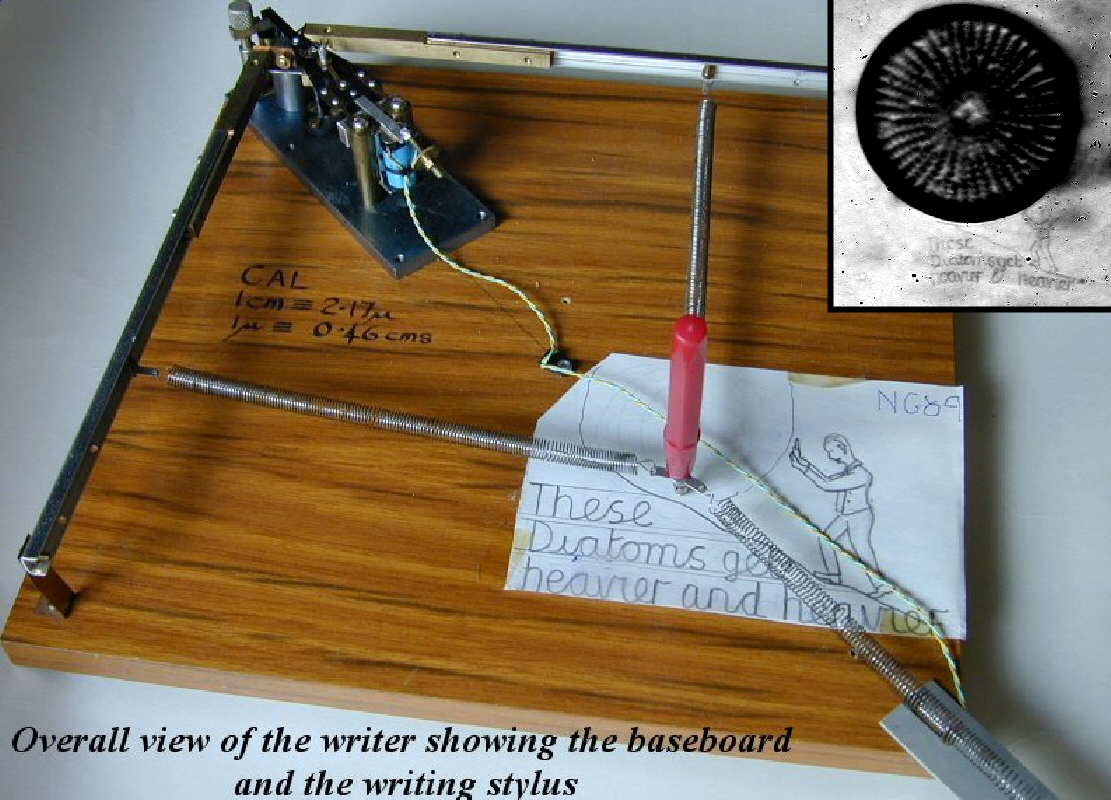
With the aid of appropriate technology, incredibly small-scale writing can be achieved. The picture on the left shows a Dall-type diamond microwriter, with the result shown in the inset. The dark circular object is a microscopic organism called a diatom, which is less than a tenth of a millimetre in diameter.

Microwriting even has its Fortean applications. On the subject of the perennially mysterious Voynich Manuscript, Gordon says “I think you’ll find that there was a man in the 1920s or 30s who suggested that the manuscript contained microscopic shorthand of some sort. His work was dismissed as pareidolia at the time, but were the pundits wrong?”

Of course, the issue of pareidolia—appearing to find what you’re looking for in random data—is quite common in Forteana. If it crops up when you’re gazing at photographs of Martian topography or listening to an old vinyl record played backwards, then it’s just as likely to happen when you’re scouring the works of Leonardo da Vinci looking for microwriting. While I was exchanging emails with Gordon I remembered a media report I’d seen in the Daily Telegraph a couple of years ago: “Art historians are probing a real life Da Vinci Code style mystery after discovering tiny numbers and letters painted into the eyes of the artist's enigmatic Mona Lisa painting”. And why not?