Search This Blog

Showing posts with label Architecture. Show all posts

Sunday, 17 March 2024

Medieval Monsters


A few years ago I discovered (by reading about it in a book, I'm sorry to say, rather than actually noticing it with my own eyes) that several of the village churches around where I live have strange demonic or cryptozoological-looking creatures crawling over their upper reaches. Colloquially you could refer to these as "gargoyles", although strictly speaking that word only refers to fancifully decorated waterspouts. The proper term for the non-functional ornaments I'm referring to is "grotesques" (which can be used as a noun as well as an adjective).

The main purpose of this post is to show off some of the photographs I took after my attention was drawn to these bizarre medieval carvings (a good excuse to give my 75 - 300 mm zoom lens an airing). Before that, however, it's interesting to speculate as to their purpose, since no one seems to know just why they were produced in the first place. Explanations I've seen include heraldic symbols relating to the local gentry, and depictions of local folklore - which here in Somerset would mostly mean dragons (as discussed in a previous post). But while some of the carved figures may well conform to one or other of those theories, they don't explain all of them - particularly the more demonic-looking ones.

By "demonic" I don't necessarily mean overtly so, in the sense of having horns and pointed ears or whatever, but just generally malevolent-looking - like the ape-headed, cloven-hoofed figure shown at the top of this post. This, and many of the other examples I've seen, are basically "chimeras" - fanciful combinations of two or more unrelated species. These were common in the mythology of ancient Greece and Egypt, but by the Middle Ages they'd become firmly associated with Hell (Dante's depiction of it, which I talked about last week, includes several chimera-like demons).

The decorations in and around medieval churches were, almost invariably, a form of communication with the congregation, who could understand imagery even if they were unable to read. So my own personal theory is that these demonic - or otherwise "ungodly" - creatures were depicted on the exterior of the church simply to emphasize that they weren't inside it. In other words, if you came into church you were safe from such monsters, but if you stayed outside you were at their mercy.

All the pictures in this post were taken on the same day in August 2019, at three different churches - Langport, Long Sutton and Huish Episcopi - the carvings on which date from circa 1450, 1490 and 1500 respectively. The ape-demon shown above, for example, is clinging to the tower of Long Sutton church - as you can see more clearly in the following wider-angle view, which also includes a vaguely pig-like face looking straight at you:

Here's another figure from Long Sutton, which reminds me a bit of a Chinese lion-dog statue:

Now two examples from Huish Episcopi. I've no idea what the first one is meant to be, partly because it's so badly weathered, but I'd say it's definitely in the demonic category. As for the much better preserved second one, it clearly depicts a chimera with a human face and four-legged body:

 Turning to Langport church, this one is absolutely covered in inter-species hybrids! Here are a couple of striking ones:

 ... and a few more:

 Langport also has a human head, but it doesn't look at all happy - possibly a soul tormented in Hell? Though it's difficult to make out from this angle, it's actually depicted wearing a crown, suggesting that maybe it's some recently deceased (and presumably unpopular) king. I mentioned last week that Dante used his description of Hell as a vehicle for political satire - perhaps that's what's going on here too! (incidentally, what looks like a bad case of chromatic aberration around the upper part of the head is actually a lead cover that's been added to protect it from the elements).

Sunday, 27 September 2015

A Weird Offer!

As mentioned last week, Weird Wessex: A Tourist Guide to 100 Strange and Unusual Sights by Paul Jackson and me (*) has just been published by the CFZ Publishing Group. Lavishly illustrated with over 200 full-colour photographs, the book takes you on a journey across the counties of Wiltshire, Hampshire, Dorset, Somerset, Devon and Berkshire in search of some of the weirder and sometimes little known sights waiting to be discovered.

For a limited time, you can order your copy of Weird Wessex direct from the publisher for just £10 – a massive discount of 18% on the recommended retail price of £12.50. What’s more, for customers in the UK postage is absolutely free, and the first 16 copies sold will include a bookplate signed by both Paul and me (*).

So what are you waiting for? It’s the perfect opportunity to add to your “Weird” collection (mine is pictured above). For full details, click here to visit the CFZ Publishing website.

You should also be able to get Weird Wessex (ISBN 978-1-909488-35-9) from any other book retailer, such as Amazon UK, or as a Kindle ebook.

(*) Until a week ago I would never have written “by Paul and me”, but “by Paul and myself” – which sounds more elegant, more polite and more grammatical to my ears. But when I used that phrase on Facebook, someone pointed out to me that “myself” is a reflexive pronoun. That means it can only ever be used in a sentence where the subject is “I”. You can say “I wrote the book myself” but you can’t say “The book is by myself”. You have to say “The book is by me”. Putting another person in the mix doesn’t change things – so “The book is by Paul and myself” is equally wrong. I will probably forget this almost immediately, but at least I got it right in this post.

Sunday, 20 September 2015

Weird Wessex

The latest book to feature my name on the cover is a collaboration with Paul Jackson of the
Random Encounters with the Unusual blog. It’s called Weird Wessex: A Tourist Guide to 100 Strange and Unusual Sights. Here is the blurb:
At its height, the Saxon kingdom of Wessex sprawled across Southern England, encompassing Wiltshire, Hampshire, Dorset, Somerset and parts of Devon and Berkshire. Even before the Saxons arrived the area had a reputation as a weird place, with Stonehenge and its Druids, Glastonbury and the Holy Grail, the bizarre chalk figure of the Cerne Giant and the reputed location of King Arthur’s Camelot. In more recent times the tradition of weirdness has continued, with flying saucers sighted over Warminster, intricate Crop Circles popping up around Alton Barnes and hordes of spaced-out hippies converging on the mystical hubs of Glastonbury and Totnes.

This book is a tourist guide with a difference. It describes 100 of the weirdest sights in Wessex, ranging from world-famous places like Glastonbury and Stonehenge to hidden oddities that may even surprise the locals. Divided into ten thematic chapters, it is lavishly illustrated with over 200 full-colour photographs.
The ten chapters, each featuring ten sites, are arranged thematically as follows:
  • Weird Archaeology
  • Weird Buildings
  • Weird Constructions
  • Weird History
  • Weird Landscape
  • Weird Legends
  • Weird Religion
  • Weird Science
  • Weird Secrets
  • Weird Tales
In terms of content, the book is pretty close to a 50:50 collaboration. Paul lives towards the eastern end of the area, on the border of Wiltshire and Hampshire, while I live further west near the Somerset-Dorset border. So it was quite easy to divide the legwork between the two of us!

The book is published by Jon Downes at CFZ Publishing, under the Fortean Words imprint (although most of the sites are “quirky” rather than out-and-out Fortean). The book is in full colour, 200 pages long, with an average of one photograph per page. I’m amazed, and very pleased, that Jon has managed to keep the cover price down to £12.50 (it would have been more like £18 if we’d used CreateSpace).

There are several ways you can get hold of your copy of Weird Wessex:
  • You can buy it from Amazon UK (or any other Amazon site). The book is print-on-demand, so don’t worry if Amazon says “out of stock”. As soon as you order it, the printer will run a copy off for you.
  • You should also be able to order the paperback through any other book retailer – the ISBN is 978-1-909488-35-9.
  • The book is available in a Kindle edition, though unfortunately not in any other ebook format.
  • In the near future (probably about a week from now) the CFZ website will be running a special offer on Weird Wessex. If you order the book direct from the publisher it will cost just £10 plus p&p, and include a bookplate signed by both authors (wow!)
  • People in the local area who cross paths with either of the authors can order a copy direct from us. We will be happy to sign it for you, and may even offer a discount (depending how generous we’re feeling).

Sunday, 9 August 2015

Cambridge Oddities

Cambridge is one of the few tourist hotspots that it actually makes sense to visit in August. There are crowds of tourists, of course, but that’s offset by the fact that there aren’t any undergraduates (and if you stay in your old college, you don’t have to share the lavatorial facilities with half a dozen barely housetrained students). That’s why I decided to spend a couple of nostalgic days there last week. Here is a quick rundown of some of the more unusual sights in the town:

One of the oldest buildings in Cambridge, dating from circa 1130, is the Round Church opposite St John’s College. Round churches are often associated with the Knights Templar (as with the Temple Church in London), but this one seems to have been built by a lesser known order, active at the same time, called the “Fraternity of the Holy Sepulchre”.
As I mentioned a few months ago in Isaac Newton and me, I spent my undergraduate years at Trinity College – as did Newton himself. Standing outside his old rooms in Great Court is an apple tree, pictured below. There probably wasn’t an apple tree there in Newton’s time (it’s clear from his account of the falling apple that it took place at his home in Lincolnshire), but Newton did keep a small private garden on this plot of land. He also had a large wooden shed which he used as a laboratory for his alchemical experiments – it may have been here, or inside Great Court itself.

(For more about Newton and alchemy, see my book Isaac Newton: Pocket Giants).
Sometimes erroneously associated with Newton, but actually nothing to do with him, is the Mathematical Bridge at the back of Queens’ College. The present bridge is the third to occupy this site, all using same timber-framed design. The first was built in 1748; this one dates from 1905. The mathematical nature of the bridge lies in the ingenious way the wooden ribs are arranged so that “each member is in compression with little or no bending moment”.
Cambridge has seen more than its fair share of scientific discoveries, and even one of the pubs claims to have played a part in one of them! Outside the Eagle in Bene’t Street there is a plaque that reads:
DNA Double Helix 1953: “The Secret of Life”. For decades the Eagle was the local pub for scientists from the nearby Cavendish Laboratory. It was here on February 28th 1953 that Francis Crick and James Watson first announced their discovery of how DNA carries genetic information.
One of the newer oddities in Cambridge is the Corpus Clock, dating from 2008 and belonging to Corpus Christi College. It stands at the end of Bene’t Street right opposite King’s College, giving it one of the highest tourist footfalls in England. The clock is unusual for several reasons: it has circles of LEDs instead of hands, and it only tells the correct time every five minutes (the rest of the time it runs erratically fast or slow). It also has a monstrous, animated insect called a Chronophage squatting on top of it.
It was somewhere near Corpus Christi College, back in the 16th century, that a man named Thomas Hobson used to rent out horses from a large livery stable. Although he had dozens of horses, customers always had to take whichever horse he wanted to hire out next. This gave rise to the phrase “Hobson’s Choice” – still used today to mean “no choice at all”. In his old age, Hobson helped to set up a new water supply to the town, which became known as “Hobson’s Conduit”. Cambridge doesn’t seem to have a monument to Hobson’s Choice, but it does have one to Hobson’s Conduit – on the corner of Lensfield Road and Trumpington Street:
From a Fortean point of view, the Haunted Bookshop – tucked away in a narrow alley called St Edward’s Passage – sounds highly promising. I had visions of shelves packed with occult and paranormal books – or horror fiction, at the very least. Unfortunately, however, the stock turned out to be predominantly antiquarian children’s books. The name comes from the fact that the building (previously an alehouse) is supposed to have its own ghost in the form of an occasionally glimpsed “White Lady”.
Cambridge has numerous free museums, of which by far the largest is the Fitzwilliam Museum on Trumpington Street. The quirkiest thing I spotted there was a pair of paintings by William Hogarth called Before and After, dating from 1731. At first sight they look innocuous enough – partly because the eye (my eye, anyhow) tends to be drawn to the girl rather than the bloke. But the latter is worth a second look in both pictures. In Before there is the distinct hint of a “bulge in his trousers” (I’m quoting from the official blurb), while in After “the man’s unbuttoned breeches reveal a tuft of pubic hair and his penis, chafed red from its exertions”. Sleazy stuff for the genteel 18th century!

Here’s Before...
... and After:

Sunday, 12 July 2015

The Ancient Temples of Stourhead

When Henry Hoare II inherited the Stourhead estate on the death of his mother in 1741, he had just returned from a grand tour of Europe. Deeply impressed by the classical architecture he had seen on the continent, with its roots in the mythology of ancient Greece and Rome, he determined to recreate as much of it as possible at Stourhead. The result is probably the most highbrow garden in England!

Although I’ve been to Stourhead many times (it’s now owned by the National Trust, and just over the border from Somerset in Wiltshire), it was only on my last visit, six weeks ago, that it occurred to me to take some photographs. At the risk of being confused with Paul Jackson’s blog, Random Encounters with the Unusual, I thought I’d show a selection of them here (Paul hasn’t done Stourhead yet, although he did do a post about King Alfred’s Tower which is close by and dates from the same period).

The largest of Stourhead’s temples is the Pantheon, seen in the picture at the top of this post. As the name suggests, this is a kind of scaled-down version of the Pantheon in Rome (although with a much more picturesque setting). It was built in 1753 to a design by the architect Henry Flitcroft, who was also responsible for King Alfred’s Tower. In literal terms a “pantheon” would be a temple to “all the gods”, but at Stourhead it’s more a case of “all the classical–looking statues Henry Hoare II could get his hands on”. In pride of place at the centre is the Graeco-Roman hero Hercules, flanked by the Roman goddesses Diana, Flora and Ceres, the Greek hero Meleager, the Egyptian goddess Isis and even the Christian heroine St Susanna! Here is my picture of the Isis statue:
Flitcroft also designed Stourhead’s two other classical style temples. The first, built in 1743, was dedicated to the goddess Flora, and the other, dating from 1765, to the god Apollo. The latter is based on a circular temple at Baalbek (Heliopolis). The Temple of Flora is difficult to photograph because it’s right by the lakeside, but here is my picture of the Temple of Apollo:
Not all the constructions at Stourhead are classical in form. The Grotto, dating from 1748, is a kind of artificial cave, housing the statue of an unnamed “river god”. It also has a statue of Ariadne, from Greek mythology, as seen in the following photograph:
Near the grotto is a small Gothic Cottage, which was added to the garden by Henry Hoare’s grandson, Sir Richard Colt Hoare, in 1806. The German tourists in front of me walked straight past it (presumably thinking there was nothing to see on the path from the Pantheon to the Grotto), but luckily for you I stopped to take a photograph:
The other Gothic feature at Stourhead is genuine mediaeval Gothic. It’s called the Bristol High Cross, and it originally stood in the centre of Bristol. It dates from the 14th century, but by the 18th century it was getting in the way of traffic and had to look for a new home. It was moved to Stourhead, where it now stands at the entrance to the garden. Here it is, with the Pantheon visible in the background on the other side of the lake:

Sunday, 23 November 2014

A Saint, a Spy and the Holy Grail

Whitchurch Canonicorum is a small village a few miles west of Bridport in Dorset. At seven syllables, it’s one of the longest place names in England. This may seem a little pretentious, but Whitchurch Canonicorum is no ordinary village. It was founded in Anglo-Saxon times by the most famous Saxon king of all, Alfred the Great, who called it Hwitan Cyrican, meaning “white church”. Nothing remains of the original Saxon church, but the present building – dating from the 12th to 15th century – has more than its fair share of Fortean oddities: the relics of a mediaeval saint, an icon of the Holy Grail, and the grave of one of the most unusual victims of Cold War espionage.

Surprising as it may seem, there are only two places in the country known to contain the mortal remains of a genuine saint. One is Westminster Abbey in London; the other is the church of Saint Candida and Holy Cross in Whitchurch Canonicorum. Candida is the Latin word for “white”, and the saint herself is more often referred to as “Saint Wite”. The only inscription visible on her shrine is a modern one: Hic reqesct reliqe Sce Wite (“Here rest the relics of Saint Wite”) – apparently duplicating the Latin inscription on a lead casket found inside the tomb when it was opened in 1900.

The tomb itself is very plain – some people think that’s why it escaped destruction during the Protestant Reformation, when so many other shrines around the country were destroyed. Its only distinguishing feature is the presence of three yonic-shaped orifices, where people can place prayer cards and other offerings to the saint (“yonic” is the feminine equivalent of phallic – I had to look it up on Google).
With regard to Saint Wite (or Saint Candida) herself, nothing at all seems to be known about her from historical records. According to local legend, however, she was a Saxon wise-woman who was murdered by the Vikings. Whether or not it’s related to the legend, on the outside of the church tower are carvings representing a ship and an axe, which are often said to symbolize the Vikings. Unfortunately the images are so badly weathered they’re difficult to make out, but lower down on the church wall is another, much clearer carving. This depicts a two-handled vessel, traditionally identified as the Holy Grail.

This part of the church dates from the 12th and 13th centuries, when the popularity of the Grail legend was at its height. But although the legend has a Christian theme, it’s not often depicted in church art of the time. So what is it doing here at Whitchurch Canonicorum? If it’s true that Joseph of Arimathea took the Grail to Glastonbury, he may have landed on the Dorset coast and made his way northwards from there. His route may well have taken him through the place that was later to become Whitchurch Canonicorum.
Moving to more recent times, the churchyard contains one gravestone with a bilingual inscription – English on one side, Cyrillic on the other. This is the last resting place of Georgi Markov, a Bulgarian journalist who was murdered in London in bizarre circumstances in 1978. One morning he was waiting at a bus stop on his way to the BBC World Service, where he worked at the time. He felt a stinging sensation in the back of his leg, and turned round to see a man pointing an umbrella at him. Four days later he died from Ricin poisoning. The umbrella had been used to fire a tiny sugar-coated pellet into his leg; when the sugar dissolved it released the deadly chemical into his bloodstream.

Phrases such as “worthy of James Bond” or “like something Q might have dreamed up” are journalistic clichés, but in this case they’re entirely justified. It’s tempting to think that a real-life James Bond discovered that Markov was a communist spy, and a real-life Q devised a foolproof method of eliminating him. But if that had happened, knowing how the British authorities normally operate, they would have botched the whole thing and Georgi Markov would still be alive and well today.

In fact it happened the other way around. Markov was murdered by Bulgarian (or possibly Russian) secret agents, because they discovered he was using his position at the BBC to spread anti-Communist propaganda. And the Communists, being super-efficient and entirely non-decadent, didn’t botch anything. Georgi Markov died, and his umbrella-wielding assassin was never caught.

I’m not sure why Markov ended up buried in a Dorset village churchyard, though.

Sunday, 25 May 2014

Devon's Underground Secrets

The photograph above shows the view from inside a cave looking out. It isn’t very clear, but you can just make out what appear to be a couple of rounded archways on either side of the central pillar. Round arches were introduced to Britain by the Romans, and it was the Romans who built this cave – the part of it that’s visible in this picture, anyway. But the Romans were just the start of it. The cave complex was steadily expanded (with a short break in the 16th and 17th centuries) from soon after the Roman invasion in 43 AD all the way up to the early 20th century. In the course of that time – almost 2000 years – the caves have witnessed their fair share of secrets, from religious outcasts and smugglers to the shadowy world of freemasons.

The cave complex is located near the seaside village of Beer on the south coast of Devon. Although Beer is only 20 miles from where I live, it wasn’t until last week that I finally got round to visiting the site. Its official name is “Beer Quarry Caves”, which never sounded massively interesting to me. I pictured a typical open rock quarry with a few shallow caves dug into the rock face. In fact it’s nothing of the sort. The entire “quarry” is underground, consisting of miles and miles of man-made tunnels. Most people would think of it as a “mine” rather than a “quarry”, but technically a mine is a place for extracting minerals. What was extracted here was stone – a special kind of limestone called Beer Stone.

Most limestone is either too soft to use as a structural material, or so hard that it is difficult to carve into intricate shapes. That was a big problem in the Middle Ages, when everyone wanted to build ornate churches and cathedrals out of stone. Beer Stone offered the best of both worlds. In its natural, waterlogged state it is easy to work (into any shape, since it’s very fine grained) but when it dries out it becomes as hard as the hardest Portland stone. That meant there was a huge demand for Beer Stone. Not only was it used in building the nearby cathedral at Exeter, but also much further afield at Winchester Cathedral, Westminster Abbey and even the Tower of London.

The heyday of Beer Quarry was the great age of church building in the 13th to 15th centuries. All this came to an abrupt end with the English Reformation in the 1530s. This proved to be a disastrous time for the quarrying industry. It wasn’t just that work on church building came to an end, but the demolition of all the monasteries meant that millions of tons of ready-worked stone suddenly came onto the market for use in non-religious buildings.

During the enforced hiatus in quarrying at Beer, other more clandestine uses were found for the caves. When Catholic church services were made illegal, on punishment of death, they were driven underground... literally. Part of the tunnel network was converted into a chapel, the empty shell of which can still be seen today (see photograph). Originally this was decorated with fittings made of Beer Stone, but apparently these were “stolen to order” early in the 20th century. The thieves were eventually caught, but they never revealed who their clients were and they were never prosecuted. According to legend, the stolen fittings now adorn the private chapel of the Houses of Parliament!

The other clandestine use of the mine was for storing smuggler’s contraband. It was ideal for this purpose, partly because of its close proximity to the sea and partly because of the vast and confusing network of pitch-dark tunnels. Customs officers brave or foolish enough to venture into the caves often disappeared without a trace. According to the tour guide, each tunnel branches into nine other tunnels, and each of these into another nine, before they start to join up again in a gigantic rabbit warren. The tour route only covers about two percent of the total – the only part fitted with electric lights. A few years ago a visitor deliberately detached himself from a tour group in order to go “exploring” on his own with a flashlight. Its battery failed long before the search party found him... 16 hours later.

In its heyday, Beer quarry employed hundreds of workers – women and children for domestic tasks and men for the muscle work. The latter fell into two categories – “unskilled” quarrymen who were paid 3 shillings a week (with deductions for poor work) and “skilled” stonemasons who got 21 shillings a week (with bonuses for good work). Much of the masons’ skill lay in their trade secrets, which they guarded jealously – the origins of the secret society still known as the Freemasons today.

Beer caves are full of pillars, like the pair seen in this photograph. The size and separation of the pillars has to be capable of supporting the weight of rock above it, which depends on the amount of rock and its physical properties. Nowadays that would involve a complex computer calculation of the forces and tolerances involved – but that wasn’t an option when Beer quarry was being worked. Yet the dimensions and separation of these pillars are within three centimetres of what modern engineering regulations would stipulate. The masons knew the secret – and they kept it to themselves!

The slightly smudged inscription below consists of a name: Anthony Northcott, a date: 1758, and a few other cryptic symbols. Under the name is what looks like the initials AN – but if you look carefully, the “A” is actually a stylized representation of the Masonic “square and compasses” symbol!

Friday, 27 December 2013

Fortean Crossword

Apparently the crossword puzzle marks its centenary this month. A few years ago I put together a Fortean-themed crossword which I thought would be worth repeating here. You can either print it out or do it in your head... or just ignore the grid and treat the questions as a trivia quiz.

Answers next week – together with an exegesis of all the Fortean connections.
ACROSS

1. Author of Chariots of the Gods [5, 3, 7]
9. First of the seven churches mentioned in the Book of Revelation [7]
10. “Their weapons were no match for the Bossonian -------“ (Robert E. Howard) [7]
11. "Voyagers who have shown every indication of intent to -----" (Charles Fort) [5]
12. Yggdrasil, for example [3]
13. The world ends without this, according to T.S. Eliot [1, 4]
14. Site of the Crucifixion [7]
16. "I had long hoped for a personal ------- with a man from a flying saucer" (George Adamski) [7]
18. The queen of the fairies, according to Shakespeare [7]
21. Sayings of Jesus that are not found in the Gospels [7]
23. Max -----, German surrealist [5]
25. --- Geller, Israeli-born psychic [3]
26. "Thus ----- Zarathustra", by Friedrich Nietzsche [5]
27. Lenape people living in New Jersey when the Europeans arrived [7]
28. "------- Tales" (1974), featuring Paloma Picasso as Countess Erzsébet Báthory [7]
29. Britain's best-known cryptid [4, 4, 7]

DOWN

1. The building pictured below [6, 9]
2. Eldest son of Abraham, according to the Book of Genesis [7]
3. Herman -----, author of Siddhartha [5]
4.The James ------- is inscribed "James, son of Joseph, brother of Jesus" [7]
5. The ------- Sibyl, prophetess of Apollo [7]
6. Professional assassin in feudal Japan [5]
7. An esoteric branch of Judaism [7]
8. A type of hippie found in 1980s Britain [3, 3, 9]
15. --- Greenslit Pudeator, hanged as a witch in Salem in 1692 [3]
17. "Alles Vergangliche ist --- ein Gleichnis" (Everything transient is only a symbol - Goethe) [3]
19. "The Serpent Power: Secrets of ------- and Shaktic Yoga" by Arthur Avalon [7]
20. Thomas -------, author of Summa Theologica [7]
21. Belief that all living and non-living things have a spiritual essence [7]
22. Generic term for Indian languages related to Sanskrit [7]
24. The largest moon of Saturn [5]
26. ----- Magus, a sorcerer mentioned in the Book of Acts [5]

Sunday, 15 December 2013

Orgy in the Temple

After the two videos I posted last week, there were still a few iMovie features I wanted to try out... so I started looking for another offbeat idea that would lend itself to a two-minute video clip. And I found one.
Arthur C. Clarke’s short story “I Remember Babylon” was published in the May 1960 issue of Playboy magazine. Essentially it’s an early speculation on the possibilities of satellite TV (which didn’t exist in 1960 – the idea was pure science fiction). The story contains the rather silly idea that you could beam blue movies into people’s homes in the form of “a highbrow movie about ecclesiastical art”... if the art in question came from certain Indian temples, that is.

The story refers specifically to the Temple of the Sun at Konarak, although I’ve also included two temples from the Khajuraho complex where the action is even more outrageous (some of the acts depicted there are illegal – I’ve only shown the legal ones). The text isn’t very specific about the musical soundtrack, except that it has sudden changes of mood and tempo. That made me think of Mahler, so I used various snippets from the final movement of the Resurrection Symphony. That fits in with the “ecclesiastical” theme, too.

The movie in Arthur C. Clarke’s story is titled “Aspects of 13th century Tantric sculpture”. However, it’s not certain that the erotic temple sculptures at Konarak (modern spelling Konark) and Khajuraho really are connected with Tantric practices. There seem to be three possibilities:
  • The images depict Maithuna – Tantric sexual union performed in a ritual context. This sounds great in principle... but it doesn’t explain the depiction of illegal acts (Either you can use your imagination at this point, or you can consult Wikimedia Commons).
  • Rather than real world events, the sculptures are meant to depict the goings on in some other-worldly paradise. Brian Ruhe mentions something similar in his book Freeing the Buddha, which I referred to in Buddhism and UFOs: “The fourth heaven is Tushita Heaven, another very popular vacation spot. This is the heaven with the number one greatest amount of sensuous pleasures – sex, drugs, rock ‘n’ roll.” Konarak and Khajuraho are Hindu temples, not Buddhist, but the same idea may apply.
  • It’s possible that the sculptures have no religious significance at all, or that they’re meant to depict “bad” rather than “good” things. It’s a fallacy to assume that any image in a place of worship must be an object of worship itself. Christian churches often contain images of the devil (such as this one at Rennes-le-Chateau), while the ubiquitous Sheela-na-gig is no less lascivious than the erotic Indian carvings. One of the highlights of Wells Cathedral in Somerset is a man with toothache – nothing especially religious about that. Mediaeval masons liked to have a bit of fun – as do their modern counterparts. The sculpture of an astronaut was added to a cathedral in Salamanca during renovations in 1992, while Washington National Cathedral has a gargoyle-like carving of Darth Vader.

Sunday, 25 August 2013

UFO architecture

I thought I’d used up all the blogworthy photos from my recent trip to Poland, and then I remembered these pictures of the Spodek arena in Katowice. Unlike the Wieliczka salt mine (More Underground Art) and Wawel Castle (From Dragon bones to Chakra stones), Katowice is well off the normal tourist trail... so not that many people from outside the area will be aware of Spodek. It was opened in 1971 as a sports, entertainment and conference venue, and the name Spodek is simply the Polish word for “saucer”.

It’s tempting to say the Spodek building “looks like a UFO”, and few people would disagree with the statement. But the term UFO, when used by official organizations like the US Air Force and the UK Ministry of Defence, simply means “unidentified flying object” – with no reference to its shape or appearance. And hardened UFO enthusiasts frequently talk about craft that are spheroidal, cigar-shaped, triangular or V-shaped. But to the public at large, “UFO” means just one thing – a flying saucer.

In this popular-culture sense of the term, Spodek is the first UFO-shaped building I’ve ever seen. The closest thing I’d come across previously was Paul Jackson’s photo of the “Big Blue” sculpture in Canada Square, as mentioned in my blog post Crashed UFO in London (see also Paul’s own post Canada Square UFO). However, a Google search quickly turned up a list of ufo-shaped-buildings and another one of 8-unique-ufo-shaped-buildings... and then buildings-that-look-like-UFOs-in-pics and 8-far-out-buildings-that-look-like-spaceships, not to mention Starship-Buildings-on-Earth-Mothership-UFOs-Across-the-Planet-Pics.

Some of the buildings featured in these lists are simply eccentric private homes, or futuristic designs with only a passing resemblance to a flying saucer. But even after filtering these out, there are a surprising number of large public buildings that, like Spodek, appear to have been directly inspired by the popular image of a UFO. The montage below shows four examples that are important enough to have their own Wikipedia entries. From top to bottom, these are: the University of Illinois State Farm Center (1963); the Evoluon conference centre in Eindhoven (1966), the Universum Science Centre in Bremen (2000) and the Mercedes-Benz Arena in Shanghai (2010).

Sunday, 14 July 2013

Dragon Symbolism

Here’s an unusual carved image that’s located just a few miles from where I live. Although I read about it some time ago, I only got round to stopping and having a look at it last week. It depicts a man battling a dragon, and it can be seen on the church of St Mary the Virgin at Stoke-sub-Hamdon. The oldest parts of the church were built during the Norman period around the year 1100, and that’s probably when this carving was produced.

Apart from the fact that a man fighting a dragon is an unusual thing to see on a church, there are a couple of striking things about the carving. The first is the clever way the arched back of the dragon fits neatly over the arch of the window (which is extremely narrow, even for the Norman period). The other is the cartoony style of the image, which is vaguely reminiscent of the Bayeux tapestry... which of course dates from around the same time.

The carving is on the exterior north wall of the church, which is a place where you often find pagan imagery on mediaeval churches (the north side was considered the “dark side” in those days). Although dragons were common in pagan folklore, this one may represent a Christianized legend. Having just done a bit of research, I’ve seen it confidently identified as “Saint Michael and the dragon” and as “Saint George and the dragon”. But Saint George is normally depicted on horseback, so personally I’d favour the first of these. There’s a hill about a mile from the church called St Michael’s Hill, which may or may not be significant.

Of course, after this lapse of time no-one can really know what legend the artist meant to depict. In a comment to my post last year about A Fortean History of Somerset, Richard Freeman mentioned that “the county also has more dragon legends than any other in the UK with a total of 11”. So who knows what the image would have meant to the 12th century inhabitants of Stoke-sub-Hamdon?

An almost universal characteristic among the dragons of European legend is that they’re bad. The majority are depicted as monsters that are just waiting to be slain by a hero (such as Saint George), while Saint Michael’s dragon was Satan himself, who was consigned to Hell. That’s a complete contrast to the dragons of Eastern tradition, which are seen as benevolent and auspicious. But there’s at least one benevolent and auspicious dragon on this side of the world, too – the Welsh dragon.

By coincidence, I saw a Welsh dragon here in England just a day after I took the photo at Stoke-sub-Hamdon. This was at a National Trust property called Bradley Manor, which is near Newton Abbot in Devon. The Great Hall there is decorated with a huge (and now partly obliterated) royal coat of arms dating from the Tudor period. This bears the familiar motto “Honi soit qui mal y pense”, but instead of the lion and unicorn it has a lion and... a dragon! (photography wasn’t permitted inside the house, so the picture here is a detail from the National Trust’s own image).

The unicorn is a symbol of Scotland, and was introduced by the Stuart monarchs who were also kings of Scotland. However, the Tudors who preceded them were a Welsh family, and so they used the dragon instead. The lion, of course, is a symbol of England. There may or may not be any significance to the fact that lions are real creatures whereas dragons and unicorns are the stuff of folklore!

Sunday, 5 May 2013

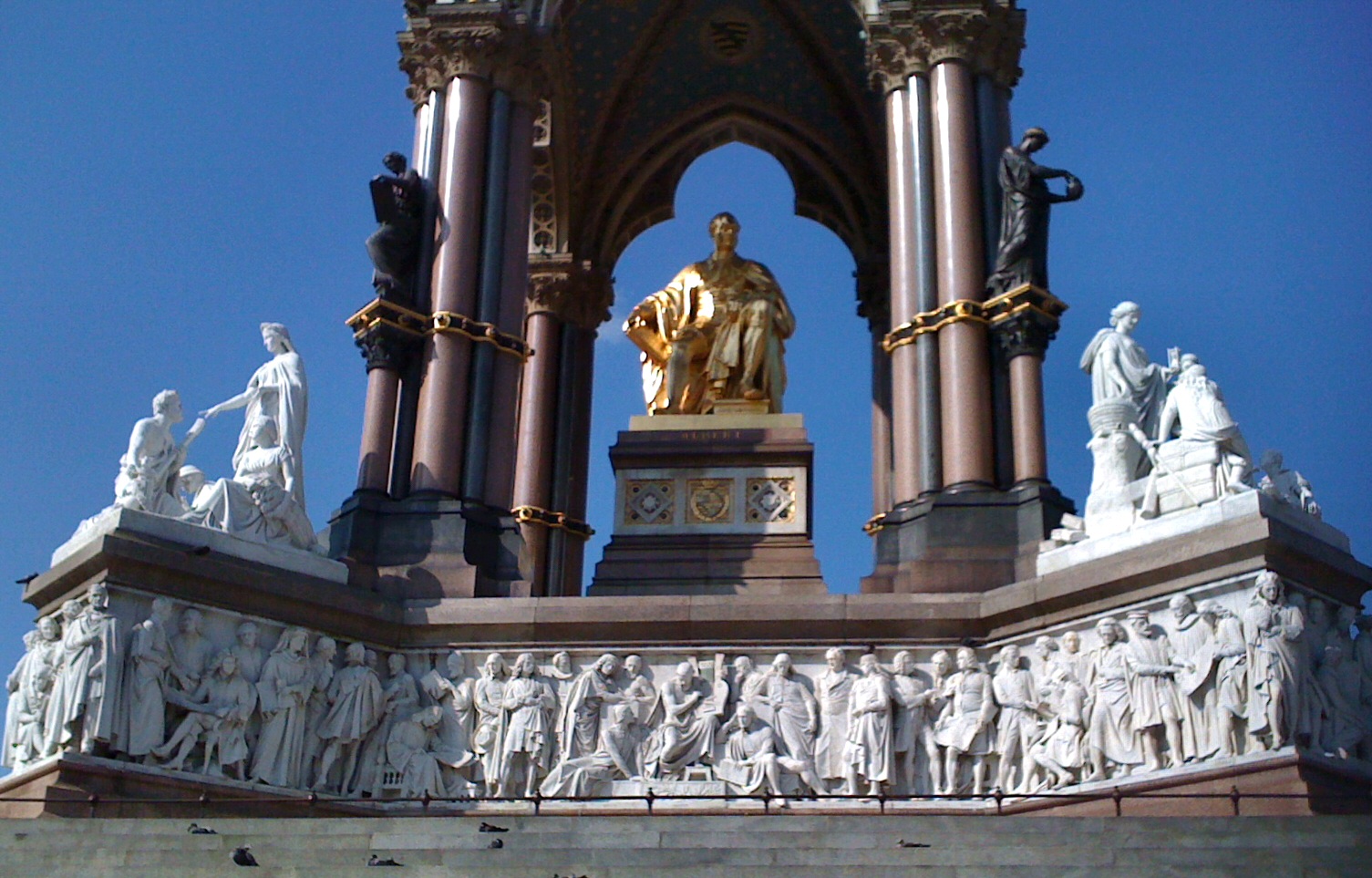
The Frieze of Parnassus

The Albert Memorial in Kensington Gardens isn’t London’s most popular tourist attraction. When it was erected in 1872 it was the height of fashionable good taste, but within a few decades it had become a symbol of bad taste... and has remained so ever since. Personally I love high Victorian Gothic architecture, but I know I’m in a minority so I won’t go on about it.

The central focus of the Albert Memorial is, of course, the huge seated figure of Prince Albert (the consort of Queen Victoria). But there are many other sculptures that deserve (but rarely get) close scrutiny. In particular there’s the Frieze of Parnassus that surrounds the base of the memorial. This depicts 160-plus historical figures from the world of the Arts. Although it’s not obvious from my photograph, each of the figures is identified by name – the Wikipedia article has clearer photographs and a full list of names.

When faced with lists like this, it’s inevitable that questions of the “why didn’t they include X?” variety spring to mind. Of course, the figures are necessarily drawn from the limited range of cultures familiar to mid-19th century Londoners – the ancient world of Egypt, Greece and Rome, and the post-renaissance world of Western Europe. In addition, the figures are limited to five specific categories – Poets, Musicians, Painters, Sculptors and Architects. But even within these constraints there are some notable omissions. I thought it would be interesting to go through all the people I’ve mentioned in previous posts who meet the basic criteria, and see which of them are included and which aren’t.

POETS

There aren’t as many poets depicted as you might expect. This is because they share the south side of the frieze (that’s the one in my photograph) with musicians.

Shakespeare is one of only three English poets to make it onto the frieze. He featured previously in connection with the authorship question and the ghost in Hamlet. If you’re interested in the latter, then watch this space – there’s more paranormal Shakespeare in the pipeline.

Alexander Pope (who featured in Angels in Machines last year) is a good example of someone who ought to be on the frieze but isn’t. The only post-Shakespeare English poet who does make the cut is John Milton, who was mentioned in passing in The Great Pyramid, and other British inventions – due to his rather nutty suggestion that the Greek philosopher Pythagoras got all his ideas from the ancient Britons. Oddly, Pythagoras appears on the frieze as a “poet” too, four places to the left of Milton.

Two of Britain’s greatest poets, Samuel Taylor Coleridge (featured in The Person from Porlock and The Ancient Mariner) and Lord Byron (featured in The Year Without a Summer) don’t make it onto the frieze, whereas Goethe and Schiller – two German poets of the same period – do.

Of the other non-English poets depicted on the frieze, Homer was featured in Space Odyssey and Dante in Dante’s Divine Comic Book.

MUSICIANS

Haydn, Mozart and Weber are the only three composers featured in Fortean Opera who died before the Frieze of Parnassus was created – and they are all on it.

Four of the composers mentioned in Philip K. Dick, music critic meet the same criterion – but only three of them are on the frieze. Bach, Mozart (again) and Beethoven made it, but Schubert didn’t.

PAINTERS

Botticelli, who featured in The Mystic Nativity, is conspicuously absent from the Frieze of Parnassus. This is odd because, as I said in that post, Botticelli “had a major influence on British painting of the Victorian period”. It’s even stranger that Botticelli’s more obscure contemporary Ghirlandaio is on the frieze.

Looking at the various omissions – Pope, Byron, Coleridge, Schubert, Botticelli – it strikes me they are all purveyors of what might be called “accessible” art. Maybe they weren’t considered sufficiently heavyweight to be commemorated in stone!

That’s certainly not true of the other great figures of the Florentine Renaissance—Leonardo da Vinci, Raphael and Michelangelo—who are all there on the frieze. In fact Michelangelo makes two appearances, both as a painter and as a sculptor! Both Michelangelo and Leonardo were featured in The Da Vinci Code and medieval symbolism, with Michelangelo also cropping up in A sixteenth century dinosaur and Leonardo in Underground Art and Crashed UFO in London. Raphael featured in my post about The School of Athens (which also mentions Pythagoras, referred to earlier).

Bellini was the subject of Descent into Limbo, and Mantegna was also mentioned in that post. Both Bellini and Mantegna are shown on the frieze.

The only other Italian artist I remember featuring is Agostino Carracci, in Bacchus and Ariadne. If you look back at that distinctly R-rated post, you won’t be surprised to learn the Victorians didn’t include Agostino in their frieze. However, Agostino’s brother Annibale Carracci (mentioned in the same post) did make the cut.

Vermeer (who featured in Chasing Vermeer... and Charles Fort) isn’t on the frieze – possibly because he falls in the “too accessible” category. But I was pleased to see that Hogarth – the epitome of accessible art – is right up there on the Frieze of Parnassus. Hogarth featured in Paranormal investigation, 18th century style and Another historical myth-conception.

Turner (who featured in Enigmatic Art) is on the frieze, but needless to say his populist contemporary John Martin (featured in Art and Archaeology) isn’t. Incidentally, one of Martin’s most characteristic works is “Joshua commanding the Sun to stand still upon Gibeon” (1816). I recently came across another version of the same scene that Martin painted in 1848 in a more Turneresque style. They’re both reproduced here (1816 top and 1848 bottom) so you can decide which you like best (I think they’re both great pictures).

SCULPTORS

I can only remember mentioning a sculptor once – that was Donatello in Alien simulacrum, one of my very first blog posts. Anyway, Donatello is there on the Frieze of Parnassus.

ARCHITECTS

As far as the Frieze of Parnassus is concerned, the “architects” of the ancient world aren’t really architects but patrons of architecture – the people who commissioned the buildings, rather than the people who designed them (the identities of the latter being lost in the mists of time). So, for example, “Cheops” is depicted as the architect of the Great Pyramid. Interest in Egyptology was still relatively new when the Albert Memorial was built, and the great wave of pyramidiocy that swept over the English-speaking world came later (see The Great Pyramid, and other British inventions, already mentioned above).

One of the oddest inclusions is Sennacherib, who would have been best known in Victorian times as the villain of a popular poem by Lord Byron (who unlike Sennacherib didn’t make it onto the Frieze of Parnassus). Presumably Sennacherib was considered the “architect” of the city of Nineveh, which had only recently been unearthed by archaeologists when the Albert Memorial was built. Sennacherib was mentioned in my posts on The Bible's Excluded Middle, Gods of the Bible and The Siege of Lachish... the last being about my ebook of the same title (which will tell you all you need to know about Sennacherib, should you choose to buy it).

Saturday, 18 June 2011

Psychic archaeology

The town of Glastonbury in Somerset has several claims to fame that, evocative as they are, don't stand up to close scrutiny. Jesus probably never visited the town as a child, and King Arthur probably isn't buried there. The Glastonbury Zodiac is an excellent example of topographical pareidolia, and even the town's eponymous Festival takes place ten miles away, much closer to Shepton Mallet than to Glastonbury! There is, however, at least one perfectly real and historically important thing in Glastonbury, and that's its Abbey.

Glastonbury Abbey was one of the first Christian monasteries in Britain, dating as far back as late Roman times, circa 600 AD. By the time it was dissolved in 1539, on the orders of King Henry VIII, it was the largest, wealthiest and most prestigious abbey in England. So prestigious, in fact, that the King was determined to make an example of it, ensuring that it was almost totally destroyed. As a result the Abbey was lost to history for 370 years, until the site was re-purchased by the Church of England and archaeological excavations were started. What is remarkable, in light of all the hyped-up pseudo-mysticism surrounding Glastonbury, is the well-documented role that genuine mysticism played in those excavations!
The picture above shows the remains of the Edgar Chapel at the eastern end of Glastonbury Abbey, excavated around 1910. In charge of the excavations was a professional architect (and amateur archaeologist) named Frederick Bligh Bond. Prior to the excavations, only the existence and general location of the Edgar Chapel were known... nothing about its shape, dimensions or exact position. Yet Bond seemed to know precisely where to dig -- a fact which baffled his colleagues, who couldn't follow his methods at all.

In 1918, while the archaeological work was still continuing, Bond finally revealed his secret in a book called The Gate of Remembrance. It turned out that he had used a spiritualist medium, who had obtained information about the Abbey from long-dead monks using a technique known as automatic writing. The book records no less than sixteen specific pieces of information, which were not known at the time from any other source, but which were proved correct by excavations.

Spiritualism was far more popular a hundred years ago than it is today, but even in those days it was frowned on both by the Church (who thought it was the work of the Devil) and by academics (who thought it was the work of charlatans). So given that Bond was employed by the Church, and all his colleagues were academics, his fate was pretty certain! Not only did he lose his job, but he was ostracized by the authorities and his role in the excavations was airbrushed out of the official history.

Although skeptics love to dismiss all "communications from the dead" as deliberate and conscious fabrications, it's difficult to see how this can be true in Bond's case. Even if he was so naïve as to think he could publish The Gate of Remembrance and keep his job, as soon as he saw that things were going against him it would have been easy to say "but it was only meant as a joke" or "I was conducting a social experiment on the gullibility of the masses" or something. But he didn't -- he stuck to his story even when it was so disastrously career-limiting.

In the cosy world of the Excluded Middle (where most skeptics and believers live), if The Gate of Remembrance isn't a deliberate hoax, then it must be evidence for survival after death. But Forteans don't have an Excluded Middle, and I'm sure there are alternative explanations that are more credible than either of the knee-jerk extremes. I'm struck particularly by the similarity between the "messages" recorded in The Gate of Remembrance and the sort of things people come up with under Past-Life Regression Hypnosis. That makes me think that both these phenomena have a common cause, which is probably nothing to do with dead people (whether surviving as spirits or reincarnated)... but just something that gets translated into those terms by the unconscious.

Saturday, 30 April 2011

From Myth to Reality

Like most people, the editors of Fortean Times generally ignore everything I say (presumably because most of what I say is indistinguishable from the ravings of a lunatic). However, this month's issue, FT275, does contain a letter from me... the first since FT187 way back in September 2004! The subject isn't particularly Fortean, but it's an interesting example of the way a long-standing "myth" can eventually become reality.

In this case, the myth in question concerns the great architect Sir Christopher Wren (1632 - 1723), who was supposed to have installed columns to support the ceiling of the Sheldonian Theatre in Oxford because his patrons insisted they were necessary. However, because Wren knew the columns were not in fact necessary, he built them so they stopped just short of the ceiling and didn't support it at all. This story was featured in FT271 (February 2011) in the "Mythconceptions" department, and can be read online here.

When I saw this, it rang a bell because I remembered hearing something very similar on a TV programme a few months earlier. Here is the text of my letter:

Another example of redundant architectural columns cropped up in the "Climbing Great Buildings" series shown on BBC2 last year. In the episode dealing with the Glasgow School of Art (aired 20 September 2010), it was revealed that the wooden pillars that appear to hold the roof up are not actually supporting anything. The capitals which supposedly form the top of the pillars are in fact hanging from the roof, while the pillars themselves are purely decorative. The architect in this instance was Charles Rennie Mackintosh, who the programme's presenter Jonathan Foyle describes as a "joker" and a "showman" whose aim here was "to have fun with traditional architectural styles".

Charles Rennie Mackintosh (1868 - 1928) is more famous today as a furniture designer of the Art Nouveau school, but in his early years he was also an architect. The Glasgow School of Art was Mackintosh's first major work, as the Sheldonian Theatre had been Wren's more than two hundred years earlier.

Here is the relevant clip from Climbing Great Buildings (thanks to Paul Jackson for help in locating and extracting it).