Andrew May's Forteana Blog, focusing on the weirder fringes of history (and other old-fashioned stuff)
Search This Blog
Sunday, 12 May 2024
Fortean-themed music, from opera to metal
ALIENS
Christus Apollo (1969) by Jerry Goldsmith. An obscure work by a far-from-obscure composer, this was one of several interesting discoveries I made while writing SofSFM. It's a religious cantata with words by SF writer Ray Bradbury, portraying Christ as a spacefaring super-being known by different names on different planets.
Alien Encounter (1996) by Phil Thornton - a purely instrumental album with tracks including "Arrival of the Mothership" and "Visions from the Homeworld". It comes from one of my all-time favourite CD labels, New World Music, which was particularly popular in the 1990s. I've got quite a collection of these - other artists on the label include Medwyn Goodall and Terry Oldfield (brother of Mike Oldfield).
GHOSTS
There's never been any shortage of operas with supernatural themes - several of them featured in my Fortean Opera post. Here are two more:
The Lighthouse (1980) by Peter Maxwell Davies - another discovery I made while writing SofSFM. It's based on the same real-world "Flannan Isle incident" as the 1977 Doctor Who serial "Horror of Fang Rock". In the latter, the mysterious disappearance of the lighthouse-keepers is down to an alien; in the opera, it's caused by a series of ghostly apparitions.
The Turn of the Screw (1954) by Benjamin Britten. This is based on the classic "psychological" ghost story of the same name by Henry James - but whereas the ghosts turn out to be imaginary in the original version, in the opera they're very real.
ATLANTIS
Eagle-eyed readers will notice that one of the CDs pictured above also featured in my recent post about Lemuria - and that's the 2004 album of that name by the symphonic metal band Therion. But there are two other albums worth mentioning in this category that I only have in intangible form in my Spotify library:
Atlantis (1969) by Sun Ra. A fascinating individual who claimed to come from the planet Saturn, Sun Ra featured prominently in SofSFM. But not all his albums are about outer space - this one has tracks called Mu, Lemuria, Yucatan and Bimini, as well as the really excellent 22-minute title track.
Atlantis Ascendant (2001) by Bal-Sagoth - another symphonic metal band, and definitely my favourite (their music always makes me think of a Masters of the Universe cartoon, for some reason). Their concept albums also have really great plots; according to Wikipedia, this one "centres on the exploits of a fictional 19th-century archaeologist and adventurer who has dedicated his life to the field of antediluvian anthropology".
ESOTERIC TRADITIONS
Voyage of the Acolyte (1975) by Steve Hackett - the esoteric tradition in this case being the Tarot. All the tracks are inspired by specific Tarot cards, such as "Hands of the Priestess", "The Hermit" and "Shadow of the Hierophant". There's also a Tarot connection in The Lighthouse, as PMD explains in the liner notes: "The structure is based on the Tower of the Tarot, whose number symbolism is present in all the music".
Tales from Topographic Oceans (1973) by Yes, based on Hindu mysticism. In its original form as a vinyl double album, each of the four sides comprised a single "movement" relating to the four categories of Hindu scripture: the shruti (revealing), the smriti (remembering), the puranas (ancients) and the tantras (rituals).
Zos Kia Cultus (2002) by Behemoth. A previously unsuspected music genre I discovered while writing SofM was what you might call "highbrow" metal, and of the bands I listened to, Behemoth was the one I liked best. This particular album is based on the occult writings of Austin Osman Spare, who I first heard of when he featured on the cover of Fortean Times in March 2001.
Masonic Music (1783-91) by Mozart. I mentioned last week that The Magic Flute was featured in my Fortean Opera post, one reason being its inclusion of a Masonic-style secret society. Mozart himself was a Freemason, and this CD contains several works incorporating Masonic ideas. One in particular, the "Little German Cantata" of 1791, must have seemed as blasphemous to some listeners as Goldsmith's Christus Apollo, with its reference to "the creator of the universe, whether named Jehovah, or God, or Fu, or Brahma" (Fu being a Chinese deity and Brahma a Hindu one).
Also featured in my Fortean Opera list was Wagner's Parsifal, which could equally fit here with its strange fusion of the Grail legend with the mystical writings of Schopenhauer. It features quite strongly in Philip K. Dick's novel VALIS (1981), which brings me neatly to the next item...
(Fortean) SCIENCE FICTION
VALIS (1987) by Tod Machover - a short opera based on Dick's novel. Most of PKD's writings are fortean to some extent, but none more so than the mishmash of metaphysics, religion, alien super-intelligence and conspiracy theories that is VALIS. As for the opera, it's discussed in some detail in SofSFM, so all I'll say here is that anything that combines Wagner and rock music has got to be worth a listen.
The Chronicle of the Black Sword (1985) by Hawkwind. There's always been a close connection between Hawkwind and the writings of Michael Moorcock, but this album (their best, in my opinion) has particularly strong fortean credentials, being based on the adventures of Moorcock's sword-and-sorcery hero, Elric of Melniboné.
(Fortean) COMICS
The Power Cosmic (1999) by Bal-Sagoth. No excuses for mentioning this band a second time, as even the album title reflects one of Marvel's more fortean superheroes, the Silver Surfer. He's also referenced, under his real name of Norrin Radd of Zenn La, in the song "The Scourge of the Fourth Celestial Host", together with several other Marvel characters, including Arishem of the Celestials - the archetypal "ancient alien".
Miss Anthropocene (2020) by Grimes. There were two reasons I sought this album out while writing SofM: (a) I was under instructions to include popular young artists, and (b) she'd spoken out in praise of AI in music, which was one of the topics in the last chapter of the book. I have to say I enjoyed her style much more than I expected, and was pleasantly surprised to find two songs inspired by the distinctly fortean comics that Jack Kirby did for DC in the 1970s: "Darkseid" and "New Gods".
While I could have found plenty more items to go in the preceding categories, that's not true here, as beyond those two albums I'm not aware of any other fortean comic-inspired music (unless you want to include "Grimly Fiendish" by The Damned). But there's a picture of Doctor Strange on the cover of the Pink Floyd album A Saucerful of Secrets (1968), and he's as fortean as superheroes get (see my post Master of the Mystic Arts). The picture, drawn by Marie Severin, is taken from Strange Tales #158, and it's quite hard to see unless you peer very closely. Here's a photograph I took of my CD version, where I've contrast-enhanced the relevant part (and outlined it in red), to make it a little clearer:
Sunday, 5 May 2024
More (free) AI creativity tools
The above may not be great comic-book art, but it's passable enough, and (with a couple of caveats I'll come to later) I created it with a single mouse-click on a website where I didn't even have to log in, let alone pay any money. And until I press "Publish" on this post, no one but me has ever seen it before. Even after a year of playing around with AI software, this still strikes me as incredibly cool (and even slightly frightening, if you stop to think about all the implications).
This particular page came from the Comic Factory website, one of two new AI discoveries I want to talk about in this post. First, however, I thought I'd summarize a few things I've written elsewhere about the "creative" use of AI. This is becoming a major hobby of mine, and I suspect it will feature increasingly often on this blog. Don't worry, though - all the applications I'm going to talk about have at least a tenuously fortean connection.
To start with, there's the article I wrote for Fortean Times last year called "AI, Art and Forteana" (FT 433, July 2023). This included a couple of imaginative fabrications from Bing's AI chatbot: first, an account of the Roswell Incident written in the unmistakable style of Charles Fort (who actually died 15 years before Roswell), and then a (hopefully entirely fictitious) conspiracy theory about Fortean Times itself.
The magazine article also contains two pieces of artwork courtesy of Bing's Image Creator. One takes the form of a two-page comic (with each of the panels having been generated separately, and then put together and captioned by myself), which also turned up in a guest post I did for Kid Robson's "Crivens" blog called Nostalgia Meets Modern Technology.
The other piece of art included in my FT article was "an engraving in the distinctive style of William Hogarth, 'proving' that he witnessed a UFO hovering over the streets of London in the 1730s". The same image also appears in a long post I did on my professional blog, 6 experiments in creative AI. As the title suggests, the "Hogarth" image was just one of several experiments discussed in that post - to read about the others, just click on the link.
Although I've occasionally found Bing's chatbot useful as an "ideas generator", the most impressive use I've found for it is in writing song lyrics, which it's surprisingly good at. I've put a couple of examples on YouTube:
- Zen Matrix - a mystical/hippie song that I think is really great (so you probably won't click on it)
- Demonic Tarot - my attempt at a "blackened death metal" song in the style of Behemoth, which really isn't very good (so you probably will click on it)
As well as AI-generated lyrics, both those videos use AI-created artwork - as do most of the recent videos on my YouTube channel. And as for this blog - you can see how often I've used Bing's Image Creator by looking at "AI art" in the tag cloud in the right-hand sidebar.
Besides being free, Bing Image Creator is also impressively high quality. But it has disadvantages, too - the biggest being that it has no memory from one image to the next. This limits its usefulness in creating comics - hence my decision to check out the AI Comic Factory. To ensure full consistency of characters and locations you need to set up a paid account, but there's a free "playground" where you can try it out without doing that.
The prompt box says "story", which seems to invite you to type quite a lot, but I just settled for a two-word prompt, "ancient aliens". The resulting artwork is noticeably less sophisticated than Bing, but it does have the advantage of being laid out like a comic - and, despite being the free version, having some vague continuity from one panel to the next.
There were just a couple of things I didn't like: the page had a broad 4:5 aspect ratio, rather than the 2:3 of a normal comic, and one panel was in a jarringly different style from the others. So, to produce the version you see at the top of this post, I deleted the dodgy panel and rearranged the others into the correct aspect ratio. But contrary to what you might think, I'm not responsible for the clumsily cropped right-hand edge of the lower panels. That was the computer's fault, and it looks like a bug to me (as opposed to the "unreadable" text captions, which I don't think are a bug, but just placeholders to add your own words).
While I won't be signing up for a Comic Factory account, I still think it's great that they let you play around with the free version (which it's best to do first thing in the morning UK time, before the server slows down as more people start to use it).
A point that was raised in the comment thread to my aforementioned Crivens post was the role of AI in creating last year's "new" Beatles song, "Now and Then". Specifically, AI was used to separate John Lennon's voice from the instrumental accompaniment on a demo tape. This brings me to the second thing I wanted to talk about in this post - because, as of a few weeks ago, exactly the same functionality is now available to anyone, free of charge, as part of a new toolkit called OpenVINO for Audacity.
I've tried a few experiments with this already, including Ozzy Osbourne singing "Paranoid" with the band muted and replaced by a classical string quartet, and a groovy Sgt Peppery remix of "A Hard Day's Night". Unfortunately, copyright laws mean the wider world is never going to hear them! Instead, you'll have to settle for my electronic remix of the Queen of the Night from Mozart's Magic Flute - the fortean credentials of which I discussed in a 2013 post on Fortean Opera (I scarcely need to add that the image in the video is c/o Bing Image Creator):
Sunday, 21 April 2024
UFO song #2
![]() |
| Image by Bing AI |
The album pictured above doesn't exist yet (and probably never will), but at least I've now got a second song for it. It's basically an electronic arrangement of Gilbert & Sullivan's "I Am the Very Model of a Modern Major General" from The Pirates of Penzance, with reworded lyrics covering all the clichés of modern ufology that I could think of. The synthesized vocals aren't always clear, so you need to see the words on the screen to follow them, but apart from that I'm really quite proud of this one. So do please have a listen to it before reading any further!
A typical song has 8 syllables per line, with pairs of lines rhyming on the last syllable. But this one has 16 syllables per line (which isn't a problem) and rhymes on the last three syllables - which is a problem, at least for me. In the original by W. S. Gilbert, he makes it look easy, with rhymes like "lot o' news ... hypotenuse" and "Sir Caradoc's ... paradox". In my version, I was quite pleased with "Zeta Reticuli ... particu'ly" and "there was a clash ... saucer crash", but a lot of the others are distinctly strained (such as "correct approach ... rectal probe" and "disastrous course ... astronauts"). Then again, I think there's a sense in which these almost-but-not-quite rhymes add to the humour!
As I often do with these musical experiments, I beta-tested it on five friends - and this was the first one that's ever come back with five "yeses". One person (who liked it enough to share it on Twitter/X, despite describing an earlier song of mine as "tuneless wibbling") raised the interesting question of what a "ufologist" should be called, now that the US government has deprecated UFO in favour of UAP. I suspect the answer is that UAP will very soon (if not already) come to be associated with "debunkers" who seek to explain sightings in non-extraterrestrial terms, leaving UFO for the true believers - who will thus always be ufologists.
Also on the subject of feedback, I can't resist including this nice comment from my cousin - I never knew such specialized emojis existed!
The singing synthesizer I use is a Japanese one called Sinsy, which is actually a deep neural network (i.e. AI) that gets better the more it's exposed to training data. It's been updated a couple of times since I started using it in 2020, and has improved noticeably in that time. For example, the synthesized voice doesn't sound nearly as good in my previous UFO-themed song, which I did in 2022 for my book The Science of Music.
One of the topics in that book is "algorithmic composition" - specifically the use of Markov chains. If that's something you've never heard of, it simply means analysing a piece of music to work out its "transition matrix" - the probability that any given note will be followed by any other particular note - and then getting a computer to generate a new piece of music using the same transition probabilities.
Since the editors wanted a focus on well-known music, the transition matrix I used came from Ed Sheeran's "Shape of You". This was something of an in-joke, since he was busy extricating himself from a plagiarism accusation at the time, so I thought he wouldn't mind if I borrowed his transition probabilities (the fact that his song only uses five different notes made the maths easier, too). For the lyrics, I dug out some UFO-themed limericks I wrote ages ago, and called the result "Mark of (Markov - get it?) the UFO". Apart from the rather strange synthesized vocals, I think it sounds quite good. Here it is:
Sunday, 31 March 2024
Popular Culture in Fortean Times
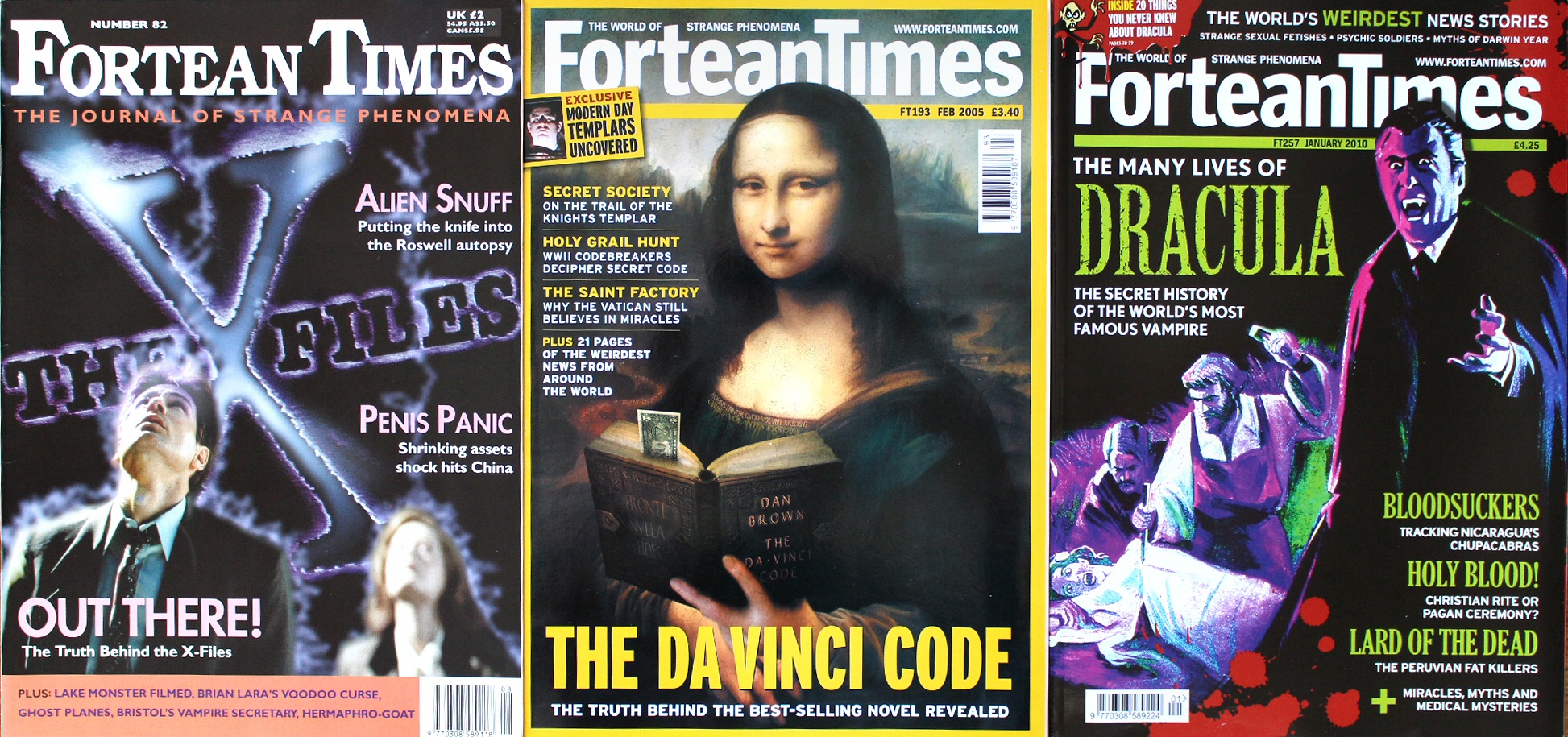
In the comment thread to last week's post, I mentioned that Fortean Times occasionally touches on various aspects of popular culture, from cult TV and movies to comics and pop music. So I thought I'd do a quick run-through of a few examples today.
To start with some very obvious topics, there are the three shown above. The X-Files (FT 82, August 1995) was not only one of the most fortean TV shows of all time, but its first appearance in 1993 coincided with the wider distribution of FT to "mainstream" retailers like WH Smith, and almost certainly contributed to the magazine's popularity at that time. Around a decade later, Dan Brown's novel The Da Vinci Code (FT 193, March 2005) was a publishing phenomenon, bringing fringe theories that had previously been the realm of specialist writers (and FT contributors) like Lionel Fanthorpe and Lynn Picknett to a much wider audience. Just over a century earlier, Bram Stoker had done something similar in his novel Dracula - the title character of which went on to become one of the most recognisable and ubiquitous pop-culture icons of them all, as recounted in the cover feature of FT 257 (January 2010).
At a less obvious level, you can find references to popular culture in almost every issue of FT. Taking the one I discussed last week, for example - FT 73 from February/March 1994 - there's an interview with cult author William Gibson, generally credited as the originator of the cyberpunk genre. And I spotted something else in that issue, too: a book review by comics legend Alan Moore. I don't mean a review of one of his graphic novels - I mean a review written by him of someone else's work. Looking online, I see he actually did quite a few reviews for FT in those days - which pleases me enormously, as I've done over 40 of them myself. It's always nice to discover that you have something in common with a famous person!
Sticking with books and comics for a moment, here are three more covers that caught my eye. No apologies for a second appearance of The Da Vinci Code (FT 212 this time, from August 2006) - both because it's one of my favourite novels, and because I love the illustration on the cover. In addition to people like Picasso and Orson Welles, it features Da Vinci himself in the act of strangling Dan Brown! The middle cover (FT 256, December 2009) features Dennis Wheatley - best remembered today for The Devil Rides Out (the only one of his novels that I've read), although in his day he was Britain's most prolific author of occult fiction. Finally there's the only comics-themed cover I could find - FT 320 (November 2014), relating to the Fredric Wertham-inspired anti-comics paranoia than swept America in the 1950s.
I found a few shorter comic-related pieces on interior pages as well. The most interesting of these was an article in FT 277 (July 2011) called "The Morning of the Mutants", speculating that Stan Lee and/or Jack Kirby got the idea for the X-Men from the seminal (though now largely forgotten) fortean conspiracy book The Morning of the Magicians, written in 1960 by Louis Pauwels and Jacques Bergier. There's also a feature about Marvel Comics' Doctor Strange in FT 349 (January 2017, to tie in with the movie), which discusses the character's origin and fictional predecessors.
Regarding the "popular culture" of the mid-20th century, I can't resist mentioning a couple of pieces by myself - in fact the only two full-length feature articles I've had in FT. First there was "Fanthorpe's Fortean Fiction" (FT 297, February 2013) about the large number of mass-market paperback novels that Lionel Fanthorpe churned out in the late 1950s and early 60s. This was followed by "Astounding Science, Amazing Theories" (FT 355, July 2017), looking at fortean themes in the pulp science fiction magazines of the 1940s.
Pulp magazines were a huge part of popular culture in the first half of the 20th century, but - with a few notable exceptions - they're only of interest to die-hard fans today. Of those exceptions, perhaps the most important is H. P. Lovecraft, whose Cthulhu Mythos first took form in the pages of Weird Tales in the 1920s and 30s, before going on to develop a life of its own to rival that of Bram Stoker's Dracula. I found no fewer than three Lovecraft-inspired FT covers: FT 184 (June 2004), FT 369 (August 2018) and FT 390 (March 2020 - this one tying in with the movie adaptation of The Color Out of Space). Here they are:
As regards cult TV shows, I've already mentioned the most fortean of all, The X-Files - which not surprisingly made several further appearances after the one pictured at the top of this post (including FT 85 from February 1996, which had a rundown of all the fortean references in the show's first season). Three other TV-related covers are shown below, the middle of which - FT 215 from October 2006, celebrating 40 years of Star Trek - needs no introduction. The other two relate to the screenwriters (both with wider fortean interests than you might expect) behind two of Britain's most famous sci-fi icons: Kit Pedler, who created Doctor Who's second-most-famous villains, the Cybermen (FT 209, May 2006), and Nigel Kneale, creator of Professor Quatermass (FT 418, May 2022). The latter may no longer be a household name, but back in the 1950s he was really the first great TV sci-fi hero, in this country at least.
Turning to movies - I was spoiled for choice here, so I've picked out three covers that really speak for themselves. First there's a celebration of 50 years of Hammer Horror films (FT 223, June 2007), then a look at one of the mainstays of those films, Peter Cushing, on the 100th anniversary of his birth (FT 301, May 2013), and finally a 40-years-on retrospective about The Exorcist (FT 313, April 2014):
To be honest, my favourite thing about The Exorcist is the music - the snippet from Mike Oldfield's Tubular Bells that it uses, I mean - which brings me neatly onto the next subject. When I talk about "pop culture" on this blog, I most often mean fairly specialized things like pulp magazines, comics (from the pre-multimedia franchise days) and cult TV shows such as The X-Files. But to most people, pop culture means just one thing, and that's pop music. This is such a pervasive part of modern life that it's acquired a plethora of fortean connections - so much so that I'm going to split them into two distinct parts.
To start with, here are three cover features that deal with direct fortean influences on musicians. The first, from FT 88 back in July 1996, describes how various pop stars from David Bowie and Jimi Hendrix to Kate Bush and The Orb absorbed ufological and similar speculations into their music. Second, there's a somewhat more arcane take on the same subject by Ian Simmons (FT 244, January 2009), featuring the likes of Stockhausen and Sun Ra - a much-referenced source for my own book The Science of Sci-Fi Music. Finally, in the immediate wake of David Bowie's death, there was a cover feature about the numerous fortean influences on his work (FT 338, March 2016) - including the aforementioned Morning of the Magicians by Pauwels and Bergier.
Another aspect of pop music that's of fortean interest is the way weird conspiracy theories grow up around the subject. So to round off what I honestly believed would be a shorter-than-usual post when I started it, but has ended up as probably my longest ever - here are three cover features addressing this aspect. The one on the left (FT 166, January 2003) deals with the numerous legends and conspiracy theories associated with Elvis, while the one on the right (FT 384, October 2019) does much the same for the Beatles. As for the one in the middle (FT 258, February 2010), it concerns the notion that the "Illuminati" employ popular music - and the musicians themselves - to manipulate the thoughts, beliefs and behaviour of the general public. But that's not really a conspiracy theory, is it? I mean, if you substitute "global media" for "Illuminati", I'd say it's an indisputable fact.
Sunday, 10 March 2024
The Gates of Hell (with music video)
A long time ago on this blog, I did a post about Dante's Inferno - Hunt Emerson's comic-book adaptation of a 14th century epic poem set in Hell. As I said there, the comic does wonders for clarifying the whole point of Dante's original - i.e. that it's basically a satire on Italian political history, rather than a serious attempt to depict the landscape and geography of Hell. But it does a strikingly vivid job of the latter even so, which has inspired a multitude of subsequent works from Sandro Botticelli's 15th century illustrations of Hell to Larry Niven & Jerry Pournelle's SF novel Inferno (1976), which uses the same basic setting (and, of course, Hunt Emerson's 2012 comic-book version).
On the musical side, there's a distinctly horror movie-esque portrayal of Hell in the Dante Symphony (1857) by Franz Liszt (who featured in another early post on this blog, Lisztomania). This begins with a dramatic depiction of the Gates of Hell, which inspired me to create the following video. I've added four electronic tracks of my own (demonic voice, drum machine, saw bass and synth pad), but otherwise it's just a digitally distorted vinyl recording of the opening of Liszt's symphony. Visually the gates and demons are courtesy of Bing's AI image creator, while the depiction of Hell itself is by Botticelli. When it's all put together, I think the result is pretty cool ((even though I say it myself):
I've twisted the original a bit in having the words spoken by demons. In Dante's poem, these are phrases that (in their original Italian form) are inscribed over the gates of Hell, while Liszt has them depicted by orchestral instruments, rather than being spoken or sung. But since I like playing with free software, I couldn't resist adding the synthesized voice.
The other software I used here was Tracktion Waveform Free, together with various free instrument and effects plugins (or ones that came free with Computer Music magazine, anyway). These are all great toys to play with, as I discovered a few years ago when I was doing a book called The Science of Music. I was asked to do that one because I'd previously written The Science of Sci-Fi Music - but while the latter was about a subject I knew something about (avant-garde classical music of the mid-20th century), the new one strayed way outside my comfort zone into modern digital music production. And the quickest way to learn a new subject is to try doing it yourself!
One thing I mentioned in passing in The Science of Music is that, if people who aren't fans of classical music have heard of Franz Liszt at all, it's most likely through the rhyming slang phrase "Brahms and Liszt". And as it happens, Brahms is another composer I've swiped a vinyl sample from. Unlike The Gates of Hell, there isn't even a tenuous fortean connection in this case, but I think the result is one of the most musically successful things I've done (in a chilled-out "lo-fi" sort of way). Here's the result:
While I was writing this post, I suddenly remembered that I've actually seen the "Gates of Hell", or at least a monumental bronze representation of them by the sculptor Auguste Rodin. This was at the Rodin Museum in Paris, which I visited in 2013 - the photograph below is one I took at the time. If you look closely at the panel above the gates, you'll see Rodin's most iconic image - "The Thinker" - in its original setting.
Sunday, 14 August 2016
Giants and Saints in the Scottish Isles
Staffa is a small uninhabited island, and a relatively new one in comparison to its neighbours. Geologically, most of the Scottish “highlands and islands” date from the Caledonian orogeny 400+ million years ago. However, Staffa popped up only about 60 million years ago, when the Atlantic Ocean began to form. As North America pulled away from the British Isles, molten magma was forced up through the rent, and where it reached the surface it cooled to form basalt extrusions. Staffa is one of these – the Giant’s Causeway on the north coast of Ireland is another. When basalt solidifies from a molten state, it has a distinctive way of forming into interlocking hexagonal columns. This is a perfectly natural process, but the result is so artificial-looking that it has given rise to a variety of myths and legends.
According to one tradition, Staffa and the Giant’s Causeway are the two ends of an 80-mile causeway that used to link Ireland and Scotland. It was supposedly built by the Irish giant Finn Mac Cool (quite a well-known figure in Irish mythology – he appears in Finnegans Wake for example). After building the causeway, Finn was involved in a battle with a Scottish giant named Benandonner. The Irish and Scottish versions of the legend differ as to which of the two giants won, but they both conclude with the destruction of all but the two ends of the causeway.
In the 18th century, the Scottish poet James Macpherson created a Scoticized version of Finn Mac Cool called “Fingal”, and the largest of Staffa’s caves (the one on the right in the picture at the top of this post) soon became known as Fingal’s Cave. Prior to this point, the idea of visiting a remote location simply because it was scenic or visually spectacular was virtually unknown. However, with the advent of steamships and railways in the 19th century, Staffa – and Fingal’s Cave in particular – soon became a must-see tourist attraction for literary and artistic types. In 1830 Mendelssohn wrote a Fingal’s Cave overture, in 1832 J. M. W. Turner painted a picture of it, and in 1864 Jules Verne mentioned it in Journey to the Centre of the Earth, when the narrator encounters a similar structure in Iceland: “I had, of course, heard of the Giant’s Causeway in Ireland and of Fingal’s Cave in Staffa, but never before had I beheld the sight of a basalt substructure.”
Here are my close-up pictures of the basalt columns (left) and Fingal’s Cave (right):
Over the years, legends have attached themselves to Staffa for the simple reason that it’s such an extraordinary sight. In contrast, the nearby island of Iona is a fairly ordinary-looking place (at least, the Mull-facing coast that we had time to explore is) ... but it has an extraordinary history. As I mentioned in last week’s post about Loch Ness, St Columba was the 6th century Irish monk who first brought Christianity to Scotland. Iona is the place that he set up the first Scottish monastery, in 563 AD. As far as I can tell, this much is real history – although many of the details of Columba’s life (including his encounter with the Loch Ness monster) are likely to be legendary accretions.
Columba’s monastery, Iona Abbey, became an important centre of “Celtic Christianity” during the Middle Ages. Sadly it fell into ruin after the Protestant Reformation of the 16th century – and then (almost as sadly, in my opinion) the ruined buildings were completely rebuilt in the early 20th century. This makes it almost impossible to get a feel for the mediaeval Abbey today. Ironically, one of the oldest objects still standing doesn’t look very old at all (either in its design or its state of preservation). This is St Martin’s Cross, pictured on the left below, which dates from the 9th century ... 1200 years ago! If you look closely you can see the decoration includes a number of snakes, which seem strangely un-Christian symbols (and un-Irish ones, for that matter).
More obviously old-looking is the statue of St Columba, in the right-hand image below. I don’t mean the wire mesh statue (which is very modern), but the mediaeval stone one – of which only the highly weathered feet remain!
Sunday, 8 December 2013
The Flying Dutchman in Comics
Rather than embed half a dozen images in the blog (and since I’ve been wanting to try out iMovie) I thought I’d make a short video instead... with a Wagnerian soundtrack, of course (Wagner’s Der Fliegende Holländer featured earlier this year in Fortean Opera).
Chronologically, the first of the three Dutchman adaptations appeared in issue #4 of Out of This World, published by Charlton Comics in June 1957. This was the work of Steve Ditko, who I’ve mentioned at least once before, in Giant from the Unknown. I first came across Ditko in reprints of early Spider-Man and Doctor Strange stories... and also (even more strikingly when I was 10 or 11) reprints of the short, quirky pieces he did for Marvel in the pre-superhero days. He also produced similar stories for Charlton comics, although I only became aware of these relatively recently when they came into the public domain – they can now be read online at http://comicbookplus.com/. That’s how I came across Ditko’s “Flying Dutchman”... although sadly it’s well below his best both in terms of storytelling and artwork.
A funny animal comic may seem an unlikely place to encounter the Flying Dutchman legend... but not when the funny animal in question is Scrooge McDuck. Created by Carl Barks, the Uncle Scrooge stories of the 1950s had less in common with Mickey Mouse than with Doc Savage – in terms of his globetrotting adventures, at least: “The Secret of Atlantis”, “The Fabulous Philosopher's Stone”, “The Lost Crown of Genghis Khan”, “The Mines of King Solomon” and dozens of others. “The Flying Dutchman” first appeared in March 1959, although I would have seen it in a British reprint circa 1964. I used to love the exotic adventure genre in those days... almost as much as I do today!
The idea of an elderly Scottish duck travelling around the world in search of adventure puts a modest strain on the imagination, but it’s nothing compared with the third and final comic on the list: The Silver Surfer. The idea of a silver-plated (but otherwise perfectly normal-looking) humanoid travelling through intergalactic space on a surfboard is – well, it’s downright silly, isn’t it? Not when you’re 11 years old, it isn’t – it’s just the totally coolest thing imaginable. Even more so when the artwork is by the incomparable John Buscema and the peerless prose is by none other than Stan Lee himself. In issue #8 (September 1969), the Surfer’s arch-nemesis Mephisto conjured up the ghost of the Flying Dutchman for the perfectly logical reason that he needed to steal the Surfer’s soul, and this was the simplest way to go about it.
After producing the video above, which is really just a fancy slideshow, I thought I’d try my hand at something more creative. Some time ago I wrote a post called Philip K. Dick, music critic, about a short story called “The Preserving Machine” in which various works of classical music are transformed into living creatures. Here is a video I’ve just put together on the same subject:
Sunday, 13 October 2013
The Curse of the Ninth
Other big names of the 19th century never even made it to No. 9. Mendelssohn wrote five symphonies, while Schumann and Brahms only managed four each. Tchaikovsky produced seven, although his last symphony is called the sixth because one of the earlier ones, based on Byron’s gothic poem Manfred, wasn’t given a number. High-numbered symphonies were commoner in the 18th century – for example Mozart wrote 41, and Haydn no fewer that 104. But these were relatively short works that took much less time to write than the sprawling romantic symphonies of the 19th century. It was only in the 20th century, with composers like Shostakovich (who wrote 15 symphonies), that the Curse of the Ninth was finally broken.
At least some of the supposed victims of the curse would have been blissfully unaware of the fact. Schubert churned out symphony after symphony without bothering to give them numbers (or even, in many cases, bothering to have them published or performed) – it was only in retrospect that it emerged he had written nine of them. Similarly Dvořák’s last symphony is his ninth only in modern numbering systems, which include four early symphonies that weren’t published in the composer’s lifetime.
Bruckner gave his symphonies the numbers by which they are known today, and the last (which he died before completing) is indeed labelled No. 9. Despite this, it was actually his tenth symphony, because Bruckner started counting at zero instead of one (or at any rate, he labelled an early unpublished symphony with a “Ø” symbol).
The one composer who really does seem to have been superstitious about the Curse of the Ninth was Gustav Mahler (the picture shows Rodin’s famous bust of Mahler, which I saw at the Musée Rodin in Paris last month). The fact was recorded by his wife, Alma Mahler, and also mentioned by the composer Arnold Schoenberg in a speech after Mahler’s death (“It seems the Ninth is a limit... as if in the Tenth something could be said that we are not yet ready to know. Whoever has written a Ninth stands too close to the afterlife.”)
Mahler had good reason to fear the Curse of the Ninth, because around the time he finished his 8th symphony
Mahler’s next work was equally novel, again with a hint of the New Age about it – a setting for voices and orchestra of Taoist style Chinese poetry. The result is at least as deserving of the name “symphony” as the 8th was, but Mahler didn’t call it that – apparently as a direct result of the Curse of the Ninth. Instead, he called it Das Lied von der Erde
But the curse wasn’t fooled so easily – Mahler’s ninth symphony
Sunday, 15 September 2013
Reinventing Ezekiel's Wheel
This is one of the most striking images to be found in any of the Hebrew prophetic books, and as such has appealed to artists throughout the centuries. This depiction by William Blake (who had mystical visions of his own) emphasizes the mystical and symbolic nature of Ezekiel’s vision.
To many people, however, Ezekiel’s vision is nothing less than an extraterrestrial flying machine. As with other “ancient astronaut” theories, you often hear people says things like “Of course, that idea originated in 1968 with Erich von Däniken’s book Chariots of the Gods
I’ve already mentioned how ancient astronaut theories were pushed by Desmond Leslie as long ago as 1953, in one of the most famous of the early UFO books – Flying Saucers Have Landed, coauthored with George Adamski. Sadly the book is remembered solely for Adamski’s contribution, even though Leslie’s chapters are a lot more sophisticated and intelligent. British readers of my generation may also remember the work of W. Raymond Drake – the first of whose “Gods and Spacemen” books was published in 1964, four years before Chariots of the Gods. To my mind, Drake’s books were more insightful than von Däniken’s, and better researched. But writers like Drake and Leslie never achieved the mass appeal of von Däniken, and people forget (or were never aware) that they predated him by several years.
Although it’s frustrating that people give all the credit to the wrong person, if you look at it another way then von Däniken’s achievement is really quite impressive. He took an idea that had previously been confined to a small niche audience, and brought it to the attention of the whole world. In Fortean circles, however, everything he had to say was old hat. In his book Great World Mysteries, published in 1962, the British Fortean writer Eric Frank Russell wrote “...anything strange seen soaring above the clouds automatically became a fiery chariot. Some imaginative writers have seized on this fact and turned out stories depicting biblical characters as enlightened visitors from another world.”
To someone brought up in a technological, materialistic culture, it may seem obvious that ancient accounts of supposedly mystical experiences are garbled descriptions of extraterrestrial hardware. But the opposite is equally true – a modern-day account of extraterrestrial hardware may be a garbled description of a mystical experience. This is the line taken by the psychologist C.G. Jung in his 1959 book Flying Saucers: A Modern Myth of Things Seen in the Skies. Jung uses Ezekiel’s vision as an example of what UFOs might be, not the other way around!
Perhaps the most mainstream reference to a “nuts and bolts” interpretation of Ezekiel’s vision is this short choral work composed by Ralph Vaughan Williams in 1956. By that time Vaughan Williams was 84 years old, and very much the grand old man of English classical music. The piece is a setting of the first chapter of the Book of Ezekiel, and the only unusual thing about it is the title the composer chose to give it: A Vision of Aeroplanes (the word “aeroplane” literally refers to an aircraft with a fixed horizontal lifting surface, but in the mid-20th century it was used loosely to mean any form of flying machine).
In an article about Vaughan Williams in issue 241 of Fortean Times (October 2008), David Sutton describes A Vision of Aeroplanes as “a cataclysmic sounding piece of musical prophecy – aeronauts from the future – for choir and organ”. But it’s odd that this particular composer should have chosen such a materialistic interpretation of the text, since the same FT article also describes Vaughan Williams as “a visionary in the tradition of Blake” (and for Blake’s distinctly non-materialistic interpretation, see above).
While most of the “nuts and bolts” proponents have been content to say “Ezekiel’s description sounds a bit like a flying machine”, some writers have gone further. In 1974, for example, an aeronautical engineer named J.F. Blumrich produced a full-length book called The Spaceships of Ezekiel. According to the author’s Foreword, this started out as an attempt to debunk the spaceship theory popularized by Eric von Däniken, but ended up supporting it – together with a fairly specific engineering design based on a line-by-line analysis of the Biblical text.
Although Blumrich’s book was the first detailed analysis to draw widespread attention, it wasn’t the first of its kind. Something very similar was attempted by Arthur W. Orton in 1961, in a 14-page article entitled “The Four-Faced Visitors of Ezekiel”. This appeared in Analog Science Fiction magazine, cover-dated March 1961 in the US and July 1961 in the UK. Again, Orton employed a line-by-line analysis of Ezekiel’s text to come up with a specific engineering design (although Orton’s design looks nothing like Blumrich’s).
The main point I wanted to make was that, contrary to popular opinion, Erich von Däniken wasn’t the first person to suggest a nuts-and-bolts interpretation of the Book of Ezekiel. Numerous lesser known authors put forward similar ideas throughout the 1950s and 60s – but on closer examination even they were merely “reinventing the wheel”. As long ago as 1902, a Baptist minister from Texas named Burrell Cannon was granted a patent for his Ezekiel Airship, which was supposedly based on the description provided in the first chapter of the Biblical account!
Sunday, 5 May 2013
The Frieze of Parnassus
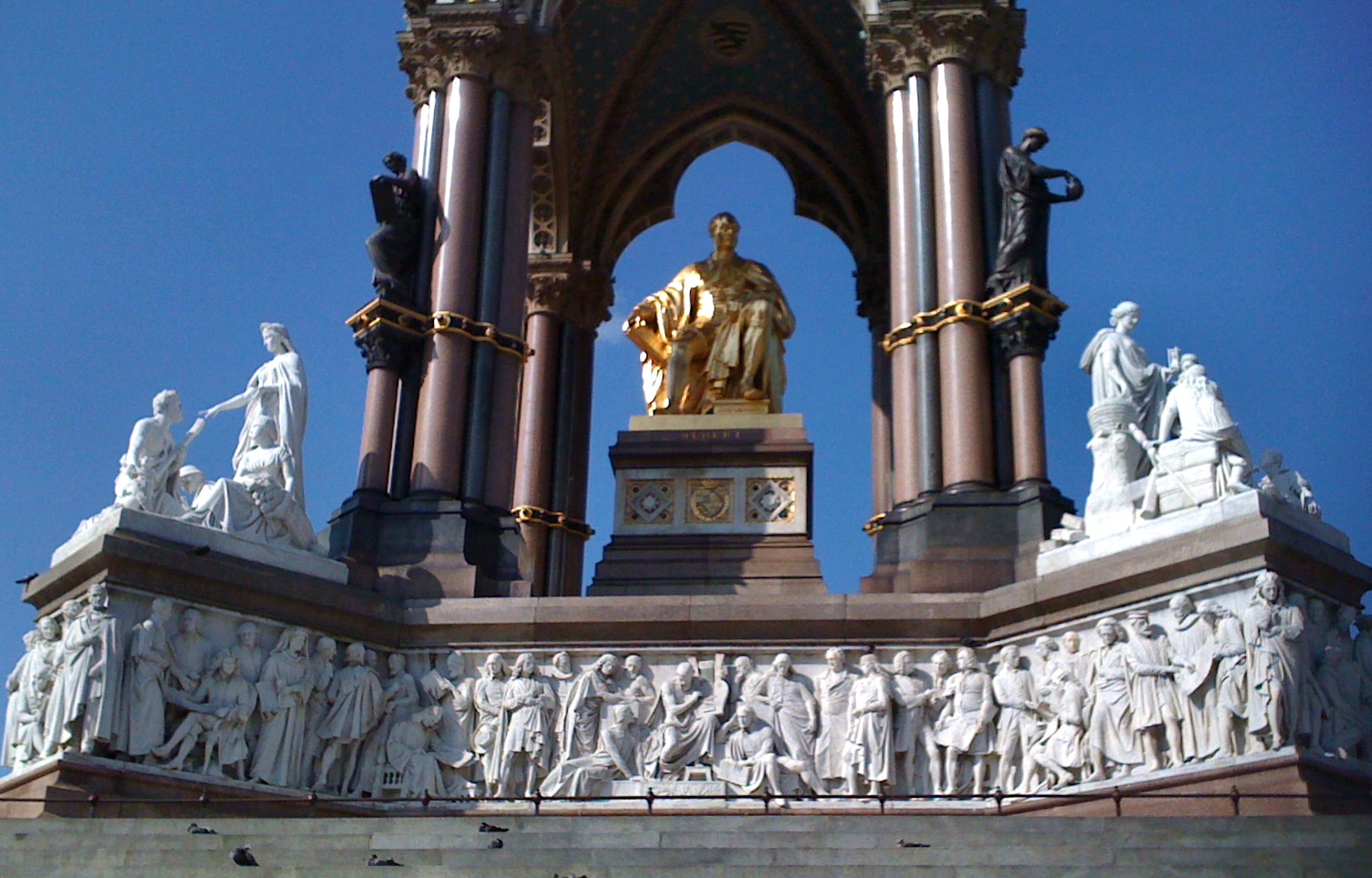
The central focus of the Albert Memorial is, of course, the huge seated figure of Prince Albert (the consort of Queen Victoria). But there are many other sculptures that deserve (but rarely get) close scrutiny. In particular there’s the Frieze of Parnassus that surrounds the base of the memorial. This depicts 160-plus historical figures from the world of the Arts. Although it’s not obvious from my photograph, each of the figures is identified by name – the Wikipedia article has clearer photographs and a full list of names.
When faced with lists like this, it’s inevitable that questions of the “why didn’t they include X?” variety spring to mind. Of course, the figures are necessarily drawn from the limited range of cultures familiar to mid-19th century Londoners – the ancient world of Egypt, Greece and Rome, and the post-renaissance world of Western Europe. In addition, the figures are limited to five specific categories – Poets, Musicians, Painters, Sculptors and Architects. But even within these constraints there are some notable omissions. I thought it would be interesting to go through all the people I’ve mentioned in previous posts who meet the basic criteria, and see which of them are included and which aren’t.
POETS
There aren’t as many poets depicted as you might expect. This is because they share the south side of the frieze (that’s the one in my photograph) with musicians.
Shakespeare is one of only three English poets to make it onto the frieze. He featured previously in connection with the authorship question and the ghost in Hamlet. If you’re interested in the latter, then watch this space – there’s more paranormal Shakespeare in the pipeline.
Alexander Pope (who featured in Angels in Machines last year) is a good example of someone who ought to be on the frieze but isn’t. The only post-Shakespeare English poet who does make the cut is John Milton, who was mentioned in passing in The Great Pyramid, and other British inventions – due to his rather nutty suggestion that the Greek philosopher Pythagoras got all his ideas from the ancient Britons. Oddly, Pythagoras appears on the frieze as a “poet” too, four places to the left of Milton.
Two of Britain’s greatest poets, Samuel Taylor Coleridge (featured in The Person from Porlock and The Ancient Mariner) and Lord Byron (featured in The Year Without a Summer) don’t make it onto the frieze, whereas Goethe and Schiller – two German poets of the same period – do.
Of the other non-English poets depicted on the frieze, Homer was featured in Space Odyssey and Dante in Dante’s Divine Comic Book.
MUSICIANS
Haydn, Mozart and Weber are the only three composers featured in Fortean Opera who died before the Frieze of Parnassus was created – and they are all on it.
Four of the composers mentioned in Philip K. Dick, music critic meet the same criterion – but only three of them are on the frieze. Bach, Mozart (again) and Beethoven made it, but Schubert didn’t.
PAINTERS
Botticelli, who featured in The Mystic Nativity, is conspicuously absent from the Frieze of Parnassus. This is odd because, as I said in that post, Botticelli “had a major influence on British painting of the Victorian period”. It’s even stranger that Botticelli’s more obscure contemporary Ghirlandaio is on the frieze.
Looking at the various omissions – Pope, Byron, Coleridge, Schubert, Botticelli – it strikes me they are all purveyors of what might be called “accessible” art. Maybe they weren’t considered sufficiently heavyweight to be commemorated in stone!
That’s certainly not true of the other great figures of the Florentine Renaissance—Leonardo da Vinci, Raphael and Michelangelo—who are all there on the frieze. In fact Michelangelo makes two appearances, both as a painter and as a sculptor! Both Michelangelo and Leonardo were featured in The Da Vinci Code and medieval symbolism, with Michelangelo also cropping up in A sixteenth century dinosaur and Leonardo in Underground Art and Crashed UFO in London. Raphael featured in my post about The School of Athens (which also mentions Pythagoras, referred to earlier).
Bellini was the subject of Descent into Limbo, and Mantegna was also mentioned in that post. Both Bellini and Mantegna are shown on the frieze.
The only other Italian artist I remember featuring is Agostino Carracci, in Bacchus and Ariadne. If you look back at that distinctly R-rated post, you won’t be surprised to learn the Victorians didn’t include Agostino in their frieze. However, Agostino’s brother Annibale Carracci (mentioned in the same post) did make the cut.
Vermeer (who featured in Chasing Vermeer... and Charles Fort) isn’t on the frieze – possibly because he falls in the “too accessible” category. But I was pleased to see that Hogarth – the epitome of accessible art – is right up there on the Frieze of Parnassus. Hogarth featured in Paranormal investigation, 18th century style and Another historical myth-conception.
Turner (who featured in Enigmatic Art) is on the frieze, but needless to say his populist contemporary John Martin (featured in Art and Archaeology) isn’t. Incidentally, one of Martin’s most characteristic works is “Joshua commanding the Sun to stand still upon Gibeon” (1816). I recently came across another version of the same scene that Martin painted in 1848 in a more Turneresque style. They’re both reproduced here (1816 top and 1848 bottom) so you can decide which you like best (I think they’re both great pictures).
SCULPTORS
I can only remember mentioning a sculptor once – that was Donatello in Alien simulacrum, one of my very first blog posts. Anyway, Donatello is there on the Frieze of Parnassus.
ARCHITECTS
As far as the Frieze of Parnassus is concerned, the “architects” of the ancient world aren’t really architects but patrons of architecture – the people who commissioned the buildings, rather than the people who designed them (the identities of the latter being lost in the mists of time). So, for example, “Cheops” is depicted as the architect of the Great Pyramid. Interest in Egyptology was still relatively new when the Albert Memorial was built, and the great wave of pyramidiocy that swept over the English-speaking world came later (see The Great Pyramid, and other British inventions, already mentioned above).
One of the oddest inclusions is Sennacherib, who would have been best known in Victorian times as the villain of a popular poem by Lord Byron (who unlike Sennacherib didn’t make it onto the Frieze of Parnassus). Presumably Sennacherib was considered the “architect” of the city of Nineveh, which had only recently been unearthed by archaeologists when the Albert Memorial was built. Sennacherib was mentioned in my posts on The Bible's Excluded Middle, Gods of the Bible and The Siege of Lachish... the last being about my ebook of the same title
Sunday, 3 February 2013
Fortean Opera
Il Mondo della Luna (The World of the Moon) by Haydn (1777). As the title suggests, this opera features a trip to the Moon and an encounter with its inhabitants. That wouldn’t be particularly Fortean... except that the “aliens” are fakes and the journey to the Moon is all a big hoax. As such, Il Mondo della Luna is probably the first opera ever written about a fake Moon landing – all the way back in 1777! It isn’t a well-known work (Haydn is more famous for his symphonies than his operas), but I found this clip on YouTube from a recent performance in New York. It looks quite jolly!
Die Zauberflöte (The Magic Flute) by Mozart (1791). This is a famously nutty opera that turns fairy tale conventions on their head. It begins with the hero, Prince Tamino, running away from a giant snake and fainting with fright. He is saved by three young women, followers of the Queen of the Night, who give him a magic flute and a mission to rescue the Queen’s daughter Pamina from a man named Sarastro. And why is this Fortean? Because it’s all a lie! When Tamino eventually catches up with Sarastro, it turns out he isn’t a villain at all, but a wise priest of Isis and Osiris (I should have mentioned this takes place in ancient Egypt). It’s true that Sarastro abducted Pamina, but only to free her from her mother’s clutches. He was keeping her safe so she could marry Tamino... but only after the latter has proved himself worthy by undergoing an arcane, Masonic-style initiation ritual. Strange as it may seem, he is assisted in this task by his magic flute, which was given to him by the evil Queen of the Night... who incidentally also steals the show.
Der Freischütz (The Freeshooter) by Weber (1821). This is a Pact with the Devil story.... the specific pact in this instance relating to the manufacture of magic bullets which always hit their target. The catch is that the seventh and last bullet does what the Devil—or rather the demon Samiel—wants it to... after which he takes your soul as per the standard agreement. The picture above illustrates the Wolf’s Glen scene, in which the magic bullets are forged while various spirits and demons look on. The whole scene is viewable on YouTube in two parts, here and here.
Der Fliegende Holländer (The Flying Dutchman) by Wagner (1843). The tale of the Flying Dutchman is a distinctly Fortean piece of folklore, about an old, ghostly ship that is occasionally glimpsed by sailors, its captain having been cursed to sail the seas forever. The original legend dates from the 17th century, but the opera turns it into a characteristically 19th century gothic romance. This is very early Wagner, and he went on to bigger and better things. It’s always struck me that, if the only thing that was known about Wagner was his operatic subject-matter, he would be considered an archetypal New Ager! You’ve got Celtic legends in Tristan und Isolde, the Holy Grail in Parsifal and paganism in the Ring – including this awesome invocation of the Earth Goddess!
La Nonne Sanglante (The Bleeding Nun) by Gounod (1854). Writing about Matthew Lewis’s novel The Monk (1796), H. P. Lovecraft wrote “In the sub-plot where the Marquis de las Cisternas meets the spectre of his erring ancestress, The Bleeding Nun, there are many enormously potent strokes; notably the visit of the animated corpse to the Marquis's bedside, and the cabalistic ritual whereby the Wandering Jew helps him to fathom and banish his dead tormentor.” This sounds like a great idea for an opera, but unfortunately Gounod’s attempt at it was a complete flop. Interestingly, the libretto was also offered to Gounod’s great contemporary Verdi, but he turned it down. If he hadn’t, The Bleeding Nun might have been up there with Rigoletto, Aida and La Traviata!
The Makropulos Case by Janáček (1926). I watched a production of this on a portable black and white TV when I was a student more than 30 years ago, and even then it occurred to me that it’s one of the few operas where the plot actually makes sense. The central character is a young woman named Emilia Marty, who takes an interest in a legal case that has been running for a century – and who talks about events of the 1820s as if she had been there. It gradually emerges that she’s lived for hundreds of years, using various different names all having the initials EM. But there’s an explanation for this which makes perfect sense. Anyone who is familiar with the story of John Dee and Edward Kelley will know that the Holy Roman Emperor Rudolf II (1552 – 1612) was obsessed with alchemy and the search for eternal life. Rudolf was based in Prague, which is where The Makropulos Case is set (Janáček was a Czech composer). When an alchemist named Hieronymus Makropulos offered Rudolf a life-extending potion, the Emperor asked him to test it on the alchemist’s daughter, Elina Makropulos, first. This caused her to fall into a coma, and the Emperor changed his mind about using the potion... but when Elina woke up a week later she discovered she had stopped aging! Hence her survival into the 20th century.
Wagner Dream by Jonathan Harvey (2007). Richard Wagner died of a heart attack in February 1883, at the age of 69. But, according to this opera, he didn’t give up without a Tibetan Book of the Dead style struggle. He was just embarking on his last opera, Die Sieger, and he argues with his spirit guide Vairochana that he ought to be allowed to go back and finish it. Wagner Dream is an opera within an opera (Wagner’s opera Die Sieger, as imagined by Harvey, framed inside Harvey’s own opera about Wagner’s battle against death). Die Sieger is set in ancient India, where the Buddha is busy setting up his community of monks. The hero is a young monk named Ananda who is trying to persuade the Buddha to allow women to join the monastic order. But isn’t that a bit far-fetched? Wagner may have been into a few New Age beliefs like Paganism and Celtic mythology, but surely not Buddhism? And feminist Buddhism at that? But it’s all true. Back in the 1850s, Wagner really did write a synopsis of Die Sieger along exactly these lines, and he really did return to the idea shortly before his death. I was aware of that (it’s mentioned by Philip K. Dick in VALIS
Friday, 21 October 2011
Lisztomania
The term Lisztomania sounds like a modern coinage, but was actually first used by the poet Heinrich Heine in 1844. At that time, however, "mania" had quite a different meaning. Nowadays it refers to an intense fad or craze, whereas originally it was a medical term referring to a serious derangement of the mind. Here is Heine's description of the audience reaction to one of Liszt's concerts:
"What tremendous rejoicing and applause! A delirium unparalleled in the annals of furore! And what is the real cause of this phenomenon? The solution of the question belongs rather to the province of pathology than to that of aesthetics. The electric action of a demoniac nature on a closely pressed multitude, the contagious power of ecstasy, and perhaps a magnetism in music itself, which is a spiritual malady which vibrates in most of us... all these phenomena never struck me so significantly or so painfully as in this concert of Liszt's."Apparently it was female listeners who were affected the most: fainting, screaming hysterically, wearing his portrait on brooches, taking cuttings of his hair, and even collecting his coffee dregs and discarded cigar stubs. It all sounds a lot like the Beatlemania of the 1960s, or any of the countless manias since then. This leads one to suspect that, despite the apparent change in meaning, the basic "mania" phenomenon is the same as it always was. What struck people as a serious derangement of the mind in the 1840s is now seen as the normal behaviour of young human females when they get close to their musical idols!
Liszt died in 1886, two years before the oldest surviving audio recording was made... so sadly we will never know what all the fuss was about. However, in parallel with his performing career Liszt was also a prolific composer, and many of his works are still popular today. He was a great innovator, and single-handedly created the musical form known as the symphonic poem, as well as producing two full-length symphonies based on Goethe's Faust and Dante's Divine Comedy. These were considered revolutionary at the time, because they attempted to tell a story using purely instrumental music. For some reason, the musical establishment of the late eighteenth and early nineteenth century enforced the view that all non-vocal music had to be abstract, and that if it tried to represent something then it was garbage. This is similar (although with one subtle and easy-to-miss difference) to the view of the artistic establishment that all painting had to represent something, and if it was abstract then it was garbage.
Monday, 26 September 2011
Words and music by Desmond Leslie
Desmond Leslie's contribution is at the opposite end of the intellectual scale from Adamski's. It's still nonsense, but it's literate and well-researched nonsense. Leslie was the first person to try to link the UFO phenomenon with what would nowadays be called New Age beliefs -- bringing in everything from Atlantis and the Pyramids to Indian flying machines (vimanas) and Celtic mythology. Leslie also draws heavily on esoteric writings such as the Stanzas of Dzyan and the theosophical theories of Madame Blavatsky... and even inserts a few original ideas of his own. Foremost among these is the notion that Flying Saucers are powered by musical tones and harmonies: "A vimana can be moved by tunes and rhythms".
This brings us onto the second item depicted above: Music of the Future
The titles of the tracks clearly show Leslie's continuing interest in the mystical and esoteric: "Comet in Aquarius", "The Warhorns of Mars", "Coming of the Elementals" and "Death of Satan". The last-named is described by Leslie as an esoteric tone-poem, and contains the album's only recognisable tune (which can be heard in the clip at the bottom of this post) -- a distorted version of the theme from Richard Strauss's own tone-poem, Don Juan.
The first six tracks on the CD were written for a now-forgotten film called The Day the Sky Fell In. I don't think Leslie had anything to do with the plot of the film, but from the way he describes it in the sleeve notes it sounds like an archetypal "contactee" scenario. A mysterious stranger visits a defence scientist and tries to dissuade him from working on nuclear weapons. The scientist refuses, so the stranger gives a loaded revolver to the scientist's son... who happens to be mentally retarded. The point being -- this is no more dangerous than giving an atom bomb to a politician!