There’s nothing more frustrating than saying something clever, being completely ignored, and then years later someone else says exactly the same thing. That’s always happening to me. A case in point was the above article on the BBC website last week. It’s about how E. M. Forster’s short story “The Machine Stops” from 1909 seems to foreshadow the world of social media, with its depiction of a dystopian future where people interact with each other via technology rather than face-to-face. But I made exactly the same point as long ago as 24 January 2011, in what was only the third post on this blog.
The post was called Wikipedia Prophecy, and in the last five years and four months it has amassed a grand total of 48 page views. In it, I said that Forster’s story “can be read today as an amusing satire on the World Wide Web, and on social networking sites such as Facebook in particular” – which is essentially what the BBC article says. However, as the title of my post indicates, I made another connection they missed – with Wikipedia’s strict (and to my mind frighteningly fascist) policy of “No Original Research”, which is also a central tenet of the future world envisaged by Forster.
A later post I wrote on a similar subject was The End of Books, about Octave Uzanne’s short story of that title from 1895. That post has fared better, with a total of 647 page views (above average for this blog). However, I can’t resist repeating this illustration by Albert Robida, which shows a group of earphone-wearing commuters on a metro train. When you realize that Queen Victoria was still on the throne when the picture was drawn, it really is astonishingly prophetic.
Andrew May's Forteana Blog, focusing on the weirder fringes of history (and other old-fashioned stuff)
Search This Blog
Showing posts with label prophecy. Show all posts
Sunday, 22 May 2016
Sunday, 25 October 2015
Going Down… Beneath the Bermuda Triangle
I’ve just read two stories – a longish novelette and a shortish novel, both dating from the 1970s – by an author I’d barely heard of, called Jane Gallion. Previously I’d only seen her name in the context of a notoriously violent post-apocalyptic novel called Biker, which dates from 1969 and is still banned in the UK. But the two stories I did get hold of are quite different in tone, and it’s a shame they’re not better known. They’re both clever, well-written and interesting, and the longer of the two is bordering on a masterpiece.
To start with the shorter story – it’s called “Beneath the Bermuda Triangle” and it was published in the June/July 1979 issue of Galaxy magazine. This was a few years after the Skull the Slayer comic series I mentioned earlier this year, and it’s just as wacky a take on the Bermuda Triangle mystery. It’s got jewel-smuggling hippies, malevolent aliens, survivors from Atlantis, underwater pyramids and the Tibetan Book of the Dead.
As far as I can tell, “Beneath the Bermuda Triangle” is the only story Jane Gallion ever wrote that doesn’t have any sex in it (apart from a couple of indirect references to Tantric Sex). But there is a tenuous connection to the world of erotica. The stand-in editor for that particular issue of Galaxy was “Hank Stine” – an alter-ego of Jean Marie Stine, who used the same byline on one of the avant-garde erotic novels published in the late sixties by the short-lived Essex House imprint (see my post about The Geek by Alice Louise Ramirez). Jane Gallion’s Biker was another Essex House novel – and according to an autobiographical note, she also worked as an editor there. At the same time, she seems to have been active in science fiction fandom – see this photograph of her (there were other links between Essex House and science fiction – Philip José Farmer also published several novels with them).
The novel I just read, and found so impressive, is called Going Down. In her autobiographical note (which dates from 1990), Jane Gallion says the book was written for Essex House but never published (partly because it broke two of their house rules – “no humour” and “no politics”). However, it was eventually published as an ebook in 2001, two years before the author died.
Unlike Biker (which is available as an ebook in America but not in Britain), Going Down is listed on the UK Kindle store
, which is where I got it. I don’t think the listing does the book any favours – there’s no cover image or preview, the blurb is misleading and it’s classified as erotica, which it isn’t really – it’s a dystopian SF satire in which sex (or the suppression of sex) plays a significant role.
Going Down is written in the kind of avant-garde literary style that was popular in the early seventies – all in the present tense, and with no quotation marks around dialogue. In that sense, and in other ways, I found the style reminiscent of Barry Malzberg, who was one of the big name writers of the time. Thematically, on the other hand, the novel is closer to Philip K. Dick – all about a sharply stratified future society in which information is tightly controlled, and the government knows more about you than you do. The book’s structure is also reminiscent of PKD, with the point of view alternating between three different characters – one high up in government, one at the very bottom of society, and one who is a major figure in the (ultimately fruitless) rebel movement. Also, like both Dick and Malzberg, the novel has a strong undercurrent of humour, even though it’s basically a very angry book.
I mentioned science fiction portrayals of the future last week – and Going Down is one of the most prophetic I’ve come across. The society it describes is ultra-capitalist and ultra-puritanical. The government has electronic spying machines everywhere, ready to pounce at the first hint of subversive or “perverted” behaviour. Giant corporations charge people (who are always referred to as “consumers”) for absolutely everything – including having sex and going to the toilet. If you try to avoid paying for something, it’s a serious crime because it “damages the economy”. Also prescient (given recent headlines) is the utter hypocrisy of the ruling class, who impose puritanical laws on ordinary citizens while indulging in the most disgustingly obscene behaviour themselves.
Although Going Down was originally written in the early seventies, I’m not sure if it was revised for its ebook publication in 2001. If it wasn’t, then it contains one amazingly prescient reference. I can’t remember anyone back in the 1970s worrying about Genetically Modified crops, but one of the characters in the novel does. It’s in a scene between a high-ranking member of the government, named Hennering, and his boyfriend Penrod (“a slender lad of eighteen”). Hennering wishes to deep-throat a certain part of Penrod’s anatomy after said anatomical part has been thrust up a chicken’s backside:
To start with the shorter story – it’s called “Beneath the Bermuda Triangle” and it was published in the June/July 1979 issue of Galaxy magazine. This was a few years after the Skull the Slayer comic series I mentioned earlier this year, and it’s just as wacky a take on the Bermuda Triangle mystery. It’s got jewel-smuggling hippies, malevolent aliens, survivors from Atlantis, underwater pyramids and the Tibetan Book of the Dead.
As far as I can tell, “Beneath the Bermuda Triangle” is the only story Jane Gallion ever wrote that doesn’t have any sex in it (apart from a couple of indirect references to Tantric Sex). But there is a tenuous connection to the world of erotica. The stand-in editor for that particular issue of Galaxy was “Hank Stine” – an alter-ego of Jean Marie Stine, who used the same byline on one of the avant-garde erotic novels published in the late sixties by the short-lived Essex House imprint (see my post about The Geek by Alice Louise Ramirez). Jane Gallion’s Biker was another Essex House novel – and according to an autobiographical note, she also worked as an editor there. At the same time, she seems to have been active in science fiction fandom – see this photograph of her (there were other links between Essex House and science fiction – Philip José Farmer also published several novels with them).
The novel I just read, and found so impressive, is called Going Down. In her autobiographical note (which dates from 1990), Jane Gallion says the book was written for Essex House but never published (partly because it broke two of their house rules – “no humour” and “no politics”). However, it was eventually published as an ebook in 2001, two years before the author died.
Unlike Biker (which is available as an ebook in America but not in Britain), Going Down is listed on the UK Kindle store
Going Down is written in the kind of avant-garde literary style that was popular in the early seventies – all in the present tense, and with no quotation marks around dialogue. In that sense, and in other ways, I found the style reminiscent of Barry Malzberg, who was one of the big name writers of the time. Thematically, on the other hand, the novel is closer to Philip K. Dick – all about a sharply stratified future society in which information is tightly controlled, and the government knows more about you than you do. The book’s structure is also reminiscent of PKD, with the point of view alternating between three different characters – one high up in government, one at the very bottom of society, and one who is a major figure in the (ultimately fruitless) rebel movement. Also, like both Dick and Malzberg, the novel has a strong undercurrent of humour, even though it’s basically a very angry book.
I mentioned science fiction portrayals of the future last week – and Going Down is one of the most prophetic I’ve come across. The society it describes is ultra-capitalist and ultra-puritanical. The government has electronic spying machines everywhere, ready to pounce at the first hint of subversive or “perverted” behaviour. Giant corporations charge people (who are always referred to as “consumers”) for absolutely everything – including having sex and going to the toilet. If you try to avoid paying for something, it’s a serious crime because it “damages the economy”. Also prescient (given recent headlines) is the utter hypocrisy of the ruling class, who impose puritanical laws on ordinary citizens while indulging in the most disgustingly obscene behaviour themselves.
Although Going Down was originally written in the early seventies, I’m not sure if it was revised for its ebook publication in 2001. If it wasn’t, then it contains one amazingly prescient reference. I can’t remember anyone back in the 1970s worrying about Genetically Modified crops, but one of the characters in the novel does. It’s in a scene between a high-ranking member of the government, named Hennering, and his boyfriend Penrod (“a slender lad of eighteen”). Hennering wishes to deep-throat a certain part of Penrod’s anatomy after said anatomical part has been thrust up a chicken’s backside:
The pullet had been organically raised. Penrod refused to have anything to do with a chicken exposed to genetically engineered or chemically adulterated food. He was afraid it might give him high blood pressure or possibly a rash. There’s a lot of that around. But Hennering made sure the bird was clean before he gave it to Penrod. Heavens to Betsy, he couldn’t have Penrod catching anything, could he?This scene struck me as doubly prophetic – not just the reference to genetic engineering (and pathological aversion thereto), but also the way a conservative politician indulges in behaviour that’s so perverted it wouldn’t even cross a normal person’s mind. Remember this news story from a month ago?
Sunday, 14 June 2015
An Astounding Prediction
Astounding Science Fiction started life as a pulp magazine, but by the latter half of the 1940s it had moved upmarket. It was printed on thinner, better quality paper in a smaller paperback-style format. The covers, as you can see from the examples above, were considerably less garish than pulp magazines of the period such as Planet Stories. Astounding’s writers tended to be more thoughtful and sophisticated than their pulp counterparts, too – and so were its readers, to judge from some of the letters printed in the magazine. Perhaps the most famous of these appeared in the November 1948 issue (the one with The Players of Null-A on the cover). I’ve written about it before, in Science Fiction Prophecy – but that was 12 years ago now, and it’s bang on topic for this blog, so I thought I’d mention it again.
The letter in question was written by Richard A. Hoen of the University Club in Buffalo, New York. When I wrote the first piece I knew nothing at all about him, but according to an obituary that appeared in 2010, he was a 20-year old student when he wrote his famous letter. At first sight it was nothing special – just his personal ratings and a few other comments on the stories that featured in a particular issue of the magazine. A lot of “letters to the editor” took that format. The extraordinary thing in Hoen’s case was that the issue he was critiquing was the one dated November 1949 – exactly 12 months after the issue his letter appeared in!
Spookily enough, when November 1949 duly came around, that month’s Astounding bore an uncanny resemblance to Hoen’s description of it. But that wasn’t because of any great precognitive powers – or the possession of a time machine – on Hoen’s part. If that had been the case, then the match between his description and actuality would have been perfect, or nearly so – but in fact there are several major discrepancies. Basically the match is as close as the magazine’s editor, John W. Campbell, Jr., could make it!
Or maybe Hoen “saw” some slightly alternative version of the future. Maybe that was what Campbell was thinking when he printed Hoen’s letter in 1948. His comment at that time was: “Hm-m-m – he must be off on another time-track. ‘Fraid it’s not THIS November ‘49.” But by the time November 1949 came around, Campbell was pretty close to being able to put the issue together the way Hoen had described it. His editorial in that issue, “Science Fiction Prophecy”, makes the point that certain types of prophecy, once they’ve been made, have a tendency to be self-fulfilling: “Generally, a desirable, practically attainable idea, suggested in prophecy, has a chance of forcing itself into reality by its very existence. Like, for example, this particular issue of Astounding Science Fiction.”
So what aspects of his prediction did Hoen “get right”? Quite a few, as it turns out. All three short stories listed by Hoen are there in the actual magazine: “Final Command” by A. E. van Vogt, “Over the Top” by Lester del Rey and “Finished” by L. Sprague de Camp. So is the novelette, “What Dead Men Tell” by Theodore Sturgeon.
Hoen mentions two non-fiction articles, by R. S. Richardson and Willy Ley. There’s nothing in the actual magazine by Willy Ley, but there is an article by R. S. Richardson – although on a different subject from the one mentioned by Hoen.
Hoen scored another near-miss in one of the magazine’s two serialized stories – “Gulf” (part 1 of 2) by Robert A. Heinlein. Hoen doesn’t say the story is serialized, and he gives the author’s byline as Anson MacDonald – although he also refers to him as R. A. Mac H., so it’s clear he meant the story to be written by Heinlein (“Anson MacDonald” was a pseudonym Heinlein used earlier in his career).
Hoen describes the November 1949 cover as being the work of Hubert Rogers, which it is. As you can see from the photograph above, the cover story is “...And Now You Don’t” by Isaac Asimov. This again is a serial, the first of three parts, which was subsequently published in book form as the final two-thirds of Second Foundation (the first third, “Now You See It...” appeared in the January 1948 issue, seen in the bottom left of the photograph).
But Hoen doesn’t mention Asimov at all in his letter. In his version of the magazine, the cover story is “We Hail” by Don A. Stuart – a pseudonym that Campbell himself used on a number of stories back in the 1930s. You might imagine this would be the easiest part of the prophecy for Campbell to make come true, yet he didn’t. Maybe, as a full-time editor, he just didn’t have the time or inclination to write a story himself!
The actual cover story, by Asimov, contains an interesting bit of “prophecy” itself. On the penultimate page of this instalment, one of the characters exclaims “What the black holes of Space are you d...doing aboard this ship?” There’s nothing odd about that, you might think, because black holes are among the most outlandish and exotic things to be found in outer space. But the use of the term “black hole” in this context only dates from the 1960s! Anyone encountering the phrase in the book version of Second Foundation may imagine it’s a later editorial change, but as you can see from the picture below it was there in the original 1949 magazine!
The letter in question was written by Richard A. Hoen of the University Club in Buffalo, New York. When I wrote the first piece I knew nothing at all about him, but according to an obituary that appeared in 2010, he was a 20-year old student when he wrote his famous letter. At first sight it was nothing special – just his personal ratings and a few other comments on the stories that featured in a particular issue of the magazine. A lot of “letters to the editor” took that format. The extraordinary thing in Hoen’s case was that the issue he was critiquing was the one dated November 1949 – exactly 12 months after the issue his letter appeared in!
Spookily enough, when November 1949 duly came around, that month’s Astounding bore an uncanny resemblance to Hoen’s description of it. But that wasn’t because of any great precognitive powers – or the possession of a time machine – on Hoen’s part. If that had been the case, then the match between his description and actuality would have been perfect, or nearly so – but in fact there are several major discrepancies. Basically the match is as close as the magazine’s editor, John W. Campbell, Jr., could make it!
Or maybe Hoen “saw” some slightly alternative version of the future. Maybe that was what Campbell was thinking when he printed Hoen’s letter in 1948. His comment at that time was: “Hm-m-m – he must be off on another time-track. ‘Fraid it’s not THIS November ‘49.” But by the time November 1949 came around, Campbell was pretty close to being able to put the issue together the way Hoen had described it. His editorial in that issue, “Science Fiction Prophecy”, makes the point that certain types of prophecy, once they’ve been made, have a tendency to be self-fulfilling: “Generally, a desirable, practically attainable idea, suggested in prophecy, has a chance of forcing itself into reality by its very existence. Like, for example, this particular issue of Astounding Science Fiction.”
So what aspects of his prediction did Hoen “get right”? Quite a few, as it turns out. All three short stories listed by Hoen are there in the actual magazine: “Final Command” by A. E. van Vogt, “Over the Top” by Lester del Rey and “Finished” by L. Sprague de Camp. So is the novelette, “What Dead Men Tell” by Theodore Sturgeon.
Hoen mentions two non-fiction articles, by R. S. Richardson and Willy Ley. There’s nothing in the actual magazine by Willy Ley, but there is an article by R. S. Richardson – although on a different subject from the one mentioned by Hoen.
Hoen scored another near-miss in one of the magazine’s two serialized stories – “Gulf” (part 1 of 2) by Robert A. Heinlein. Hoen doesn’t say the story is serialized, and he gives the author’s byline as Anson MacDonald – although he also refers to him as R. A. Mac H., so it’s clear he meant the story to be written by Heinlein (“Anson MacDonald” was a pseudonym Heinlein used earlier in his career).
Hoen describes the November 1949 cover as being the work of Hubert Rogers, which it is. As you can see from the photograph above, the cover story is “...And Now You Don’t” by Isaac Asimov. This again is a serial, the first of three parts, which was subsequently published in book form as the final two-thirds of Second Foundation (the first third, “Now You See It...” appeared in the January 1948 issue, seen in the bottom left of the photograph).
But Hoen doesn’t mention Asimov at all in his letter. In his version of the magazine, the cover story is “We Hail” by Don A. Stuart – a pseudonym that Campbell himself used on a number of stories back in the 1930s. You might imagine this would be the easiest part of the prophecy for Campbell to make come true, yet he didn’t. Maybe, as a full-time editor, he just didn’t have the time or inclination to write a story himself!
The actual cover story, by Asimov, contains an interesting bit of “prophecy” itself. On the penultimate page of this instalment, one of the characters exclaims “What the black holes of Space are you d...doing aboard this ship?” There’s nothing odd about that, you might think, because black holes are among the most outlandish and exotic things to be found in outer space. But the use of the term “black hole” in this context only dates from the 1960s! Anyone encountering the phrase in the book version of Second Foundation may imagine it’s a later editorial change, but as you can see from the picture below it was there in the original 1949 magazine!
Sunday, 7 September 2014
Retro Terrorism
As regular readers probably know, I’m a sucker for garishly-covered mass-market paperbacks from the 1970s. Whenever I’m looking through a display of used books, those are the ones that jump out at me. That’s what happened at the Yeovilton Air Day back in July, when I spotted the book pictured above.
My immediate thought was that it was a factual account of the September 11 attacks on the World Trade Center thirteen years ago. With the title 911, and the words “Terror” and “New York” on the cover, that’s a reasonable assumption. The seller must have thought the same way, since she’d stacked the book under “Military History”.
After a few seconds thought, however, I realized that couldn’t be the case. They’d stopped producing covers like that long before 2001 (more’s the pity). The price on the back, 85 pence, strongly indicates an origin in the mid-seventies. After I’d bought the book and taken it out of its plastic bag, I saw that the publication date inside was 1977.
Actually, this is a work of fiction, by an author I’d never heard of before – Thomas Chastain. I’d like to creep people out by saying the novel is a prophetic vision of future events, but it isn’t. The “terrorist” villain is a lone psychopath with a grudge against the city of New York, who plants a series of time-bombs around midtown Manhattan. The title refers to the emergency telephone number (equivalent to 112 or 999 in the UK), where the bomber leaves taunting messages. The book is essentially a police procedural, similar in style to the Kojak TV series – also based in New York – which was popular at the time.
The plot is pretty good, but the novel has far too much padding for my taste. It’s 280 pages long, but could easily be cut to half that length. If the book had been 140 pages (as many novels were in those days), then I’d probably give it a top rating. As it is, I found parts of the book almost unreadably tedious. The last few chapters are absolutely gripping stuff, though.
Perhaps the most striking thing about the book, judged by modern standards, is how cozy it is. Despite the wording on the cover, there really isn’t any “terror” at all. The focus is almost entirely on the police investigation, with very little about the public or media reaction to the bombings. There’s a distinct lack of gratuitous violence, too (no, I’m not disappointed – I’m just saying). Although there are a dozen bombing incidents in the course of the novel, they cause very few fatalities or serious injuries.
In fact it’s almost a case of “gratuitous non-violence”. The clearest example is when one of the bombs is placed under the back seat of a bus. This foreshadows Britain’s own 9/11 – the 7/7 London Transport bombings which killed 52 people in July 2005, half of them on a Number 30 bus that exploded in Tavistock Square. But when the Number 4 bus blows up on Fifth Avenue in the novel, it just happens to be out of service at the time, so there’s no-one on board except the driver. And because the bomb was right at the back, he only suffers from smoke inhalation. Like I said – gratuitous non-violence!
Of course, the world was a much simpler place in the seventies. In those days, the word “bomber” was more likely to conjure up images of a large military aircraft than a homicidal individual. And that reminds me...
Since I mentioned the Yeovilton Air Day in the first paragraph, here are some pictures I took (not great quality, I’m afraid) of what must be the most beautiful bomber still flying – Vulcan XH558, the Spirit of Great Britain. The pilot on this occasion was almost as legendary as the aircraft – Martin Withers, who led the first of the Black Buck bombing raids against Stanley airfield in the Falklands in 1982.
My immediate thought was that it was a factual account of the September 11 attacks on the World Trade Center thirteen years ago. With the title 911, and the words “Terror” and “New York” on the cover, that’s a reasonable assumption. The seller must have thought the same way, since she’d stacked the book under “Military History”.
After a few seconds thought, however, I realized that couldn’t be the case. They’d stopped producing covers like that long before 2001 (more’s the pity). The price on the back, 85 pence, strongly indicates an origin in the mid-seventies. After I’d bought the book and taken it out of its plastic bag, I saw that the publication date inside was 1977.
Actually, this is a work of fiction, by an author I’d never heard of before – Thomas Chastain. I’d like to creep people out by saying the novel is a prophetic vision of future events, but it isn’t. The “terrorist” villain is a lone psychopath with a grudge against the city of New York, who plants a series of time-bombs around midtown Manhattan. The title refers to the emergency telephone number (equivalent to 112 or 999 in the UK), where the bomber leaves taunting messages. The book is essentially a police procedural, similar in style to the Kojak TV series – also based in New York – which was popular at the time.
The plot is pretty good, but the novel has far too much padding for my taste. It’s 280 pages long, but could easily be cut to half that length. If the book had been 140 pages (as many novels were in those days), then I’d probably give it a top rating. As it is, I found parts of the book almost unreadably tedious. The last few chapters are absolutely gripping stuff, though.
Perhaps the most striking thing about the book, judged by modern standards, is how cozy it is. Despite the wording on the cover, there really isn’t any “terror” at all. The focus is almost entirely on the police investigation, with very little about the public or media reaction to the bombings. There’s a distinct lack of gratuitous violence, too (no, I’m not disappointed – I’m just saying). Although there are a dozen bombing incidents in the course of the novel, they cause very few fatalities or serious injuries.
In fact it’s almost a case of “gratuitous non-violence”. The clearest example is when one of the bombs is placed under the back seat of a bus. This foreshadows Britain’s own 9/11 – the 7/7 London Transport bombings which killed 52 people in July 2005, half of them on a Number 30 bus that exploded in Tavistock Square. But when the Number 4 bus blows up on Fifth Avenue in the novel, it just happens to be out of service at the time, so there’s no-one on board except the driver. And because the bomb was right at the back, he only suffers from smoke inhalation. Like I said – gratuitous non-violence!
Of course, the world was a much simpler place in the seventies. In those days, the word “bomber” was more likely to conjure up images of a large military aircraft than a homicidal individual. And that reminds me...
Since I mentioned the Yeovilton Air Day in the first paragraph, here are some pictures I took (not great quality, I’m afraid) of what must be the most beautiful bomber still flying – Vulcan XH558, the Spirit of Great Britain. The pilot on this occasion was almost as legendary as the aircraft – Martin Withers, who led the first of the Black Buck bombing raids against Stanley airfield in the Falklands in 1982.
Sunday, 15 September 2013
Reinventing Ezekiel's Wheel
Ezekiel was a priest who was exiled to Babylon along with King Jehoiachin of Judah in the sixth century BC. Ezekiel experienced a number of visions, and his account of these form one of the main prophetic books of the Hebrew scriptures. The best known of Ezekiel’s visions is the first, involving an encounter with a heavenly figure seated on a throne borne by four strange creatures, each of which has four faces and is supported by a “wheel within a wheel”.
This is one of the most striking images to be found in any of the Hebrew prophetic books, and as such has appealed to artists throughout the centuries. This depiction by William Blake (who had mystical visions of his own) emphasizes the mystical and symbolic nature of Ezekiel’s vision.
To many people, however, Ezekiel’s vision is nothing less than an extraterrestrial flying machine. As with other “ancient astronaut” theories, you often hear people says things like “Of course, that idea originated in 1968 with Erich von Däniken’s book Chariots of the Gods
”. Well, no it didn’t. All von Däniken did was to pitch the idea in populist, uncomplicated language that was capable of appealing to a huge mass-market audience. But the idea was by no means a new one.
I’ve already mentioned how ancient astronaut theories were pushed by Desmond Leslie as long ago as 1953, in one of the most famous of the early UFO books – Flying Saucers Have Landed, coauthored with George Adamski. Sadly the book is remembered solely for Adamski’s contribution, even though Leslie’s chapters are a lot more sophisticated and intelligent. British readers of my generation may also remember the work of W. Raymond Drake – the first of whose “Gods and Spacemen” books was published in 1964, four years before Chariots of the Gods. To my mind, Drake’s books were more insightful than von Däniken’s, and better researched. But writers like Drake and Leslie never achieved the mass appeal of von Däniken, and people forget (or were never aware) that they predated him by several years.
Although it’s frustrating that people give all the credit to the wrong person, if you look at it another way then von Däniken’s achievement is really quite impressive. He took an idea that had previously been confined to a small niche audience, and brought it to the attention of the whole world. In Fortean circles, however, everything he had to say was old hat. In his book Great World Mysteries, published in 1962, the British Fortean writer Eric Frank Russell wrote “...anything strange seen soaring above the clouds automatically became a fiery chariot. Some imaginative writers have seized on this fact and turned out stories depicting biblical characters as enlightened visitors from another world.”
To someone brought up in a technological, materialistic culture, it may seem obvious that ancient accounts of supposedly mystical experiences are garbled descriptions of extraterrestrial hardware. But the opposite is equally true – a modern-day account of extraterrestrial hardware may be a garbled description of a mystical experience. This is the line taken by the psychologist C.G. Jung in his 1959 book Flying Saucers: A Modern Myth of Things Seen in the Skies. Jung uses Ezekiel’s vision as an example of what UFOs might be, not the other way around!
Perhaps the most mainstream reference to a “nuts and bolts” interpretation of Ezekiel’s vision is this short choral work composed by Ralph Vaughan Williams in 1956. By that time Vaughan Williams was 84 years old, and very much the grand old man of English classical music. The piece is a setting of the first chapter of the Book of Ezekiel, and the only unusual thing about it is the title the composer chose to give it: A Vision of Aeroplanes (the word “aeroplane” literally refers to an aircraft with a fixed horizontal lifting surface, but in the mid-20th century it was used loosely to mean any form of flying machine).
In an article about Vaughan Williams in issue 241 of Fortean Times (October 2008), David Sutton describes A Vision of Aeroplanes as “a cataclysmic sounding piece of musical prophecy – aeronauts from the future – for choir and organ”. But it’s odd that this particular composer should have chosen such a materialistic interpretation of the text, since the same FT article also describes Vaughan Williams as “a visionary in the tradition of Blake” (and for Blake’s distinctly non-materialistic interpretation, see above).
While most of the “nuts and bolts” proponents have been content to say “Ezekiel’s description sounds a bit like a flying machine”, some writers have gone further. In 1974, for example, an aeronautical engineer named J.F. Blumrich produced a full-length book called The Spaceships of Ezekiel. According to the author’s Foreword, this started out as an attempt to debunk the spaceship theory popularized by Eric von Däniken, but ended up supporting it – together with a fairly specific engineering design based on a line-by-line analysis of the Biblical text.
Although Blumrich’s book was the first detailed analysis to draw widespread attention, it wasn’t the first of its kind. Something very similar was attempted by Arthur W. Orton in 1961, in a 14-page article entitled “The Four-Faced Visitors of Ezekiel”. This appeared in Analog Science Fiction magazine, cover-dated March 1961 in the US and July 1961 in the UK. Again, Orton employed a line-by-line analysis of Ezekiel’s text to come up with a specific engineering design (although Orton’s design looks nothing like Blumrich’s).
The main point I wanted to make was that, contrary to popular opinion, Erich von Däniken wasn’t the first person to suggest a nuts-and-bolts interpretation of the Book of Ezekiel. Numerous lesser known authors put forward similar ideas throughout the 1950s and 60s – but on closer examination even they were merely “reinventing the wheel”. As long ago as 1902, a Baptist minister from Texas named Burrell Cannon was granted a patent for his Ezekiel Airship, which was supposedly based on the description provided in the first chapter of the Biblical account!
This is one of the most striking images to be found in any of the Hebrew prophetic books, and as such has appealed to artists throughout the centuries. This depiction by William Blake (who had mystical visions of his own) emphasizes the mystical and symbolic nature of Ezekiel’s vision.
To many people, however, Ezekiel’s vision is nothing less than an extraterrestrial flying machine. As with other “ancient astronaut” theories, you often hear people says things like “Of course, that idea originated in 1968 with Erich von Däniken’s book Chariots of the Gods
I’ve already mentioned how ancient astronaut theories were pushed by Desmond Leslie as long ago as 1953, in one of the most famous of the early UFO books – Flying Saucers Have Landed, coauthored with George Adamski. Sadly the book is remembered solely for Adamski’s contribution, even though Leslie’s chapters are a lot more sophisticated and intelligent. British readers of my generation may also remember the work of W. Raymond Drake – the first of whose “Gods and Spacemen” books was published in 1964, four years before Chariots of the Gods. To my mind, Drake’s books were more insightful than von Däniken’s, and better researched. But writers like Drake and Leslie never achieved the mass appeal of von Däniken, and people forget (or were never aware) that they predated him by several years.
Although it’s frustrating that people give all the credit to the wrong person, if you look at it another way then von Däniken’s achievement is really quite impressive. He took an idea that had previously been confined to a small niche audience, and brought it to the attention of the whole world. In Fortean circles, however, everything he had to say was old hat. In his book Great World Mysteries, published in 1962, the British Fortean writer Eric Frank Russell wrote “...anything strange seen soaring above the clouds automatically became a fiery chariot. Some imaginative writers have seized on this fact and turned out stories depicting biblical characters as enlightened visitors from another world.”
To someone brought up in a technological, materialistic culture, it may seem obvious that ancient accounts of supposedly mystical experiences are garbled descriptions of extraterrestrial hardware. But the opposite is equally true – a modern-day account of extraterrestrial hardware may be a garbled description of a mystical experience. This is the line taken by the psychologist C.G. Jung in his 1959 book Flying Saucers: A Modern Myth of Things Seen in the Skies. Jung uses Ezekiel’s vision as an example of what UFOs might be, not the other way around!
Perhaps the most mainstream reference to a “nuts and bolts” interpretation of Ezekiel’s vision is this short choral work composed by Ralph Vaughan Williams in 1956. By that time Vaughan Williams was 84 years old, and very much the grand old man of English classical music. The piece is a setting of the first chapter of the Book of Ezekiel, and the only unusual thing about it is the title the composer chose to give it: A Vision of Aeroplanes (the word “aeroplane” literally refers to an aircraft with a fixed horizontal lifting surface, but in the mid-20th century it was used loosely to mean any form of flying machine).
In an article about Vaughan Williams in issue 241 of Fortean Times (October 2008), David Sutton describes A Vision of Aeroplanes as “a cataclysmic sounding piece of musical prophecy – aeronauts from the future – for choir and organ”. But it’s odd that this particular composer should have chosen such a materialistic interpretation of the text, since the same FT article also describes Vaughan Williams as “a visionary in the tradition of Blake” (and for Blake’s distinctly non-materialistic interpretation, see above).
While most of the “nuts and bolts” proponents have been content to say “Ezekiel’s description sounds a bit like a flying machine”, some writers have gone further. In 1974, for example, an aeronautical engineer named J.F. Blumrich produced a full-length book called The Spaceships of Ezekiel. According to the author’s Foreword, this started out as an attempt to debunk the spaceship theory popularized by Eric von Däniken, but ended up supporting it – together with a fairly specific engineering design based on a line-by-line analysis of the Biblical text.
Although Blumrich’s book was the first detailed analysis to draw widespread attention, it wasn’t the first of its kind. Something very similar was attempted by Arthur W. Orton in 1961, in a 14-page article entitled “The Four-Faced Visitors of Ezekiel”. This appeared in Analog Science Fiction magazine, cover-dated March 1961 in the US and July 1961 in the UK. Again, Orton employed a line-by-line analysis of Ezekiel’s text to come up with a specific engineering design (although Orton’s design looks nothing like Blumrich’s).
The main point I wanted to make was that, contrary to popular opinion, Erich von Däniken wasn’t the first person to suggest a nuts-and-bolts interpretation of the Book of Ezekiel. Numerous lesser known authors put forward similar ideas throughout the 1950s and 60s – but on closer examination even they were merely “reinventing the wheel”. As long ago as 1902, a Baptist minister from Texas named Burrell Cannon was granted a patent for his Ezekiel Airship, which was supposedly based on the description provided in the first chapter of the Biblical account!
Sunday, 2 June 2013
Precog Fiction
A few days ago I wrote a review of Richard Thomas’s fascinating new book Para News
for Fortean Times. I won’t pre-empt the review here, except to say the book is excellent value – you don’t just get Richard’s own views, but (by way of interviews) those of more than twenty key players in the world of parapolitics and the paranormal. If you’re interested in conspiracy theories, or in the overlap between conspiracy theories and ufology and other paranormal beliefs, or in the overlap between science fiction and any of the above, then you’ll find plenty of thought-provoking stuff in Para-News.
It was the last of these—overlaps between fringe beliefs and science fiction—that particularly set me to thinking. The basic idea is that certain themes of present-day conspiracy subculture are foreshadowed in earlier works of fiction, whether on screen or in print. The book refers to this as “Precog Fiction” – a term I’d never come across before, although I did do a blog post entitled Precogging Philip K. Dick. But that was about the foreshadowing of some of Dick’s fictional themes in earlier fiction. What about the foreshadowing of “non-fictional” themes in fiction?
Philip K. Dick himself is one of the most obvious examples of this. He may not have invented paranoia, but he certainly raised it to a fine art. Most of his novels, in one way or another, contain pre-echoes of the kind of conspiracy thinking you can find all over the internet these days. One of my favourites is The Penultimate Truth
. This 1964 novel has the bulk of the world’s population living in underground squalor, led by the government to believe the surface of the planet is dangerously uninhabitable due to nuclear war. In reality, the surface is an idyllic paradise populated by the top-ranking elite. The details may be different, but the basic themes are the same. The government lies to its people, and keeps them exactly where it wants them through stage-managed wars and rumours of wars.
Everyone has heard of Philip K. Dick. Less well known is the author I’ve described as a British Philip K. Dick – John Brunner. One of the most chilling pieces of conspiracy fiction I’ve ever come across is a short story he wrote in 1974 called “The Protocols of the Elders of Britain”. This is how I described the story in Cold War Collaboration: “A computer engineer succeeds in decrypting an archive of Top Secret messages sent between the British government and its counterparts all over the world – not just friendly countries, but so-called enemies as well. It turns out they are all conspiring together to make the world a volatile and unstable place...” Not many people believed such things in 1974, but thousands do today.
A common theme in conspiracy theory is the idea that headline-making disasters are the result not of chance, but of the machinations of a small, super-powerful elite that works from the shadows. While such ideas have widespread currency today, they were almost unknown in 1948 when Eric Frank Russell’s novel Dreadful Sanctuary
was serialized in Astounding Science Fiction magazine. The plot was years ahead of its time. It starts with attempts to launch rockets into space, which was common enough in the science fiction of the 1940s. But, for one reason or another, the space flights all end in disaster. It emerges they are being sabotaged by a small but powerful secret society, that believes it knows a dangerous truth about the extraterrestrial origins of humanity. The members of the society believe they are the only truly sane people on the planet, and that everyone else is suffering from a mass delusion. But are they right, or are they the ones that are delusional? The uncertainty is maintained throughout the novel in a style worthy of Philip K. Dick himself.
The term “science fiction” only came into widespread usage in the 1930s, at which time—as the name suggests—it was mainly concerned with futuristic developments in science and technology (cf. Futuristic Gadgets of the 1930s). Before then, much of what is retrospectively described as science fiction was preoccupied with the future direction of society, and had little interest in technology. As we now know, however, technology is one of the major drivers of social change – a fact that was only occasionally foreseen by earlier writers. I’ve already mentioned a couple of examples: The End of Books, with its 1895 pre-echo of iPods on the Paris metro, and The Machine Stops, with its 1909 vision of technology-facilitated social networking (see Wikipedia Prophecy).
In a similar vein, but more relevant to the world of parapolitics, is Rudyard Kipling’s short story As Easy as ABC. This was first published in 1912, although it has the still-futuristic setting of 2065. At first glance, the story could be dismissed as hopelessly outdated – the ABC of the title is the Aerial Board of Control, and the core technology of the story consists of huge dirigible airships. But the specifics of the technology aren’t as important as its role in society – to provide a single planet-wide communications infrastructure. Nowadays, we would see that as being the internet rather than a transportation network. But Kipling’s basic point is still chillingly valid – that the entrepreneurs who control the technological infrastructure are the true rulers of the world, and technology increasingly renders traditional democracy obsolete and impotent.
Early on in the story, there is a striking scene in which the protagonists, approaching a young woman sitting on a veranda, find themselves caught in an electric force field. “We heard the click of a switch, and almost fell forward as the currents round our knees were withdrawn. The girl laughed, and laid aside her knitting. An old-fashioned controller stood at her elbow, which she reversed from time to time, and we could hear the snort and clank of the obedient cultivator half a mile away... ‘Come in and sit down,’ she said. ‘I’m only playing a plough’.”
This is interesting both from the technological point of view (a mechanically operated plough would have been a novelty in 1912, let alone a remotely controlled one) and the social point of view (a middle-class young woman in charge of heavy farm machinery). But perhaps most striking is the descriptive term itself – “playing a plough”. This must surely be the first example in history of what nowadays would be referred to as “gamification of the user interface”!
The above are just a few thoughts that sprang to mind when I came across the phrase “Precog Fiction” – you can find many other fascinating examples in Richard’s book Para-News. Two of his examples actually relate to works I’ve mentioned recently in this blog (The Devil Rides Out from Phascinating Phacts and Quatermass and the Pit from Cosmic Relics)... although the specific “Precog” aspects hadn’t occurred to me before Richard pointed them out.
It was the last of these—overlaps between fringe beliefs and science fiction—that particularly set me to thinking. The basic idea is that certain themes of present-day conspiracy subculture are foreshadowed in earlier works of fiction, whether on screen or in print. The book refers to this as “Precog Fiction” – a term I’d never come across before, although I did do a blog post entitled Precogging Philip K. Dick. But that was about the foreshadowing of some of Dick’s fictional themes in earlier fiction. What about the foreshadowing of “non-fictional” themes in fiction?
Philip K. Dick himself is one of the most obvious examples of this. He may not have invented paranoia, but he certainly raised it to a fine art. Most of his novels, in one way or another, contain pre-echoes of the kind of conspiracy thinking you can find all over the internet these days. One of my favourites is The Penultimate Truth
Everyone has heard of Philip K. Dick. Less well known is the author I’ve described as a British Philip K. Dick – John Brunner. One of the most chilling pieces of conspiracy fiction I’ve ever come across is a short story he wrote in 1974 called “The Protocols of the Elders of Britain”. This is how I described the story in Cold War Collaboration: “A computer engineer succeeds in decrypting an archive of Top Secret messages sent between the British government and its counterparts all over the world – not just friendly countries, but so-called enemies as well. It turns out they are all conspiring together to make the world a volatile and unstable place...” Not many people believed such things in 1974, but thousands do today.
A common theme in conspiracy theory is the idea that headline-making disasters are the result not of chance, but of the machinations of a small, super-powerful elite that works from the shadows. While such ideas have widespread currency today, they were almost unknown in 1948 when Eric Frank Russell’s novel Dreadful Sanctuary
The term “science fiction” only came into widespread usage in the 1930s, at which time—as the name suggests—it was mainly concerned with futuristic developments in science and technology (cf. Futuristic Gadgets of the 1930s). Before then, much of what is retrospectively described as science fiction was preoccupied with the future direction of society, and had little interest in technology. As we now know, however, technology is one of the major drivers of social change – a fact that was only occasionally foreseen by earlier writers. I’ve already mentioned a couple of examples: The End of Books, with its 1895 pre-echo of iPods on the Paris metro, and The Machine Stops, with its 1909 vision of technology-facilitated social networking (see Wikipedia Prophecy).
In a similar vein, but more relevant to the world of parapolitics, is Rudyard Kipling’s short story As Easy as ABC. This was first published in 1912, although it has the still-futuristic setting of 2065. At first glance, the story could be dismissed as hopelessly outdated – the ABC of the title is the Aerial Board of Control, and the core technology of the story consists of huge dirigible airships. But the specifics of the technology aren’t as important as its role in society – to provide a single planet-wide communications infrastructure. Nowadays, we would see that as being the internet rather than a transportation network. But Kipling’s basic point is still chillingly valid – that the entrepreneurs who control the technological infrastructure are the true rulers of the world, and technology increasingly renders traditional democracy obsolete and impotent.
Early on in the story, there is a striking scene in which the protagonists, approaching a young woman sitting on a veranda, find themselves caught in an electric force field. “We heard the click of a switch, and almost fell forward as the currents round our knees were withdrawn. The girl laughed, and laid aside her knitting. An old-fashioned controller stood at her elbow, which she reversed from time to time, and we could hear the snort and clank of the obedient cultivator half a mile away... ‘Come in and sit down,’ she said. ‘I’m only playing a plough’.”
This is interesting both from the technological point of view (a mechanically operated plough would have been a novelty in 1912, let alone a remotely controlled one) and the social point of view (a middle-class young woman in charge of heavy farm machinery). But perhaps most striking is the descriptive term itself – “playing a plough”. This must surely be the first example in history of what nowadays would be referred to as “gamification of the user interface”!
The above are just a few thoughts that sprang to mind when I came across the phrase “Precog Fiction” – you can find many other fascinating examples in Richard’s book Para-News. Two of his examples actually relate to works I’ve mentioned recently in this blog (The Devil Rides Out from Phascinating Phacts and Quatermass and the Pit from Cosmic Relics)... although the specific “Precog” aspects hadn’t occurred to me before Richard pointed them out.
Sunday, 19 May 2013
Paranormal Shakespeare
Today, Shakespeare’s plays are the epitome of respectable mainstream culture, while all things paranormal are relegated to the crackpot fringe. Aspiring authors who want their books to be studied in the hallowed halls of English Literature would be well advised to steer clear of tales of ghosts, witches, demons and sorcery. Such topics are a sure sign of lowbrow fiction, aren’t they? But the plays of Shakespeare are anything but lowbrow, and they’re packed full of tales of ghosts, witches, demons and sorcery.
Shakespeare was the archetypal Renaissance Man. He was a contemporary of Galileo and Francis Bacon, the pioneers of the scientific method, and also of John Dee – the most famous occultist in English history. As Shakespeare’s most famous character, Hamlet, said: “There are more things in Heaven and Earth, Horatio, than are dreamt of in your philosophy”. Horatio’s philosophy was Humanism – the precursor of modern Skepticism. Shakespeare himself was more open-minded.
A previous post (More things in Heaven and Earth) described the pivotal role played by the paranormal in Hamlet. This is one of the most highly-regarded works of English literature, and yet the whole action of the play is set in motion by an encounter with a ghost. The apparition is seen by multiple witnesses, and it imparts information that later turns out to be true – although it couldn’t have been obtained by non-paranormal means (for more on the ghost in Hamlet, see The Ghost of Lulworth Cove on the Dark Dorset blog).
Hamlet isn’t the only work by Shakespeare where paranormal phenomena play a central role. In Macbeth, the title character is set on his road to power (and his ultimate downfall) by the prophecies of the three witches. Everything the witches predict during the course of the play comes to pass... although not always in the way Macbeth expects. The witches in Macbeth aren’t the evil Satan-worshippers of mediaeval imagination, but wise and superhumanly powerful women in the pagan tradition.
And that’s just the start of it. There are ghostly encounters in Julius Caesar and Richard the Third. There’s magic and sorcery in The Tempest, and midnight necromancy in Henry VI Part 2. There’s astrology and demonology in King Lear. There are paranormal-inspired high jinks in The Merry Wives of Windsor and The Comedy of Errors. And much more.
You can read all about Paranormal Shakespeare in a short ebook by myself that’s just been published by Bretwalda Books. It’s available from various places, including Amazon.com
, Amazon UK, iTunes, Barnes & Noble and W H Smith.
Shakespeare was the archetypal Renaissance Man. He was a contemporary of Galileo and Francis Bacon, the pioneers of the scientific method, and also of John Dee – the most famous occultist in English history. As Shakespeare’s most famous character, Hamlet, said: “There are more things in Heaven and Earth, Horatio, than are dreamt of in your philosophy”. Horatio’s philosophy was Humanism – the precursor of modern Skepticism. Shakespeare himself was more open-minded.
A previous post (More things in Heaven and Earth) described the pivotal role played by the paranormal in Hamlet. This is one of the most highly-regarded works of English literature, and yet the whole action of the play is set in motion by an encounter with a ghost. The apparition is seen by multiple witnesses, and it imparts information that later turns out to be true – although it couldn’t have been obtained by non-paranormal means (for more on the ghost in Hamlet, see The Ghost of Lulworth Cove on the Dark Dorset blog).
Hamlet isn’t the only work by Shakespeare where paranormal phenomena play a central role. In Macbeth, the title character is set on his road to power (and his ultimate downfall) by the prophecies of the three witches. Everything the witches predict during the course of the play comes to pass... although not always in the way Macbeth expects. The witches in Macbeth aren’t the evil Satan-worshippers of mediaeval imagination, but wise and superhumanly powerful women in the pagan tradition.
And that’s just the start of it. There are ghostly encounters in Julius Caesar and Richard the Third. There’s magic and sorcery in The Tempest, and midnight necromancy in Henry VI Part 2. There’s astrology and demonology in King Lear. There are paranormal-inspired high jinks in The Merry Wives of Windsor and The Comedy of Errors. And much more.
You can read all about Paranormal Shakespeare in a short ebook by myself that’s just been published by Bretwalda Books. It’s available from various places, including Amazon.com
Sunday, 28 April 2013
The Strange Death of General Sikorski
General WÅ‚adysÅ‚aw Sikorski (pictured above and in the two pictures below) is one of the less well-remembered leaders of the Second World War. He was effectively the Polish equivalent of General de Gaulle – the military and political leader of his country, in exile in the UK, after it had fallen to the Germans. Both men were seen as charismatic and inspiring by their own people, and as forceful and intransigent by the other Allied leaders.
The war in Europe was won by a coalition of three powerful nations: the United States, the Soviet Union and the United Kingdom (together with other members of the British Commonwealth such as Canada and Australia). Yet after the War, Germany was divided not into three zones but into four. The fourth zone was French. Why on earth was that? Because the forceful and intransigent General de Gaulle suggested it.
General Sikorski never lived to make a similar suggestion vis-Ã -vis Poland. There's an article by me on the subject of his death in the latest issue of Fortean Times (FT 301 page 49). Normally when I read something by myself in FT I shake my head sadly and think “this magazine isn’t as good as it used to be”. But this is the first article of mine which I feel is really up to standard, and a decent piece of storytelling. So I won’t spoil it by repeating all the details here (a lot of people who read this blog are regular readers of the magazine anyway).
Suffice to say that Sikorski was killed in July 1943, when a plane he was travelling on crashed into the sea shortly after take-off from the British base on Gibraltar. There are several strange things about the incident – not least that it was described in a series of anonymous phone calls received in May 1943. The messages were accurate in every detail... except for the use of the past tense and not the future tense! You can read the full details in my FT article.
The plane crash appears to have been a bizarre accident, but that’s not a fact that will deter conspiracy theorists. At the time of his death, Sikorski was doing his best to cause a rift between the Soviet and British leaders, Joseph Stalin and Winston Churchill (who were close and mutually dependent allies at the time), by suggesting that the Soviets rather than the Nazis had been responsible for the Katyn massacre. I’ve never been a subscriber to the “cui bono” school of conspiracy theories (that’s the one that asks “who benefits?”, and takes the answer as definitive proof of the perpetrator’s identity). But for those who are, the conclusion is inescapable – General Sikorski was assassinated either by Joseph Stalin, or by Winston Churchill. Or maybe by both (we’re talking about a conspiracy, after all).
There is another bizarre episode in the story that I didn’t mention in the article, because it’s not relevant to the main theme (and it’s really rather gross). When Sikorski’s bloated remains were recovered from the sea, they were placed in a zinc-lined coffin which was laid in state, draped by a Polish flag, inside Gibraltar’s Roman Catholic cathedral (it’s worth remembering at this point that Gibraltar in July is a very hot place). Around midnight, a Polish officer discovered that the soldiers who were supposed to be guarding the coffin had fled their posts, claiming the cathedral was haunted by ghosts. It was true that some very strange noises were emanating from the area of the coffin. The officer was just in time to see the whole thing explode like a bomb! No foul play here, though – just the natural processes of gaseous decomposition!
I became interested in the Sikorski story a couple of years ago, when I came across a collection of grotty old photographs my father took during the War. It was obvious the three reproduced here showed an individual of some importance, and a cousin identified him as General Sikorski. I took the pictures to the Sikorski Museum in London, where they identified the location as Scotland (although they weren’t sure exactly what event is depicted).
If you’re wondering what my father was doing photographing General Sikorski in Scotland – at the time (late 1942 or early 1943) he was a Second Lieutenant in the Polish 1st Armoured Division, which was originally based in Scotland. Prior to that, he was a Cadet Sergeant Major in the Anders Army. His identity card for the latter is date-stamped 7 December 1941 – “a date which will live in infamy”, according to President Roosevelt (although for a different reason).
The war in Europe was won by a coalition of three powerful nations: the United States, the Soviet Union and the United Kingdom (together with other members of the British Commonwealth such as Canada and Australia). Yet after the War, Germany was divided not into three zones but into four. The fourth zone was French. Why on earth was that? Because the forceful and intransigent General de Gaulle suggested it.
General Sikorski never lived to make a similar suggestion vis-Ã -vis Poland. There's an article by me on the subject of his death in the latest issue of Fortean Times (FT 301 page 49). Normally when I read something by myself in FT I shake my head sadly and think “this magazine isn’t as good as it used to be”. But this is the first article of mine which I feel is really up to standard, and a decent piece of storytelling. So I won’t spoil it by repeating all the details here (a lot of people who read this blog are regular readers of the magazine anyway).
Suffice to say that Sikorski was killed in July 1943, when a plane he was travelling on crashed into the sea shortly after take-off from the British base on Gibraltar. There are several strange things about the incident – not least that it was described in a series of anonymous phone calls received in May 1943. The messages were accurate in every detail... except for the use of the past tense and not the future tense! You can read the full details in my FT article.
The plane crash appears to have been a bizarre accident, but that’s not a fact that will deter conspiracy theorists. At the time of his death, Sikorski was doing his best to cause a rift between the Soviet and British leaders, Joseph Stalin and Winston Churchill (who were close and mutually dependent allies at the time), by suggesting that the Soviets rather than the Nazis had been responsible for the Katyn massacre. I’ve never been a subscriber to the “cui bono” school of conspiracy theories (that’s the one that asks “who benefits?”, and takes the answer as definitive proof of the perpetrator’s identity). But for those who are, the conclusion is inescapable – General Sikorski was assassinated either by Joseph Stalin, or by Winston Churchill. Or maybe by both (we’re talking about a conspiracy, after all).
There is another bizarre episode in the story that I didn’t mention in the article, because it’s not relevant to the main theme (and it’s really rather gross). When Sikorski’s bloated remains were recovered from the sea, they were placed in a zinc-lined coffin which was laid in state, draped by a Polish flag, inside Gibraltar’s Roman Catholic cathedral (it’s worth remembering at this point that Gibraltar in July is a very hot place). Around midnight, a Polish officer discovered that the soldiers who were supposed to be guarding the coffin had fled their posts, claiming the cathedral was haunted by ghosts. It was true that some very strange noises were emanating from the area of the coffin. The officer was just in time to see the whole thing explode like a bomb! No foul play here, though – just the natural processes of gaseous decomposition!
I became interested in the Sikorski story a couple of years ago, when I came across a collection of grotty old photographs my father took during the War. It was obvious the three reproduced here showed an individual of some importance, and a cousin identified him as General Sikorski. I took the pictures to the Sikorski Museum in London, where they identified the location as Scotland (although they weren’t sure exactly what event is depicted).
If you’re wondering what my father was doing photographing General Sikorski in Scotland – at the time (late 1942 or early 1943) he was a Second Lieutenant in the Polish 1st Armoured Division, which was originally based in Scotland. Prior to that, he was a Cadet Sergeant Major in the Anders Army. His identity card for the latter is date-stamped 7 December 1941 – “a date which will live in infamy”, according to President Roosevelt (although for a different reason).
Sunday, 17 March 2013
The Papal Prophecies
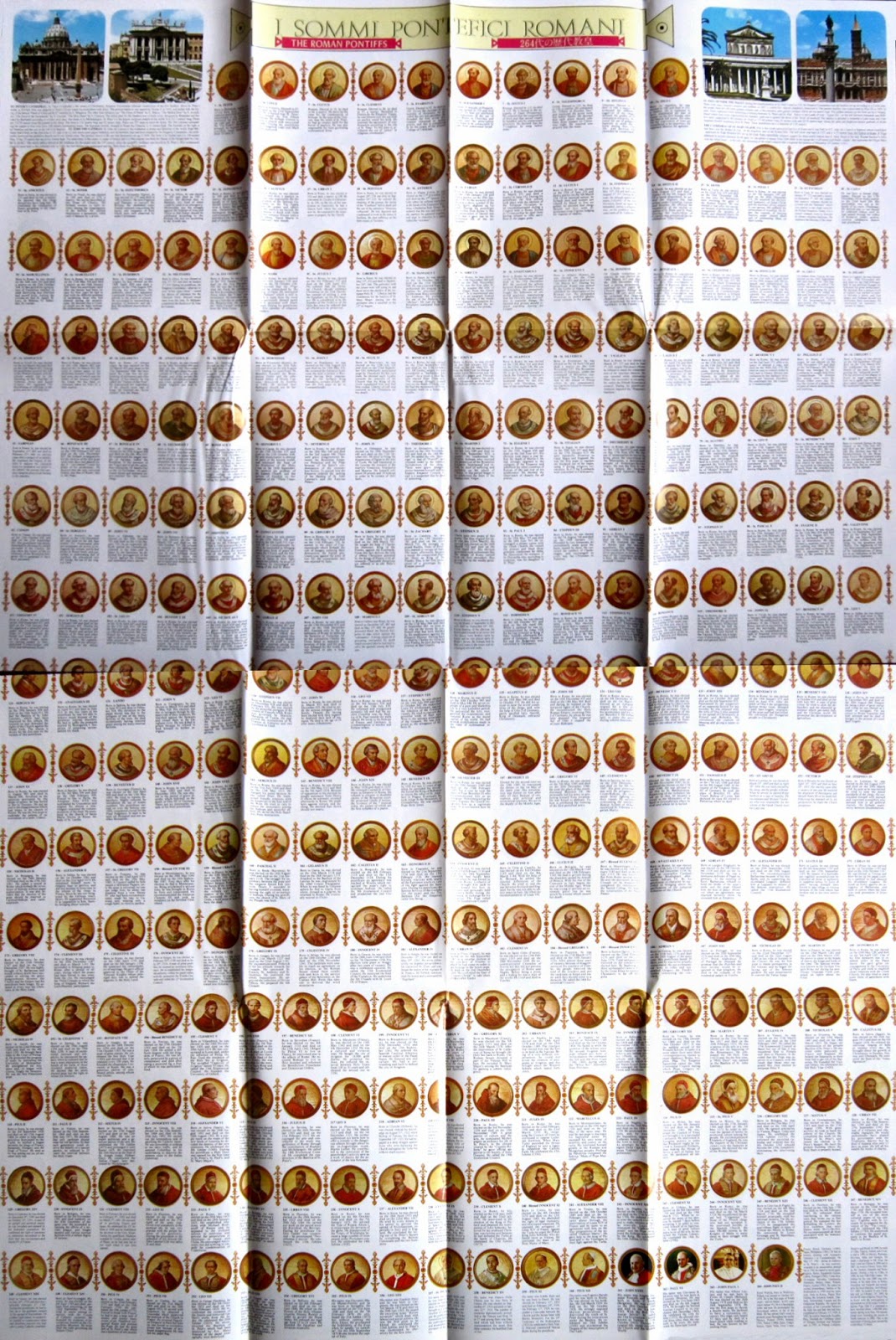
So we have our second new Pope since I bought my papal wallchart on a visit to Rome in March 2005 (you may have to open the image in its own window and zoom in to view it properly). But will Francis I be the last Pope ever? Probably not – although that’s the gist of a prophecy supposedly made by an Irish Archbishop way back in the 12th century. I’ve just been reading all about it in a short ebook by Oliver Hayes entitled The Papal Prophecies: St Malachy and the Doom of the Popes
. The case turns out to be an excellent example of something I’ve always believed – that most “prophecies” tell you more about the times in which they originated than they do about the future.
The book starts with a biography of Saint Malachy, who fought his way (literally) to the position of Archbishop of Armagh in the 1130s. While this is all interesting and exciting stuff, it isn’t actually very relevant to the prophecies that bear his name – since they were almost certainly written long after his death. It’s true there were vague rumours that Malachy had experienced some kind of prophetic vision during a visit to Rome in 1139, but nothing was known about the details.
Then in 1590 everything changed. A Spanish Dominican scholar named Alphonsus Ciacconius claimed to have discovered an ancient parchment, bearing a series of cryptic phrases in Latin, in the Vatican archives in Rome. This was during the renaissance period, when people were just starting to develop a genuinely forensic approach to the study of historical documents. Ciacconius was one of the few people at the time who was versed in the new science of palaeography – the dating of old writings based on the materials, style and language employed. He announced that the parchment and its cryptic Latin phrases dated from the middle of the twelfth century.
Ciacconius showed the manuscript to a fellow scholar named Arnold de Wyon, and between them they attempted to decipher its cryptic message. Eventually they concluded that it was Saint Malachy’s account of his prophetic vision, and that each Latin phrase corresponded to a future Pope. In other words, it was a list of all the Popes that would be elected after the time of Malachy’s vision in 1139. The “Prophecy of the Popes” was first published by Wyon in 1595, together with an interpretation of its meaning.
In total, the list includes 112 Popes – the first 74 of which date from after the supposed time of Malachy’s vision, but before the discovery of the manuscript by Ciacconius. These 74 Popes are represented by short Latin phrases that relate—often by means of a verbal pun or metaphor—to the name or place of birth of the Pope in question. For example, the first item on the list, “Ex castro Tiberis” means “From a castle of the Tiber”, and is taken to refer to Pope Celestine II, who was elected in 1143 and was born in Città di Castello – a fortified town on the banks of the River Tiber. The only British-born Pope, Adrian IV, corresponds to the fifth item on the list, “De rure albo”– which literally means “from the white country”, but can be taken as a pun on Albion, the ancient poetic name for Britain.
After Wyon published the list in 1595, people were eager to see how each new Pope fitted the corresponding prophecy. Although ways were found to match the prophecy to the actuality, it became more and more obvious that there was a qualitative difference between the pre-publication fits and the post-publication ones. Very few of the post-publication matches took the form of a simple pun on a name or birthplace. Instead, they often referred to the general state of affairs at the time the Pope was elected, or to some action taken by him during his incumbency. By the late 17th century the discrepancy had become painfully obvious, and a number of Catholic scholars—Louis Moréri among them—realized that everything focused down to the pivotal year of 1590. That was the year that Ciacconius “discovered” the manuscript and pronounced it to be a work of the 12th century... and 1590 was also the year the prophecies suddenly switched from being right on target to being vague and woolly.
There was a succession of three different Popes in 1590. Sixtus V died in August to be replaced by Urban VII, who died the following month and was replaced by Gregory XIV. The prophecies for Sixtus V and Urban VII are good matches, but the prophecy for the next Pope didn’t match Gregory XIV at all. Moréri quickly realized this was the single most important prophecy in the whole list – the only one out of the 112 that really mattered. All the rest were window dressing.
The key prophecy—for the Pope to follow Urban VII—said “Ex antiquitate Urbis”, meaning “of the old city”. While that doesn’t mean much in the context of the actual successor, Gregory XIV, it’s a perfect match for one of the other cardinals who was in the running at that particular conclave. This was Girolamo Simoncelli, who had been born in Orvieto – the Latin name for which was Urbevetanum, meaning “the old city”! Simoncelli was the candidate favoured by the King of Spain, Philip II... who just happened to be the rich patron of Alphonsus Ciacconius – the Spanish scholar who “found” the prophecies at just the right moment, and vouched for their authenticity!
It seems almost certain that the Papal Prophecies attributed to Saint Malachy were a 16th century forgery. Whether the culprit was Alphonsus Ciacconius or someone else, the aim seems to have been political – to strengthen the case for one particular individual being elected Pope at one particular conclave. But to give the manuscript credibility, it couldn’t stop there. So 38 further prophecies—of no real interest to the perpetrator—were appended to the list. But even they had to end somewhere. It just happens that, if you go through the list ascribing each consecutive prophecy to each consecutive Pope, then the very last item on the list corresponds to... none other than Francis I, who was elected Pope just a few days ago.
This final prophecy is wordier than any of the others, and appropriately apocalyptic: “Peter the Roman, who will nourish the sheep in many tribulations; when they are finished, the city of seven hills will be destroyed, and the dreadful judge will judge his people.” Fortunately for the general sanity of the world, the “Prophecy of the Popes” hasn’t received anything like the same attention as the doom-laden utterances of Harold Camping, or the Mayan calendar fiasco of last year. I guess that’s because the sort of people who are most likely to be interested in end-of-the-world predictions—namely Protestants and New Agers—are also the least likely to be interested in anything to do with Popes!
The Papal Prophecies is published by Bretwalda Books, which makes Oliver Hayes a sort of colleague of mine. In fact Oliver is the main author of the Bretwalda Battles series, to which I’ve contributed half a dozen titles of my own. My latest ebook is all about The Destruction of Hiroshima
... which I try to put in its proper historical context, without the overlay of wise-after-the-fact hindsight that is often found in discussions of the subject.
The book starts with a biography of Saint Malachy, who fought his way (literally) to the position of Archbishop of Armagh in the 1130s. While this is all interesting and exciting stuff, it isn’t actually very relevant to the prophecies that bear his name – since they were almost certainly written long after his death. It’s true there were vague rumours that Malachy had experienced some kind of prophetic vision during a visit to Rome in 1139, but nothing was known about the details.
Then in 1590 everything changed. A Spanish Dominican scholar named Alphonsus Ciacconius claimed to have discovered an ancient parchment, bearing a series of cryptic phrases in Latin, in the Vatican archives in Rome. This was during the renaissance period, when people were just starting to develop a genuinely forensic approach to the study of historical documents. Ciacconius was one of the few people at the time who was versed in the new science of palaeography – the dating of old writings based on the materials, style and language employed. He announced that the parchment and its cryptic Latin phrases dated from the middle of the twelfth century.
Ciacconius showed the manuscript to a fellow scholar named Arnold de Wyon, and between them they attempted to decipher its cryptic message. Eventually they concluded that it was Saint Malachy’s account of his prophetic vision, and that each Latin phrase corresponded to a future Pope. In other words, it was a list of all the Popes that would be elected after the time of Malachy’s vision in 1139. The “Prophecy of the Popes” was first published by Wyon in 1595, together with an interpretation of its meaning.
In total, the list includes 112 Popes – the first 74 of which date from after the supposed time of Malachy’s vision, but before the discovery of the manuscript by Ciacconius. These 74 Popes are represented by short Latin phrases that relate—often by means of a verbal pun or metaphor—to the name or place of birth of the Pope in question. For example, the first item on the list, “Ex castro Tiberis” means “From a castle of the Tiber”, and is taken to refer to Pope Celestine II, who was elected in 1143 and was born in Città di Castello – a fortified town on the banks of the River Tiber. The only British-born Pope, Adrian IV, corresponds to the fifth item on the list, “De rure albo”– which literally means “from the white country”, but can be taken as a pun on Albion, the ancient poetic name for Britain.
After Wyon published the list in 1595, people were eager to see how each new Pope fitted the corresponding prophecy. Although ways were found to match the prophecy to the actuality, it became more and more obvious that there was a qualitative difference between the pre-publication fits and the post-publication ones. Very few of the post-publication matches took the form of a simple pun on a name or birthplace. Instead, they often referred to the general state of affairs at the time the Pope was elected, or to some action taken by him during his incumbency. By the late 17th century the discrepancy had become painfully obvious, and a number of Catholic scholars—Louis Moréri among them—realized that everything focused down to the pivotal year of 1590. That was the year that Ciacconius “discovered” the manuscript and pronounced it to be a work of the 12th century... and 1590 was also the year the prophecies suddenly switched from being right on target to being vague and woolly.
There was a succession of three different Popes in 1590. Sixtus V died in August to be replaced by Urban VII, who died the following month and was replaced by Gregory XIV. The prophecies for Sixtus V and Urban VII are good matches, but the prophecy for the next Pope didn’t match Gregory XIV at all. Moréri quickly realized this was the single most important prophecy in the whole list – the only one out of the 112 that really mattered. All the rest were window dressing.
The key prophecy—for the Pope to follow Urban VII—said “Ex antiquitate Urbis”, meaning “of the old city”. While that doesn’t mean much in the context of the actual successor, Gregory XIV, it’s a perfect match for one of the other cardinals who was in the running at that particular conclave. This was Girolamo Simoncelli, who had been born in Orvieto – the Latin name for which was Urbevetanum, meaning “the old city”! Simoncelli was the candidate favoured by the King of Spain, Philip II... who just happened to be the rich patron of Alphonsus Ciacconius – the Spanish scholar who “found” the prophecies at just the right moment, and vouched for their authenticity!
It seems almost certain that the Papal Prophecies attributed to Saint Malachy were a 16th century forgery. Whether the culprit was Alphonsus Ciacconius or someone else, the aim seems to have been political – to strengthen the case for one particular individual being elected Pope at one particular conclave. But to give the manuscript credibility, it couldn’t stop there. So 38 further prophecies—of no real interest to the perpetrator—were appended to the list. But even they had to end somewhere. It just happens that, if you go through the list ascribing each consecutive prophecy to each consecutive Pope, then the very last item on the list corresponds to... none other than Francis I, who was elected Pope just a few days ago.
This final prophecy is wordier than any of the others, and appropriately apocalyptic: “Peter the Roman, who will nourish the sheep in many tribulations; when they are finished, the city of seven hills will be destroyed, and the dreadful judge will judge his people.” Fortunately for the general sanity of the world, the “Prophecy of the Popes” hasn’t received anything like the same attention as the doom-laden utterances of Harold Camping, or the Mayan calendar fiasco of last year. I guess that’s because the sort of people who are most likely to be interested in end-of-the-world predictions—namely Protestants and New Agers—are also the least likely to be interested in anything to do with Popes!
The Papal Prophecies is published by Bretwalda Books, which makes Oliver Hayes a sort of colleague of mine. In fact Oliver is the main author of the Bretwalda Battles series, to which I’ve contributed half a dozen titles of my own. My latest ebook is all about The Destruction of Hiroshima
Sunday, 16 December 2012
Prophecies and Probabilities
Since I normally do my weekly blog post at the weekend, it just occurred to me that this is my last opportunity to jump on the Mayan Prophecy bandwagon. The basic idea is that the world is going to end on Friday (21 December 2012), because more than a thousand years ago a Central American civilization called the Maya said that’s what would happen. Most of what I’ve read on the subject has been debunking the idea, with a lot of effort being put into proving that the Maya never actually said the world would end on Friday. This is really funny, because it suggests that if the Maya had said the world would end on Friday, then there would be serious cause for alarm, but actually it’s okay because they didn’t.
The Maya were a sophisticated and clever culture – they built pyramids like the one on the right, for example (photo courtesy of Paul Jackson). But history is filled with sophisticated and clever cultures. In the Western world, ancient Greece and Rome have been revered as paragons of wisdom and insight since the late Middle Ages. During the 18th and 19th centuries, other ancient civilizations were added to the cultural pantheon: Egypt, India, China and several others. But not the Maya. The idea that the teachings of the Maya should be heeded above all the others is (to put it politely) of recent manufacture. The most catastrophic event in Mayan history was the coming of the Spanish conquerors in the 16th century, which resulted in the near-total obliteration of their cultural heritage. If they didn’t foresee that clearly enough to prevent it, why believe their powers of prophecy are better than anyone else’s?
Anyone who wants to take the Mayan Prophecy seriously needs to explain why the Maya—of all cultures—got it right when no-one else did. And there’s a bigger thing they need to explain – why anyone should believe that a date-specific prophecy made more than a thousand years ago is going to come true. There simply isn’t a precedent. In the whole of history, date-specific prophecies of disaster conspicuously fail to come true.
There’s a reason for this. Macroscopic physical processes are probabilistic, not deterministic. You can’t predict when catastrophes will happen, because even the catastrophes themselves don’t know. There are plenty of big disasters that will happen, with certainty, at some point in the future – even “apocalyptic” disasters on a scale greater than anything in recorded history. A supervolcano, or a massive geomagnetic storm—particularly if coupled with a weakening of the Earth’s magnetic field—could destroy the infrastructure that holds the modern, high-tech world together. That might not literally be the “end of the world”, but it would be the end of civilized society. Events like that have happened before in Earth’s history, and it’s a dead cert they will happen again. But there’s inherent randomness in the system, so it’s impossible to determine exactly when they will happen. It may be a thousand years from now, or it may be next Thursday. Or Friday.
The Met Office can’t even predict the weather next Friday (except in terms of probabilities), so it’s ludicrous to suppose the Maya could predict some catastrophe—to the exact day—more than a thousand years in advance. Even if they were in contact with extraterrestrial aliens who had computer technology millions of years ahead of ours, they couldn’t predict something that is fundamentally indeterminate. On the other hand, it’s equally foolish to say—as some extreme skeptics have—that there definitely won’t be a world-ending catastrophe on Friday. That’s effectively saying that such a thing is less likely to occur on that day than on any other day. In other words, the extreme skeptics give special significance to that particular day just as much as the extreme believers do!
The Maya were a sophisticated and clever culture – they built pyramids like the one on the right, for example (photo courtesy of Paul Jackson). But history is filled with sophisticated and clever cultures. In the Western world, ancient Greece and Rome have been revered as paragons of wisdom and insight since the late Middle Ages. During the 18th and 19th centuries, other ancient civilizations were added to the cultural pantheon: Egypt, India, China and several others. But not the Maya. The idea that the teachings of the Maya should be heeded above all the others is (to put it politely) of recent manufacture. The most catastrophic event in Mayan history was the coming of the Spanish conquerors in the 16th century, which resulted in the near-total obliteration of their cultural heritage. If they didn’t foresee that clearly enough to prevent it, why believe their powers of prophecy are better than anyone else’s?
Anyone who wants to take the Mayan Prophecy seriously needs to explain why the Maya—of all cultures—got it right when no-one else did. And there’s a bigger thing they need to explain – why anyone should believe that a date-specific prophecy made more than a thousand years ago is going to come true. There simply isn’t a precedent. In the whole of history, date-specific prophecies of disaster conspicuously fail to come true.
There’s a reason for this. Macroscopic physical processes are probabilistic, not deterministic. You can’t predict when catastrophes will happen, because even the catastrophes themselves don’t know. There are plenty of big disasters that will happen, with certainty, at some point in the future – even “apocalyptic” disasters on a scale greater than anything in recorded history. A supervolcano, or a massive geomagnetic storm—particularly if coupled with a weakening of the Earth’s magnetic field—could destroy the infrastructure that holds the modern, high-tech world together. That might not literally be the “end of the world”, but it would be the end of civilized society. Events like that have happened before in Earth’s history, and it’s a dead cert they will happen again. But there’s inherent randomness in the system, so it’s impossible to determine exactly when they will happen. It may be a thousand years from now, or it may be next Thursday. Or Friday.
The Met Office can’t even predict the weather next Friday (except in terms of probabilities), so it’s ludicrous to suppose the Maya could predict some catastrophe—to the exact day—more than a thousand years in advance. Even if they were in contact with extraterrestrial aliens who had computer technology millions of years ahead of ours, they couldn’t predict something that is fundamentally indeterminate. On the other hand, it’s equally foolish to say—as some extreme skeptics have—that there definitely won’t be a world-ending catastrophe on Friday. That’s effectively saying that such a thing is less likely to occur on that day than on any other day. In other words, the extreme skeptics give special significance to that particular day just as much as the extreme believers do!
Tuesday, 28 February 2012
The End of Books
The picture above, showing passengers on the Paris metro listening on earphones rather than engrossed in reading books, was drawn almost 120 years ago by a man named Albert Robida. It’s an illustration for Octave Uzanne’s short story “La Fin des Livres” (“The End of Books”), published in 1895 -- when the most advanced audio technology consisted of cumbersome Edison phonographs with wax cylinders, hand-cranks and brass horns.
As 19th century predictions of future technology go, I think this one is pretty impressive. The story is set in London, and concerns a group of Victorian gentlemen who discuss what the future might hold. When one of them is asked about the future of books, he says “If by books you speak of our countless collections of paper, printed, sewn and bound... I tell you frankly that I do not believe—and the progress of electricity and modern mechanics forbids me to believe—that Gutenberg's invention should not soon fall more or less into disuse as a medium for our intellectual products.”
“Gutenberg’s invention” refers to the printing press, invented by Johannes Gutenberg in the 15th century. Ironically, the text of Uzanne and Robida’s “La Fin des Livres” is now available in electronic form on a website called Project Gutenberg!
The picture of the metro passengers shows them plugged into communal devices built into the train, but Uzanne and Robida also predicted personal media players (as depicted on the left): “there will be recording cylinders as light as celluloid pens... devices for the pocket, around the neck or on a shoulder strap that will be held in a single tube like a case of spectacles.” This strikes me as particularly impressive, because miniaturization is one aspect of modern technology that most early science fiction failed to predict -- even into the 1930s and 40s.
So is the prophecy of “the end of books” coming true? In one sense it is, and in another it isn’t. Uzanne and Robida imagined that the printed word would die out, to be replaced by voice recordings. There is little sign of this happening -- there are such things as “audio books”, but only as a fringe interest. Most people use the written word as much as they ever did... if not more. But the “written word” appears increasingly on LCD screens rather than printed paper -- so in that sense this is one Victorian prediction that was spot on!
As 19th century predictions of future technology go, I think this one is pretty impressive. The story is set in London, and concerns a group of Victorian gentlemen who discuss what the future might hold. When one of them is asked about the future of books, he says “If by books you speak of our countless collections of paper, printed, sewn and bound... I tell you frankly that I do not believe—and the progress of electricity and modern mechanics forbids me to believe—that Gutenberg's invention should not soon fall more or less into disuse as a medium for our intellectual products.”
“Gutenberg’s invention” refers to the printing press, invented by Johannes Gutenberg in the 15th century. Ironically, the text of Uzanne and Robida’s “La Fin des Livres” is now available in electronic form on a website called Project Gutenberg!
The picture of the metro passengers shows them plugged into communal devices built into the train, but Uzanne and Robida also predicted personal media players (as depicted on the left): “there will be recording cylinders as light as celluloid pens... devices for the pocket, around the neck or on a shoulder strap that will be held in a single tube like a case of spectacles.” This strikes me as particularly impressive, because miniaturization is one aspect of modern technology that most early science fiction failed to predict -- even into the 1930s and 40s.
So is the prophecy of “the end of books” coming true? In one sense it is, and in another it isn’t. Uzanne and Robida imagined that the printed word would die out, to be replaced by voice recordings. There is little sign of this happening -- there are such things as “audio books”, but only as a fringe interest. Most people use the written word as much as they ever did... if not more. But the “written word” appears increasingly on LCD screens rather than printed paper -- so in that sense this is one Victorian prediction that was spot on!
Monday, 14 November 2011
The government asks an astrologer for help (1666)
The Great Fire of London occurred early in September 1666, causing major devastation to a large part of the city. It came just a year after London had been ravaged by the Great Plague, and five years after the British Monarchy had been restored after a dozen years of Parliamentary rule. In 1651, two years after the Parliamentary coup and fifteen years before the Great Fire, an astrologer named William Lilly published a book entitled Monarchy or no Monarchy in which he purported to depict future events via a series of symbolic illustrations he called "hieroglyphics". According to Lilly's autobiography, the hieroglyphic on page 7 of Monarchy or no Monarchy represents "a great sickness and mortality", while that on page 8 depicts "a great city all in flames of fire".
In October 1666, the month after the Great Fire, the government ordered an inquiry into the incident due to concerns that it may have been the work of a hostile nation. To the amusement of many people, the Committee called Lilly to give evidence before them. He was nervous at first, because (based on past experience) he was expecting them to make fun of him. But he was pleasantly surprised to find the Committee took him seriously as a source of information, and just wanted to know whether his astrological skills could tell them anything else... such as the identity of the imagined perpetrators!
Lilly explained that, back in 1651, he was unhappy with the rule of Parliament (obviously a politically correct thing to say after the Restoration) and that he "was desirous, according to the best knowledge God had given me, to make enquiry by the art I studied, what might from that time happen unto the Parliament and the nation in general". He went on to discover "that the city of London should be sadly afflicted with a great plague, and not long after with an exorbitant fire"... but added that he could not discern any human culprits behind the fire and hence concluded that "it was the only finger of God; but what instruments he used thereunto, I am ignorant". He finishes his account by observing that "the Committee seemed well pleased with what I spoke, and dismissed me with great civility".
From the above, it's clear that as an astrologer William Lilly was taken more seriously than most. This is also reflected in the fact that there is an official City of Westminster plaque marking the site of his house on the Strand: "William Lilly (1602 - 1681) Master Astrologer lived in a house on this site". As can be seen from the photograph below, this plaque is attached to the wall of the disused Strand tube station (aka Aldwych station, before it closed in 1994).
In October 1666, the month after the Great Fire, the government ordered an inquiry into the incident due to concerns that it may have been the work of a hostile nation. To the amusement of many people, the Committee called Lilly to give evidence before them. He was nervous at first, because (based on past experience) he was expecting them to make fun of him. But he was pleasantly surprised to find the Committee took him seriously as a source of information, and just wanted to know whether his astrological skills could tell them anything else... such as the identity of the imagined perpetrators!
Lilly explained that, back in 1651, he was unhappy with the rule of Parliament (obviously a politically correct thing to say after the Restoration) and that he "was desirous, according to the best knowledge God had given me, to make enquiry by the art I studied, what might from that time happen unto the Parliament and the nation in general". He went on to discover "that the city of London should be sadly afflicted with a great plague, and not long after with an exorbitant fire"... but added that he could not discern any human culprits behind the fire and hence concluded that "it was the only finger of God; but what instruments he used thereunto, I am ignorant". He finishes his account by observing that "the Committee seemed well pleased with what I spoke, and dismissed me with great civility".
From the above, it's clear that as an astrologer William Lilly was taken more seriously than most. This is also reflected in the fact that there is an official City of Westminster plaque marking the site of his house on the Strand: "William Lilly (1602 - 1681) Master Astrologer lived in a house on this site". As can be seen from the photograph below, this plaque is attached to the wall of the disused Strand tube station (aka Aldwych station, before it closed in 1994).
Saturday, 15 October 2011
Shadow of the Feathered Serpent
Paul Jackson and his wife have just returned from their honeymoon, which consisted of two weeks in Mexico followed by two weeks in Scotland. While in Mexico, they went on a day trip to see the thousand-year old Mayan ruins at Chichén Itzá. But they didn't go on just any day -- they went on the Autumn Equinox, when the direction of the setting Sun is exactly due West, making it a special day in the calendar. And as everyone knows, the Mayans were obsessive about the calendar.
The Chichén Itzá complex is dominated by the huge pyramid-shaped Temple of Kukulkan, who was the Mayan equivalent of the Aztec god Quetzalcoatl -- the Feathered Serpent. As the Sun sets on the Equinox, the temple displays an unusual phenomenon that can be seen in Paul's photograph on the left. The phenomenon was described by Adrian Gilbert and Maurice Cotterell in The Mayan Prophecies
(1995): "Twice a year, at the equinoxes, the Sun plays an amazing trick, which must have seemed like a miracle to anyone not initiated into its secrets. During the afternoon on these two days, shadows are cast on the balustrade which take the form of moving serpents gliding down the side of the pyramid. We can only speculate on what this symbolized, but perhaps it seemed to the onlooker as though some magical, ghostly Quetzalcoatl were in a sense coming back to life."
Although much newer than the pyramids of Egypt, or even the ruins of ancient Greece and Rome, Mayan archaeological sites like Chichén Itzá were lost in obscurity until comparatively recently. It was only in the early part of the 20th century that the scrub and overgrowth was cleared from the Temple of Kukulkan, and the mysterious shadow effect was rediscovered. Now, of course, with 2012 looming, everyone has heard about the Mayans and their alleged prophecy concerning the end of the world (Gilbert and Cotterill's book, mentioned above, scooped almost all the other writings on this subject by more than a decade). If you believe in the prophecy, and you want to see the shadow of the serpent god, you'll have to hurry. There are only two equinoxes left -- in March and September next year!
A full view of the pyramid, seen earlier in the day, is shown below.
The Chichén Itzá complex is dominated by the huge pyramid-shaped Temple of Kukulkan, who was the Mayan equivalent of the Aztec god Quetzalcoatl -- the Feathered Serpent. As the Sun sets on the Equinox, the temple displays an unusual phenomenon that can be seen in Paul's photograph on the left. The phenomenon was described by Adrian Gilbert and Maurice Cotterell in The Mayan Prophecies
Although much newer than the pyramids of Egypt, or even the ruins of ancient Greece and Rome, Mayan archaeological sites like Chichén Itzá were lost in obscurity until comparatively recently. It was only in the early part of the 20th century that the scrub and overgrowth was cleared from the Temple of Kukulkan, and the mysterious shadow effect was rediscovered. Now, of course, with 2012 looming, everyone has heard about the Mayans and their alleged prophecy concerning the end of the world (Gilbert and Cotterill's book, mentioned above, scooped almost all the other writings on this subject by more than a decade). If you believe in the prophecy, and you want to see the shadow of the serpent god, you'll have to hurry. There are only two equinoxes left -- in March and September next year!
A full view of the pyramid, seen earlier in the day, is shown below.
Sunday, 9 October 2011
The Year Without a Summer
British readers could be forgiven for thinking that 2011 was the "Year Without a Summer", but actually the phrase refers to 1816. In that year, not just Britain but the whole of the Northern Hemisphere was plunged into a kind of apocalyptic nuclear winter. The chief cause was a volcanic eruption a year earlier on the island of Sumbawa in Indonesia... the biggest eruption the planet had seen for more than a thousand years. 80,000 people were killed instantly, and the ash cloud that was blasted into the upper atmosphere blotted out the sun over half the world, causing surface temperatures to plunge to record lows.
Across Europe crops failed, food prices soared and famine was widespread. People took to the streets: there was rioting, arson and wholesale looting. Nowhere was the problem felt more acutely than in Switzerland, where the government was forced to declare a state of emergency. In the area around Lake Geneva it rained almost every day, the Sun was perpetually hidden by clouds, and there was frost even in August. Not a pleasant place at all -- certainly not the sort of place for a wealthy young British aristocrat to suddenly choose to relocate to.
But that's just what Lord Byron did. Byron (left, as painted by Géricault) was a romantic poet who was famously described as "mad, bad and dangerous to know". In the summer of 1816, together with a few house guests, he moved into the Villa Diodati on the shores of Lake Geneva.
The conditions at the time -- not just the cold and gloom, but also the primitive responses of the population at large -- inspired Byron to write one of his most famous poems, called "Darkness". The poem extrapolates the situation to a time when the Sun itself has grown dark, and people revert to a savage, animal-like existence. As with all poems, "Darkness" can be interpreted in a number of different ways. On the face of it, it's simply an attempt to portray in realistic terms what might happen if such a catastrophe befell the Earth. That's probably the way most people would read it today, and it's certainly the way I viewed it until I read what other people had written about it.
What that straightforward interpretation misses is the fact that in those days most people believed in the literal truth of the Bible, and its predictions about the way the world would end. It was expected that sinners would go to Hell, which is effectively what Byron's poem is describing -- except that in his version, everyone ends up in Hell. There is no salvation for the virtuous. This bleakly pessimistic view (which most people today would consider simple common sense) must have been intensely shocking at the time.
A third interpretation I've come across suggests that the poem wasn't meant to be taken seriously -- that in effect it's a satire on the social situation at the time. By taking current events and exaggerating them, Byron is poking fun at the ignorance of the masses and their mindlessly self-defeating behaviour. Again, to get your head round this, you have to put yourself back in the mind-set of the time at which the poem was written... not an easy thing to do. Whatever Byron's original intention, there's no doubt that the poem set the tone for the gloomy "end-of-the-world" sub-genre of science fiction so beloved of British writers in the later nineteenth and early-to-mid twentieth centuries.
Although it's virtually forgotten as a meteorological phenomenon, the non-summer of 1816 did have a couple of lasting cultural effects. Unable to do anything outdoors, Byron and his house-guests had no alternative but to stay inside and write. Byron, as we have seen, wrote the poem "Darkness". His guest Mary Shelley wrote the original version of Frankenstein. And another guest, John Polidori, wrote a short novel called The Vampyre -- not a well-known work in itself, but culturally significant because it transformed the gawky, red-faced, red-haired, pot-bellied vampire of East European folklore into the cool, sophisticated, aristocratic vampire of modern times... modelled at least in part on Lord Byron himself!
Across Europe crops failed, food prices soared and famine was widespread. People took to the streets: there was rioting, arson and wholesale looting. Nowhere was the problem felt more acutely than in Switzerland, where the government was forced to declare a state of emergency. In the area around Lake Geneva it rained almost every day, the Sun was perpetually hidden by clouds, and there was frost even in August. Not a pleasant place at all -- certainly not the sort of place for a wealthy young British aristocrat to suddenly choose to relocate to.
But that's just what Lord Byron did. Byron (left, as painted by Géricault) was a romantic poet who was famously described as "mad, bad and dangerous to know". In the summer of 1816, together with a few house guests, he moved into the Villa Diodati on the shores of Lake Geneva.
The conditions at the time -- not just the cold and gloom, but also the primitive responses of the population at large -- inspired Byron to write one of his most famous poems, called "Darkness". The poem extrapolates the situation to a time when the Sun itself has grown dark, and people revert to a savage, animal-like existence. As with all poems, "Darkness" can be interpreted in a number of different ways. On the face of it, it's simply an attempt to portray in realistic terms what might happen if such a catastrophe befell the Earth. That's probably the way most people would read it today, and it's certainly the way I viewed it until I read what other people had written about it.
What that straightforward interpretation misses is the fact that in those days most people believed in the literal truth of the Bible, and its predictions about the way the world would end. It was expected that sinners would go to Hell, which is effectively what Byron's poem is describing -- except that in his version, everyone ends up in Hell. There is no salvation for the virtuous. This bleakly pessimistic view (which most people today would consider simple common sense) must have been intensely shocking at the time.
A third interpretation I've come across suggests that the poem wasn't meant to be taken seriously -- that in effect it's a satire on the social situation at the time. By taking current events and exaggerating them, Byron is poking fun at the ignorance of the masses and their mindlessly self-defeating behaviour. Again, to get your head round this, you have to put yourself back in the mind-set of the time at which the poem was written... not an easy thing to do. Whatever Byron's original intention, there's no doubt that the poem set the tone for the gloomy "end-of-the-world" sub-genre of science fiction so beloved of British writers in the later nineteenth and early-to-mid twentieth centuries.
Although it's virtually forgotten as a meteorological phenomenon, the non-summer of 1816 did have a couple of lasting cultural effects. Unable to do anything outdoors, Byron and his house-guests had no alternative but to stay inside and write. Byron, as we have seen, wrote the poem "Darkness". His guest Mary Shelley wrote the original version of Frankenstein. And another guest, John Polidori, wrote a short novel called The Vampyre -- not a well-known work in itself, but culturally significant because it transformed the gawky, red-faced, red-haired, pot-bellied vampire of East European folklore into the cool, sophisticated, aristocratic vampire of modern times... modelled at least in part on Lord Byron himself!
Sunday, 14 August 2011
The Great Pyramid, and other British inventions
For more than 400 years, from the time of Henry VIII to the outbreak of the Second World War, Britain was -- in the eyes of many of its citizens -- the world's Top Nation (to use a memorable phrase from 1066 and All That
). And there were those who were prepared to go even further, and demonstrate that Britain had in fact been a great nation since time immemorial. To make their task harder, they had to achieve this in a way that linked Britain to those cultures they respected (such as ancient Greece, ancient Egypt and the Hebrew civilization) while distancing it from those cultures they despised (such as the Roman Empire, Germany and France).
I've already mentioned (in Magic Words) Mary Caine's theory that the English county of Somerset derives its name from the venerable old civilization of Sumeria. I've also mentioned Sir William Jones's theory that Stonehenge was built as a temple to the Buddha (The Black Buddha of Stonehenge). Most people will be familiar with poet William Blake's identification of the Biblical Jerusalem with England's "green and pleasant land"... although perhaps not with his wackier writings on the subject: "The fields from Islington to Marylebone, to Primrose Hill and St John’s Wood, were builded over with pillars of gold, and there Jerusalem’s pillars stood."
Another poet, John Milton, wrote in Areopagitica (1644) that "... even the school of Pythagoras and the Persian wisdom took beginning from the old philosophy of this island". More than a century earlier, William Tyndale, who translated the Bible into English (and therefore knew a thing or two about comparative philology) claimed that for every word in the English language that derived from Latin, there were a thousand words derived from Hebrew. In 1885, the Reverend A.B. Grimaldi produced a genealogical table linking Zedekiah, the last king of Judah, via ninety-two generations of Irish and Scottish monarchs, to King James I of England.
But all these examples fade into insignificance compared to a modest little monograph I picked up in a second-hand bookshop a few years ago... The Great Pyramid: Its Construction, Symbolism and Chronology by Basil Stewart (my copy is the Revised Third Edition, dated May 1931). The author's basic thesis is that "the Great Pyramid was built under Divine inspiration with the purpose of transmitting a message to the present age and particularly to the British race." More specifically, he claims that the pyramid was constructed by the ancient Britons, and its coded message relates to the "Tribulation" being experienced by the British people at the time Stewart's book was written (see diagram).
It's worth getting one thing straight: only the Great Pyramid was built by the British. The other, lesser pyramids were all built by the Egyptians. Just why the ancient Britons chose to build their Great Pyramid in Egypt, and not in Great Britain, isn't explained. The author does, however, explain why generations of French Egyptologists miserably failed to unlock the secret of the pyramid -- they insisted on measuring its dimensions in metric units, rather than honest British inches.
If you're wondering why Stewart's chronology ends abruptly in August 1953... well, he reckoned that by then the Tribulation would be over, the end-times would be well and truly established, and people would no longer have any control over their individual destinies. Given that by 1953 most of the British Empire that existed when the book was written had been lost, maybe he was right!
I've already mentioned (in Magic Words) Mary Caine's theory that the English county of Somerset derives its name from the venerable old civilization of Sumeria. I've also mentioned Sir William Jones's theory that Stonehenge was built as a temple to the Buddha (The Black Buddha of Stonehenge). Most people will be familiar with poet William Blake's identification of the Biblical Jerusalem with England's "green and pleasant land"... although perhaps not with his wackier writings on the subject: "The fields from Islington to Marylebone, to Primrose Hill and St John’s Wood, were builded over with pillars of gold, and there Jerusalem’s pillars stood."
Another poet, John Milton, wrote in Areopagitica (1644) that "... even the school of Pythagoras and the Persian wisdom took beginning from the old philosophy of this island". More than a century earlier, William Tyndale, who translated the Bible into English (and therefore knew a thing or two about comparative philology) claimed that for every word in the English language that derived from Latin, there were a thousand words derived from Hebrew. In 1885, the Reverend A.B. Grimaldi produced a genealogical table linking Zedekiah, the last king of Judah, via ninety-two generations of Irish and Scottish monarchs, to King James I of England.
But all these examples fade into insignificance compared to a modest little monograph I picked up in a second-hand bookshop a few years ago... The Great Pyramid: Its Construction, Symbolism and Chronology by Basil Stewart (my copy is the Revised Third Edition, dated May 1931). The author's basic thesis is that "the Great Pyramid was built under Divine inspiration with the purpose of transmitting a message to the present age and particularly to the British race." More specifically, he claims that the pyramid was constructed by the ancient Britons, and its coded message relates to the "Tribulation" being experienced by the British people at the time Stewart's book was written (see diagram).
It's worth getting one thing straight: only the Great Pyramid was built by the British. The other, lesser pyramids were all built by the Egyptians. Just why the ancient Britons chose to build their Great Pyramid in Egypt, and not in Great Britain, isn't explained. The author does, however, explain why generations of French Egyptologists miserably failed to unlock the secret of the pyramid -- they insisted on measuring its dimensions in metric units, rather than honest British inches.
If you're wondering why Stewart's chronology ends abruptly in August 1953... well, he reckoned that by then the Tribulation would be over, the end-times would be well and truly established, and people would no longer have any control over their individual destinies. Given that by 1953 most of the British Empire that existed when the book was written had been lost, maybe he was right!
Labels:
Archaeology,
History,
prophecy,
pyramids,
Theories
Tuesday, 24 May 2011
The Swinging Sixties (1950-style)
One of the things that makes vintage science fiction so appealing is that, while it's supposed to be all about the future, it generally remains firmly rooted in the culture of the time and place it was written. On the face of it, the picture on the left is a case in point -- the heroine of a space opera supposedly set in the far future, yet looking for all the world like a groovy hippie chick of the 1960s.
The only problem is that the picture doesn’t date from the 1960s! It's from the November 1950 issue of Astounding Science Fiction magazine... one of the illustrations for James Schmitz's story "The Truth About Cushgar". And any groovy hippie chick who dressed like that in 1950 would have got very disapproving looks indeed! The 1960s feel extends to the drawing's distinctly "Art Nouveau" style -- which of course enjoyed a massive revival in the 60s, but was still old-fashioned "grandma's stuff" in 1950!
The drawing is signed by "K. Ward" who, if the Internet Science Fiction Database is anything to go by, did very little other SF work -- illustrating just seven stories, all in Astounding between 1949 and 1951. Maybe he was a time-traveller, or some kind of clairvoyant who foresaw the future! Not all his illustrations are as 60s-looking as the one above, but the following one (also from "The Truth About Cushgar") clearly depicts some kind of psychedelic freak-out!
The only problem is that the picture doesn’t date from the 1960s! It's from the November 1950 issue of Astounding Science Fiction magazine... one of the illustrations for James Schmitz's story "The Truth About Cushgar". And any groovy hippie chick who dressed like that in 1950 would have got very disapproving looks indeed! The 1960s feel extends to the drawing's distinctly "Art Nouveau" style -- which of course enjoyed a massive revival in the 60s, but was still old-fashioned "grandma's stuff" in 1950!
The drawing is signed by "K. Ward" who, if the Internet Science Fiction Database is anything to go by, did very little other SF work -- illustrating just seven stories, all in Astounding between 1949 and 1951. Maybe he was a time-traveller, or some kind of clairvoyant who foresaw the future! Not all his illustrations are as 60s-looking as the one above, but the following one (also from "The Truth About Cushgar") clearly depicts some kind of psychedelic freak-out!
Tuesday, 12 April 2011
Crystal-gazing
As you might guess from the crystal ball on the cover, crystal-gazing is one of the topics covered in The Complete Book of Fortune: a Comprehensive Survey of the Occult Sciences (undated, but from internal evidence I'd guess it was written in the 1930s). The book also deals with the Tarot, astrology, tea-leaf reading, palmistry, handwriting analysis, phrenology and dream interpretation... but in at least one sense, crystal-gazing is different from any of these. With a crystal ball, the practitioner allegedly sees events in the future, rather than having to interpret "portents" through obscure layers of symbolism.
According to Saint Augustine, crystal-gazing was used as a form of divination by the ancient Persians... but he believed the scenes they saw were false prophecies created by malevolent demons. Much later, during the nineteenth century, crystal-gazing was put on a pseudo-scientific footing by Baron von Reichenbach, who postulated a hitherto unknown force called odyle which linked crystalline substances with human consciousness.
By the time this book was written (I bought it for two pounds at a car boot sale, in case you're wondering) crystal-gazing was a popular attraction on fairgrounds and seaside piers... but the anonymous authors are scathing about such acts ("It seems to be an inflexible rule of the occult that, whenever any manifestation of psychic power is exploited by human beings for their own commercial benefit, that power, if the greater part of it is not taken away from such unworthy custodians, ceases, at least, to display its deeper and more inspired attributes"). The book also warns the reader against the use of magical ceremonies and incantations, which "may be considered not only as unnecessary to the encouragement of lucidity, but even dangerous." That's what I wanted to hear!
One of the most famous proponents of crystal-gazing (who wasn't afraid to use magical ceremonies and incantations, either) was the Elizabethan occultist Dr John Dee (1527 - 1609). Dee's own crystal ball has survived to this day, and is on display in the British Museum (see below).
According to Saint Augustine, crystal-gazing was used as a form of divination by the ancient Persians... but he believed the scenes they saw were false prophecies created by malevolent demons. Much later, during the nineteenth century, crystal-gazing was put on a pseudo-scientific footing by Baron von Reichenbach, who postulated a hitherto unknown force called odyle which linked crystalline substances with human consciousness.
By the time this book was written (I bought it for two pounds at a car boot sale, in case you're wondering) crystal-gazing was a popular attraction on fairgrounds and seaside piers... but the anonymous authors are scathing about such acts ("It seems to be an inflexible rule of the occult that, whenever any manifestation of psychic power is exploited by human beings for their own commercial benefit, that power, if the greater part of it is not taken away from such unworthy custodians, ceases, at least, to display its deeper and more inspired attributes"). The book also warns the reader against the use of magical ceremonies and incantations, which "may be considered not only as unnecessary to the encouragement of lucidity, but even dangerous." That's what I wanted to hear!
One of the most famous proponents of crystal-gazing (who wasn't afraid to use magical ceremonies and incantations, either) was the Elizabethan occultist Dr John Dee (1527 - 1609). Dee's own crystal ball has survived to this day, and is on display in the British Museum (see below).
Sunday, 10 April 2011
An Intercontinental Rapid Transit System (1829)
At first glance, this vision of the future looks like something out of a novel by Jules Verne... except that it dates from 1829, when Jules Verne was only a year old! Entitled March of Intellect, this is one of several works by the satirical artist William Heath (1795 - 1840) on display in the British Museum. The drawing is one of the earliest I've seen which focuses predominantly on technological inventions as a mark of progress... and it's really quite remarkable given that it dates from a time when the only overland modes of transport were balloons and horse-drawn carriages! The first steam passenger service (the Liverpool to Manchester Railway) was still a year in the future, while the first dirigible airship was more than 20 years away!
The most striking feature of the picture is the metallic tube into which passengers are embarking. The wording on this (which is not very legible in my photograph, I'm afraid) says "GRAND VACUUM TUBE COMPANY: Direct to Bengal". Assuming the starting point is meant to be London, this is a distance of seven thousand miles! Presumably Heath's idea was that the passengers would sit in a tight-fitting capsule, which would then be forced along the tube at high speed by atmospheric pressure... rather like a more advanced version of Brunel's Atmospheric Railway in South Devon, which opened in 1847 (and shut the following year, because it didn't work very well).
Monday, 24 January 2011
Wikipedia Prophecy (1909)
Although science fiction ostensibly deals with the future, it's extremely rare to come across genuinely prophetic visions in SF. One that comes close, however, is "The Machine Stops
" -- a short story by E.M. Forster originally published in 1909. Whatever its original intention, the story can be read today as an amusing satire on the World Wide Web, and on social networking sites such as Facebook in particular. However, my favorite bit is aimed more at Wikipedia with its anally constricting policies of "No original research", "Neutral Point of View", "Wikipedia is a mainstream encyclopedia" and "Wikipedia is a tertiary source".
"Beware of firsthand ideas!" exclaimed one of the most advanced of them [you can take 'them' to be Wikipedia admins, if you like]. "Firsthand ideas do not really exist. They are but the physical impressions produced by love and fear, and on this gross foundation who could erect a philosophy? Let your ideas be second-hand, and if possible tenth-hand, for then they will be far removed from that disturbing element -- direct observation. Do not learn anything about this subject of mine -- the French Revolution. Learn instead what I think that Enicharmon thought Urizen thought Gutch thought Ho-Yung thought Chi-Bo-Sing thought Lafcadio Hearn thought Carlyle thought Mirabeau said about the French Revolution... Your descendants will be even in a better position than you, for they will learn what you think I think, and yet another intermediate will be added to the chain. And in time" -- his voice rose -- "there will come a generation that has got beyond facts, beyond impressions, a generation absolutely colorless, a generation 'seraphically free from taint of personality', which will see the French Revolution not as it happened, nor as they would like it to have happened, but as it would have happened, had it taken place in the days of the Machine."
Subscribe to:
Posts (Atom)