Search This Blog

Showing posts with label hoaxes. Show all posts

Sunday, 7 April 2024

Fake Physics and Dubious Statistics


 With April Fools' Day last week, it brought to mind a book I wrote a few years ago called Fake Physics. Around a third of the books I've written weren't actually my idea, but originated in a suggestion from the editors - and Fake Physics is in this category. It arose when an editor at Springer Books drew my attention to the ArXiv website, which is normally home to serious physics papers but has a tradition of publishing spoof papers on the first day of April each year. Some of the more fortean-sounding examples include "On the Influence of the Illuminati in Astronomical Adaptive Optics" (2012), "Conspiratorial Cosmology: the Case against the Universe" (2013) and "Astrology in the Era of Exoplanets" (2016).

I chose the title Fake Physics to echo the "fake news" that everyone was talking about at the time, but it's very much about fakery for the purposes of entertainment rather than deception. The scope is made clearer in the book's subtitle, which is "Spoofs, Hoaxes and Fictitious Science". In the latter category are science-fictional creations ranging from the carefully explained (but entirely made-up) Blackett-Dirac equations of James Blish's Cities in Flight novels to the throwaway technobabble - "subspace field stress" and the like - of Star Trek.

As for hoaxes - in the world of academic physics, their most common purpose is to catch out gullible editors while amusing fellow scientists. These include such things as littering papers with references to popular culture from Star Wars to Rick and Morty, or using an AI-style computer program to generate convincing-looking technical jargon. As an example of the latter, specially created for this blog post, I used an online tool called MathGen to produce a paper on abstract mathematics by Charles Fort and H. P. Lovecraft. The result is 9 pages long, highly academic-looking and incomprehensible in a thoroughly realistic way. I won't inflict the whole thing on you, but I'll attach a screenshot of the opening to the bottom of this post.

Perhaps the most amusing items in Fake Physics are the numerous scientific spoofs, whether done specifically for April Fools' Day or not. These include an entire book called Mathematical Modelling of Zombies, published by the University of Ottawa Press in 2012 and featuring chapters with titles like "When Humans Strike Back: Adaptive Strategies for Zombie Attacks" and "An Evolvable Linear Representation for Simulating Government Policy in Zombie Outbreaks".

Even the most upmarket journals aren't above printing the occasional April Fool piece. A case in point is Nature, which Wikipedia describes as "one of the world's most-read and most prestigious academic journals". In April 2015 it printed a short article called "Here Be Dragons", which begins as follows:
Emerging evidence indicates that dragons can no longer be dismissed as creatures of legend and fantasy, and that anthropogenic effects on the world's climate may inadvertently be paving the way for the resurgence of these beasts.
The authors back up their claim with a graph - based on genuine, unaltered statistical data - showing a definite correlation between global temperature and the occurrence of dragons in fiction. This is an example of another category of "fakes" discussed in the book - ones that use valid data, but deliberately misinterpret it to humorous effect. There's a whole website devoted to such things - Tyler Viglen's Spurious Correlations - which is packed with bizarre relationships that his software has found while trawling through a vast database of statistical data. Here's an example, showing an indisputable correlation between UFO sightings in Massachusetts between 2011 and 2021, and patents granted to the Sony Corporation over the same period:

Despite the website's name, correlations like this aren't "spurious" - they're perfectly real. Where the error arises is in assuming (as is common among conspiracy theorists, for example) that, if two quantities are correlated, there must be a cause-and-effect relationship between them. As Viglen's strapline puts it, "correlation is not causation". If you go to the page where I found that graph, he gives a detailed explanation of what's shown, where the data came from, and what can and can't be deduced from it. You'll also notice that, just below the graph, he seems to imply that he's in the process of developing an AI that can fabricate its own explanations for all these correlations!

Finally, before I forget, here's the snippet from that maths paper by Fort and Lovecraft that I promised:


Sunday, 18 September 2016

Sacred Porn

As you can see from the screenshot above, I’ve been doing some more online research. Just why I decided to do a Google search for “walter fritz hotwife bareback gangbang porn” will become clear in due course. You’ll be relieved to see, however, that the search results are entirely Safe for Work. You can also see that it’s rather old news, dating back three months. However, I only belatedly encountered it in the latest issue of Fortean Times (FT 345, October 2016) – and I’m glad I did, because it’s part of an ongoing (and increasingly bizarre) saga that I’ve been following off and on for a quarter of a century now.

When I first joined the Civil Service in 1991, my boss was a loveable old bloke who was full of eccentric ideas (sadly he’s no longer alive). One of his favourite hobby-horses was the theory that Jesus was married to Mary Magdalene. At first I assumed this was his own idea (that was the way he presented it), but before long I discovered it was quite widespread in certain circles. I read about it in Fortean Times, and even saw a couple of talks on the subject at FT Unconventions. Then in 2003 Dan Brown put the idea at the heart of The Da Vinci Code and it entered mainstream consciousness.

In its most developed form (à la The Da Vinci Code), the theory goes way beyond Jesus simply being married. It holds that Tantra-style “sacred sex” rituals were at the heart of early Christianity, just as they are in certain forms of Buddhism, Hinduism, Taoism and many other non-western traditions. If true this would be an astonishing revelation – implying that all round the world, there is an inextricable and fundamental link between religion and copulation.

For a long time, this was just a fringe theory based on speculation and wishful thinking – with no real hard evidence. That suddenly changed in September 2012, when the religious historian Karen King (a professor at Harvard University, just like Robert Langdon in The Da Vinci Code) announced the discovery of “The Gospel of Jesus’s Wife”. Despite its grandiose title, this was really just a tiny, business-card-size scrap of papyrus bearing a few words written in an ancient Egyptian language called Coptic. But among those few words was the phrase “Jesus said to them, my wife” – potentially turning conventional Christian scholarship on its head.

Needless to say “The Gospel of Jesus’s Wife” was a controversial discovery. Harvard accordingly subjected the papyrus to a barrage of forensic tests – all of which indicated its authenticity. Strangely (from the point of view of an outsider), the one thing they didn’t bother to scrutinize was the back history of the fragment. Apparently the issue of “provenance” isn’t something academics normally bother about, so it was left to a journalist named Ariel Sabar to do the necessary detective work. His findings are written up in a long article in The Atlantic magazine – and this is where the story starts to get really bizarre.

After considerable effort, Sabar traced the original ownership of “The Gospel of Jesus’s Wife” to a Florida businessman and amateur Egyptologist named Walter Fritz. The exact nature of Fritz’s “businesses” – some of them at least – almost defied belief. I’m going to have to quote Sabar’s own words here, or you’ll think I’m making it up:
Beginning in 2003, Fritz had launched a series of pornographic sites that showcased his wife having sex with other men – often more than one at a time. One home page billed her as “America’s #1 Slut Wife”.
This was lucrative stuff – at one point about a third of the couple’s income was coming from porn site subscriptions. But it wasn’t just sex and money – there was a spiritual dimension too. Fritz’s wife told Sabar “that she was clairvoyant and had channelled the voices of angels since she was 17” ... and then added “I’m here to do God’s service”. Fritz claimed that during sexual intercourse his wife often muttered phrases in Aramaic – the language spoken by Jesus, which she had no conscious knowledge of.

Although Fritz talked openly about his sexual and pornographic activities, he continued to maintain that “The Gospel of Jesus’s Wife” was the real thing. But after publication of the Atlantic article his credibility seems to have taken a nose-dive, and even Professor King herself now considers that the papyrus is most likely a hoax.

And what about that sacred porn? Sabar says in his article that “all of the sites seem to have been taken down in late 2014 and early 2015 ... but archived pages and free images and videos were easy to find online”. This brings me back to my starting point – the Google search pictured at the top of this post. I tried all sorts of keywords drawn from Sabar’s article – but frustratingly they all led back to that article, or to things written about it. Of course some of the search terms threw up porn images, but nothing I felt sure was Walter Fritz and his Aramaic-channelling wife.

Sunday, 17 April 2016

A little box of Bigfoot relics

Pictured above is a rather unusual Bigfoot-related item I happened to spot on an episode of Baggage Battles on the Travel Channel last weekend. It appears to be some kind of sideshow gimmick or stage prop (it’s too deliberately phony to call it a “hoax”). There are a couple more pictures below, but first I’ll explain the context.

I hardly ever watch TV these days, and when I do it’s often low-budget “factual” programmes on high-numbered channels that most people never bother with. Baggage Battles is a case in point. It features a group of people who attend auctions around America (and sometimes elsewhere) buying up the oddest items they can find, and then getting them independently valued. There used to be a similar show on British TV, and it was rubbish. The antique dealers were real antique dealers, the auctions were real auctions, and the end-customers were real end-customers. Boring, boring, boring. If I wanted real-life, I wouldn’t switch on the TV, would I? Baggage Battles is fake from beginning to end, but it’s really good escapist entertainment – which is exactly what TV should be.

This particular episode (season 5 episode 5, called “Burial Expenses”) was set in Providence, Rhode Island – and was even more “fake” than usual. All the auction lots were horror-related novelties, from sideshow items to movie props. The weirdest item was a small framed object that appeared to be a tattooed human nipple. You can see it on YouTube if you want to (and I bet you do): just click here.

At the start of that clip, you can just see one of the buyers, Valérie-Jeanne Mathieu, winning a lot at $275 (actually that figure is meaningless, since the under-bidder was fellow cast member Billy Leroy trying to give her a hard time, rather than a genuine bidder). Although you can’t see it in the video clip, that particular item is the “Bigfoot kit”. At the end of the show Valérie gets it appraised by a local Bigfoot expert, Dina Palazini, who puts its value around $400 – although she doesn’t explain what it is (other than confirming the obvious fact that it’s not real).

The label inside the lid has a still from the Patterson-Gimlin film, together with an inscription saying “Cryptozoologist Roger M. Allen, Chief Investigator, has found long sought after evidence that a so-called Bigfoot (Gigantopithecus) does in fact exist. New DNA, a small finger digit and hair samples conclude positive results.” There is also a date, 1999. Inside the box there are two small glass jars, one labelled “hair sample – human/animal hybrid” and the other, containing what appears to be a finger, labelled “unknown being – possible human hybrid”.

I deciphered those inscriptions from a set of HD screenshots that Paul Jackson was kind enough to send me. One of them was shown above, and here are two more. First, a clearer view inside the box:
… and a close-up of the “finger”, when Billy was inspecting it earlier in the show:

Sunday, 17 May 2015

Fake News and Lazy Journalism

Earlier this year I wrote about the huge upsurge in Fake News Stories circulating on social media. The Snopes website is very good at identifying and debunking these stories, and a few days ago they had an interesting article on Fake News Sites to Avoid Sharing (from which the above graphic is taken). The first paragraph emphasizes the cynical financial motive behind most of these “fake news” stories:
The sharp increase in popularity of social media networks (primarily Facebook) has created a predatory secondary market among online publishers seeking to profitably exploit the large reach of those networks [...] and a number of frequent offenders regularly fabricate salacious and attention-grabbing tales simply to drive traffic (and revenue) to their site.
There’s another factor at play though, besides deliberate fake news sites. That’s lazy journalism by mainstream media, who often repeat a far-fetched claim without attempting to check up on its background and credibility. There was a good example of this last week (admittedly a slow news week here in the UK, what with the General Election) when several tabloids chose to run the “Roswell Slides” story at face value:
  • “REVEALED: Images of Roswell ALIEN found in wreckage of crashed UFO almost 70 years ago” (Daily Express, 6 May 2015)
  • “Is this evidence of alien life? New Roswell photos prove ‘beyond any doubt’ that ET exists, claim UFO specialists” (Daily Mail, 7 May 2015)
In fact the images in question look less like a dead alien in a government laboratory than a child mummy in a public museum (which is what they almost certainly do show). But if the papers had said that, they wouldn’t have sold as many copies.

The latest issue of Animals & Men magazine (issue 53, May 2015) contains a letter from me on another example of lazy journalism with a Fortean flavour. You can read the whole issue online for free (my letter is on pp. 70-71), but here is the gist of what I said:
[...] The mainstream media appear to judge the newsworthiness of Fortean-type stories not by their credibility but by their outrageousness. A case in point was the “Whitstable giant crab” you mentioned on page 25 of Issue 52. This started out as a whimsical piece of artwork in issue 301 of Fortean Times (May 2013), which was a special tribute issue to the actor Peter Cushing on the hundredth anniversary of his birth. Whitstable was Cushing’s adopted home, and the magazine included a lighthearted feature on “Weird Whitstable”. The article was the work of artist Quinton Winter, and the idea that a giant crab can be seen on Google Earth images of Whitstable was just one of his inventions. Sadly, however, it seems that people these days simply aren’t wired up to understand irony. In October 2014, it was reported as a genuine news story in the Sunday Express, soon followed by several other tabloids including the Daily Mail and the Daily Mirror. Within days, the story of “Crabzilla”, as it became known, had gone viral on social media around the world! (Source: Fortean Times issue 321, December 2014, page 2).

Sunday, 8 March 2015

Fake News Stories

Forteans who scour news media for unusual-sounding stories have always had to contend with deliberate fabrications. One of the earliest, now known as “The Balloon Hoax” (pictured above), was perpetrated by the great writer Edgar Allan Poe in 1844. It claimed that one Monck Mason had crossed the Atlantic Ocean in a flying machine – a feat that was not accomplished in reality for another 75 years.

Since the advent of social media, however, fake news stories have become a real plague. Dozens of new ones are created every day by websites which exist solely for that purpose (World News Daily Report, Empire News, National Report and The Daily Currant are among the worst offenders). Ostensibly these sites describe themselves as “satire”, but their techniques (and their motivations, I suspect) are significantly different from those of traditional satirists. Take a story that did the rounds a few weeks ago about a Catholic Priest’s near-death experience in which he came face-to-face with God – only to find that the deity in question was female! That’s a timeless joke, which could easily have featured on a classic satire show such as That Was The Week That Was in the 1960s, or Not the Nine O’Clock News in the 1980s.

But there’s a difference. TV satires had laughter tracks, so the audience knew from the context that it was just a joke. TV shows make most of their money from advertising revenue on first airing, and people are far more likely to tune into a comedy show than a straight news program. But that business model simply won’t work with internet satire. Very few people knowingly visit satire sites just to check out the stories and click on the ads. They are more likely to be lured in unwittingly by an eyecatching link they saw on their Facebook feed – and that’s going to work far more effectively if they don’t realize it’s satire.

I wrote about the tendency for Facebook users to mistake satire for real news before, in Satire and the Internet. At the time I assumed this was because they were stupid, but now I think there are other factors at play as well. I found an article on Wikipedia recently about Poe’s Law, which isn’t named after the aforementioned great writer but some nobody named Nathan Poe. What he said is highly relevant, though: “Without a blatant display of humour, it is impossible to create a parody of extremism that someone won’t mistake for the real thing.” The same is true of any satire: without that laughter track, how can you tell whether it’s meant to be taken seriously or not?

“Because satire is funny,” you might reply. But that brings us to the other really important new trend in internet satire – most of it isn’t funny at all. It’s cynically tailored to make people click on it because it sounds like it’s true. Often it concerns the sudden death of a popular celebrity, or an arrogant right-wing politician making an arrogant right-wing statement – things that might be true, but just happen not to be. It doesn’t have to be true, though, and it doesn’t have to be funny, when the sole aim is to make the story go viral on Facebook so the hosting site gets plenty of advertising clicks.

Since the whole purpose of fake news stories is to get as many people as possible to social-share them, they don’t often deal with Fortean subjects which usually only have a minority appeal. But there was an exception a few months ago, when a story went viral about Buzz Aldrin finally admitting that the Moon landings were a hoax (“I am ashamed to say this but I cannot hide it any more... we decided to fake the moon landings of Apollo 11 to say we were greater than the Soviets”). That story came from a site called Huzlers, which even has a convenient “submit” form so that anyone in the world can create their own fake news story!

Sunday, 27 April 2014

The First UFO Hoaxers?

According to a quote I came across a few days ago, Sir Isaac Newton “caused one of the earliest recorded UFO scares by flying a kite at night with a paper lantern attached to it”. That’s really one of the archetypal UFO hoaxes (although people nowadays would probably use a balloon rather than a kite)... but Newton was doing it way back in the 17th century!

And he wasn’t the only one. Athanasius Kircher was a German scholar who was born about 40 years before Newton. According to the same source as the previous quote “he launched little hot air balloons with Flee the Wrath of God written underneath”. So Kircher was another 17th century UFO hoaxer!

Of course, it’s unlikely that Kircher and Newton wanted people to think the Earth was being visited by extraterrestrials, since the idea barely existed in the 17th century. But there’s no doubt they were trying to alarm people by perpetrating a deception. There’s a tendency to think of hoaxing as a modern phenomenon, so that any unusual object seen in the sky in past centuries must have been the real thing. But why couldn’t it have been some joker flying a balloon or a kite?

The book those quotes come from is The Forbidden Universe by Lynn Picknett and Clive Prince (technically the Newton quote is itself a quote from another book by John Gribbin). The quotes don’t have much to do with the main theme of the book, though, which is the significant role (usually glossed over by historians of science) played by the Hermetic tradition during the scientific revolution of the 16th and 17th centuries.

I find this period of history fascinating, because of the dramatic changes that were taking place in the prevailing worldview. One thing that interests me in particular (since my original specialism was stellar dynamics) is the way the universe suddenly grew from very small (with the Solar System embedded in a hollow sphere of fixed stars) to very large (with the stars spread throughout infinite space).

Contrary to popular opinion, the change didn’t come with Copernicus. He put the Sun instead of the Earth at the centre of the Solar System, but he still believed there was a rigid sphere of fixed stars – just tiny points of light – somewhere beyond the orbit of Saturn. It’s a huge leap from that to the idea of an infinite universe, in which the stars are of equal importance to the Sun, possibly with their own planets orbiting around them. In an earlier post (The man who invented aliens) I attributed this idea to Giordano Bruno (1548 – 1600). According to Picknett and Prince, however, the same idea seems to have occurred to other people independently. One of them was an English near-contemporary of Bruno’s named Thomas Digges (1546 – 1595).

You may never have heard of Thomas Digges, but you’ve probably heard of a young man who lodged with him for a time in Bishopsgate – William Shakespeare. The latter worked at the same theatre, The Globe, as Digges’s son. So Shakespeare almost certainly heard the revolutionary new theory of “infinite space” direct from the horse’s mouth. One phrase Digges used in refuting the old worldview was to say the universe was not enclosed within the stellar sphere “as in a nutshell”.

“Hang on a second,” you say. “In a Nutshell is a well-known cliché. I thought Shakespeare was the only Elizabethan with a license to coin clichés. Didn’t Shakespeare say something about In a Nutshell?”

Well yes, he did. It comes from Act 2 Scene 2 of Hamlet: “O God, I could be bounded in a nutshell and count myself a king of infinite space, were it not that I have bad dreams.”

Probably the first reference to “infinite space” in English literature!

Sunday, 10 November 2013

Hoaxes in the Age of Reason

Judging from Alex Boese’s excellent book The Museum of Hoaxes, the 18th century was something of a golden age for that particular art form. It’s probably no accident that this coincided with the so-called “Age of Reason”, sandwiched between the witch-burning Puritanism of the 17th century and the Gothic romanticism of the 19th. A hoax works best when the victims think of themselves as sophisticated, logically-minded intellectuals!

I was reminded of two of the most famous hoaxes of the 18th century by this picture I saw on the British Museum website. You may spot the reason immediately – but if not, bear with me and everything will become clear in the end. The picture dates from 1771, and shows a central figure wearing female dress while adorned with distinctly male accessories, including a sword and Masonic regalia (the picture is subtitled “The Female Freemason”). The subject is the Chevalier d'Eon, whose gender was much disputed – living first as a man, and then from middle age onwards as a woman.

Nowadays this would be seen as a transgender issue, but in the 18th century that simply wasn’t an option. Whether you were a man or a woman was simply a question of anatomy, and if you claimed to be one when you were actually the other then you were perpetrating a hoax. As it happened, d’Eon claimed to be anatomically female, but was eventually revealed by post-mortem examination to be anatomically male. So to that extent, the skeptics – like the creator of this print – were right.

You can tell the artist considered d’Eon to be a hoaxer from the two pictures he’s drawn hanging on the wall. These depict two of the most notorious London-based hoaxes of the 18th century. The picture hanging on the left shows Mary Toft allegedly giving birth to rabbits. This isn’t an exact reproduction of William Hogarth’s Cunicularii, which I described some time ago in Paranormal investigation, 18th century style, but it’s the same subject. As I described in that earlier post, the hoax was particularly aimed at “supposedly intelligent and educated individuals who ‘want to believe’... and hence are easily duped by hoaxers.”

The picture hanging on the right side of the d’Eon portrait depicts the “Great Bottle Hoax” of 1749. This was the result of a wager between the Duke of Portland and the Earl of Chesterfield regarding the gullibility of the public. The Duke claimed he could advertise a patently absurd feat – that a man was capable of squeezing himself into a quart bottle – and still fill a London theatre with people prepared to hand over cash to see it. The (non) event took place at the New Theatre in Haymarket, and the Duke won his bet easily – every seat in the house was sold, and many people had to stand or were turned away. I’ve seen conflicting descriptions of the ensuing events. Some say the curtains simply remained closed, while others say a man appeared, showed the audience a bottle, thanked them for their money, and promptly left. What all accounts agree on is the riot that followed – some versions even end with the complete destruction of the theatre!

You can read more about the Mary Toft case, the Great Bottle Hoax and other examples of 18th century hoaxes on the Museum of Hoaxes website.

Sunday, 11 August 2013

Museum Secrets

The third season of the Canadian documentary series Museum Secrets started airing a couple of weeks ago on the Yesterday channel here in the UK. It’s a series I particularly enjoy because it’s about unusual things in easily accessible locations. About half the museums featured I’ve already been to, and most of the rest are in cities that are relatively easy to get to. The programme’s format also suits my limited attention span – each episode consists of six short segments centred around various items in the featured museum. The series is unusual in that it doesn’t have a regular team in front of the camera – the only continuity is provided by the voiceover, and the people you see on screen are all local experts in the relevant fields. On one occasion, one of the experts was someone I once worked with – a former RAF pilot who was featured in the episode about the Imperial War Museum.

Here’s just one interesting fact I learned from each of the 14 episodes in the first two seasons:

Episode 1.1: The Vatican (Rome). During the renaissance period there was a lot nudity on display in the Vatican, in paintings and sculptures. Michelangelo’s Sistine Chapel ceiling, completed in 1512, is a good example. But by the 1530s a wave of Puritanism was sweeping over Europe, and things started to get covered up with fig leaves and drapery. When Michelangelo tried to put dozens of naked people in his Last Judgment (begun in 1536), he encountered opposition from various quarters – not least a man named Cesena. Michelangelo’s response was to paint Cesena into the bottom right hand corner of the painting (detail reproduced here). It’s a rather unflattering portrait, with long pointed ears like a donkey, but Michelangelo was respectful enough to conceal Cesena’s genitalia... with a snake!

Episode 1.2: The Louvre (Paris). When the popular French King Henri IV was stabbed to death in a Paris street in 1610, the official view was that the assassin – like Lee Harvey Oswald – acted alone. But that didn’t stop the conspiracy theorists, many of them pointing the finger at Henri’s ambitious and politically well-connected widow, Marie de’ Medici.

Episode 1.3: Royal Ontario Museum (Toronto). In the museum’s collection is a 19th century Sioux headdress that has no established provenance... but it may have belonged to none other than Sitting Bull himself, who took refuge in Canada after the Battle of the Little Bighorn.

Episode 1.4: The Egyptian Museum (Cairo). Over the centuries, the ancient Egyptians produced literally millions of animal mummies – especially of creatures like baboons and falcons that were powerful religious symbols. People used to buy the animal mummies to use as offerings to the gods. But mummies were time-consuming to make, and baboons and falcons aren’t the easiest creatures to come by... so most of the mummies were fakes!

Episode 1.5: Natural History Museum (London). One of the less well-known objects in the museum sounds like something out of a Victorian adventure novel. The “Cursed Amethyst” was stolen from the Temple of Indra during the Indian Mutiny of 1857... and ever since then dire misfortune is said to befall anyone who dares hold the jewel in their grasp!

Episode 1.6: The Metropolitan Museum (New York). When the Antioch Chalice was first displayed in New York early in the 20th century, it was popularly touted as the Holy Grail. Even academics believed it was a drinking cup from the time of Christ. But subsequent research has identified it as a humble lamp base from a 6th century church.

Episode 2.1: The Hermitage (Saint Petersburg). The story of the murder of the “mad monk” Rasputin in 1916 has been told many times, but the possible involvement of the British Secret Service is rarely mentioned. Yet the fatal bullet appears to have been an unjacketed round from a Webley revolver, and the only person on the scene with such a weapon was a British Secret Service agent. Rasputin’s death was very much in British interests, since he was pushing for the Russians to withdraw their support for the allies in the war against Germany.

Episode 2.2: American Museum of Natural History (New York). Despite its vast size and sophistication, the Inca civilization left behind no written records. What it did leave behind were countless knotted strings called quipu. Most of these were subsequently destroyed as being worthless... until it was realized that their variety and complexity meant that the knots must hold gigabytes of information. In fact it’s probable that the quipu are the Inca equivalent of written records – but no-one knows how to read them.

Episode 2.3: National Archaeological Museum (Athens). Many ancient Greeks, including philosophers like Pythagoras and Plato, took part in secret rituals known as the Eleusinian mysteries. Little is known about the rituals, except that they involved the consumption of a beverage known as Kykeon, and that they culminated in a revelatory state of consciousness. So it’s reasonable to suppose that Kykeon contained some kind of psychoactive drug!

Episode 2.4: Imperial War Museum (London). Now that it’s been released under the Freedom of Information Act, it’s interesting to contrast Britain’s top secret Civil Defence Plan, dating from the 1950s, with the cheerful public information films of the same period. The former stressed (for the benefit of the few people with security clearance to read it) that only those who got into underground shelters fast enough would survive a nuclear attack, while the latter assured the masses that they would be perfectly safe as long as they stayed in their homes for a day or two until the radiation had passed over.

Episode 2.5: National Museum of Anthropology (Mexico City). I was surprised to learn that some of the notorious “crystal skulls” are genuine pre-Columbian artifacts – I thought they were all modern fakes. But the real ones weren’t as special as their New Age devotees make out. Apparently it was quite common to use rock crystal to make ritual objects, and these took many other forms besides skulls. And ritual skull carvings are found in many other materials besides rock crystal – the skull being the symbol of the god of death.

Episode 2.6: Museum Island (Berlin). Although the Vikings boasted that their swords were indestructible, most Viking swords that are found have been shattered. Many of these shattered swords are stamped with the word Ulfberht, which was the name of an ancient steel foundry. In fact it was the greatest foundry in early mediaeval Europe. So did the Ulfberht foundry make swords that shattered the first time you used them? No – because the broken swords were all cheap fakes. As far as I know, this is the earliest example of poor quality goods being passed off with designer labels!

Episode 2.7: Kunsthistoriches Museum (Vienna). Everyone knows that alchemists claimed to be able to transform base metals into gold, but this is generally assumed to be charlatanism. Yet the Vienna museum has a gold medallion that, apparently, started out as a silver medallion. It was transformed into gold by a 17th century alchemist, who immersed it in a chemical solution in front of witnesses that included the Holy Roman Emperor Leopold I. However, it all appears to have been a clever conjuring trick. The medallion was probably made from gold to start with, and only coated in silver. The chemical may have been Nitric Acid (called aqua fortis by the alchemists), which would have dissolved the silver while leaving the gold untouched.

Episode 2.8: Topkapi Palace (Istanbul). “The Book of Ingenious Devices” is a lavishly illustrated manuscript by an Arab scholar named al-Jazari. It’s filled with drawings of sophisticated mechanical devices which al-Jazari claimed to have made for the amusement of the Sultan (a couple of examples are shown below). The book looks a bit like something Leonardo da Vinci might have produced... except that it’s dated 1206, two and a half centuries before Leonardo was born.

Saturday, 20 July 2013

Satire and the Internet

Ed Snowden is one of the great heroes of our time. Or maybe he’s one of the great villains. But despite the range of views on the subject, few people doubt that the government secrets he’s released are indeed true. That’s if, like me, you get your facts from old-fashioned “reputable sources” like the BBC and the Guardian. But there’s a whole generation now who get their news from Facebook shares and similar social media. And for them, Ed Snowden is one of the great clowns of our time.

On 5 July, Snowden revealed the truth about UFOs: “There is a species more intelligent than homo sapiens living in the mantle of the Earth. It makes sense, if you think about it, because that is the only place where conditions have been more or less stable for billions of years... The president receives daily briefings about their activities. Analysts believe their technology to be so far advanced that we stand little chance of survival in any potential war. The general sentiment is that we are but ants from their perspective.”

On 10 July, Snowden “released documents... proving that the High Frequency Active Auroral Research Program, or HAARP, is definitively engaged in a program of assassination and mind control.” The following day, 11 July, Snowden uncovered “the shocking truth behind Chemtrails” (HAARP and Chemtrails have been mainstays of hardcore conspiracy theory for the last two decades, although they’re not particularly well known to the public at large).

On 16 July Snowden revealed the existence of “a fleet of undercover prototype cars equipped with long-range neuroimaging sensors” that “carve carefully planned routes through urban and suburban centers, collecting detailed brain scans of sleeping citizens” in order to “determine whether your dreams indicate a subversive mindset”. This may sound like something out of a novel by Philip K. Dick, but it’s pretty mild compared with “Snowden’s greatest leak” that came a few days earlier (12 July): “God, according to documents released by Snowden, is a mechanic living in Cuthbert Georgia who goes by the name of Wilbur Mercer... Snowden quickly determined that our universe exists inside of a video game system which is owned and used by Mr. Mercer.”

Wilbur Mercer, of course, is the name of a character in Philip K. Dick’s 1968 novel Do Androids Dream of Electric Sheep?, and the image of “Wilbur Mercer” accompanying the article is in fact a photograph of Dick himself. Although many people will have encountered these Ed Snowden stories via second or third order Facebook shares, they are all ultimately derived (as you can see from my links) from the Internet Chronicle – which is one of a number of popular websites devoted to satire.

Satire has been around since ancient times, and for most of its history people never had much trouble recognizing it for what it is. Partly this is a self-selection effect. The only people who would have been exposed to satire—which after all is essentially a branch of literature—would have been relatively sophisticated, educated individuals who knew what they were letting themselves in for. But the rise of the internet and social media has seen a sudden democratization of the written word. I suspect that many Facebook users don’t even have the word “satire” in their vocabulary, any more than other literary terms like “semicolon” or “metaphor”. Everyone understands what humour and fiction are, so there’s no problem with works of satire that obviously fall in one or both these categories. The trouble starts when you get on to the kind of deadpan satire in which the humorous content is subtle and the fiction is presented as fact.

The phenomenon actually goes back to before the days of the internet. Last year I did a post about Ronald Knox’s First Radio Hoax, way back in 1926. It seems clear to me that Knox never thought of his broadcast as a hoax at all, but as a piece of outrageous satire. He simply overestimated the intellectual sophistication of certain segments of the listening public (not to mention the media).

One of the newsfeeds I follow avidly is “New Urban Legends” from snopes.com. As they repeatedly emphasize, “no satire can be so obvious that someone won’t take it literally”. Scarcely a week goes by without some pretty far-fetched story being debunked with the information that (a) it originated on a website that specializes in satirical content, and (b) it was subsequently “circulated via social media, with many of those who encountered the item mistaking it for a genuine news article”.

The great majority of the satirical pieces that go viral on social media revolve around the perennially dull subject (for us non-Americans) of U.S. politics. That’s even true of the Ed Snowden stories mentioned above, despite their superficial veneer of coolness (e.g. UFOs). But I came across one notable exception a few days ago: “Bow Valley flooding exposes rotting carcass of a Sasquatch. Legendary Cryptid believed to be a surviving Gigantopithecus”. The article comes complete with a photograph and some quotes by credible-sounding experts. One of these is named as “Coren Lowman” – a play on “Loren Coleman” that will sound warning bells for cryptozoological insiders, but probably won’t register with the casual reader.

Sadly, the whole thing is spoiled by the disclaimer at the bottom of the piece: “The above article is SATIRE. This article is provided as humour and any article, image or photograph held out as news is satirical and faux in nature and does not reflect the actions, statements or event of real persons.” Even so, I saw the item linked as “real news” a couple of times on Facebook. Perhaps the most worrying thing about the article is that it actually sounds more credible—with a better understanding of zoology and natural history—than most of the Bigfoot-related news items I’ve seen on the web this year!

Sunday, 30 June 2013

The Flying Saucer

I finally got round to reading The Flying Saucer, a novel by Bernard Newman that was originally published in July 1948 – just a year after the term “Flying Saucer” was coined following the Kenneth Arnold sighting. Newman’s book was reputedly the very first to cash in on the Saucer craze – which, as far as anyone knew at the time, might have fizzled out as quickly as it had arisen. I first saw it mentioned in Flying Saucerers, by David Clarke and Andy Roberts, and then in Mark Pilkington’s Mirage Men, and I’ve been meaning to get hold of a copy ever since (this American paperback edition, dating from 2010, says “originally published in the United States in 1950” – but it had already appeared in the UK two years before that).
It’s a good book, but not at all what I was expecting from the various reviews and teasers I’d read. There are no sinister government conspiracies and no hushed-up crash retrievals. The book is firmly rooted in the political and social preoccupations of its time, and to approach it with the additional perspective of 60-plus years of ufological speculation risks missing the point entirely. As with most fiction, the best way to appreciate it is to think yourself into the mindset of the time the book was written (for anyone who hasn’t read the book yet, the following discussion is guaranteed spoiler-free).

Regular readers of this blog will know that I’m a big fan of 1940s fiction (looking at the authors in my tag cloud, John Dickson Carr, Eric Frank Russell, Agatha Christie and A.E. van Vogt were all active at the time). So I’m embarrassed to say that—apart from this one novel—I’d never heard of Bernard Newman until I did a little research a few days ago. It turns out he was a prolific writer (his bibliography lists almost 50 novels), who was particularly well known during his lifetime for his series of first-person spy thrillers. The Flying Saucer fits into this series – not because it’s a spy story as such, but because (judging by internal evidence) it shares the same continuity and the same characters.

The novel is narrated in the first person by “Bernard Newman”. As well as being the author’s real name, this is the name by which he is addressed by other characters in the novel. The narrator, as well as being a well-known author (he refers to his earlier spy novels as if they were non-fiction), is also a government-trained espionage agent. Was this true of the “real world” Newman too? He didn't do much to dispel frequent speculations to this effect (although such speculations were unlikely to harm his book sales, even if they were unfounded). Newman aside, the two other main characters are entirely fictitious – a brilliant English scientist named Drummond and an equally brilliant (if somewhat elderly) French spy named Pontivy. I get the feeling that both of them appeared in several of Newman’s novels prior to The Flying Saucer.

The plot of The Flying Saucer was inspired by a news report from 1947. But it wasn’t the Kenneth Arnold flying saucer sighting in June of that year. It was a speech delivered on 1 March by Anthony Eden (who was Shadow Foreign Secretary at the time), which the novel paraphrases in the following terms: “It seemed to be an unfortunate fact that the nations of the world were only really united when they were facing a common menace. What we really needed was an attack by Mars.”

At the start of the novel, under the influence of Eden’s remark, Drummond, Pontivy and Newman decide they will stage a fake threat from Mars. This is easier for them than it would be for most people, because Drummond is a scientific genius. He is able to build rockets that are different from any “earthly” rockets in their appearance and characteristics. As the plot progresses, Drummond is called on to develop many other “Martian” technologies, while experts in other fields—sworn to secrecy—are brought into the scheme as and when necessary.

So where do flying saucers fit into the story? The answer is hardly at all. My guess is that the first draft of the novel (under a different title) was finished before the saucers hit the headlines for the first time. Newman then made some hasty additions – the opportunistic change of title, and a few references here and there to saucer sightings. But the latter aren’t part of the fake Martian invasion – they’re an independent (and never explained) phenomenon that goes on quietly in the background. While our heroes are happy for people to associate the saucers with their Martians, they don’t really exploit the sightings as much as they might. This is what makes me think the first draft was finished before the saucer craze even started. The fake Martian spaceships are described as being cylindrical, not saucer shaped, and they are physical objects found on the ground, not mysterious objects in the sky.

But none of this is relevant to the point Newman was trying to make. He was focused on the single biggest concern of the international community in the wake of the Second World War – namely, the tense standoff between the United States and the Soviet Union. No-one wanted another war, but the differences between the two sides seemed irreconcilable. So, inspired by Eden’s quote about the Martians, he thought he’d offer a radical solution to the problem. In a way, it was Newman’s misfortune to slap the trendy new label “Flying Saucer” onto the novel, which makes it look (to modern readers) like an inept treatment of a subject that barely even existed when it was written. Most of the baggage we now associate with the UFO phenomenon lay in the future, and it would be anachronistic to expect to find it in a novel of the 1940s:
  • Early on in the novel (in what I imagine is an interpolation into the original draft) Newman recounts numerous saucer sightings from 1947. Significantly, however, there is no mention of the Roswell incident in July that year. Since Roswell was the archetypal “crashed saucer”, and the novel revolves around rocket crashes, this may seem a surprising omission – but it isn’t really. Although few people realize it today, Roswell was scarcely ever mentioned in the ufological literature prior to the 1970s.
  • The plot of the novel could be paraphrased as “a conspiracy to fake an alien invasion”... but even so it has little common ground with modern conspiracy theory. The “conspiracy” in the novel is a conspiracy in the historical (pre-JFK) sense of the word – a covert plot by a group of private individuals against the established order, rather than a covert plot by the government against its own people.
  • The portrayal of politicians and government officials is likewise in the historical, pre-JFK tradition – as stuffed shirts full of vacuous rhetoric, rather than the coldly competent schemers of modern conspiracy theory. Although the protagonists are perpetrating a massive deception against the governments of the United States and Soviet Union (and all the other governments of the world), their battle is against stolid bureaucracy, not a vastly powerful secret elite.
  • The novel paints a vivid picture of early Cold War society, in which the pervading atmosphere was one of suspicion (at one point Newman even anticipates the X-Files mantra: “Trust No One”). But this is suspicion of other people’s governments, not one’s own. The British are suspicious of the Russians and the Americans. The Russians are suspicious of the Americans and the Chinese. The Americans are suspicious of Communist countries and Communist spies. But, in those days at least, the Americans were not suspicious of their own government.

Sunday, 17 March 2013

The Papal Prophecies

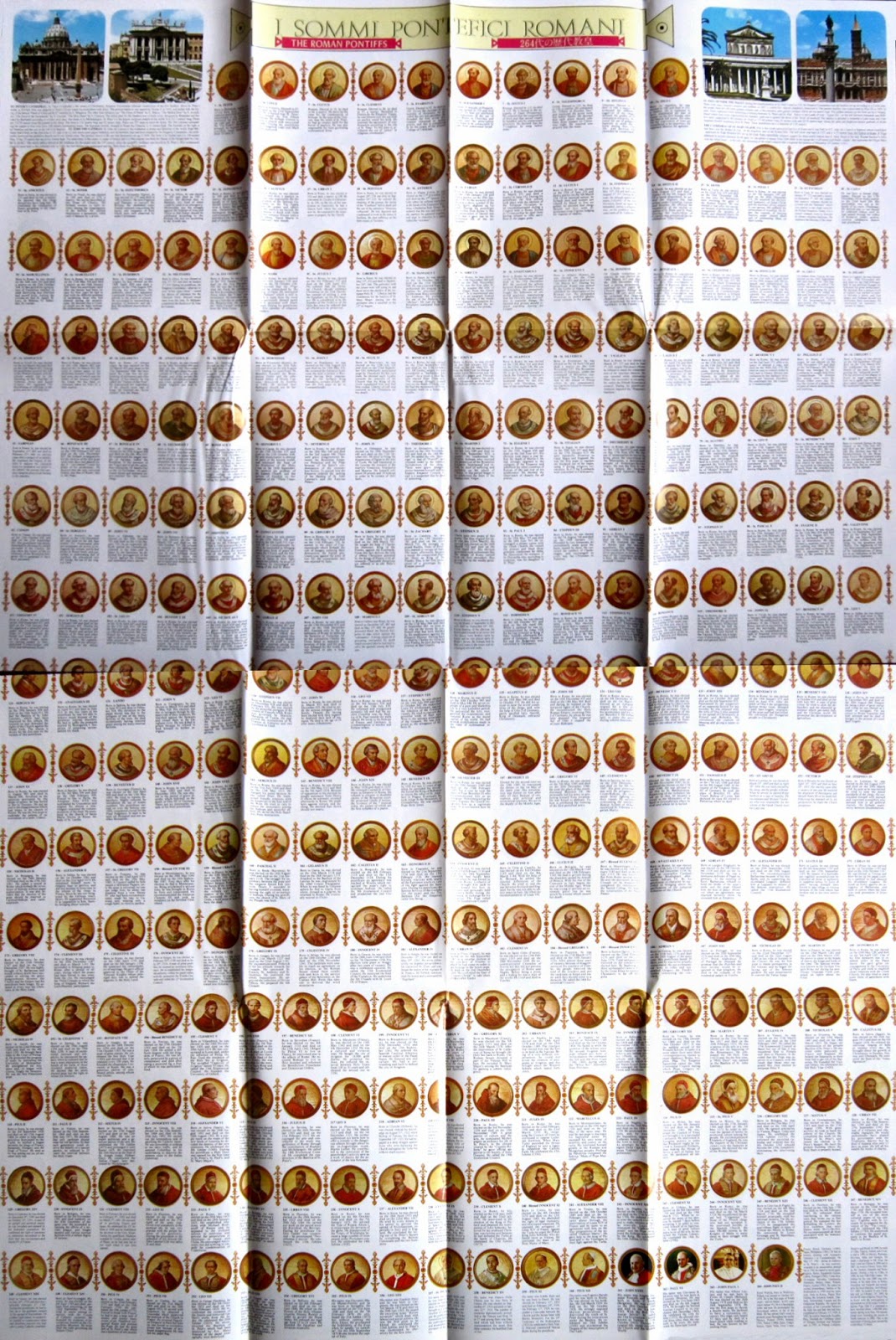
So we have our second new Pope since I bought my papal wallchart on a visit to Rome in March 2005 (you may have to open the image in its own window and zoom in to view it properly). But will Francis I be the last Pope ever? Probably not – although that’s the gist of a prophecy supposedly made by an Irish Archbishop way back in the 12th century. I’ve just been reading all about it in a short ebook by Oliver Hayes entitled The Papal Prophecies: St Malachy and the Doom of the Popes. The case turns out to be an excellent example of something I’ve always believed – that most “prophecies” tell you more about the times in which they originated than they do about the future.

The book starts with a biography of Saint Malachy, who fought his way (literally) to the position of Archbishop of Armagh in the 1130s. While this is all interesting and exciting stuff, it isn’t actually very relevant to the prophecies that bear his name – since they were almost certainly written long after his death. It’s true there were vague rumours that Malachy had experienced some kind of prophetic vision during a visit to Rome in 1139, but nothing was known about the details.

Then in 1590 everything changed. A Spanish Dominican scholar named Alphonsus Ciacconius claimed to have discovered an ancient parchment, bearing a series of cryptic phrases in Latin, in the Vatican archives in Rome. This was during the renaissance period, when people were just starting to develop a genuinely forensic approach to the study of historical documents. Ciacconius was one of the few people at the time who was versed in the new science of palaeography – the dating of old writings based on the materials, style and language employed. He announced that the parchment and its cryptic Latin phrases dated from the middle of the twelfth century.

Ciacconius showed the manuscript to a fellow scholar named Arnold de Wyon, and between them they attempted to decipher its cryptic message. Eventually they concluded that it was Saint Malachy’s account of his prophetic vision, and that each Latin phrase corresponded to a future Pope. In other words, it was a list of all the Popes that would be elected after the time of Malachy’s vision in 1139. The “Prophecy of the Popes” was first published by Wyon in 1595, together with an interpretation of its meaning.

In total, the list includes 112 Popes – the first 74 of which date from after the supposed time of Malachy’s vision, but before the discovery of the manuscript by Ciacconius. These 74 Popes are represented by short Latin phrases that relate—often by means of a verbal pun or metaphor—to the name or place of birth of the Pope in question. For example, the first item on the list, “Ex castro Tiberis” means “From a castle of the Tiber”, and is taken to refer to Pope Celestine II, who was elected in 1143 and was born in Città di Castello – a fortified town on the banks of the River Tiber. The only British-born Pope, Adrian IV, corresponds to the fifth item on the list, “De rure albo”– which literally means “from the white country”, but can be taken as a pun on Albion, the ancient poetic name for Britain.

After Wyon published the list in 1595, people were eager to see how each new Pope fitted the corresponding prophecy. Although ways were found to match the prophecy to the actuality, it became more and more obvious that there was a qualitative difference between the pre-publication fits and the post-publication ones. Very few of the post-publication matches took the form of a simple pun on a name or birthplace. Instead, they often referred to the general state of affairs at the time the Pope was elected, or to some action taken by him during his incumbency. By the late 17th century the discrepancy had become painfully obvious, and a number of Catholic scholars—Louis Moréri among them—realized that everything focused down to the pivotal year of 1590. That was the year that Ciacconius “discovered” the manuscript and pronounced it to be a work of the 12th century... and 1590 was also the year the prophecies suddenly switched from being right on target to being vague and woolly.

There was a succession of three different Popes in 1590. Sixtus V died in August to be replaced by Urban VII, who died the following month and was replaced by Gregory XIV. The prophecies for Sixtus V and Urban VII are good matches, but the prophecy for the next Pope didn’t match Gregory XIV at all. Moréri quickly realized this was the single most important prophecy in the whole list – the only one out of the 112 that really mattered. All the rest were window dressing.

The key prophecy—for the Pope to follow Urban VII—said “Ex antiquitate Urbis”, meaning “of the old city”. While that doesn’t mean much in the context of the actual successor, Gregory XIV, it’s a perfect match for one of the other cardinals who was in the running at that particular conclave. This was Girolamo Simoncelli, who had been born in Orvieto – the Latin name for which was Urbevetanum, meaning “the old city”! Simoncelli was the candidate favoured by the King of Spain, Philip II... who just happened to be the rich patron of Alphonsus Ciacconius – the Spanish scholar who “found” the prophecies at just the right moment, and vouched for their authenticity!

It seems almost certain that the Papal Prophecies attributed to Saint Malachy were a 16th century forgery. Whether the culprit was Alphonsus Ciacconius or someone else, the aim seems to have been political – to strengthen the case for one particular individual being elected Pope at one particular conclave. But to give the manuscript credibility, it couldn’t stop there. So 38 further prophecies—of no real interest to the perpetrator—were appended to the list. But even they had to end somewhere. It just happens that, if you go through the list ascribing each consecutive prophecy to each consecutive Pope, then the very last item on the list corresponds to... none other than Francis I, who was elected Pope just a few days ago.

This final prophecy is wordier than any of the others, and appropriately apocalyptic: “Peter the Roman, who will nourish the sheep in many tribulations; when they are finished, the city of seven hills will be destroyed, and the dreadful judge will judge his people.” Fortunately for the general sanity of the world, the “Prophecy of the Popes” hasn’t received anything like the same attention as the doom-laden utterances of Harold Camping, or the Mayan calendar fiasco of last year. I guess that’s because the sort of people who are most likely to be interested in end-of-the-world predictions—namely Protestants and New Agers—are also the least likely to be interested in anything to do with Popes!

The Papal Prophecies is published by Bretwalda Books, which makes Oliver Hayes a sort of colleague of mine. In fact Oliver is the main author of the Bretwalda Battles series, to which I’ve contributed half a dozen titles of my own. My latest ebook is all about The Destruction of Hiroshima... which I try to put in its proper historical context, without the overlay of wise-after-the-fact hindsight that is often found in discussions of the subject.

Sunday, 10 June 2012

Giant from the Unknown

The Steve Ditko Comics Weblog has recently finished reprinting all the Ditko stories that are in the public domain. Looking through these, I found one with a distinctly Fortean theme, called “Giant from the Unknown”. This is a seven-page story that originally appeared in 1958, and begins with a farmer unearthing an apparently petrified giant while digging in a field. He calls in the archaeological experts, but as can be seen in the excerpt below, they assume it’s a hoax along the lines of the Cardiff Giant: “Back in the 1800s a farmer was digging a well near Cardiff, New York... claimed he found a giant petrified. It was no giant nor an ancient statue either. It was a fake. A fake that fooled a lot of scientists but made a lot of money for the farmer who let people see it for a price!”

[If you want to read Ditko’s story in full, you might want to read it now because I’m going to give away the ending on the other side of the picture...]
Needless to say, the giant in the story isn’t a hoax but a real creature, in a state of suspended animation, “from a wonderful civilization in the distant past”. While this ending might seem perfectly logical and satisfying to those of us who were raised on a diet of Ditko weirdness, it has to be admitted that it’s a rather bizarre idea in the context of 1950s science fiction. When people think of digging up proto-humans from the distant past they think in terms of ape-like hominid skeletons, not smooth-skinned giants with “intricate electronic material like transistors or something”. However, the idea does have a precedent in the esoteric writings of people like Madame Blavatsky and William Scott-Elliot in the late 19th century -- who imagined that the lost continent of Atlantis was populated by a highly advanced race of giants much like the one in Ditko’s story.

Tuesday, 10 April 2012

The First Radio Hoax?

To most people, the phrase “radio hoax” conjures up the notorious Orson Welles Martian invasion broadcast of 1938. But it’s sometimes alleged that a similar hoax was perpetrated a dozen years earlier, in January 1926. At that time the BBC, which was little more than three years old, had a state monopoly on radio broadcasting in the UK. British listeners had just one channel to choose from, so a Saturday evening prime-time broadcast had a captive audience of perhaps ten million people. And so it happened—according to the story—that on Saturday 16 January 1926 ten million people were taken in by the world’s very first radio hoax.

The usual account is something like the following. Switching on their crystal sets to listen to an uplifting moral lecture by a distinguished academic, the audience instead hears breaking news of an unruly demonstration in Trafalgar Square. They listen in alarm as the protesters break into the National Gallery and vandalize it, swarm into St James’s Park and throw broken bottles at the ducks, and then advance towards Parliament Square in a threatening manner. A government minister is spotted trying to flee the scene, and summarily hanged from a lamppost. An academic who is on his way to the BBC to deliver a lecture is roasted alive. The Houses of Parliament are attacked with trench mortars and the ‘Big Ben’ clock tower crashes to the ground. At this point, in an attempt to calm the audience, the programme switches to a live relay of band music from the ballroom of the Savoy Hotel... but this is interrupted by a loud crash, which listeners are informed was the sound of the Savoy being blown up by the rioters.

Actually, of course, nothing untoward happened in London that day. The broadcast was the work of just one man: Father Ronald A. Knox, a rather unorthodox Catholic priest who was probably most famous as a writer of mystery novels. He did all the voices and sound effects himself — for example the noise of the Savoy being destroyed was actually made by Knox demolishing a wooden greengrocer’s crate. So the broadcast was a work of fiction... but was it really a hoax? Well no, it wasn’t -- it was a satirical comedy sketch. It may not have been a precocious forerunner of Orson Welles, but it was certainly a precocious forerunner of classic BBC radio comedy of the kind normally associated with The Goon Show of the 1950s. All this becomes obvious when you look more closely at the details of the programme.

For a start, the show lasted a mere twelve minutes, which is far too short a time for the events that were supposedly unfolding. It’s true that people often choose Trafalgar Square as a venue for protests, but not at 7.40 on a January evening. The day’s radio schedule listed the show as ‘Broadcasting the Barricades’ -- so, far from being spontaneous ‘breaking news’, it was obviously programmed in advance! To make this absolutely clear, the show was announced on air as ‘a work of humour and imagination, enlivened by realistic sound effects’. This is a fact the hoax proponents tend to gloss over, together with the absurdist humour that permeates the script.

The leader of the protest is a Mr Popplebury, described as ‘Secretary of the National Movement for the Abolition of Theatre Queues’. The academic who is attacked on his way to the BBC has the equally ludicrous name of Sir Theophilus Gooch... and after informing his listeners that Gooch is being roasted alive, Knox adds that ‘he will therefore be unable to deliver his lecture to you’.

When the Palace of Westminster is attacked, Knox informs his listeners that ‘The building is made of magnesian limestone from Yorkshire, a material which is unfortunately liable to rapid decay. At present, in any case, it is being demolished with trench mortars.’ After Big Ben is destroyed, he points out that it can no longer be used for the BBC time signal, which in future will come from ‘uncle Leslie’s repeating watch’.

Perhaps the most absurd thing of all is the programme’s ending. After destroying the Houses of Parliament and the Savoy Hotel, the rioters set their sights on the BBC studio itself. They head there ‘with a threatening demeanour’, but as soon as they arrive they sit down quietly in the waiting room and start to read The Radio Times!

Tuesday, 6 December 2011

Fossil Hoaxes and Simulacra

Today, it's taken for granted that fossils are the petrified remains of once-living animals. This idea has been around since antiquity, but from the days of ancient Greece right up to the eighteenth century it was in constant competition with an alternative theory: that fossils, although formed in the shape of living creatures, have never actually been alive themselves -- they've been made of stone right from the start. As with so many "wrong" ideas, this one appears to have originated with Aristotle, or at any rate it was popularized by him. Aristotle believed that fossils were spontaneously created inside solid rock as the result of a natural creative force.

Inevitably, when Aristotle's ideas were appropriated by the early Christians, this "natural creative force" was interpreted as God. One of the last and most enthusiastic proponents of this theory of fossil formation was Johann Beringer, a Professor at the University of Würzburg in Germany. In 1726 he published a remarkable illustrated book, Lithographiæ Wirceburgensis, which can now be read online. You can skip the text (which is in Latin) -- the pictures at the end are the important thing. Beringer's fossils don't look like anyone else's, before or since. Here are just a few of them, depicting spiders on their webs, strange chimerical creatures and even frogs caught in the act of mating!
Of course, Beringer was the victim of a hoax. The fossils were carved out of limestone by students of his, spurred on by a couple of rival professors that Beringer later took to court over the affair. It's said that Beringer tried to buy up all the existing copies of his book so he could destroy them... it's a good thing for Fortean posterity that he didn't succeed!

One of Beringer's contemporaries was Johann Scheuchzer. Unlike Beringer, Scheuchzer held the "correct" view that fossils were the remains of once-living life-forms... except that he believed they were all deposited during the Great Flood described in the Book of Genesis. Scheuchzer was particularly interested in fossil plants, and he wrote a book on the subject called Herbarium Diluvianum, published in 1723. Like Beringer's book, this is in Latin and can be read online.

The picture on the left, taken from Scheuchzer's book, appears to show a couple of human simulacra seen in fossilized bark. As far as I can make out from the Latin text (or rather, from the garbled translation of it that I got out of Google), the simulacrum on the right has been embellished by a crude rustic hand using a paint-brush, whereas the one on the left is entirely the product of Nature. Of these two assertions, I can readily believe the first but I'm dubious about the second. I suspect the engraver has subtly "improved" the original... the 18th century equivalent of photoshopping!

Thursday, 27 October 2011

Con Artists

It's Turner Prize time again. For non-UK readers who may never have heard of it, the Turner Prize is an annual award for upcoming young artists that has become famous (or notorious) for the fact that the creative content of the works is more often than not contained in the artist's "message" rather than the object itself. Although named after the great nineteenth century painter Turner, mere paintings rarely win the Turner Prize -- it's more likely to go to a cheap plastic garden gnome or a carefully preserved piece of elephant dung. Even pop-art is far too passé for the Turner judges. A meticulously executed painting of a soup can wouldn't stand a chance... although a real soup can, bought for 50 pence from a supermarket and accompanied by an appropriately trendy textual analysis, would be a sure-fire winner.

Coming to the title of this post: I don't mean to suggest that submissions for the Turner Prize are the work of con artists -- after all, they're merely pandering to the judges' tastes. That may be cynical, but it isn't deceptive. What I do mean is that by allowing banal objects and images to be transformed into expensive works of art, simply by attaching pretentious interpretations to them, does tend to open the doors to a wide variety of hoaxers, pranksters and con-men. This isn't a particularly new phenomenon -- the Museum of Hoaxes website lists quite a number of artistic con tricks that were perpetrated during the 20th century, including the following:
  • Disumbrationism was invented in the 1920s by an American named Paul Jordan Smith, who wanted to hit back at highbrow art critics who had been dismissive about his wife's rather conservative paintings. He produced a series of works that were as bad as he could make them, both in concept and execution, and exhibited them under the Russianized name of Pavel Jerdanowitch. Smith's master-stroke was to juxtapose these childish paintings with textual commentaries designed to appeal to the liberal academics of the time. As a result (and much to Smith's disgust) Disumbrationism was a huge hit with the critics.
  • Naromji was an artist who appeared out of the blue in 1946, with a painting called "Three Out Of Five" exhibited at the Los Angeles Art Association with a price tag of a thousand dollars (about $11,200 in today's money). Naromji was actually the well-known prankster Jim Moran who, like Paul Jordan Smith, wanted to make fools out of pretentious art experts. He succeeded in this, but not in the way he'd expected. The work was quickly revealed as a hoax, and summarily dismissed as worthless by the Art Association. But then an established artist named Leonard Kester claimed that "Three out Of Five" was actually his own work, and that Moran had pinched it from him. This caused a sudden change of heart at the Los Angeles Art Association, who decided the picture was worth displaying after all!
  • Pierre Brassau exhibited four paintings at an exhibition in Sweden in 1964. Opinions among critics were divided: one described him as "an artist who performs with the delicacy of a ballet dancer" while another said "only an ape could have done this". The latter may have been meant as an insult, but actually it was spot on. Pierre Brassau was indeed an ape -- a four-year old chimpanzee from Boras Zoo. A journalist had decided to try an experiment to find out if art critics could tell the difference between human art and simian art. Apparently only one of them could!
Here is my own effort. A few years ago, the BBC ran a "Mock Turner" competition on their website, and this was my contribution. It's called $0.0001 and is intended to conceptualize the deplorably low financial value placed on artworks intended for mass consumption when contrasted with those aimed at society's elite. In strictly technical terms, the picture is a detail taken from issue 139 of The Mighty Thor -- a comic book originally published in 1967 at a price of 12 cents for 20 pages. Each page has an area of approximately 60 square inches, which means that one square inch of the comic (as shown here, magnified) was valued at one hundredth of a cent, or $0.0001. Although the original comic was drawn by Jack Kirby, the true creator of this work of art is myself, not Kirby, because I was the one who thought up the trendy left-wing message behind it. I thought it was pretty clever, but the BBC disagreed -- I didn't make it into their Mock Turner shortlist!

Saturday, 27 August 2011

Ningyo: the ugly little mermaid

This time last week, I was privileged to see the late Phineas T. Barnum discoursing on his celebrated Feejee Mermaid (as pictured on the left), in the small North Devon village of Woolfardisworthy. This isn't as unlikely as it sounds, since Woolfardisworthy is the home of the Centre for Fortean Zoology, which last weekend hosted their annual gathering: the Weird Weekend 2011. In true Barnum tradition, neither the mermaid on display or Barnum himself were exactly authentic. The latter was played by Silas Hawkins, while the mermaid was a model made for the CFZ by special effects wizard Alan Friswell.

The original "Feejee mermaid" was displayed by Barnum in the nineteenth century, and should more correctly be described as a Ningyo -- a legendary Japanese creature that is smaller and uglier than the traditional European mermaid. At one time it was not uncommon for Japanese sailors to fake Ningyo specimens by stitching the top half of a dead monkey onto the bottom half of a dead fish. The first mermaid exhibited by Barnum was one of these... a genuine fake, in other words. However, after the original was destroyed in a fire, he resorted to displaying a fake fake! The CFZ model is also a "fake fake", by the way -- no dead animals were involved in its construction!

The Ningyo is an example of a Yokai -- a generic term referring to a wide range of monsters, demons, ghosts and other creatures from Japanese legend and folklore. The most comprehensive reference work on Yokai in the English language is Richard Freeman's 400-page Great Yokai Encyclopaedia, which was published by CFZ Press last year. My copy (pictured right) was secured at the Weird Weekend for just 12 pounds -- 20 percent off the list price. As if that wasn't enough of a bargain, Richard was then good enough to sign it for me... no doubt doubling its value!

Tuesday, 2 August 2011

Paranormal investigation, 18th century style

From a Fortean point of view, the artist William Hogarth (1697-1764) is best known for his satirical print "Credulity, Superstition, and Fanaticism" -- one of his last works, dating from 1762. As discussed in issue 202 of Fortean Times (October 2005), the actual target of the satire was the new religion of Methodism, but (presumably because Methodists were seen as particularly credulous) the picture contains references to several popular paranormal phenomena of the time. These include the Cock Lane ghost, the phantom Drummer of Tedworth and the hoax perpetrated by Mary Toft -- a young woman who, back in the 1720s, convinced a lot of people that she regularly gave birth to live rabbits.

There is an earlier and less well-known work by Hogarth depicting Mary Toft, which he produced in 1726 when she was at the height of her fame. Although it's not a great work of art, there is at least one sense in which the earlier picture is more interesting than the later one. Rather than Methodists (who have always struck me as rather harmless) Hogarth's satire is directed at supposedly intelligent and educated individuals who "want to believe"... and hence are easily duped by hoaxers.
The title of the print is Cunicularii, as can be seen in the lower middle caption (you may need to click on the picture to enlarge it). Now "Cunicularii" is actually Latin for "rabbits"... but, since none of Hogarth's other prints have Latin names, it's safe to assume he chose this title because (in the timeless tradition of British anatomical humour) it "sounds a bit rude". The subtitle is "The Wise Men of Godliman in Consultation" -- the fictitious town of "Godliman" being similar (but not actionably similar) to Godalming in Surrey, where Mary Toft lived. The quotation "They held their talents most adroit / For any mystical exploit" is paraphrased from Samuel Butler's 17th century poem Hudibras... but it could be the motto of paranormal investigators in any century!

The three Wise Men attending at the birth (not an original idea, of course) are labelled A, B and C:
  • Wise Man A is captioned as "The Dancing Master or Preternatural Anatomist", and he is exclaiming "A Great Birth!"
  • Wise Man B, "An Occult Philosopher searching into the depth of things", is pictured with his hand up the subject's skirt, saying "It pouts, it swells, it spreads, it comes!"
  • Wise Man C, who is exclaiming "A Sooterkin!" is labelled "The Sooterkin Doctor Astonished".
The last of the three may cause a puzzled frown, because you thought the woman was giving birth to rabbits, not sooterkins... and come to that, what's a sooterkin? But in those days it was just like it is today -- if you get three paranormal believers in a room together, you will hear three different explanations for the same phenomenon! A sooterkin, in the folklore of the time, was a small, furry, non-human creature that some women were supposed to give birth to spontaneously. The legend arose in Germany and the Low Countries, so possibly "sooterkin" is a corruption of "Pseudokind" (German Kind meaning "child", as in Wunderkind).