Search This Blog

Showing posts with label poetry. Show all posts

Sunday, 10 March 2024

The Gates of Hell (with music video)

A long time ago on this blog, I did a post about Dante's Inferno - Hunt Emerson's comic-book adaptation of a 14th century epic poem set in Hell. As I said there, the comic does wonders for clarifying the whole point of Dante's original -  i.e. that it's basically a satire on Italian political history, rather than a serious attempt to depict the landscape and geography of Hell. But it does a strikingly vivid job of the latter even so, which has inspired a multitude of subsequent works from Sandro Botticelli's 15th century illustrations of Hell to Larry Niven & Jerry Pournelle's SF novel Inferno (1976), which uses the same basic setting (and, of course, Hunt Emerson's 2012 comic-book version).

On the musical side, there's a distinctly horror movie-esque portrayal of Hell in the Dante Symphony (1857) by Franz Liszt (who featured in another early post on this blog, Lisztomania). This begins with a dramatic depiction of the Gates of Hell, which inspired me to create the following video. I've added four electronic tracks of my own (demonic voice, drum machine, saw bass and synth pad), but otherwise it's just a digitally distorted vinyl recording of the opening of Liszt's symphony. Visually the gates and demons are courtesy of Bing's AI image creator, while the depiction of Hell itself is by Botticelli. When it's all put together, I think the result is pretty cool ((even though I say it myself):

I've twisted the original a bit in having the words spoken by demons. In Dante's poem, these are phrases that (in their original Italian form) are inscribed over the gates of Hell, while Liszt has them depicted by orchestral instruments, rather than being spoken or sung. But since I like playing with free software, I couldn't resist adding the synthesized voice.

The other software I used here was Tracktion Waveform Free, together with various free instrument and effects plugins (or ones that came free with Computer Music magazine, anyway). These are all great toys to play with, as I discovered a few years ago when I was doing a book called The Science of Music. I was asked to do that one because I'd previously written The Science of Sci-Fi Music - but while the latter was about a subject I knew something about (avant-garde classical music of the mid-20th century), the new one strayed way outside my comfort zone into modern digital music production. And the quickest way to learn a new subject is to try doing it yourself!

One thing I mentioned in passing in The Science of Music is that, if people who aren't fans of classical music have heard of Franz Liszt at all, it's most likely through the rhyming slang phrase "Brahms and Liszt". And as it happens, Brahms is another composer I've swiped a vinyl sample from. Unlike The Gates of Hell, there isn't even a tenuous fortean connection in this case, but I think the result is one of the most musically successful things I've done (in a chilled-out "lo-fi" sort of way). Here's the result:

While I was writing this post, I suddenly remembered that I've actually seen the "Gates of Hell", or at least a monumental bronze representation of them by the sculptor Auguste Rodin. This was at the Rodin Museum in Paris, which I visited in 2013 - the photograph below is one I took at the time. If you look closely at the panel above the gates, you'll see Rodin's most iconic image - "The Thinker" - in its original setting.


Sunday, 14 February 2016

Some old X-Files

I don’t usually hoard old magazines (except Fortean Times), but I kept these three issues of Cinefantastique because between them they contain complete episode guides to the first four seasons of The X-Files. I was prompted to dig them out last week – not because of the “reboot” currently showing on Channel 5, or from any general sense of nostalgia, but because I needed to do some research for a new book I’m working on. In looking through them, I was struck by how highbrow some of the X-Files episode titles were. Here are a few of the more Fortean examples – two from each of those first four seasons (just focusing on the titles, not the storylines).

The Jersey Devil (Season 1, Episode 5). One of America’s lesser known cryptids, this one dates back to those pre-Darwin days when mysterious creatures weren’t required to conform to the logic of evolutionary genetics. According to Wikipedia it’s “a kangaroo-like creature with the head of a goat, leathery bat-like wings, horns, small arms with clawed hands, cloven hooves and a forked tail”. Wings AND arms AND hooves… they don’t make them like that any more.

Ghost in the Machine (Season 1, Episode 7). This cool-sounding phrase was coined by the British philosopher Gilbert Ryle in 1949, as a disparaging description of the dualistic theory of human nature (i.e. a spiritual soul inhabiting a material body).

Little Green Men (Season 2, Episode 1). A facetious term for extraterrestrials, which was already well established when Mack Reynolds wrote The Case of the Little Green Men in 1951 – a Fortean-themed detective novel I wrote about in a blog post last year.

Fearful Symmetry (Season 2, Episode 18). This phrase comes from William Blake’s famous poem “Tiger, Tiger, burning bright”. The poem isn’t very Fortean, but its author was – as I explained in A 19th Century Contactee. One of the strangest spiritual creatures Blake claimed to have encountered was “The Ghost of a Flea” – his painting of which I happened to see in the Tate Gallery last year (see photo at the bottom of this post).

Paper Clip (Season 3, Episode 2). This is a reference to Operation Paperclip, a real world “conspiracy” that brought hundreds of German scientists – many of them war criminals – to the United States in the aftermath of WW2, giving them clean new records and salaried positions working for the U.S. government. It may be no coincidence that “Nasa” sounds a bit like “Nazi”.

Talitha Cumi (Season 3, Episode 24). This is one of several X-Files titles derived from a foreign language. In this case it’s Aramaic, the language spoken by Jesus. It’s a quote from the New Testament, which of course is full of Jesus quotes, but most of them only appear in translation. This example (from Mark 5:41) is one of only about a dozen that are given in the original Aramaic first (I’d be interested to know why they were singled out in this way). From the King James version: “And he took the damsel by the hand, and said unto her, Talitha cumi; which is, being interpreted, Damsel, I say unto thee, arise.”

Tunguska (Season 4, Episode 8). This, of course, was the site of a mysterious explosion that flattened two thousand square kilometres of Siberian forest in 1908. It was probably caused by a meteor impact, although several odd things about it have led to various alternative explanations (e.g. an exploding UFO). As mentioned in my post about Ian Watson last year, his novel Chekhov’s Journey offers a particularly weird interpretation of the Tunguska event.

Terma (Season 4, Episode 9). This has to be one of the most obscure X-Files titles of all. It’s a technical term from Tantric Buddhism, referring to secret teachings carefully handed down among the inner circle of adepts. Such as, for example, that Tantric classic “Sex Secrets of the Ancient Masters” (which I really must get round to writing one of these days).

Sunday, 3 January 2016

The Writer’s Secret

In the comment thread after my Who Remembers Guru? post last summer, I mentioned that I wanted to try my hand at creating a similar “comic strip collage” using public domain images. A few weeks later I did a sort of trial run with the cover image for Jill Trent and the Flying Saucer Mystery, but with plenty of idle time over the Christmas break I thought I’d try something a little more ambitious.

I had a look round for a suitable idea, and came across this unpublished poem I wrote several years ago:
A world-renowned writer named Blott
Said of genres, “I’ve written the lot:
From horror and mystery
To fantastical history
And all of them have the same plot!”
Turning this into a Guru-style cartoon wasn’t as easy as I thought. There are thousands of free images on the web, but finding ones that fit (both thematically and stylistically) was harder than I’d expected. Also, the last line caused problems because it doesn’t have a natural visual interpretation. A fairly obvious idea did spring to mind, but I couldn’t use it on account of the “no porn” clause in Blogger’s terms and conditions. So I decided to go with a more abstract notion instead.

Sunday, 23 February 2014

Satan, Sin and Death

The dramatic scene depicted above is the work of the 18th century painter and engraver William Hogarth. This particular engraving is based on a painting he produced circa 1735-40, but it’s easier to see what’s going on in this black-and-white version. It’s a scene from Milton’s Paradise Lost in which Satan, en route from Hell to Earth, encounters two strange figures guarding the Gates of Hell:

Before the gates there sat on either side a formidable Shape. The one seemed woman to the waist, and fair, but ended foul in many a scaly fold, voluminous and vast – a serpent armed with mortal sting. [...] The other Shape – if shape it might be called, that shape had none distinguishable in member, joint, or limb. Or substance might be called that shadow seemed, for each seemed either. Black it stood as Night, fierce as ten Furies, terrible as Hell, and shook a dreadful dart.

The first figure is the personification of Sin, while the second figure is Death. It’s interesting that Satan himself is portrayed in relatively heroic form, although his facial features look more monstrous in the original painted version than in this engraving.

“Satan, Sin and Death” is an unusual departure for Hogarth, most of whose works are satirical in nature (see for example Paranormal investigation, 18th century style and Another historical myth-conception). Hogarthian satire was pretty gentle stuff, aimed at broad social classes rather than at specific individuals. By the end of the 18th century, however, all that had changed – and political caricatures were every bit as viciously ad hominem as they are today.

James Gillray (1756 – 1815) was one of the first great political cartoonists. His own variation on the theme of “Sin, Death and the Devil”, dating from 1792, is shown below. Death is represented by the Prime Minister of the time, William Pitt the Younger, while the Devil is Pitt’s Lord Chancellor, Baron Thurlow. They are separated by the figure of Sin in the person of Queen Charlotte, the wife of King George III. Even today, the depiction of the present Queen in such an unflattering way would be frowned on in some quarters (although Conspiracy Theorists might detect a resemblance between Her Majesty and Milton’s personification of Sin, in that both of them are half reptilian).
William Blake (mentioned previously in A 19th Century Contactee and Reinventing Ezekiel's Wheel) was born the year after Gillray. He had something of an obsession with Milton’s Paradise Lost, producing at least 30 illustrations based on it. The earlier of Blake’s two versions of “Satan, Sin and Death” (circa 1807) is depicted below. Like Hogarth, Blake makes the figure of Satan look surprisingly heroic... while his version of Death is a semi-transparent ghost.

Wednesday, 1 January 2014

Crossword Exegesis

I don’t really know what an exegesis is, but people expect a crossword compiler to have a big vocabulary. What I mean is, on the other side of the following image are the answers to last week’s crossword and/or trivia quiz, together with an explanation of the various Fortean connections.

If you want to do the puzzle but haven’t done so yet, reading beyond this point will take you into spoiler territory. But if you’ve done the puzzle, or just want to see the answers, scroll on...


ACROSS

1. Author of Chariots of the Gods: ERICH VON DANIKEN. An easy one to start with! But EvD’s ideas weren’t as original as many people imagine – see Reinventing Ezekiel's Wheel.

9. First of the seven churches mentioned in the Book of Revelation: EPHESUS. A Turkish town and a major centre of early Christianity. It was also the site of one of the Seven Wonders of the World: the Temple of Artemis.

10. “Their weapons were no match for the Bossonian LONGBOW" (Robert E. Howard). This comes from the only full-length Conan novel that Howard wrote, The Hour of the Dragon (also sometimes published as Conan the Conqueror). Not a particularly Fortean story, although some of Howard’s other fiction is. I think I’ll make that the subject of my next blog post.

11. "Voyagers who have shown every indication of intent to EVADE " (Charles Fort). This comes from The Book of the Damned, a few paragraphs after the oft quoted “I think we're property” – the voyagers in question being extraterrestrial ones.

12. Yggdrasil, for example: ASH. Yggdrasil is the World Ash Tree in Norse mythology.

13. The world ends without this, according to T.S. Eliot: A BANG. From The Hollow Men (1925): “This is the way the world ends: Not with a bang but a whimper.” Another Eliot poem from the same period, The Waste Land, is packed with Fortean themes – I’ll have to add that to my list of future posts as well.

14. Site of the Crucifixion: CALVARY. From the Latin Calvariæ Locus = “place of the skull”. The Hebrew equivalent is Golgotha.

16. "I had long hoped for a personal CONTACT with a man from a flying saucer" (George Adamski). A quote from Flying Saucers have Landed, co-authored with the far more interesting Desmond Leslie.

18. The queen of the fairies, according to Shakespeare: TITANIA. From A Midsummer Might’s Dream, of course. The picture (fourth image on top row) shows a detail from The Reconciliation of Oberon and Titania (1847) by Sir Joseph Noel Paton.

21. Sayings of Jesus that are not found in the Gospels: AGRAPHA. This is an obscure one, but anyone who’s tried compiling a crossword will know that the more words you fill in, the harder it gets to find unobscure words to fit the remaining spaces! But Agrapha isn’t so obscure that it doesn’t have its own Wikipedia page.

23. Max ERNST, German surrealist. Perhaps the most Fortean connection here is Ernst’s bird-man creation called Loplop, which was adopted as a kind of mascot by Jon Downes and the Centre for Fortean Zoology (see picture – third image on the top row).

25. URI Geller, Israeli-born psychic. Geller’s 1973 appearance on the Dimbleby Talk-In was one of my Fortean Events that Shook the World.

26. "Thus SPAKE Zarathustra", by Friedrich Nietzsche. Written in the 1880s, this philosophical work focused on two concepts more often associated with the 20th century: “The Superman” and “God is Dead”.

27. Lenape people living in New Jersey when the Europeans arrived: RARITAN. This is one of two grid entries where I just couldn’t find anything Fortean that would fit. There’s a modern-day city in New Jersey named Raritan, as well as Raritan Bay between New Jersey and New York.

28. "IMMORAL Tales" (1974), featuring Paloma Picasso as Countess Erzsébet Báthory. The Báthory segment focuses on the historical countess, not the later legends that associate her with vampirism. So she doesn’t slaughter large quantities of female virgins and bathe in their blood in order to restore her youth. She just slaughters large quantities of female virgins and bathes in their blood because she enjoys it (see picture – first image on bottom row).

29. Britain's best-known cryptid: LOCH NESS MONSTER. In light of the upcoming Scottish independence vote, perhaps I should have worded this as “Scotland's best-known cryptid” to stay on the safe side.

DOWN

1. The building pictured [in last week’s post]: EXETER CATHEDRAL. Another non-Fortean one – I needed a 15-letter word or phrase beginning with E and ending with L, and this was the best I could do. The answer was actually written on the image, if you can read Latin: Exoniensis Ecclesiae Cathedralis.

2. Eldest son of Abraham, according to the Book of Genesis: ISHMAEL. In the Judaeo-Christian tradition, Ishmael is less important than his younger half-brother Isaac. In Islam, however, Ishmael is the more important of the two, being a direct ancestor of Muhammad.

3. Herman HESSE, author of Siddhartha. According to Wikipedia, this 1922 novel “deals with the spiritual journey of self-discovery of a man named Siddhartha during the time of the Gautama Buddha.... It was published in the U.S. in 1951 and became influential during the 1960s.”

4. The James OSSUARY is inscribed "James, son of Joseph, brother of Jesus". If the inscription is genuine, it might constitute archaeological evidence for the Biblical Jesus... but quoting Wikipedia again, “most scholars hold the last part of the inscription to be a forgery”.

5. The DELPHIC Sibyl, prophetess of Apollo. The illustration (second image on top row) is from Michelangelo’s Sistine Chapel ceiling.

6. Professional assassin in feudal Japan: NINJA. I’m not sure if this is an easy one or not – everyone uses the word “ninja”, but do they really know what it means?

7. An esoteric branch of Judaism: KABBALA. When I compiled the crossword a few years ago, I convinced myself this was a valid spelling – although “Kabbalah”, “Cabala” and “Qabbala” are more common.

8. A type of hippie found in 1980s Britain: NEW AGE TRAVELLER. Again the spelling may look wrong to some people, but that’s how it’s spelled here in Britain. And hey, spelling rules are just another fascist conspiracy anyhow. If you catch my drift, man.

15. ANN Greenslit Pudeator, hanged as a witch in Salem in 1692. It was tragic, of course, that so many innocent women were accused of witchcraft in the 17th century... but really, with a name like Ann Greenslit Pudeator, what do you expect? She probably had a pierced nasal septum and wore black lipstick, too.

17. "Alles Vergangliche ist NUR ein Gleichnis" (Everything transient is only a symbol - Goethe). These words are sung by the Chorus Mysticus at the end of Mahler’s 8th Symphony (see The Curse of the Ninth).

19. "The Serpent Power: Secrets of TANTRIC and Shaktic Yoga" by Arthur Avalon. The author’s real name was Sir John Woodroffe, who derived his pseudonym from Arthurian mythology. Oddly, though, the book isn’t about Arthurian mythology but about Indian mysticism. Woodroffe was one of the first proponents of the New Age formula “if it’s old, and it doesn’t come from the Judaeo-Christian or Graeco-Roman tradition, then it must be good.”

20. Thomas AQUINAS, author of "Summa Theologica". Aquinas was a 13th century scholar who specialized in interpreting the works of Aristotle (that’s what scholars used to do in those days, in lieu of thinking for themselves). He was often depicted trampling on a rival Aristotle-interpreter named Averroës, as seen in the painting by Gozzoli in the rightmost image above.

21. Belief that all living and non-living things have a spiritual essence: ANIMISM. Closely related to paranoia: the belief that all living and non-living things are out to get you.

22. Generic term for Indian languages related to Sanskrit: PRAKRIT. Most mystical and religious Indian writings are in Sanskrit, although the earliest Buddhist scriptures are in a Prakrit language called Pali. “Karma” and “Nirvana” are Sanskrit – the Pali equivalents are “Kamma” and “Nibbana”.

24. The largest moon of Saturn: TITAN. One of the few bodies in the Solar System that astrobiologists believe may support alien life – thought probably not as advanced as the alien life envisaged by Philip K. Dick in The Game-Players of Titan.

26. SIMON Magus, a sorcerer mentioned in the Book of Acts. All the Bible says about Simon is that he became a Christian, but not a very good one. However, later writers describe him as one of the founders of Gnosticism, and presumably for that reason he’s one of the many highbrow figures namedropped by Philip K. Dick in VALIS.

Friday, 27 December 2013

Fortean Crossword

Apparently the crossword puzzle marks its centenary this month. A few years ago I put together a Fortean-themed crossword which I thought would be worth repeating here. You can either print it out or do it in your head... or just ignore the grid and treat the questions as a trivia quiz.

Answers next week – together with an exegesis of all the Fortean connections.
ACROSS

1. Author of Chariots of the Gods [5, 3, 7]
9. First of the seven churches mentioned in the Book of Revelation [7]
10. “Their weapons were no match for the Bossonian -------“ (Robert E. Howard) [7]
11. "Voyagers who have shown every indication of intent to -----" (Charles Fort) [5]
12. Yggdrasil, for example [3]
13. The world ends without this, according to T.S. Eliot [1, 4]
14. Site of the Crucifixion [7]
16. "I had long hoped for a personal ------- with a man from a flying saucer" (George Adamski) [7]
18. The queen of the fairies, according to Shakespeare [7]
21. Sayings of Jesus that are not found in the Gospels [7]
23. Max -----, German surrealist [5]
25. --- Geller, Israeli-born psychic [3]
26. "Thus ----- Zarathustra", by Friedrich Nietzsche [5]
27. Lenape people living in New Jersey when the Europeans arrived [7]
28. "------- Tales" (1974), featuring Paloma Picasso as Countess Erzsébet Báthory [7]
29. Britain's best-known cryptid [4, 4, 7]

DOWN

1. The building pictured below [6, 9]
2. Eldest son of Abraham, according to the Book of Genesis [7]
3. Herman -----, author of Siddhartha [5]
4.The James ------- is inscribed "James, son of Joseph, brother of Jesus" [7]
5. The ------- Sibyl, prophetess of Apollo [7]
6. Professional assassin in feudal Japan [5]
7. An esoteric branch of Judaism [7]
8. A type of hippie found in 1980s Britain [3, 3, 9]
15. --- Greenslit Pudeator, hanged as a witch in Salem in 1692 [3]
17. "Alles Vergangliche ist --- ein Gleichnis" (Everything transient is only a symbol - Goethe) [3]
19. "The Serpent Power: Secrets of ------- and Shaktic Yoga" by Arthur Avalon [7]
20. Thomas -------, author of Summa Theologica [7]
21. Belief that all living and non-living things have a spiritual essence [7]
22. Generic term for Indian languages related to Sanskrit [7]
24. The largest moon of Saturn [5]
26. ----- Magus, a sorcerer mentioned in the Book of Acts [5]

Sunday, 13 October 2013

The Curse of the Ninth

Classical music has its own version of the 27 Club in the Curse of the Ninth. The idea is that, from Beethoven onwards, no composer has been able to get beyond Symphony No. 9. It’s true that “tenth” symphonies are very scarce in the regular classical repertory. For several of the big name composers, the ninth meant “the last”: Beethoven himself, his younger contemporary Schubert, the two great Austrian symphonists Bruckner and Mahler, as well as Dvořák (whose ninth is his famous New World symphony) and Ralph Vaughan Williams (who was mentioned a few weeks ago in Reinventing Ezekiel's Wheel).

Other big names of the 19th century never even made it to No. 9. Mendelssohn wrote five symphonies, while Schumann and Brahms only managed four each. Tchaikovsky produced seven, although his last symphony is called the sixth because one of the earlier ones, based on Byron’s gothic poem Manfred, wasn’t given a number. High-numbered symphonies were commoner in the 18th century – for example Mozart wrote 41, and Haydn no fewer that 104. But these were relatively short works that took much less time to write than the sprawling romantic symphonies of the 19th century. It was only in the 20th century, with composers like Shostakovich (who wrote 15 symphonies), that the Curse of the Ninth was finally broken.

At least some of the supposed victims of the curse would have been blissfully unaware of the fact. Schubert churned out symphony after symphony without bothering to give them numbers (or even, in many cases, bothering to have them published or performed) – it was only in retrospect that it emerged he had written nine of them. Similarly Dvořák’s last symphony is his ninth only in modern numbering systems, which include four early symphonies that weren’t published in the composer’s lifetime.

Bruckner gave his symphonies the numbers by which they are known today, and the last (which he died before completing) is indeed labelled No. 9. Despite this, it was actually his tenth symphony, because Bruckner started counting at zero instead of one (or at any rate, he labelled an early unpublished symphony with a “Ø” symbol).

The one composer who really does seem to have been superstitious about the Curse of the Ninth was Gustav Mahler (the picture shows Rodin’s famous bust of Mahler, which I saw at the Musée Rodin in Paris last month). The fact was recorded by his wife, Alma Mahler, and also mentioned by the composer Arnold Schoenberg in a speech after Mahler’s death (“It seems the Ninth is a limit... as if in the Tenth something could be said that we are not yet ready to know. Whoever has written a Ninth stands too close to the afterlife.”)

Mahler had good reason to fear the Curse of the Ninth, because around the time he finished his 8th symphony he was diagnosed with a potentially fatal heart condition. Mahler’s 8th was a symphony only because that’s what he chose to call it – actually it’s like nothing else before or since. The first movement is a choral setting of the mediaeval hymn Veni Creator Spiritus (“Come, Creator Spirit”). The huge second movement, lasting the best part of an hour, is a virtual mini-opera – a setting of the final scenes of Goethe’s Faust. If, like me, you’re really only familiar with the Faust legend from Christopher Marlowe’s play Doctor Faustus, you might expect this final scene to involve Faust being dragged down to Hell. But Goethe’s version is completely different – Faust is rescued by angels and taken up to Heaven, while the other characters indulge in mystical speculations about the Eternal Feminine and the illusory nature of reality. It’s all very New Age, and that’s what Mahler depicts in the finale of his 8th Symphony.

Mahler’s next work was equally novel, again with a hint of the New Age about it – a setting for voices and orchestra of Taoist style Chinese poetry. The result is at least as deserving of the name “symphony” as the 8th was, but Mahler didn’t call it that – apparently as a direct result of the Curse of the Ninth. Instead, he called it Das Lied von der Erde – “The Song of the Earth”. According to Alma, her husband wanted to cheat the curse by passing his ninth symphony off as something else, so he could leapfrog over the danger zone and get straight to his tenth symphony... which would be called his ninth.

But the curse wasn’t fooled so easily – Mahler’s ninth symphony was his last. He did start work on another one, but it was left unfinished at his death. Alma refused to allow any attempted reconstructions of “Mahler’s Tenth” to be performed until the 1960s – by which time symphonies were a thing of the past. The victims of the next curse, the 27 club, had already stepped onto the stage: Brian Jones, Jimi Hendrix, Janis Joplin, Jim Morrison...
Sunday, 5 May 2013

The Frieze of Parnassus

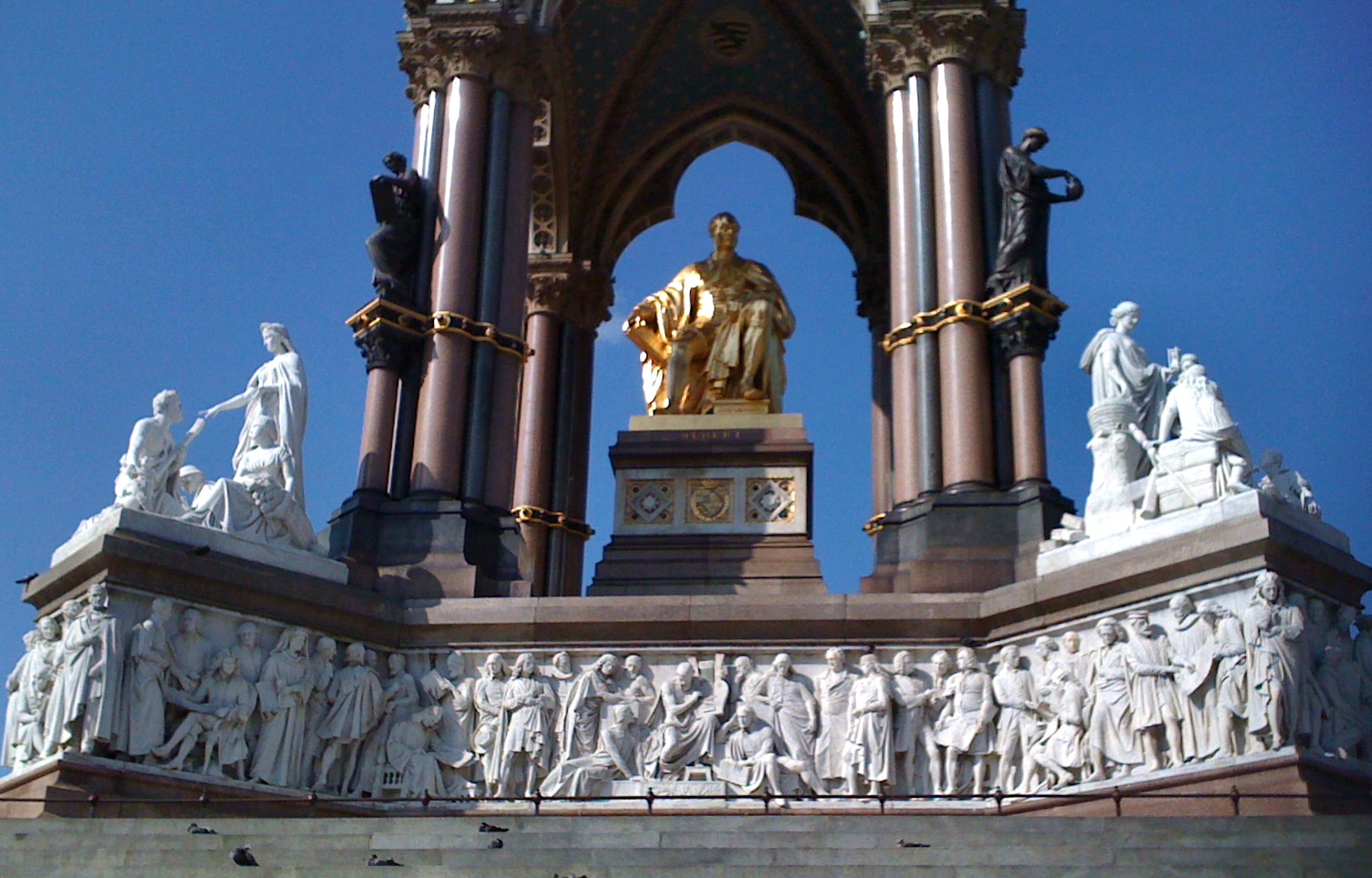
The Albert Memorial in Kensington Gardens isn’t London’s most popular tourist attraction. When it was erected in 1872 it was the height of fashionable good taste, but within a few decades it had become a symbol of bad taste... and has remained so ever since. Personally I love high Victorian Gothic architecture, but I know I’m in a minority so I won’t go on about it.

The central focus of the Albert Memorial is, of course, the huge seated figure of Prince Albert (the consort of Queen Victoria). But there are many other sculptures that deserve (but rarely get) close scrutiny. In particular there’s the Frieze of Parnassus that surrounds the base of the memorial. This depicts 160-plus historical figures from the world of the Arts. Although it’s not obvious from my photograph, each of the figures is identified by name – the Wikipedia article has clearer photographs and a full list of names.

When faced with lists like this, it’s inevitable that questions of the “why didn’t they include X?” variety spring to mind. Of course, the figures are necessarily drawn from the limited range of cultures familiar to mid-19th century Londoners – the ancient world of Egypt, Greece and Rome, and the post-renaissance world of Western Europe. In addition, the figures are limited to five specific categories – Poets, Musicians, Painters, Sculptors and Architects. But even within these constraints there are some notable omissions. I thought it would be interesting to go through all the people I’ve mentioned in previous posts who meet the basic criteria, and see which of them are included and which aren’t.

POETS

There aren’t as many poets depicted as you might expect. This is because they share the south side of the frieze (that’s the one in my photograph) with musicians.

Shakespeare is one of only three English poets to make it onto the frieze. He featured previously in connection with the authorship question and the ghost in Hamlet. If you’re interested in the latter, then watch this space – there’s more paranormal Shakespeare in the pipeline.

Alexander Pope (who featured in Angels in Machines last year) is a good example of someone who ought to be on the frieze but isn’t. The only post-Shakespeare English poet who does make the cut is John Milton, who was mentioned in passing in The Great Pyramid, and other British inventions – due to his rather nutty suggestion that the Greek philosopher Pythagoras got all his ideas from the ancient Britons. Oddly, Pythagoras appears on the frieze as a “poet” too, four places to the left of Milton.

Two of Britain’s greatest poets, Samuel Taylor Coleridge (featured in The Person from Porlock and The Ancient Mariner) and Lord Byron (featured in The Year Without a Summer) don’t make it onto the frieze, whereas Goethe and Schiller – two German poets of the same period – do.

Of the other non-English poets depicted on the frieze, Homer was featured in Space Odyssey and Dante in Dante’s Divine Comic Book.

MUSICIANS

Haydn, Mozart and Weber are the only three composers featured in Fortean Opera who died before the Frieze of Parnassus was created – and they are all on it.

Four of the composers mentioned in Philip K. Dick, music critic meet the same criterion – but only three of them are on the frieze. Bach, Mozart (again) and Beethoven made it, but Schubert didn’t.

PAINTERS

Botticelli, who featured in The Mystic Nativity, is conspicuously absent from the Frieze of Parnassus. This is odd because, as I said in that post, Botticelli “had a major influence on British painting of the Victorian period”. It’s even stranger that Botticelli’s more obscure contemporary Ghirlandaio is on the frieze.

Looking at the various omissions – Pope, Byron, Coleridge, Schubert, Botticelli – it strikes me they are all purveyors of what might be called “accessible” art. Maybe they weren’t considered sufficiently heavyweight to be commemorated in stone!

That’s certainly not true of the other great figures of the Florentine Renaissance—Leonardo da Vinci, Raphael and Michelangelo—who are all there on the frieze. In fact Michelangelo makes two appearances, both as a painter and as a sculptor! Both Michelangelo and Leonardo were featured in The Da Vinci Code and medieval symbolism, with Michelangelo also cropping up in A sixteenth century dinosaur and Leonardo in Underground Art and Crashed UFO in London. Raphael featured in my post about The School of Athens (which also mentions Pythagoras, referred to earlier).

Bellini was the subject of Descent into Limbo, and Mantegna was also mentioned in that post. Both Bellini and Mantegna are shown on the frieze.

The only other Italian artist I remember featuring is Agostino Carracci, in Bacchus and Ariadne. If you look back at that distinctly R-rated post, you won’t be surprised to learn the Victorians didn’t include Agostino in their frieze. However, Agostino’s brother Annibale Carracci (mentioned in the same post) did make the cut.

Vermeer (who featured in Chasing Vermeer... and Charles Fort) isn’t on the frieze – possibly because he falls in the “too accessible” category. But I was pleased to see that Hogarth – the epitome of accessible art – is right up there on the Frieze of Parnassus. Hogarth featured in Paranormal investigation, 18th century style and Another historical myth-conception.

Turner (who featured in Enigmatic Art) is on the frieze, but needless to say his populist contemporary John Martin (featured in Art and Archaeology) isn’t. Incidentally, one of Martin’s most characteristic works is “Joshua commanding the Sun to stand still upon Gibeon” (1816). I recently came across another version of the same scene that Martin painted in 1848 in a more Turneresque style. They’re both reproduced here (1816 top and 1848 bottom) so you can decide which you like best (I think they’re both great pictures).

SCULPTORS

I can only remember mentioning a sculptor once – that was Donatello in Alien simulacrum, one of my very first blog posts. Anyway, Donatello is there on the Frieze of Parnassus.

ARCHITECTS

As far as the Frieze of Parnassus is concerned, the “architects” of the ancient world aren’t really architects but patrons of architecture – the people who commissioned the buildings, rather than the people who designed them (the identities of the latter being lost in the mists of time). So, for example, “Cheops” is depicted as the architect of the Great Pyramid. Interest in Egyptology was still relatively new when the Albert Memorial was built, and the great wave of pyramidiocy that swept over the English-speaking world came later (see The Great Pyramid, and other British inventions, already mentioned above).

One of the oddest inclusions is Sennacherib, who would have been best known in Victorian times as the villain of a popular poem by Lord Byron (who unlike Sennacherib didn’t make it onto the Frieze of Parnassus). Presumably Sennacherib was considered the “architect” of the city of Nineveh, which had only recently been unearthed by archaeologists when the Albert Memorial was built. Sennacherib was mentioned in my posts on The Bible's Excluded Middle, Gods of the Bible and The Siege of Lachish... the last being about my ebook of the same title (which will tell you all you need to know about Sennacherib, should you choose to buy it).

Sunday, 27 January 2013

The Tamam Shud Mystery

I’m a sucker for any kind of mystery – the more abstruse and intellectually challenging the better. For that reason I’m a great fan of the classic puzzle-style detective novels of the 1920s and 30s, written by people like Agatha Christie and John Dickson Carr. But not everyone agrees. The commonest criticism of such fiction is that it isn’t “true to life” – real world murders don’t take the form of an enigmatic intellectual puzzle. Maybe that’s true as a general rule, but it’s a rule with one striking exception: the Tamam Shud case.

I was reminded of the case by a new blog, TAMAM SHUD, that has just been started by Gordon Cramer (who supplied the information for my recent post about Microwriting). Gordon lives in Australia, where the case is quite well known, but it’s less widely known outside Australia. I first encountered it just 18 months ago, in a blog post by Mike Dash entitled The Body on Somerton Beach. Anyone wanting a broad overview of the case should definitely read Mike’s post, while Gordon’s new blog is a great place to catch up with some recent research on the subject. All I’m going to do here is provide a quick introduction for people who may never have come across the case before, or who want to refresh their memories about it.

It started with the discovery of a dead body on Somerton Beach near Adelaide in South Australia, on the morning of 1 December 1948 (early summer in the southern hemisphere). The man was reported to have been seen sitting in the same spot the previous evening, behaving as if he was drunk. But he’d definitely been alive then – the Coroner set the time of death as some time after 2 am. To this day the victim has never been convincingly identified – he is usually referred to as “the Somerton Man”.

An autopsy revealed extensive lesions of the internal organs consistent with acute poisoning, although no trace of the poison itself was discovered. “Undetectable poisons” are extremely rare, and accident was ruled out. The official view tended towards suicide, although why a suicide should choose to employ an undetectable poison isn’t clear – especially as the extent of internal damage suggests the man died slowly and painfully. The circumstantial evidence points to murder, not suicide.

The same is true of the fact that extreme care had been taken to remove all evidence of the man’s identity. Why would a suicide do that? He was carrying a few commonplace items, but no wallet or keys that could identify him. All the labels had been carefully cut out of his clothes (which incidentally were of high quality, and in good condition – this wasn’t some homeless down-and-out). There was, however, one other item found on his person – the thing that transforms this case from a plodding police-procedural into an intellectual conundrum worthy of John Dickson Carr. And it’s the thing that gives the case its famously evocative name: TAMAM SHUD.

In the fob pocket of the victim’s trousers, there was a small, tightly rolled scrap of paper bearing the words “Tamám Shud” (pictured on the left). Now Tamám Shud is an old Persian phrase corresponding to “The End” in English or “Fin” in French – the words that are traditionally written at the end of a book. But the script isn’t Persian, although it’s printed in a mock-oriental font. The source of the phrase was less of a mystery in 1948 than it would be today. It’s the closing line of a book called The Rubaiyat of Omar Khayyam, by a Victorian poet named Edward Fitzgerald. The book is loosely based on a mediaeval Persian work, but it belongs to the mock-oriental genre that was enormously popular in Victorian times, and remained so into the mid-20th century. At the time of the Somerton Man case, in 1948, there were thousands of copies of The Rubaiyat of Omar Khayyam floating around the English-speaking world, in dozens of different editions. All the Adelaide police had to do was find the edition—and preferably the exact copy—that the scrap of paper bearing the words “Tamám Shud” had been torn from.

It wasn’t as easy as they thought. Of all the dozens of editions in circulation, none of them used that particular font. Then after almost eight months of searching, the book suddenly turned up. A local man claimed to have found it, around the time of the Somerton Man’s death, dumped in the back of his car a short distance from where the body was found. He only realized its significance when he saw an appeal in the press. It looked like it was the long sought-after volume all right – even down to the fact that the last page, which should have borne the words “Tamám Shud”, had been torn out. It turned out to be a very rare edition of the work – something similar had been produced by a New Zealand publisher, but it wasn’t quite the same. This copy seemed to be one of a kind.

There was another unusual thing about the book. On the inside rear cover, so faint that it could only be read in ultraviolet light, there was what appeared to be a coded message – five lines of handwritten letters with no obvious meaning. Although it’s a fascinating subject, I won’t say anything else about the code here because the fact is no-one knows what it means. It’s one of the things that particularly intrigues Gordon, and you can read about the Somerton Man Code Page on his blog.

There was also a telephone number pencilled inside the book. This turned out to belong to a young local woman named Jestyn. When questioned by police, she said she had given a copy of The Rubaiyat to a man named Alfred Boxall a few years earlier. So did that mean Alfred Boxall was the Somerton Man? No – because Alfred Boxall was still alive, and he still had his copy of The Rubaiyat of Omar Khayyam... complete with the Tamam Shud page!

The Somerton Man case was never classified as a murder investigation, or any other kind of crime. The police were simply trying to identify an unidentified body. So their questioning of witnesses—such as Jestyn, and the car-owner who found the discarded book—wasn’t as deep or persistent as it might have been. As a result, the case remains bafflingly unsolved – a striking counterexample to anyone who claims that real life is never as mystifying as a detective novel.

Who was the Somerton Man? How did such an apparently well-to-do individual manage to die without being missed by anyone? If it was suicide, why did he use an untraceable poison? Why did he destroy all evidence of his identity? If he was murdered, who was the murderer and what was the motive? What is the significance of the scrap of paper bearing the words Tamam Shud? Was it torn from the book found in the car? If so, who put it there, and why? Who wrote the five-line coded message, and what does it mean? Why was Jestyn’s phone number written in the book? Is there any significance to the fact that it was a very rare copy of a very popular work?

There are other questions as well, that I haven’t even touched on – peculiarities of the dead man’s physiology, similarities with other unexplained deaths... even links to the murky world of Cold War espionage. Needless to say, many amateur detectives have tried their hand at solving the mystery, leading to many fascinating theories and suggestions. But there is still a shortage of hard facts – the Tamam Shud case remains tantalizingly unsolved.

Saturday, 8 December 2012

Dante’s Divine Comic Book

Dante Alighieri (circa 1265 - 1321) is one of the most famous figures of European literature... and also one of the earliest. Although commonly associated with the Florentine Renaissance, he actually predated people like Botticelli and Michelangelo by two hundred years. The famous portrait of him in Florence Cathedral (left) wasn’t painted until more than a century after his death.

Dante’s most famous work is a long narrative poem called The Divine Comedy. This is in three parts, containing detailed descriptions of, in turn, Hell, Purgatory and Paradise. Not surprisingly, the first part—called the Inferno (which is simply the Italian word for Hell)—is the best-known and most popular. I bought my copy from a second-hand bookshop in Cambridge when I was a student in 1977, and—despite several abortive attempts—I still haven’t read it. It’s one of those books, like Finnegans Wake, that in spite of being one of the coolest things ever written just sits there on the bookshelf, decade after decade, not getting read.

What’s needed, of course, is a nice reader-friendly comic-book version of Dante's Inferno. And that’s exactly what Hunt Emerson has just produced (available from largecow.com). Hunt is best known to Forteans for his long-running Phenomenonix feature in Fortean Times, but he’s also produced what might be described as “intelligent but irreverent” comic-book adaptations of various literary works ranging from the Book of Leviticus (with Alan Moore) to the Rime of the Ancient Mariner by Coleridge. And now he’s done the same for Dante.

The complete poem of the Inferno is over 4700 lines long, so in a 71-page comic adaptation it’s inevitable that you end up with a somewhat condensed version of the original. For example, there is no mention in the comic book of Saladin in Limbo. On the other hand, when Dante meets the group of classic poets in Limbo he has to put up with a couple of pages of really bad limericks, which I’m sure aren’t in the original. People who are used to Hunt Emerson’s style will be expecting this sort of thing... although according to the helpful endnotes by Kevin Jackson, the adaptation is surprisingly faithful to Dante. [I thought I'd found an error in that the comic puts Aristotle in Limbo, who doesn't appear by name in Dante's version... but he is referred to obliquely as "the Master of those who know". Thanks to Kevin Jackson for putting me right on this!]

As well as giving the reader a vivid picture of the topography of Hell, as envisaged by Dante, Hunt Emerson’s version also provides an interesting insight into the nature of Dante’s poem itself. It really is a work of the Renaissance, and couldn’t be anything else. If it had been written earlier, during the darkest days of the Middle Ages, it would have been a simple warning to sinners about the dire punishments awaiting them in the afterlife, presented in a pious framework of the accepted Christian cosmology and demonology of the time (the same would have been true if it had been written centuries later, in a post-Reformation Protestant country).

In fact, the poem draws heavily on the pre-Christian mythology of Europe, and of Italy in particular, for its symbolism and terms of reference. But the thing that really comes across loud and clear is that Dante wasn’t as interested in providing a warning to future sinners as he was in cataloguing the misdeeds and torments of all the specific individuals who’d pissed him off over the years. To quote Dante (the comic-book version, that is) “... Hell was a sort of personal revenge theme-park, dedicated to getting back at all the bastards that have done me down in my life.” In other words, Dante’s Inferno isn’t pious moralizing, it’s satire. That’s why it’s great literature – and it took a comic-book to bring that point home to me!

Now, if only Hunt Emerson could be persuaded to take on Finnegans Wake...

Wednesday, 22 February 2012

Angels in Machines

Most of the planets and moons in the Solar System are named after characters from Greek mythology. The moons of Uranus are an exception, with most of the names swiped from Shakespeare’s plays. But two of the moons, Umbriel and Belinda, aren’t Shakespearean characters. They sound like they might be, but actually they come from a narrative poem by Alexander Pope. It’s called The Rape of the Lock, and it’s the daftest poem in the English language.

The phrase “The Rape of the Lock” may bring a bizarre image to mind, but you’d be wrong. It’s not a lock in the sense of a keyhole, but a lock of hair. Pope was writing in the genteel and sophisticated 18th century, when young women were obsessed with following all the latest fashions in clothes and hairstyles (times have changed since then, obviously). In those days, to go up behind a woman and snip off a lock of her hair was a crime of the utmost seriousness -- and if the victim was at all important (or thought she was), then it would very likely start a war. Well no, it wouldn’t... but Pope was a satirist, so he was allowed to exaggerate. The Rape of the Lock is a heroic tragedy modelled on Greek epics like the story of the Trojan War.

Belinda is the heroine of the story. When she discovers that a lock of her hair has been cut off, she goes into what can best be described as a hissy fit. Or that’s how it might be described today -- in Pope’s time, it was called a “fit of spleen”. Unknown to the people around her, Belinda has a whole host of invisible sprites who look after her every need. Umbriel is one of them. When she has her hissy fit, he heads off on an undercover mission to the Cave of Spleen (in the internal logic of the poem, this all makes perfect sense). The cave turns out to be a pretty cool place: “Now glaring Fiends, and Snakes on rolling Spires, Pale Spectres, gaping Tombs, and Purple Fires: Now Lakes of liquid Gold, Elysian Scenes, And Crystal Domes, and Angels in Machines.”

I’ve no idea what “Angels in Machines” means, but it sounds distinctly surreal. The surreal aspect of the poem was picked up by Aubrey Beardsley in his illustration The Cave of Spleen from 1896 (detail below):
So what happened to the lock of hair? It rose up into the sky and became a new star which could be seen through telescopes (“Galileo’s eyes”). Maybe that’s where they got the idea for the moons of Uranus!

Sunday, 9 October 2011

The Year Without a Summer

British readers could be forgiven for thinking that 2011 was the "Year Without a Summer", but actually the phrase refers to 1816. In that year, not just Britain but the whole of the Northern Hemisphere was plunged into a kind of apocalyptic nuclear winter. The chief cause was a volcanic eruption a year earlier on the island of Sumbawa in Indonesia... the biggest eruption the planet had seen for more than a thousand years. 80,000 people were killed instantly, and the ash cloud that was blasted into the upper atmosphere blotted out the sun over half the world, causing surface temperatures to plunge to record lows.

Across Europe crops failed, food prices soared and famine was widespread. People took to the streets: there was rioting, arson and wholesale looting. Nowhere was the problem felt more acutely than in Switzerland, where the government was forced to declare a state of emergency. In the area around Lake Geneva it rained almost every day, the Sun was perpetually hidden by clouds, and there was frost even in August. Not a pleasant place at all -- certainly not the sort of place for a wealthy young British aristocrat to suddenly choose to relocate to.

But that's just what Lord Byron did. Byron (left, as painted by Géricault) was a romantic poet who was famously described as "mad, bad and dangerous to know". In the summer of 1816, together with a few house guests, he moved into the Villa Diodati on the shores of Lake Geneva.

The conditions at the time -- not just the cold and gloom, but also the primitive responses of the population at large -- inspired Byron to write one of his most famous poems, called "Darkness". The poem extrapolates the situation to a time when the Sun itself has grown dark, and people revert to a savage, animal-like existence. As with all poems, "Darkness" can be interpreted in a number of different ways. On the face of it, it's simply an attempt to portray in realistic terms what might happen if such a catastrophe befell the Earth. That's probably the way most people would read it today, and it's certainly the way I viewed it until I read what other people had written about it.

What that straightforward interpretation misses is the fact that in those days most people believed in the literal truth of the Bible, and its predictions about the way the world would end. It was expected that sinners would go to Hell, which is effectively what Byron's poem is describing -- except that in his version, everyone ends up in Hell. There is no salvation for the virtuous. This bleakly pessimistic view (which most people today would consider simple common sense) must have been intensely shocking at the time.

A third interpretation I've come across suggests that the poem wasn't meant to be taken seriously -- that in effect it's a satire on the social situation at the time. By taking current events and exaggerating them, Byron is poking fun at the ignorance of the masses and their mindlessly self-defeating behaviour. Again, to get your head round this, you have to put yourself back in the mind-set of the time at which the poem was written... not an easy thing to do. Whatever Byron's original intention, there's no doubt that the poem set the tone for the gloomy "end-of-the-world" sub-genre of science fiction so beloved of British writers in the later nineteenth and early-to-mid twentieth centuries.

Although it's virtually forgotten as a meteorological phenomenon, the non-summer of 1816 did have a couple of lasting cultural effects. Unable to do anything outdoors, Byron and his house-guests had no alternative but to stay inside and write. Byron, as we have seen, wrote the poem "Darkness". His guest Mary Shelley wrote the original version of Frankenstein. And another guest, John Polidori, wrote a short novel called The Vampyre -- not a well-known work in itself, but culturally significant because it transformed the gawky, red-faced, red-haired, pot-bellied vampire of East European folklore into the cool, sophisticated, aristocratic vampire of modern times... modelled at least in part on Lord Byron himself!

Sunday, 18 September 2011

The Ancient Mariner

On a recent trip to the North Somerset coast, I came across this rather unlikely statue of a man with a dead albatross hanging around his neck. Obviously it depicts the Ancient Mariner, from the poem by Samuel Taylor Coleridge, but what's it doing in the small fishing village of Watchet? The answer is simply that Coleridge used to live in this part of the world... in fact Watchet is only a few miles from the place where he had his famous encounter with The Person from Porlock.

As mentioned in my Porlock piece, Coleridge was a bit of an opium-head... a fact worth bearing in mind when trying to make sense of The Ancient Mariner. It reads almost like something from the pages of Weird Tales magazine -- a far cry from the cosy "gothic horror" that was all the rage when the poem was written in 1798. The Ancient Mariner is a tale of supernatural horror, but there's nothing cosy or familiar about it. Even H.P. Lovecraft remarked on its "sinister daemonism".

As in Lovecraft's own At the Mountains of Madness, the horror in Coleridge's poem emanates from the Antarctic regions. And it's something much less tangible than an albatross. The Mariner's shipmates hung the bird around his neck as punishment for shooting it, because they thought it was a friendly spirit that had brought them good fortune. This was mere superstition, of course, and the bird was really just a bird. Unfortunately, it was a bird that happened to be a particular favorite of an immaterial (and distinctly unfriendly) creature that inhabited the South Pole... and that's when the weirdness really starts! As Coleridge says in a side-note: "A spirit had followed them; one of the invisible inhabitants of this planet, neither departed souls nor angels; concerning whom the learned Jew, Josephus, and the Platonic Constantinopolitan, Michael Psellus, may be consulted. They are very numerous, and there is no climate or element without one or more."

Here Coleridge is using a trick that Lovecraft later made his own -- hitting the reader with a mixture of real and spurious references in order to add verisimilitude to his tale. Josephus, of course, was a famous historian who wrote on a great number of subjects... although immaterial spirits of the Earth wasn't one of them! On the other hand, the less well-known Michael Psellus did produce a treatise called De Operatione Daemonium in the 11th century, which does indeed describe ethereal spirits of the kind imagined by Coleridge.

The polar daemon dispatches a couple of avatars in a spectral ship to deal with the hapless crew, all of whom are slain except for the Ancient Mariner. The latter seems condemned to a slow death in the freezing, windless ocean, while the eyes of his dead crewmates continue to stare accusingly at him. Unexpectedly, Heaven comes to his rescue (for the simple, and typically bizarre, reason that he manages to look on a writhing mass of sea-snakes with something less than utter revulsion). The corpses of the crewmen are reanimated... but not with their own, now departed souls, but with angelic spirits.

There is one final bit of weirdness. As the ship speeds homewards at an unimaginable pace, there is still no trace of a breeze. A disembodied voice asks "But why drives on that ship so fast, without or wave or wind?"... to which a second voice answers "The air is cut away before, and closes from behind." That sounds very much like the mode of operation of William Heath's "Grand Vacuum Tube" described in An Intercontinental Rapid Transit System (1829)!

Friday, 15 July 2011

King Arthur's Stone

The inscribed stone pictured on the left is larger than it looks in the photograph: about nine feet (2.75 metres) long. Originally it must have stood upright, but for centuries it has lain on its side on the banks of the River Camel in North Cornwall. It's called King Arthur's Stone... and although there's no real evidence connecting it with King Arthur, it does at any rate come from the right period of history.

The "King Arthur" familiar from works like Tennyson's Idylls of the King (1869) is almost entirely mythical, based on legends that grew up during the mediaeval period. It's possible that King Arthur never even existed -- but if he did, then it must have been after the end of the Roman occupation of Britain, but before the country was overrun by the Anglo-Saxons. That's quite a narrow window of time, more or less corresponding to the sixth century AD. But that's precisely the period this stone dates from!

The most obvious inscription on the stone is in Latin -- in my photograph (if you click on it to enlarge it), you can read the first few words quite clearly: "LATINI IC IACIT FILIUS MA...". The most likely translation is "Here lies Latinius, the son of Ma[carius?]". But there is another inscription (not visible in the photograph, and barely legible) which is written in a runic-style alphabet called Ogham -- a "secret" language used by the Druids in Ireland. And the only time that both Latin and Ogham scripts were in use was... the sixth century! So the stone really does have an Arthurian connection, even if it's a very tenuous one! The best archaeological date for the stone is 540 AD.

Nowadays, thousands of tourists visit King Arthur's Stone every year. But one of the first travellers to make the trip, in June 1848, was the poet Tennyson. About his visit he wrote: "Sought for King Arthur's Stone, found it at last by a rock under two or three sycamores. The stone, a nine foot pillar, lies in a dank and picturesque setting near a stream. It is an inscribed memorial stone of the sixth century." This discovery was one of the things that inspired him to write Idylls of the King!

Tuesday, 15 March 2011

The Person from Porlock

The Person from Porlock
Porlock is a small town on the North Somerset coast which has given its name to a phenomenon every bit as sinister as the Men in Black... the Person (or Persons) from Porlock. While the Men in Black try to convince individuals they didn't really see a UFO, the Persons from Porlock interrupt people just as they are on the point of a major scientific or artistic breakthrough.

The original Person from Porlock called on the poet Samuel Taylor Coleridge one evening in 1797 while the latter was frantically writing down Kubla Khan -- the entire text of which had just come to him in an opium dream. It's because of the Person from Porlock that Kubla Khan is only 54 lines long, and not the three hundred lines it would have been if Coleridge had been able to recall the whole of his dream.

There are many conspiracy theories associated with the Person from Porlock, but perhaps the most grandiose of all is presented by Raymond F. Jones in his short story "The Person from Porlock", first published in Astounding Science Fiction in August 1947. The hero of this story is a scientist who becomes obsessively convinced that an organization he refers to as the "Persons from Porlock" is conspiring to prevent him completing his work. Not surprisingly, this is dismissed as paranoia by his colleagues... but by the end of the story, he is proved right. The "Persons from Porlock" turn out to be human-looking aliens in our midst, who will go to any lengths to keep their existence secret!

The aliens even provide a convincing explanation for the original Person from Porlock: "It was one of [our] colonies which the drugged mind of your poet, Coleridge, was able to see in his unconsciousness, and which he began to describe in 'Kubla Khan'. My people had detected the presence of his perceptions and one of them was sent immediately to interrupt the work of his recollection, because they didn't want their colony revealed with such accurate description as Coleridge could make. The Person from Porlock was this disturbing emissary."