Search This Blog

Showing posts with label New Age. Show all posts

Thursday, 28 December 2023

Fortean shelfies


Following on from last week's instalment What does fortean mean? I thought I'd post a couple of "shelfies" featuring books that fit my wider definition of the word. The one above contains newer books (what I think of as "newer" anyway, i.e. post-1990), while the one below shows books I've acquired second-hand - some of them genuine "retro-forteana" dating back to the 1950s or even earlier.

Although these are what I think of as my "fortean" books, they don't include everything I own that might fit the definition. For example, I've amassed a vast collection of fiction, much of which (as pointed out in the previous post) could easily be considered fortean. I also have numerous science books (many of them acquired as review copies for Fortean Times, or as research for my own writing) which are "fringy" enough to class as borderline forteana. But just two of them managed to squeeze into the picture above, both by my colleague Brian Clegg: How to Build a Time Machine and Extra-Sensory.

Another near-fortean topic that I have a whole shelf of books about is Buddhism (again many of them review copies, having spent 10 years as a book reviewer for the Buddhist Society). But I tend not to think of Buddhism as a fortean subject - unlike "alternative" religions, New Age beliefs and holistic therapies, all of which are quite well represented above. Amongst the latter is Scent Therapy by Raje Airey - who of the 10 or so authors featured here that I know personally, is the one I've known longest - since I went to school with her!

Looking at the picture above, I was surprised to see how biased my book-buying habits seem to be towards British authors. I honestly hadn't been aware of that until now. But certainly on subjects like UFOs, I do prefer the more methodical, less sensational approach of researchers like Jenny Randles, Nigel Watson, David Clarke and Mark Pilkington - with How UFOs Conquered the World and Mirage Men (book and DVD) by the latter two probably being my all-time favourite takes on the subject.

Turning to the older books pictured below, you'll spot quite a few classic UFO titles there - plus one oddity I was particularly pleased to find in a second-hand bookshop: The House of Lords UFO Debate (1979). Another rarity, which I've written about previously on this blog, is The Riddle of the Flying Saucers by Gerald Heard. Dating from 1950, it's the oldest of my UFO books - though not the oldest on this shelf, that honour going to Paranormal Cognition from 1944.

Another book I was pleased to get hold of was Damon Knight's biography of Charles Fort (with the brilliant subtitle "Prophet of the Unexplained", which sadly isn't shown on the spine). I bought this from a UK bookseller, but it's actually stamped "Miami Public Library" inside, so I'm not sure how and when it crossed the Atlantic. Another ex-library book - and a particularly battered and much-read copy it is too - is Three Men Seeking Monsters by Nick Redfern. In this case the library in question is much closer to home, on the Isle of Portland - specifically, the library of Portland Prison. The inmates there obviously include some very discerning readers!


Sunday, 25 September 2016

Contradiction - the All-Video Murder Mystery

Here’s another great adventure game that should be of interest to retro-forteans everywhere. Steam has it listed as “Contradiction: Spot the Liar” – which almost put me off buying it, because I assumed it was all about politicians. But the official logo says “Contradiction: the All-Video Murder Mystery Adventure”, which sounds much more promising! It’s not an old game (it only came out last year), but it has a nice retro feel – a cosy, puzzle-style detective story set in a small English village. And there’s plenty of fortean stuff going on in the background, as I’ll explain later (no spoilers – I promise).

Contradiction is an unusual sort of game, certainly in comparison to other recent adventure games I’ve played. Generally I hate cut-scenes and dialogue, because they slow things down and hardly ever tell you anything you need to know to solve the puzzles. Of course, they’re important if you want to follow the plot – but in most adventure games the plot is about as sophisticated as a Saturday-morning cartoon. Contradiction is completely different. It’s at least 90% cut-scenes and dialogue – but you have to pay close attention to them, because the whole point is to spot contradictions in the various characters’ testimony. And the plot is absolutely first-rate – it would be worth watching even if there wasn’t a game to play.

Another thing that makes Contradiction such a pleasure to play is its seamlessness. Perhaps it’s my computer, but in most games of this type I’m used to sitting through long pauses while the next scene loads (another recent detective mystery, Sherlock Holmes: Crimes & Punishments, was almost ruined for me by that sort of thing). But there’s none of that in Contradiction – everything runs as smoothly as if you were watching a film on TV. That’s true of the professionalism of the video-making too, with things like lighting and camera angles, and the authentic country village locations. And the acting is perfect for the context, too.

The most famous actor in Contradiction – for people of my age-group, anyway – is Paul Darrow (top left of the screenshots above). He played Avon in Blake’s 7 – which was a brilliant series, even if everyone wasn’t able to appreciate it. People who missed the point often criticized it for “ham acting” – but that style of acting was absolutely essential to match the over-the-top, space-operatic plots. And Contradiction needs exactly the same kind of calculated, deliberate ham acting – not because it’s a space opera, but because it’s a video game. That’s particularly noticeable with the protagonist, Detective Inspector Jenks (played by Rupert Booth, top right). He had to record the words “And what do you know about this?” (and sundry variations thereof) literally dozens of times, in different settings and with reference to different objects. And you can tell he enjoyed every minute of it!

The most fortean character in the game is James Wilson, played by Stephen Mosley (bottom left). In fact, he comes across as pretty much the archetypal Fortean Times reader. A former student of plant science, he now ekes out a meagre living selling scrying mirrors and specialist herbal tea (you know the kind – made with ingredients like Salvia Divinorum and poppy pods). James is convinced the government is spying on him, and that anyone with a lot of power and/or money must be a practicing Satanist. All in all, James is the most normal and likeable person in the village.

At the opposite extreme – and much more interesting – is Ryan Rand, played by John Guilor (bottom right). The son of Paul Darrow’s character, Ryan is a posh millionaire who runs an unorthodox training course for business executives. Surprisingly, there’s a fortean element here too. Ryan’s gimmick is to mix the usual management bullshit-bingo with a heavy dose of New Age nonsense. There’s trance-like meditation and doll-burning, triple goddesses and third eyes, and role-playing exercises that border on pagan rituals. The ultimate aim of the training course is to transform ordinary people into ruthless and ambitious business leaders. And Ryan delivers it all with such over-the-top sincerity you end up believing it might actually work! Ryan Rand has to be one of the greatest video game characters of all time – it’s worth playing Contradiction just for his scenes alone.

But I’m left with a nagging doubt. I can’t help thinking that if they’d put all the same ideas on a DVD, and marketed it as a straight management training video, they would have made a lot more money than they’ll ever get from this game!

Sunday, 3 April 2016

My Kirlian Aura

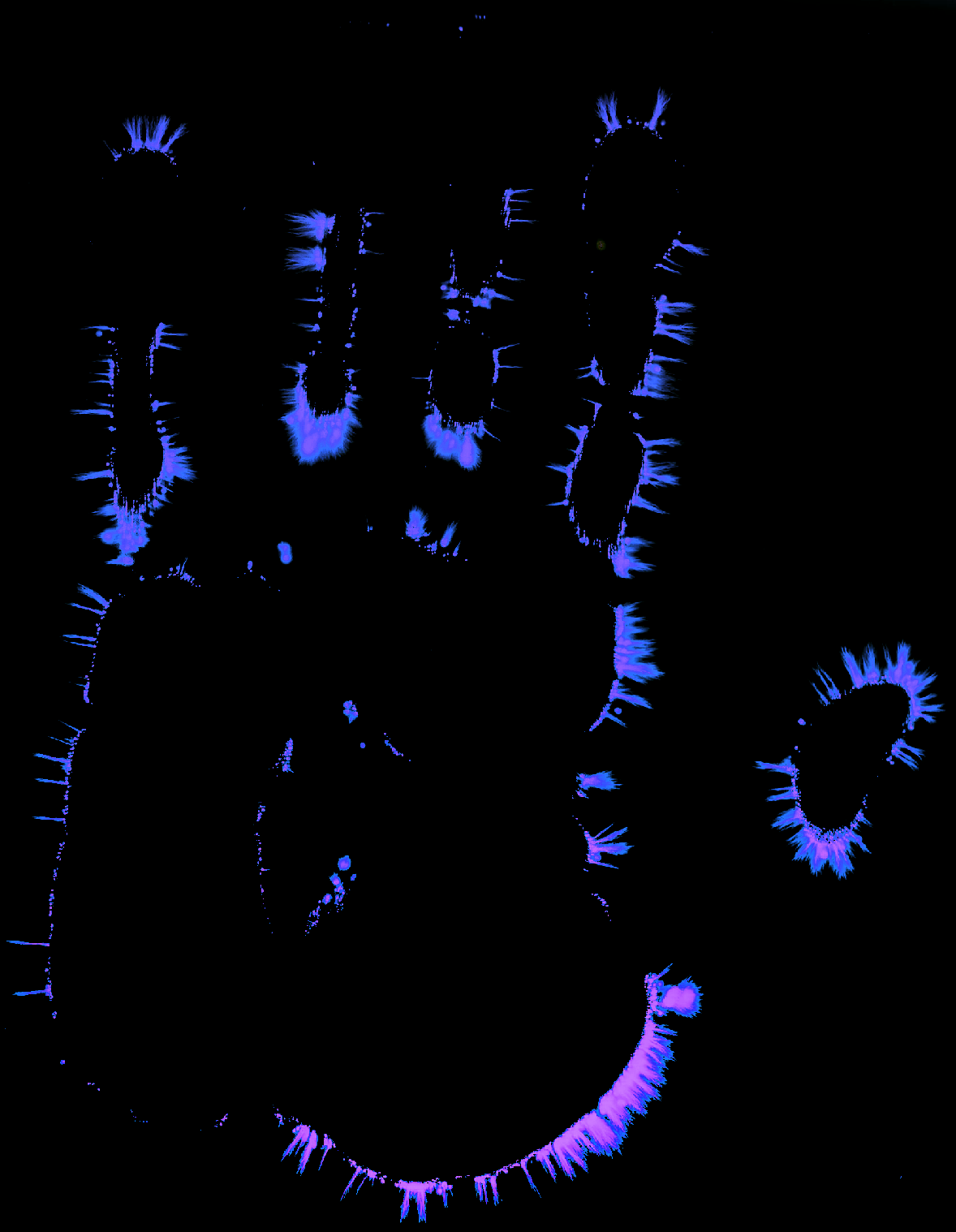
On a recent trawl through my Weird Science files (which are extensive) I found this Kirlian photograph of my hand that was taken about 16 years ago. According to my copy of The Aquarian Guide to the New Age (which is even older), this is supposed to show my mystical energy aura. Alternatively, the ever-skeptical Wikipedia says “the coronal discharges identified as Kirlian auras are the result of stochastic electric ionization processes”.

Whichever it is, my Kirlian aura and/or stochastic coronal discharge looks disappointingly unimpressive, so I couldn’t resist trying to improve on nature. The version below has the image inverted and false colour added – and it looks a lot livelier!

Sunday, 3 May 2015

Camelot, maybe

Hill-forts are among the most impressive pre-Roman structures to be found in Britain. They are particularly common in southern England, as Paul Jackson described in his blog post A Handful of Hill Forts. Despite the name, hill-forts weren’t really military structures so much as small, self-contained towns that were defended by artificially built ramparts. An example can be seen in the photograph above, which shows Cadbury Castle in Somerset.

Cadbury Castle was built during the Iron Age, around 500 BC, and was continuously occupied until it was overrun by the Romans in the first century AD, in what seems to have been a particularly brutal and violent event. According to the Somerset County Council website, there is “clear evidence of destruction by fire and the massacre of a group of inhabitants”. However, after the departure of the Romans, the South Cadbury site was reoccupied and redeveloped in the early Middle Ages.

In 1533, a man named John Leland was given a commission by King Henry VIII “to make a search after England’s Antiquities”. This assignment took him to all corners of the country, including the Somerset village of South Cadbury, where he wrote “At the very south end of the church of South Cadbury standeth Camelot, sometime a famous town or castle” and that “The people can tell nothing there but that they have heard say that Arthur much restored to Camelot.

In other words, Leland was saying that Cadbury Castle was nothing less than King Arthur’s Camelot!

Now King Arthur is one of the most frustrating figures in British history. Almost everyone has heard of him, but there is no firm consensus on what century he lived in, what kingdom he ruled over, or even if he existed in the real world at all. As I said last year in The Lost Tomb of King Arthur:
Down here in the south-west, the prevailing opinion is that he was the King of Dumnonia around 500 AD, a century or so after the departure of the Romans. Dumnonia roughly corresponded to modern-day Cornwall, Devon and Somerset, which remained resolutely Celtic while Wessex to the East (Dorset/Wiltshire/Hampshire) adopted the language and culture of the Anglo-Saxons.
According to this view, it’s not that unreasonable to suggest that Cadbury Castle might have been associated with King Arthur – possibly even one of his main courts. It was occupied at the right time, and it’s in the right place. I made this point in my book Bloody British History: Somerset:
Cadbury Castle is one of the best natural defences on what would have been the eastern border of Dumnonia. Although the hillfort had existed for more than a thousand years in Arthur’s time, its modern name dates from precisely that period. Cadbury means ‘Cado’s Fort’... and Cado was king of Dumnonia around the time Arthur was born. Archaeologically, too, the evidence points to the site being an important military installation of the period. It was refortified in the fifth century with massive stone walls, and in the middle of the hilltop a timber-framed Great Hall was built – a splendid palace fit for a King!
These days, the only structure on the top of Cadbury Castle is a stone plinth dated “2000 AD” (see picture below). The plaque on top of this shows the directions and distances to a number of other places in southwest England. I struggled at first to discern a common theme to these, eventually deciding that they're all places dear to the hearts of hippies and New Agers! There are nine places in all, as follows:
  • Two other “Arthurian” sites, Tintagel and Glastonbury
  • Two other hill-forts, Ham Hill and Maiden Castle
  • Another Iron Age site, Hengistbury Head, which was a busy seaport and trading centre
  • Two megalithic sites, Stonehenge and Avebury
  • Lamyatt Beacon, the site of a Romano-Celtic temple
  • Alfred’s Tower, an 18th century folly commemorating Alfred the Great

Sunday, 26 April 2015

Isaac Newton and me

The studious-looking geek in the above photo is me, at the age of 21 in 1979, posing in front of a portrait of Isaac Newton. The picture was taken in Trinity College, Cambridge, at the top of I staircase where I had a room during my third year at university. I staircase is about 200 feet along the east front of Great Court from E staircase, where Newton himself lived for many years (although I staircase, which is a 20th century utilitarian monstrosity, wasn’t there in his time).

Along with Einstein, Newton was one of the scientific heroes of my teenage years. I read a biography of him in 1973 (as I’ve mentioned before, I kept a list of all the books I read) and visited his birthplace in Lincolnshire a year or two after that. So I was pleased to end up at Newton’s college, Trinity, even though I had no say in the matter. The school I went to (a comprehensive in the West Midlands, before you ask) had a tradition of trying to get its best science student into that particular college each year. All I needed to do was get three grade As at A-level (I got four, just to be on the safe side).

After I graduated (the day that photo was taken – I didn’t always dress like that) I went to Manchester University to do a PhD on the computer simulation of galaxy dynamics. That may sound very modern and state-of-the-art, but the only science involved was 100% Newtonian. In three years I never had to use a single equation that isn’t present, either explicitly or implicitly, in the Philosophiae Naturalis Principia Mathematica that Newton wrote in 1687. So I owe Newton my doctorate, too!

Just over a year ago the History Press (which published my first book, Bloody British History: Somerset) started a new series of short biographies called Pocket Giants. I was intrigued by this idea (as I’ve said before, I like short books) so I contacted the series editor, Tony Morris, to see if there was anything I could do for him. After batting a few ideas around, we eventually zeroed in – perhaps not surprisingly – on Isaac Newton. Tony was as enthusiastic about the project as I was, and with his encouragement and constructive input the proposal was accepted by the History Press, the contract signed and the book written in the space of a few months last year.

Despite being a lifelong fan of Newton, I still learned a lot about him while I was researching and writing the book. Perhaps the oddest thing about him – which is more widely known today than it was in the 1970s – is that he spent less time on the scientific work for which he’s remembered than on pursuing non-scientific interests like alchemy, Hermeticism, theology and ancient history. There’s a common tendency to view the scientific and non-scientific (or even anti-scientific, by modern standards) activities as separate and non-overlapping. Scientists see the non-scientific work as an irrelevance and embarrassment that ought to be ignored and forgotten, while mystics and New Agers see the scientific work as the irrelevance – a kind of smoke-screen of acceptability designed to hide Newton’s real achievements.

I came to the conclusion that both these views miss the point. Everything Newton did stemmed from the same world-view – the idea that the universe was designed, by God, according to a simple code that could be rediscovered if it was searched for carefully enough. Newton looked for the code in the Bible and other ancient writings, and in the work of alchemists and Hermeticists. But he also looked for mathematical relationships that applied to the material world – something that seemed just as mystical and improbable to his contemporaries. But Newton’s “applied mathematics” worked – and worked so well that it’s become synonymous with mainstream science. Both scientists and New Agers have forgotten, or can’t see, what a profoundly mystical notion it is.

This was the point I tried to make in a blog post I wrote last week for the History Press. My original title was “Isaac Newton and the Key to the Universe”, which I thought was quite clever, but they wanted to tie it in with the series so they changed it to Why was Isaac Newton such a giant? (It was meant as a rhetorical question, but one clever lady on Twitter replied “Because he stood on the shoulders of giants”).

Needless to say, all these ideas are explored in more detail in the book itself, together with lots of other fascinating facts about Newton (such as how he perpetrated a UFO hoax as a teenager, predicted the end of the world and became “17th-Century London’s Dirty Harry”). You can order your copy from any good bookseller or from Amazon.

Sunday, 12 April 2015

Madame Xanadu

Madame Xanadu #1 (pictured above left) dates from 1981, but I bought my copy much more recently than that. I can’t remember exactly when or where, but it was probably about 10 or 12 years ago. I don’t often buy DC comics, so it was obviously an impulse buy – probably on account of the Tarot cards on the cover, which is a subject I’ve always found fascinating. Quite apart from the Tarot connection, though, it’s a really good story. I was reminded of it last week when I saw a Madame Xanadu trade paperback (pictured above right) in a local shop. It was reduced to £4.99 so I bought that too. The story isn’t quite as perfect as the first one, but it’s still great fun.

The character of Madame Xanadu first appeared in a comic called Doorway to Nightmare in 1978, but the story in Madame Xanadu #1 is pretty self-contained. The setting is Greenwich Village, the same as the early Dr Strange stories (see Master of the Mystic Arts). But there’s little indication at this stage that Madame Xanadu has the same kind of supernatural powers as Dr Strange – the character is basically just a Tarot card reader (albeit one with genuine psychic powers and a rather mysterious background). The story includes a detailed Tarot reading as an integral part of the plot, and there’s a text article on the inside front cover about the history and use of the Tarot.

The story itself isn’t really about Madame Xanadu though, but one of her clients. It’s a variation on my favourite occult cliché – bored teenager starts to dabble in witchcraft for a giggle... gets drawn into a big grown-up world of sex and drugs... ends up summoning timeless demons who don’t give a toss whether she lives or dies. Then enter Madame Xanadu, and cue the happy ending!

The trade paperback, Madame Xanadu: Broken House of Cards, is one of a series collecting issues from a later incarnation of the Madame Xanadu title – the ones in this volume date from 2010. By this time, Madame Xanadu has been retconned as a powerful supernatural being from Arthurian mythology. Personally I feel this is a backward step, because it makes the character harder to believe in and relate to (for me, anyway), and it reduces the title’s Unique Selling Point – the use of Tarot cards – to little more than a cover story to hide the protagonist’s secret identity, instead of her primary talent. But that’s just my opinion – other people may disagree.

Having said that, it’s really a very enjoyable story. It’s set in the late 1950s, which gives it a nice retro feel (even in the 1981 comic, it was implied that Madame Xanadu had occupied the same Greenwich Village premises for several decades without appearing to get any older). There are a number of threads to the story, including one about a cult of devil-worshippers called the Church of the Midnight Dawn. As in the earlier story, the people involved are portrayed as predominantly middle-class and driven by boredom (as you can see in the sample panels below). I imagine that’s true of real-world Satanists, too... although in the real world they probably end up having a promiscuous orgy instead of conjuring up demons from hell. But you can’t have an orgy in a comic book, so you get the demons instead – which is much better!
 

Sunday, 5 April 2015

The Natural Law Party

There’s an interesting article in the current issue of Fortean Times called “Westminster Weirdos”, all about the nuttier fringes of British politics. The main focus is on the parties contesting next month’s General Election, but there’s a brief mention of a very nutty fringe party that fielded a number of candidates way back in the General Election of 1992: the Natural Law Party.

All the policies of the Natural Law Party centred around the practice of Transcendental Meditation (that’s a special kind of meditation devised by Maharishi Mahesh Yogi, best known as the Beatles’ guru in the 1960s). When they first appeared on the British political scene in 1992, I happened to be particularly interested in wacky New Age beliefs, reading lots of books on the subject and attending lectures at the Theosophical Society and Buddhist Society and places like that. So I was fascinated by the Natural Law Party, and I’ve kept their campaign leaflet (pictured above) ever since. According to Wikipedia, William Stevens of the Natural Law Party got 92 votes in the 1992 General Election. I think one of those was mine, although at this distance in time I can’t be certain!

As you can see from the back cover of the manifesto, Transcendental Meditation would be good for the economy (by making people more creative), good for education (by increasing intelligence), good for defence (by creating an “invincible national consciousness”) and good for law & order (by eliminating the cause of crime, i.e. “the inability of the population to think and act spontaneously in accord with natural law”). You may say that’s all a load of unworkable idealistic nonsense, which of course it is – but no more unworkable than the idealistic nonsense purveyed by the mainstream political parties! There’s a difference, too – the mainstream parties have an annoying habit of talking down to the electorate, as if we’re all a bunch of ignorant yokels. That certainly wasn’t the case with the Natural Law party, as you can see from this interior page from the leaflet:
“Time to Bring the Light of Science into Politics”. That sentiment appealed to me, since I was working as a scientist at the time. But for most people it would have had the opposite effect – an instant turn-off! Especially as the science in question was fundamental physics, which is one of the most abstract, mathematically complex disciplines of all. Just zoom in on the left-hand side of the page and look at all those symbols and equations! Admittedly they’ve been annotated with user-friendly words like “FREEDOM”, “SIMPLICITY” and “OMNIPOTENCE”, but they’re still pretty daunting for the non-mathematician.

The thing that is depicted, as it says at the bottom, is “the Lagrangian of the superstring”. Now, how many people know what to do with a Lagrangian? I used to know, but I’ve forgotten – and I expect that most people who studied physics at degree level will say the same thing. To everyone else, it’s just so much mumbo-jumbo... which I guess is why only 92 Battersea residents voted for them!

It’s not mumbo-jumbo, though – it’s real science (the equation, I mean – not the bits about omnipotence and freedom). The image below shows, on the left, a zoomed-in view of the bottom line from the Natural Law manifesto. On the right is a closely similar equation from the book Why Does E = mc2? by Brian Cox and Jeff Forshaw. They describe it as “one of the most wonderful equations in physics”, and go on to say: “It really is possible to get a flavour of what is going on just by talking about the symbols without knowing any mathematics at all.” Sadly, however, they don’t say anything about “IMMORTALITY” or “INVINCIBILITY”.

Sunday, 25 January 2015

The History of Atlantis

I wrote another short article for eHow last week: What Did Atlantis Look Like?. The editorial instructions said the piece should draw on multiple “credible expert sources”, but when it comes down to it there is only one really credible source on the subject :  the ancient Greek philosopher Plato, who described the sinking of Atlantis in his dialogues Timaeus and Critias in the 4th century BC. Everything that has ever been written about Atlantis draws in one way or another on Plato’s account.

Modern proponents of Atlantis seem to fall into three broad camps:
  • Academics (and pseudo-academics) who scour the world looking for archaeological and historical evidence of a lost Atlantean civilization. This approach really took off with the publication of Ignatius Donnelly’s Atlantis: The Antediluvian World in 1882.
  • New Agers and other mystics who emphasize the spiritual and high-tech aspects of Atlantean culture, often receiving their information through telepathic “channelling” as opposed to more materialistic methods. This idea seems to have originated with the Theosophical movement in the late 19th century, continuing into the 20th century with the writings of Edgar Cayce and others.
  • Fictional treatments of Atlantis often portray it as still existing, thousands of years after it sank beneath the waves, in the form of a highly advanced underwater civilization. The best-known representative of this version of Atlantis is probably Namor the Sub-Mariner from Marvel Comics, although the earliest occurrence of the idea that I’m aware of is Arthur Conan Doyle’s novel The Maracot Deep from 1929.
The thing about Plato’s account that makes all this variety possible is that virtually no-one imagines he was telling the whole truth and nothing but the truth. That leaves people free to pick and choose the bits they like, and add whatever further details they feel necessary.

Plato was a philosopher, not a historian, so he wasn’t in the business of recording purely factual accounts of historical events. He used the story of Atlantis as a vehicle to make specific points about moral and political philosophy. At the same time, however, Plato wasn’t in the business of writing imaginative fiction either. It’s hard to see why he would have gone to the trouble of fabricating such a convoluted story when he could have conveyed the same message in a more straightforward way. So it’s reasonable enough to conclude that some of what Plato said about Atlantis was based in fact, and some of it was made up.

But which is which? Translated into modern-day terms, the essential elements of Plato’s account are as follows:
  1. Atlantis was an island which sank beneath the sea as the result of a catastrophic earthquake.
  2. The island was large, perhaps 2000 or more miles in extent, and located in the Atlantic Ocean beyond the Straits of Gibraltar. After it sank, Plato says it “became an impassable barrier of mud to voyagers sailing from hence to any part of the ocean”.
  3. According to Plato, the sinking of Atlantis occurred around 9600 BC, when Atlantean civilization was at its height. Although Europe, North Africa and the Middle East were still in the early Neolithic period (New Stone Age) at that time, Plato’s Atlantis boasted a rich and thriving Bronze Age culture of a kind not seen elsewhere until 6000 years later.
As a general rule, the closer an Atlantis-hunter is to the academic mainstream, the fewer details of Plato’s account they seem prepared to accept. At the most hardnosed extreme, they just accept point (1) and ignore the rest. The second point – an island of that size located where Plato said it was – really isn’t credible in light of what is now known about the north Atlantic seabed. Similarly, the idea that such an advanced Bronze Age culture could have existed 12 millennia ago, without leaving the slightest trace in the neighbouring parts of Africa and Europe, just doesn’t fit with academically accepted chronology.

The figure of 9600 BC comes from Plato’s dating of the sinking of Atlantis to 9000 years before the time of Solon — a Greek statesman who lived around 600 BC. But one of the references cited in my eHow article claims that “Studies have shown there would appear to be a ten-fold error in all figures over a hundred in Plato’s work, due probably to an early translation error.” This would give a date of 600 + 900 (not 9000) = 1500 BC, which neatly coincides with the Bronze Age eruption of the small Greek island of Santorini – often cited as the most rationalistic explanation for the origin of Plato’s story.

But rationality is for the academics. At the other extreme, the mystics and New Agers are perfectly happy to accept Plato’s date of approximately 10,000 BC. They’re generally less interested in the location of Atlantis than in its level of technical and spiritual advancement – so they tend to focus on point (3) above rather than the first two. From their point of view, the idea of Bronze Age technology presents no problem at all, even when the rest of the world was back in the Stone Age. In fact they’re likely to advocate an even higher level of ancient Atlantean culture, complete with such things as flying vehicles, ESP, teleportation and maybe even space travel!

Sunday, 4 January 2015

The Museum of the Future

The Museum of the Future is a new collection of 20 short stories, published by Jon Downes at CFZ Press under the “Fortean Fiction” imprint. I included the blurb in my Books, plural post last month, but here it is again:
Twenty tales of High Strangeness featuring conspiracy theorists, mad scientists, hippies, geeks and miscellaneous weirdos: A group of Cambridge academics investigate a crashed UFO... An outcast scientist discovers the secret of anti-gravity... A paranormal author finds himself prime suspect in the Case of the Purloined Poe... A student has a bewildering vision of the future... Four New Agers are regressed back to their past lives... An engineer invents a new way to spy on the competition... A viewer gets too deeply involved in a TV cop show... A young woman battles the spies, aliens and perverts that only she can see... and a dozen more stories!
Most of the stories were written because I was looking for an entertaining way of getting a particular idea across. As a result there’s quite a mix of styles and genres. There’s some science fiction, some adventure, some mystery and some horror. At least half the stories have a humorous element to them, and several are parodies of a specific style. I guess if I had to stick a label on the collection it would be “Fortean satire”.

There’s an account of the Rennes-le-Chateau mystery in the style of an M. R. James ghost story, and of the Rendlesham UFO incident in the style of a pulp adventure. There’s Roswell-style paranoia, transplanted backward in time from the Cold War to the period just before the First World War. There’s H. P. Lovecraft’s “Call of Cthulhu” retold in the style of Philip K. Dick. And there’s a murder mystery featuring homeopathy, Tesla coils and other internet-age wackiness.

The title story, “Museum of the Future”, is very short – but it’s retold five times. It’s a vision of the British Museum in the year 2012, as envisaged in 1912, 1932, 1952, 1972 and 1992. The basic plot is pretty much the same, but the background details are different every time. Not surprisingly, these reflect the political preoccupations of the time the story was written!

The Museum of the Future is published as a paperback (ISBN 978-1-909488-23-6), which I believe can be ordered from “all good bookshops” or via any of the Amazon sites. It’s also available as an ebook, but only in Kindle format (so my apologies to regular reader Colin and anyone else who may buy their ebooks elsewhere). Here are a few links:

Sunday, 5 October 2014

Qhe: Superhero of the Seventies


His very name, evocative of Che Guevara, suggests a cultural rebel and style icon. The back cover blurbs portray him as some kind of spaced-out mystical version of James Bond. Qhe is both these things, and much more. He is a master of martial arts, yoga, kamasutra and ESP. He has a degree in Philosophy from the Sorbonne University in Paris. He is the absolute monarch of a small Himalayan kingdom on the borders of India and Tibet. And he fights bad guys.

“If Qhe is so cool,” you may be wondering at this point, “how come I’ve never heard of him?” That’s a good question.

Qhe is the hero of four novels published between 1974 and 1976, under the mystical-looking pseudonym of W∴W∴ (I hope that renders correctly – the dotted triangles are evocative of Fortean favourite Aleister Crowley and the Order of the A∴A∴). In fact, W∴W∴ was the pseudonym of William Bloom, better known today as a non-fiction writer and teacher of New Age subjects.

As far as I know, the Qhe books only ever appeared as paperback originals here in the UK – they were never reprinted in America, which is a shame. In last week’s post I was complaining that very few of Ron Goulart’s novels were published on this side of the Atlantic – now it’s the reverse situation!

The other connection with last week’s post is that the third of the Qhe novels – The Riches (1975) – was another of my purchases in the dealers’ hall at the science fiction Worldcon in August (although the books aren’t science fiction – they’re set firmly in the nostalgic world of the mid-seventies). I bought the first two books 8 years ago, and had been looking for the third and fourth ever since – I’m still missing the final book, The Prophets of Evil (1976).

I bought the first book in the series, The Taming Power (1974), when I saw it in a used bookstore in 2006. I’d never heard of Qhe at the time, although it was obvious from the blurb the character was right up my street. I managed to get the second book, White Fire (1974), from an online retailer a few weeks later.

You might be forgiven for assuming (as I did at first) that the entire novelty of the Qhe books lies in their way-out hero, while the plotlines themselves are hackneyed and hastily written adventure stories. That would explain why they were only ever printed once, and why so few people have heard of them. But that’s not the case at all. It’s true the stories deal with fairly standard-type international crises – but the plotlines are far from formulaic, and the quality of the writing is excellent. If the series flopped, my guess is that was because the material was over the head of the readership the packaging was targeted at, while more sophisticated readers were put off by the lowbrow packaging!

The second novel, White Fire, is the most Fortean of the three I’ve read, with its irresistible mix of sadistic scientists and ancient Mayan temples. The first book, The Taming Power, is a real Cold War nostalgia trip, complete with spies, communists and nuclear missiles. The one I just read, The Riches, is the most overtly Bond-like, with a powerful industrialist holding the world’s mineral resources to ransom.

There are differences, though. James Bond wouldn’t have dealt with a deadly scorpion by radiating waves of unconditional love at the creature, until he’d convinced it he was its best friend. He wouldn’t have taken time out to teach a baby elephant to sit cross-legged and meditate. If a sadistic interrogator stuck an acupuncture needle into Bond’s skull, he might respond by hurling said interrogator across the room – but he wouldn’t do it by suddenly releasing a built-up charge of static electricity inside his brain. And – insatiable sexual athlete though he is – James Bond would probably draw the line at a gang-bang involving a witch doctor, an overweight African monarch, a 70-year-old Hindu sage and twenty-two nubile young females belonging to the Tanzanyaka National Folklore Troop of Dancers and Singers!

Sunday, 12 January 2014

The Waste Land

When T.S. Eliot wrote The Waste Land in 1922, it was one of the most avant-garde poems in the English language. It’s also a long poem – about 3000 words, divided into five sections, and followed by more than 1500 words of detailed endnotes. Both the text of the poem and the notes are packed full of quotations and allusions on a wide variety of themes, some of them distinctly Fortean – the Holy Grail, Eastern mysticism and Tarot cards among them.

The poem is Fortean in its structure as well as its content. The concatenation of seemingly unrelated fragments, in different styles and sometimes even different languages, is reminiscent of Charles Fort’s own writings, where he strings together quotes from newspaper clippings. Eliot wanted to produce a similar effect in the poem – a fact that would be clearer if the work was still known by the title he originally gave it.

The poem’s actual title, “The Waste Land”, is a reference to the desolate area surrounding the castle of the Grail in Arthurian legends. However, during the early stages of composition Eliot’s working title was “He Do the Police in Different Voices”. This silly-sounding phrase is a quotation from a novel by Charles Dickens, Our Mutual Friend, in which a woman describes how her son reads newspaper stories out loud. Eliot’s use of this title suggests he conceived The Waste Land as a Fort-like compendium of press clippings – something that was apparently more obvious in earlier drafts of the poem than in the final published version. The critic M. C. Bradbrook wrote: “The original title, He Do the Police in Different Voices (applied to reading newsprint in Dickens’s Our Mutual Friend) would be applicable to some of the excised stories; the riotous scene in Boston might have fed a newspaper column, the heroic deaths of the fishermen certainly would; and the lady Fresca must have featured in gossip columns.”

Eliot’s notes to the poem are somewhat tongue-in-cheek, and he deliberately overstates the Grail connection: “Not only the title, but the plan and a good deal of the incidental symbolism of the poem were suggested by Miss Jessie L. Weston’s book on the Grail legend: From Ritual to Romance... Miss Weston’s book will elucidate the difficulties of the poem much better than my notes can do.” Besides references to the Grail and the Arthurian “Fisher King”, the poem includes quotations from Tristan and Isolde (“Mein Irisch Kind, wo weilest du?”) and Das Rheingold (“Weialala leia Wallala leialala”). In Wagner’s opera, the latter words are sung by the three Rhine-daughters – in Eliot’s poem they are attributed to the three Thames-daughters!

The Waste Land may be one of the few works of mainstream English literature to feature that New Age favourite, the Tarot pack. “Madame Sosostris, famous clairvoyant, had a bad cold, nevertheless is known to be the wisest woman in Europe, with a wicked pack of cards. Here, said she, is your card, the drowned Phoenician Sailor... Here is the man with three staves, and here the Wheel, and here is the one-eyed merchant, and this card, which is blank, is something he carries on his back, which I am forbidden to see. I do not find the Hanged Man.”

In his notes, Eliot says “I am not familiar with the exact constitution of the Tarot pack of cards, from which I have obviously departed to suit my own convenience. The Hanged Man, a member of the traditional pack, fits my purpose in two ways: because he is associated in my mind with the Hanged God of Frazer, and because I associate him with the hooded figure in the passage of the disciples to Emmaus in Part V. The Phoenician Sailor and the Merchant appear later... The Man with Three Staves (an authentic member of the Tarot pack) I associate, quite arbitrarily, with the Fisher King himself.”

The hooded figure that Eliot refers to is an interesting Fortean phenomenon in its own right: “Who is the third who walks always beside you? When I count, there are only you and I together but when I look ahead up the white road there is always another one walking beside you. Gliding wrapt in a brown mantle, hooded, I do not know whether a man or a woman—but who is that on the other side of you?” In the endnotes, Eliot explains that these lines “were stimulated by the account of one of the Antarctic expeditions (I forget which, but I think one of Shackleton’s): it was related that the party of explorers, at the extremity of their strength, had the constant delusion that there was one more member than could actually be counted.”

Two of the poem’s five sections take their titles from works of Eastern mysticism – again, not the usual subject matter for works of mainstream literature at the time. Part III is called “The Fire Sermon”, after a sermon of the Buddha which Eliot says “corresponds in importance to the Sermon on the Mount”. Then Part V is called “What the Thunder Said”, in reference to a fable from an ancient Hindu text called the Brihadaranyaka-Upanishad. Eliot even includes a Sanskrit quote from the work: “datta, dayadhvam, damyata”, which he translates in the notes as “give, sympathize, control”. Then he concludes the poem with another Sanskrit word, shantih, repeated three times, which he describes as the formal ending to an Upanishad.

Wednesday, 1 January 2014

Crossword Exegesis

I don’t really know what an exegesis is, but people expect a crossword compiler to have a big vocabulary. What I mean is, on the other side of the following image are the answers to last week’s crossword and/or trivia quiz, together with an explanation of the various Fortean connections.

If you want to do the puzzle but haven’t done so yet, reading beyond this point will take you into spoiler territory. But if you’ve done the puzzle, or just want to see the answers, scroll on...


ACROSS

1. Author of Chariots of the Gods: ERICH VON DANIKEN. An easy one to start with! But EvD’s ideas weren’t as original as many people imagine – see Reinventing Ezekiel's Wheel.

9. First of the seven churches mentioned in the Book of Revelation: EPHESUS. A Turkish town and a major centre of early Christianity. It was also the site of one of the Seven Wonders of the World: the Temple of Artemis.

10. “Their weapons were no match for the Bossonian LONGBOW" (Robert E. Howard). This comes from the only full-length Conan novel that Howard wrote, The Hour of the Dragon (also sometimes published as Conan the Conqueror). Not a particularly Fortean story, although some of Howard’s other fiction is. I think I’ll make that the subject of my next blog post.

11. "Voyagers who have shown every indication of intent to EVADE " (Charles Fort). This comes from The Book of the Damned, a few paragraphs after the oft quoted “I think we're property” – the voyagers in question being extraterrestrial ones.

12. Yggdrasil, for example: ASH. Yggdrasil is the World Ash Tree in Norse mythology.

13. The world ends without this, according to T.S. Eliot: A BANG. From The Hollow Men (1925): “This is the way the world ends: Not with a bang but a whimper.” Another Eliot poem from the same period, The Waste Land, is packed with Fortean themes – I’ll have to add that to my list of future posts as well.

14. Site of the Crucifixion: CALVARY. From the Latin Calvariæ Locus = “place of the skull”. The Hebrew equivalent is Golgotha.

16. "I had long hoped for a personal CONTACT with a man from a flying saucer" (George Adamski). A quote from Flying Saucers have Landed, co-authored with the far more interesting Desmond Leslie.

18. The queen of the fairies, according to Shakespeare: TITANIA. From A Midsummer Might’s Dream, of course. The picture (fourth image on top row) shows a detail from The Reconciliation of Oberon and Titania (1847) by Sir Joseph Noel Paton.

21. Sayings of Jesus that are not found in the Gospels: AGRAPHA. This is an obscure one, but anyone who’s tried compiling a crossword will know that the more words you fill in, the harder it gets to find unobscure words to fit the remaining spaces! But Agrapha isn’t so obscure that it doesn’t have its own Wikipedia page.

23. Max ERNST, German surrealist. Perhaps the most Fortean connection here is Ernst’s bird-man creation called Loplop, which was adopted as a kind of mascot by Jon Downes and the Centre for Fortean Zoology (see picture – third image on the top row).

25. URI Geller, Israeli-born psychic. Geller’s 1973 appearance on the Dimbleby Talk-In was one of my Fortean Events that Shook the World.

26. "Thus SPAKE Zarathustra", by Friedrich Nietzsche. Written in the 1880s, this philosophical work focused on two concepts more often associated with the 20th century: “The Superman” and “God is Dead”.

27. Lenape people living in New Jersey when the Europeans arrived: RARITAN. This is one of two grid entries where I just couldn’t find anything Fortean that would fit. There’s a modern-day city in New Jersey named Raritan, as well as Raritan Bay between New Jersey and New York.

28. "IMMORAL Tales" (1974), featuring Paloma Picasso as Countess Erzsébet Báthory. The Báthory segment focuses on the historical countess, not the later legends that associate her with vampirism. So she doesn’t slaughter large quantities of female virgins and bathe in their blood in order to restore her youth. She just slaughters large quantities of female virgins and bathes in their blood because she enjoys it (see picture – first image on bottom row).

29. Britain's best-known cryptid: LOCH NESS MONSTER. In light of the upcoming Scottish independence vote, perhaps I should have worded this as “Scotland's best-known cryptid” to stay on the safe side.

DOWN

1. The building pictured [in last week’s post]: EXETER CATHEDRAL. Another non-Fortean one – I needed a 15-letter word or phrase beginning with E and ending with L, and this was the best I could do. The answer was actually written on the image, if you can read Latin: Exoniensis Ecclesiae Cathedralis.

2. Eldest son of Abraham, according to the Book of Genesis: ISHMAEL. In the Judaeo-Christian tradition, Ishmael is less important than his younger half-brother Isaac. In Islam, however, Ishmael is the more important of the two, being a direct ancestor of Muhammad.

3. Herman HESSE, author of Siddhartha. According to Wikipedia, this 1922 novel “deals with the spiritual journey of self-discovery of a man named Siddhartha during the time of the Gautama Buddha.... It was published in the U.S. in 1951 and became influential during the 1960s.”

4. The James OSSUARY is inscribed "James, son of Joseph, brother of Jesus". If the inscription is genuine, it might constitute archaeological evidence for the Biblical Jesus... but quoting Wikipedia again, “most scholars hold the last part of the inscription to be a forgery”.

5. The DELPHIC Sibyl, prophetess of Apollo. The illustration (second image on top row) is from Michelangelo’s Sistine Chapel ceiling.

6. Professional assassin in feudal Japan: NINJA. I’m not sure if this is an easy one or not – everyone uses the word “ninja”, but do they really know what it means?

7. An esoteric branch of Judaism: KABBALA. When I compiled the crossword a few years ago, I convinced myself this was a valid spelling – although “Kabbalah”, “Cabala” and “Qabbala” are more common.

8. A type of hippie found in 1980s Britain: NEW AGE TRAVELLER. Again the spelling may look wrong to some people, but that’s how it’s spelled here in Britain. And hey, spelling rules are just another fascist conspiracy anyhow. If you catch my drift, man.

15. ANN Greenslit Pudeator, hanged as a witch in Salem in 1692. It was tragic, of course, that so many innocent women were accused of witchcraft in the 17th century... but really, with a name like Ann Greenslit Pudeator, what do you expect? She probably had a pierced nasal septum and wore black lipstick, too.

17. "Alles Vergangliche ist NUR ein Gleichnis" (Everything transient is only a symbol - Goethe). These words are sung by the Chorus Mysticus at the end of Mahler’s 8th Symphony (see The Curse of the Ninth).

19. "The Serpent Power: Secrets of TANTRIC and Shaktic Yoga" by Arthur Avalon. The author’s real name was Sir John Woodroffe, who derived his pseudonym from Arthurian mythology. Oddly, though, the book isn’t about Arthurian mythology but about Indian mysticism. Woodroffe was one of the first proponents of the New Age formula “if it’s old, and it doesn’t come from the Judaeo-Christian or Graeco-Roman tradition, then it must be good.”

20. Thomas AQUINAS, author of "Summa Theologica". Aquinas was a 13th century scholar who specialized in interpreting the works of Aristotle (that’s what scholars used to do in those days, in lieu of thinking for themselves). He was often depicted trampling on a rival Aristotle-interpreter named Averroës, as seen in the painting by Gozzoli in the rightmost image above.

21. Belief that all living and non-living things have a spiritual essence: ANIMISM. Closely related to paranoia: the belief that all living and non-living things are out to get you.

22. Generic term for Indian languages related to Sanskrit: PRAKRIT. Most mystical and religious Indian writings are in Sanskrit, although the earliest Buddhist scriptures are in a Prakrit language called Pali. “Karma” and “Nirvana” are Sanskrit – the Pali equivalents are “Kamma” and “Nibbana”.

24. The largest moon of Saturn: TITAN. One of the few bodies in the Solar System that astrobiologists believe may support alien life – thought probably not as advanced as the alien life envisaged by Philip K. Dick in The Game-Players of Titan.

26. SIMON Magus, a sorcerer mentioned in the Book of Acts. All the Bible says about Simon is that he became a Christian, but not a very good one. However, later writers describe him as one of the founders of Gnosticism, and presumably for that reason he’s one of the many highbrow figures namedropped by Philip K. Dick in VALIS.

Sunday, 13 October 2013

The Curse of the Ninth

Classical music has its own version of the 27 Club in the Curse of the Ninth. The idea is that, from Beethoven onwards, no composer has been able to get beyond Symphony No. 9. It’s true that “tenth” symphonies are very scarce in the regular classical repertory. For several of the big name composers, the ninth meant “the last”: Beethoven himself, his younger contemporary Schubert, the two great Austrian symphonists Bruckner and Mahler, as well as Dvořák (whose ninth is his famous New World symphony) and Ralph Vaughan Williams (who was mentioned a few weeks ago in Reinventing Ezekiel's Wheel).

Other big names of the 19th century never even made it to No. 9. Mendelssohn wrote five symphonies, while Schumann and Brahms only managed four each. Tchaikovsky produced seven, although his last symphony is called the sixth because one of the earlier ones, based on Byron’s gothic poem Manfred, wasn’t given a number. High-numbered symphonies were commoner in the 18th century – for example Mozart wrote 41, and Haydn no fewer that 104. But these were relatively short works that took much less time to write than the sprawling romantic symphonies of the 19th century. It was only in the 20th century, with composers like Shostakovich (who wrote 15 symphonies), that the Curse of the Ninth was finally broken.

At least some of the supposed victims of the curse would have been blissfully unaware of the fact. Schubert churned out symphony after symphony without bothering to give them numbers (or even, in many cases, bothering to have them published or performed) – it was only in retrospect that it emerged he had written nine of them. Similarly Dvořák’s last symphony is his ninth only in modern numbering systems, which include four early symphonies that weren’t published in the composer’s lifetime.

Bruckner gave his symphonies the numbers by which they are known today, and the last (which he died before completing) is indeed labelled No. 9. Despite this, it was actually his tenth symphony, because Bruckner started counting at zero instead of one (or at any rate, he labelled an early unpublished symphony with a “Ø” symbol).

The one composer who really does seem to have been superstitious about the Curse of the Ninth was Gustav Mahler (the picture shows Rodin’s famous bust of Mahler, which I saw at the Musée Rodin in Paris last month). The fact was recorded by his wife, Alma Mahler, and also mentioned by the composer Arnold Schoenberg in a speech after Mahler’s death (“It seems the Ninth is a limit... as if in the Tenth something could be said that we are not yet ready to know. Whoever has written a Ninth stands too close to the afterlife.”)

Mahler had good reason to fear the Curse of the Ninth, because around the time he finished his 8th symphony he was diagnosed with a potentially fatal heart condition. Mahler’s 8th was a symphony only because that’s what he chose to call it – actually it’s like nothing else before or since. The first movement is a choral setting of the mediaeval hymn Veni Creator Spiritus (“Come, Creator Spirit”). The huge second movement, lasting the best part of an hour, is a virtual mini-opera – a setting of the final scenes of Goethe’s Faust. If, like me, you’re really only familiar with the Faust legend from Christopher Marlowe’s play Doctor Faustus, you might expect this final scene to involve Faust being dragged down to Hell. But Goethe’s version is completely different – Faust is rescued by angels and taken up to Heaven, while the other characters indulge in mystical speculations about the Eternal Feminine and the illusory nature of reality. It’s all very New Age, and that’s what Mahler depicts in the finale of his 8th Symphony.

Mahler’s next work was equally novel, again with a hint of the New Age about it – a setting for voices and orchestra of Taoist style Chinese poetry. The result is at least as deserving of the name “symphony” as the 8th was, but Mahler didn’t call it that – apparently as a direct result of the Curse of the Ninth. Instead, he called it Das Lied von der Erde – “The Song of the Earth”. According to Alma, her husband wanted to cheat the curse by passing his ninth symphony off as something else, so he could leapfrog over the danger zone and get straight to his tenth symphony... which would be called his ninth.

But the curse wasn’t fooled so easily – Mahler’s ninth symphony was his last. He did start work on another one, but it was left unfinished at his death. Alma refused to allow any attempted reconstructions of “Mahler’s Tenth” to be performed until the 1960s – by which time symphonies were a thing of the past. The victims of the next curse, the 27 club, had already stepped onto the stage: Brian Jones, Jimi Hendrix, Janis Joplin, Jim Morrison...

Friday, 20 September 2013

The Scarab and the Stars

Earlier this year a scientific paper was published with the eyecatching title “Dung Beetles Use the Milky Way for Orientation”, which was widely reported in the mainstream media. The research has now been awarded one of the 2013 Ig Nobel Prizes – the “Joint Prize in Biology and Astronomy”.

Actually the result isn’t as outrageous as it sounds. The problem is that people focus on the symbolic associations of words, rather than the underlying thing a word is being used to describe. So a really basic image-processing task, because of the way it’s described, suddenly takes on cosmic or mystical significance. The mystical dimension is enhanced by the fact that the dung beetle, under its alternative name of Scarab, was a sacred symbol in ancient Egypt that has now become a favourite of New Agers.
Stars also have a New Age connection, via astrology. This is one of the reasons – alongside associations with UFOs and science fiction – that any mention of “the stars” is likely to provoke a giggle reflex in the general public. But this is because people are focusing on the layers of associations superimposed on words, rather than what words actually mean. Living in the modern world, we have a complex mental model of what a star is. But from a purely empirical perspective, the stars are just points of light in the sky.

Needless to say, a scarab beetle doesn’t carry along any intellectual baggage regarding the scientific and cultural associations of the stars. It just knows it can see them, because they’re there (in this respect, the beetle is closer to reality than most humans, who read all about outer space on the internet but rarely look up at the night sky). From the beetle’s point of view, there is survival value in being able to travel in a straight line. By trial and error over countless generations, it’s developed a way of doing this which involves looking up at the sky.

When humans navigate by the sun (during the daytime) or the stars (at night) they need to do some complex calculations, for a couple of reasons: (a) because they want to travel in a specific direction relative to the Earth’s surface, and (b) because journeys generally last several hours, during which time the positions of objects in the sky change. The beetle isn’t bothered by either of these considerations. It just sets off in a random direction, and wants to continue in that direction irrespective of the ups and downs of the terrain. And it only needs to travel a few metres, so objects in the sky aren’t going to move much.

The beetle doesn’t need a high resolution image of the sky – in fact quite the opposite. All it has to do is form a general impression of where the brightest part of the sky is, and then make sure this bright patch stays on the same relative bearing (“check sky – move forward – check sky – if bright patch has shifted counterclockwise turn slightly to the left – else if bright patch has shifted clockwise turn slightly to the right – repeat until destination is reached”).

But why does the beetle use the Milky Way? It’s a spiral galaxy consisting of a hundred billion stars, held together by gravity and dark matter. Isn’t that a rather sophisticated concept for an insect? Well no – the “concept” modern humans choose to attach to it is irrelevant. The Milky Way is just a distinctive feature in the night sky (in the clear skies of Egypt, where scarab beetles live). Having a low resolution imaging sensor, the beetle just looks for the brightest feature in its field of view. During the daytime, it uses the sun. At night, if there’s a moon, it uses the moon. If there isn’t a moon, it uses the Milky Way.

Sunday, 11 August 2013

Museum Secrets

The third season of the Canadian documentary series Museum Secrets started airing a couple of weeks ago on the Yesterday channel here in the UK. It’s a series I particularly enjoy because it’s about unusual things in easily accessible locations. About half the museums featured I’ve already been to, and most of the rest are in cities that are relatively easy to get to. The programme’s format also suits my limited attention span – each episode consists of six short segments centred around various items in the featured museum. The series is unusual in that it doesn’t have a regular team in front of the camera – the only continuity is provided by the voiceover, and the people you see on screen are all local experts in the relevant fields. On one occasion, one of the experts was someone I once worked with – a former RAF pilot who was featured in the episode about the Imperial War Museum.

Here’s just one interesting fact I learned from each of the 14 episodes in the first two seasons:

Episode 1.1: The Vatican (Rome). During the renaissance period there was a lot nudity on display in the Vatican, in paintings and sculptures. Michelangelo’s Sistine Chapel ceiling, completed in 1512, is a good example. But by the 1530s a wave of Puritanism was sweeping over Europe, and things started to get covered up with fig leaves and drapery. When Michelangelo tried to put dozens of naked people in his Last Judgment (begun in 1536), he encountered opposition from various quarters – not least a man named Cesena. Michelangelo’s response was to paint Cesena into the bottom right hand corner of the painting (detail reproduced here). It’s a rather unflattering portrait, with long pointed ears like a donkey, but Michelangelo was respectful enough to conceal Cesena’s genitalia... with a snake!

Episode 1.2: The Louvre (Paris). When the popular French King Henri IV was stabbed to death in a Paris street in 1610, the official view was that the assassin – like Lee Harvey Oswald – acted alone. But that didn’t stop the conspiracy theorists, many of them pointing the finger at Henri’s ambitious and politically well-connected widow, Marie de’ Medici.

Episode 1.3: Royal Ontario Museum (Toronto). In the museum’s collection is a 19th century Sioux headdress that has no established provenance... but it may have belonged to none other than Sitting Bull himself, who took refuge in Canada after the Battle of the Little Bighorn.

Episode 1.4: The Egyptian Museum (Cairo). Over the centuries, the ancient Egyptians produced literally millions of animal mummies – especially of creatures like baboons and falcons that were powerful religious symbols. People used to buy the animal mummies to use as offerings to the gods. But mummies were time-consuming to make, and baboons and falcons aren’t the easiest creatures to come by... so most of the mummies were fakes!

Episode 1.5: Natural History Museum (London). One of the less well-known objects in the museum sounds like something out of a Victorian adventure novel. The “Cursed Amethyst” was stolen from the Temple of Indra during the Indian Mutiny of 1857... and ever since then dire misfortune is said to befall anyone who dares hold the jewel in their grasp!

Episode 1.6: The Metropolitan Museum (New York). When the Antioch Chalice was first displayed in New York early in the 20th century, it was popularly touted as the Holy Grail. Even academics believed it was a drinking cup from the time of Christ. But subsequent research has identified it as a humble lamp base from a 6th century church.

Episode 2.1: The Hermitage (Saint Petersburg). The story of the murder of the “mad monk” Rasputin in 1916 has been told many times, but the possible involvement of the British Secret Service is rarely mentioned. Yet the fatal bullet appears to have been an unjacketed round from a Webley revolver, and the only person on the scene with such a weapon was a British Secret Service agent. Rasputin’s death was very much in British interests, since he was pushing for the Russians to withdraw their support for the allies in the war against Germany.

Episode 2.2: American Museum of Natural History (New York). Despite its vast size and sophistication, the Inca civilization left behind no written records. What it did leave behind were countless knotted strings called quipu. Most of these were subsequently destroyed as being worthless... until it was realized that their variety and complexity meant that the knots must hold gigabytes of information. In fact it’s probable that the quipu are the Inca equivalent of written records – but no-one knows how to read them.

Episode 2.3: National Archaeological Museum (Athens). Many ancient Greeks, including philosophers like Pythagoras and Plato, took part in secret rituals known as the Eleusinian mysteries. Little is known about the rituals, except that they involved the consumption of a beverage known as Kykeon, and that they culminated in a revelatory state of consciousness. So it’s reasonable to suppose that Kykeon contained some kind of psychoactive drug!

Episode 2.4: Imperial War Museum (London). Now that it’s been released under the Freedom of Information Act, it’s interesting to contrast Britain’s top secret Civil Defence Plan, dating from the 1950s, with the cheerful public information films of the same period. The former stressed (for the benefit of the few people with security clearance to read it) that only those who got into underground shelters fast enough would survive a nuclear attack, while the latter assured the masses that they would be perfectly safe as long as they stayed in their homes for a day or two until the radiation had passed over.

Episode 2.5: National Museum of Anthropology (Mexico City). I was surprised to learn that some of the notorious “crystal skulls” are genuine pre-Columbian artifacts – I thought they were all modern fakes. But the real ones weren’t as special as their New Age devotees make out. Apparently it was quite common to use rock crystal to make ritual objects, and these took many other forms besides skulls. And ritual skull carvings are found in many other materials besides rock crystal – the skull being the symbol of the god of death.

Episode 2.6: Museum Island (Berlin). Although the Vikings boasted that their swords were indestructible, most Viking swords that are found have been shattered. Many of these shattered swords are stamped with the word Ulfberht, which was the name of an ancient steel foundry. In fact it was the greatest foundry in early mediaeval Europe. So did the Ulfberht foundry make swords that shattered the first time you used them? No – because the broken swords were all cheap fakes. As far as I know, this is the earliest example of poor quality goods being passed off with designer labels!

Episode 2.7: Kunsthistoriches Museum (Vienna). Everyone knows that alchemists claimed to be able to transform base metals into gold, but this is generally assumed to be charlatanism. Yet the Vienna museum has a gold medallion that, apparently, started out as a silver medallion. It was transformed into gold by a 17th century alchemist, who immersed it in a chemical solution in front of witnesses that included the Holy Roman Emperor Leopold I. However, it all appears to have been a clever conjuring trick. The medallion was probably made from gold to start with, and only coated in silver. The chemical may have been Nitric Acid (called aqua fortis by the alchemists), which would have dissolved the silver while leaving the gold untouched.

Episode 2.8: Topkapi Palace (Istanbul). “The Book of Ingenious Devices” is a lavishly illustrated manuscript by an Arab scholar named al-Jazari. It’s filled with drawings of sophisticated mechanical devices which al-Jazari claimed to have made for the amusement of the Sultan (a couple of examples are shown below). The book looks a bit like something Leonardo da Vinci might have produced... except that it’s dated 1206, two and a half centuries before Leonardo was born.

Sunday, 4 August 2013

From Dragon bones to Chakra stones

I’ve just been reading a book called The Legends of Cracow, which gives me an excuse to use a few more of the photos from my recent visit there. Of the ten legends described in the book, the first and best known is that of the Wawel dragon, Smok. I’ve already mentioned this legend once, back in a post about Dragons and Dinosaurs. The story is associated with the founding of the city of Kraków by the legendary King Krakus, who is said to have built the royal castle on Wawel Hill in the 8th century. The dragon, before it was slain by a clever peasant, was supposed to have lived in a cave under the hill. There really is a cave there, which is now a tourist attraction – as is the 6-metre high fire-breathing bronze dragon that was installed in the 20th century.

Rather more bizarrely, there is a collection of huge “dragon bones” hanging from chains outside the main entrance to the 14th century Wawel Cathedral. When these were originally dug up, people may have genuinely believed they’d discovered the bones of a dragon. In fact, they come from a variety of prehistoric creatures... although there doesn’t seem to be any consensus on exactly which ones. The TV documentary I mentioned in my Dragons and Dinosaurs post suggested that they are (from top to bottom in my photo): part of the femur of a mammoth, part of the jawbone of a whale, and part of the skull of a woolly rhinoceros.

The legends of King Krakus and the Wawel dragon first appeared in print towards the end of the 12th century. That was around the same time the legends of King Arthur and the Holy Grail were first written down. So as legends go, they are pretty old and venerable. Of course, all legends purport to be “ancient”, but some of them may have popped into existence in much more recent times.

I suspect that’s the case with the tenth and last legend in the book, concerning the Kraków Chakram – the sacred stone of the Hindus. To quote directly from the book: “According to Hindu mythology and contemporary Hindu initiates, centuries ago the God Shiva cast onto the earth seven stones concentrating cosmic and earthly energy... they say that one of the chakrams was cast onto the Wawel Hill and is located beneath the Royal Castle. The others fell in Delhi, Jerusalem, Mecca, Delphi, Rome and Velehrad.”

I have to confess this sounds like New Age syncretism to me. It’s true that Shiva has been worshipped in India for centuries, and it’s possible there’s an ancient legend about him casting seven mystical stones onto the Earth. But Hinduism is an inward-looking religion, and while its ancient sages might have known of sites like Jerusalem, Mecca, Delphi and Rome it seems doubtful they would have heard of Kraków or Velehrad (I had to look that one up – it’s a small village in the Czech Republic about 300 kilometres from Kraków).

Apparently the legend of the Wawel chakra stone first came to light in the period between the First and Second World Wars, when a group of Hindu pilgrims asked to go down into the crypt in one particular corner of the Royal Castle. A “mysterious radiance” was seen to emanate from the crypt while they were down there – and on such flimsy evidence a New Age legend was born! Fortunately I hadn’t heard of this legend when I visited last week, so I didn’t waste any time looking for the chakra stone (and apparently the crypt is closed to the public anyway). However, I think it’s more or less directly below the point from which this photo was taken.

Another reason I’m sceptical about this particular legend is that a Google search for “Shiva chakra stone” doesn’t turn up much of relevance in the way of Hindu primary sources. Most of the search results relate to the Shivalingam – a phallic-shaped stone that is one of the primary symbols of Shiva. And speaking of phallic-shaped stones... that gives me an excuse for one more photograph from my trip to Poland.

Pieskowa Skała is another royal castle, about 30 km from the Wawel, that was built by King Casimir the Great in the 14th century. Just adjacent to it is the 30-metre high free-standing rock formation pictured here, known as Maczuga Herkuleza (the Club of Hercules). The name suggests a legendary connection with the pagan hero Hercules, although there is also a well-known Christian legend concerning its origin (see A Polish Pact with the Devil). As far as I know, however, there are no legends connecting it with the Hindu God Shiva!