Search This Blog

Showing posts with label Buddhism. Show all posts

Monday, 5 February 2024

Googling Retro-Forteana

Bing Image Creator (prompt = "black hole dinosaur Large Hadron Collider")


 What do the following have in common: "supermassive black holes", "Large Hadron Collider", "big bang theory"? If you said they're all fashionable science topics that large numbers of people might search for on Google, then that's the answer I wanted. If you type any of those phrases into Google, then among the top 5 or so results you'll see one from the Space.com website which (if you click on it) includes my name as one of the co-authors. I only spotted this recently, and while it hardly amounts to "fame" (since no one ever notices the author's name in situations like this, except the author themselves), it did start me thinking.

Google is where this blog gets most of its visitors from, after an initially flurry from my RSS and social media followers (all six of them). The result can be anything from under 50 views (as with a couple of my most recent posts) to over 5,000 (in the case of my luckiest half dozen posts). Years ago I set up Google Search Console to keep track of the blog's search performance, and then promptly forgot all about it. But I just had another look at it, and tried typing some of its suggested search terms into Google to see how they fare (just to clarify my methodology: I used a desktop rather than mobile browser, in incognito mode so it didn't know who I was, and I'm only counting hits from Google's main list, not the differently formatted items such as sponsored links, images, Reddit, Quora etc).

Suffice to say the blog doesn't score well on anything a normal person is likely to search for! Of course, it comes top for "retro-forteana", but only because it's a name I made up myself. Of the terms suggested by Google Search Console, it only makes the top 5 for "esoteric mathematics", "dinosaurs in the 16th century" and "spooky action at a distance in German" - all of somewhat specialized interest, to say the least.

At the opposite extreme, the three examples from Space.com I gave earlier really are the kind of thing the general public might search for. Those particular articles were joint productions with other writers, but there are a few other (admittedly less search-worthy) topics where the Space.com result is all my own work, such as "What is a parsec?" and "Blue stars".

"Blue stars", in fact, is the first search term I found where my article comes right at the top of Google's results. But if you want something more fortean, try "Beginner's Guide to Time Travel". As a search term it's a little contrived, but it has the benefit (from my point of view) that Google's first non-sponsored result is my article of that title on Space.com's sister site LiveScience.

As well as this blog, I've got a website andrew-may.com which I'm also monitoring on Google Search Console. The only remotely popular search terms it does well on are "Astounding Science Fiction" (a pulp magazine of the 1940s and 50s, for which my site places around third in a Google search) and "Heart Sutra in Japanese" (a chanted text used in Zen Buddhism, for which Google puts me just inside the top 10).

If you expand the second of those to "Heart Sutra in Japanese with English subtitles", then Google puts me right at the top - not with the website this time, but a video I uploaded to YouTube just a few months ago. Despite its good search performance, this hasn't had many views yet - but give it time! A much older video of mine, "Dirac on Einstein" (which also comes top in a Google search) is now up to 127k views - the one and only time I've seen a six-figure number in any of my online statistics!

One final thing, which I wouldn't have mentioned (honest!) if I hadn't just spotted it in the Google Search Console data. But another term my website scores highly on is "Andrew May astrophysicist". I'm not sure which is more surprising  - that my website comes out at number 1 ahead of LinkedIn, Space.com, LiveScience, Twitter, Amazon, Icon Books and BBC Science Focus - or that all those other sites are referring to me as well, not someone else of the same name!

Bing Image Creator (prompt = "science fiction Heart Sutra astrophysics")

Sunday, 14 February 2016

Some old X-Files

I don’t usually hoard old magazines (except Fortean Times), but I kept these three issues of Cinefantastique because between them they contain complete episode guides to the first four seasons of The X-Files. I was prompted to dig them out last week – not because of the “reboot” currently showing on Channel 5, or from any general sense of nostalgia, but because I needed to do some research for a new book I’m working on. In looking through them, I was struck by how highbrow some of the X-Files episode titles were. Here are a few of the more Fortean examples – two from each of those first four seasons (just focusing on the titles, not the storylines).

The Jersey Devil (Season 1, Episode 5). One of America’s lesser known cryptids, this one dates back to those pre-Darwin days when mysterious creatures weren’t required to conform to the logic of evolutionary genetics. According to Wikipedia it’s “a kangaroo-like creature with the head of a goat, leathery bat-like wings, horns, small arms with clawed hands, cloven hooves and a forked tail”. Wings AND arms AND hooves… they don’t make them like that any more.

Ghost in the Machine (Season 1, Episode 7). This cool-sounding phrase was coined by the British philosopher Gilbert Ryle in 1949, as a disparaging description of the dualistic theory of human nature (i.e. a spiritual soul inhabiting a material body).

Little Green Men (Season 2, Episode 1). A facetious term for extraterrestrials, which was already well established when Mack Reynolds wrote The Case of the Little Green Men in 1951 – a Fortean-themed detective novel I wrote about in a blog post last year.

Fearful Symmetry (Season 2, Episode 18). This phrase comes from William Blake’s famous poem “Tiger, Tiger, burning bright”. The poem isn’t very Fortean, but its author was – as I explained in A 19th Century Contactee. One of the strangest spiritual creatures Blake claimed to have encountered was “The Ghost of a Flea” – his painting of which I happened to see in the Tate Gallery last year (see photo at the bottom of this post).

Paper Clip (Season 3, Episode 2). This is a reference to Operation Paperclip, a real world “conspiracy” that brought hundreds of German scientists – many of them war criminals – to the United States in the aftermath of WW2, giving them clean new records and salaried positions working for the U.S. government. It may be no coincidence that “Nasa” sounds a bit like “Nazi”.

Talitha Cumi (Season 3, Episode 24). This is one of several X-Files titles derived from a foreign language. In this case it’s Aramaic, the language spoken by Jesus. It’s a quote from the New Testament, which of course is full of Jesus quotes, but most of them only appear in translation. This example (from Mark 5:41) is one of only about a dozen that are given in the original Aramaic first (I’d be interested to know why they were singled out in this way). From the King James version: “And he took the damsel by the hand, and said unto her, Talitha cumi; which is, being interpreted, Damsel, I say unto thee, arise.”

Tunguska (Season 4, Episode 8). This, of course, was the site of a mysterious explosion that flattened two thousand square kilometres of Siberian forest in 1908. It was probably caused by a meteor impact, although several odd things about it have led to various alternative explanations (e.g. an exploding UFO). As mentioned in my post about Ian Watson last year, his novel Chekhov’s Journey offers a particularly weird interpretation of the Tunguska event.

Terma (Season 4, Episode 9). This has to be one of the most obscure X-Files titles of all. It’s a technical term from Tantric Buddhism, referring to secret teachings carefully handed down among the inner circle of adepts. Such as, for example, that Tantric classic “Sex Secrets of the Ancient Masters” (which I really must get round to writing one of these days).

Sunday, 6 December 2015

A Few Fortean Novels by Ian Watson

UFOs and the Men in Black – Temporal anomalies and the Tunguska event – Tantric Sex and the Tibetan Book of the Dead – Alchemy and the paintings of Hieronymus Bosch – Space Gods and a Martian Inca… The novels that Ian Watson wrote in the 1970s and 80s certainly aren’t short of Fortean ideas. I don’t always remember to make a distinction on this blog between fictional works that are “good” (i.e. enjoyable to read) and ones that are “interesting” (i.e. thought-provoking). So I’ll say right away that Ian Watson is very much a master of the second category, without always finding his way into the first. I’ve read six of his novels in three short bursts – three in 1997, two in 2004 and one just last week. Some are definitely better than others, but here’s a quick rundown in the chronological order that I read them:

Miracle Visitors (1978) is one of the books on my Charles Fort in Fiction list. I bought my copy in 1997, from Watkins esoteric bookshop in London. They’d shelved it among the non-fiction UFO books, which is quite appropriate really. Although the story has “characters” and a “plot”, they’re primarily vehicles for the author to get his ideas across. I’m not averse to novels of this type, as long as the ideas are good ones – which they are in this case. There are countless science fiction stories about UFOs, but almost all of them are based on some variant of the Extraterrestrial Hypothesis (ETH). What’s unusual about Miracle Visitors is that Watson opts for a Psycho-Social Hypothesis (PSH), in which the whole UFO Phenomenon (with a capital P) is a manifestation of a higher state of consciousness. Still more unusual, he actually manages to make the PSH sound interesting – he even works the Men in Black into the Phenomenon as well as the different kinds of Close Encounter.

I was sufficiently impressed with Miracle Visitors that I went out and bought two more Watson novels. The first of these was Chekhov’s Journey (1983). This has nothing to do with Star Trek – the title character is the playwright Anton Chekhov, who really did go on a long and somewhat mysterious journey in 1890. The novel is set a century later in 1990, when a documentary film is being made about Chekhov’s journey. Since so few facts are known about it, they use a form of “past-life regression” hypnosis to fill in some of the details. This brings all sorts of wacky weirdness to light, including a connection to the Tunguska explosion (which occurred in 1908) and a spacecraft from the future which is hurtling backwards in time. Of all the Watson novels I’ve read, this is probably my favourite – certainly in terms of being exciting and enjoyable to read.

The other Watson novel I read in 1997 was Alien Embassy (1977). This is set in a strange future society based on Tibetan Buddhism, in which the space program ostensibly uses Tantric sex rituals as a mystical means of travelling to the stars. Now I may be wrong, but this strikes me as the single most brilliant idea for a science fiction novel that anyone has ever come up with. Unfortunately the execution doesn’t live up to the concept, and Watson heads off on a deeply undesirable tangent. Ignoring all the potentialities of sex, mysticism and space travel, the novel is almost exclusively about (wait for it) … politics. Aaarghh! It’s not surprising that it was another seven years before I picked up another Watson novel.

When I did, it was another really good one. The Gardens of Delight (1980) is based on the intriguing concept of a planet modelled on The Garden of Earthly Delights by Hieronymus Bosch. This extraordinary triptych can be seen in the Prado Museum in Madrid, which I’ve visited a couple of times (that’s my souvenir postcard at the bottom of this post). It’s arguably the strangest, most baffling artwork of the Renaissance period, and there are innumerable theories and speculations as to its meaning. According to one school of thought, it depicts an allegory of the alchemical process… and that’s the interpretation Watson opts for here. The result is a really fascinating and original novel, which ought to be read by anyone who’s a fan of Bosch’s painting.

The other Watson book I read in 2004 was God’s World (1979). I have to be honest and say I don’t have a clear recollection of this one. The back cover blurb sounds promising enough: “Earth has been alerted by messengers of God and summoned to the planet of angels, 82 Eridani. Powered by a mysterious space drive found in the Gobi desert, a crusading space ship is launched through High Space to explore this heavenly world.” Beyond that, all I can remember is a bunch of rather dull people on a spaceship talking to each other. As with Alien Embassy, I suspect that if the reader took the blurb and wrote their own novel around it, they’d have a lot more fun.

Much the same is true of the novel I’ve just read – The Martian Inca (1977). I bought this one several years ago, but it kept slipping down the pile before I got round to reading it. As with all Watson’s novels, the basic premise is fascinating. An unmanned sample-return mission is sent to Mars, and on its return it crash-lands in a remote part of Bolivia. The soil sample contains a psychoactive substance which causes one of the villagers to have a revelatory vision (or a pseudo-revelatory one – it isn’t clear which), after which he claims to be a reincarnated Inca with special powers (again, it’s ambiguous as to whether these powers are real or self-delusion) – and promptly sets off to lead a populist revolution. At the same time, a crewed mission lands on Mars and is exposed to the same substance, with equally strange results. I imagine that’s pretty much how Watson pitched the novel to his publishers, in which case it’s not surprising that they jumped at it. Unfortunately, however, the end-product doesn’t live up to the pitch. In particular, the details of the flight to Mars and the Bolivian revolution are too sketchy for the reader to engage with, or believe in, to any great extent.

I don’t want to end on a negative note, though. There is so much trite, unchallenging, formulaic science fiction around that novels like these are a much-needed antidote to all that.

Sunday, 1 November 2015

A Very Odd Picture


It’s not every day you see the founder of a major world religion working in a comic book studio, so imagine my surprise when I saw this picture in the British Museum yesterday, which depicts not one but two of them doing just that. The caption reads: “Nakamura Hikaru (born 1984): Buddha and Jesus drawing manga, cover artwork for Saint Oniisan vol. 10. This artwork for the front cover of a manga book depicts Buddha creating his own manga, helped by Jesus.”

I know almost nothing about manga comics, but Nakamura Hikaru is described as a “young and very popular manga artist who specialises in comedy.” Apparently Saint Oniisan is her best-selling title, with weekly sales around 30,000 (which would have been a relatively low figure back in the heyday of comics in the mid-20th century, but much higher today when fewer people read comics). As far as I can tell, the series deals with the comic adventures of Jesus and the Buddha as they attempt to pass themselves off as ordinary people in modern-day Tokyo. The caption goes on to say “The playful depiction of the founders of two world religions as youthful men on holiday in Japan has achieved cult status. The two divine beings negotiate the ups and downs of their life together in a humble flat in suburban Tokyo. The series explores dilemmas in everyday life with visual gags, puns and word play.”

The current display in the British Museum focuses on the work of three manga artists of different generations, Nakamura Hikaru being the youngest. As well as the cover image, several black and white pages from Saint Oniisan are also on display (see example below). There is also a short interview with Hikaru in which she says “I was surprised by the positive reactions to my manga. I received letters from religious specialists, university professors, Buddhist priests and Christian clergy. I have also had requests to use my manga in universities for teaching purposes.”

Sunday, 3 August 2014

Buddhism and Human Rights

In last week’s post I mentioned the United Nations Declaration on Human Rights, which also happened to feature in the very first thing I ever wrote for publication. That was a review of a book called Buddhism and Human Rights, which appeared in the Buddhist Society magazine The Middle Way back in August 1998 – sixteen years ago, in other words.

Since the whole purpose of human rights is to protect individuals against authoritarian governments, I took the (possibly over-simplistic) view that to oppose such rights is to show support for authoritarian governments. Yet for the most part the book’s contributors – mostly Western academics – seemed lukewarm about human rights at best. Since I can’t think of anything else to write about this week, here is an abridged version of my review:

Human rights are a man-made concept, developed within the specific context of modern Western culture. The concept is not native to Buddhism, but it is so central to the modern world that Buddhist thinkers must face the subject squarely if they are not to appear irrelevant or anachronistic. This book constitutes the proceedings of an online conference held in October 1995 to address just this issue.

A book of this kind needs to consider three important questions. First, exactly what are Westerners referring to when they speak of human rights? Secondly, are these concepts compatible with Buddhist morality and practice? And finally, can a Buddhist viewpoint help to alleviate suffering in countries with poor human rights records, whether the Buddhists in question are an ethnic minority or a government-supported majority? The book answers the first question very well, but gets so bogged down in the second that the all-important third question does not receive the attention it deserves. Earlier this year [1998], demonstrators in London were handing out leaflets accusing one particular government of waging “genocidal war” while being “propped up by a vicious fundamentalist Buddhist priesthood”. Whether or not there is any truth to this claim, it brings home the enormity of the issues at stake, and dispels any illusion that we are talking about a cosy theoretical abstraction.

Human rights, as affirmed in the UN declaration, address the relationship between society and the individual, in particular protecting the latter from exploitation and persecution. The purpose of the declaration is not ethical or philosophical but legal. Although it is not legally binding in itself, it forms the basis of other documents which do have power in international law. To Western thinking, at least some of the clauses should apply to all cultures at all times – the right to life and to equality of treatment, for example. Others are more politically specific, such as the right to own property or to join a trade union, but it is only the former category of “universal” rights that needs to concern a book such as this. The various contributors achieve reasonable, though not total, consensus that these universal rights are consistent with Buddhist morality, the most persuasive argument being based on the Buddhist notion of compassion for all beings.

Despite this grudging consensus, only a minority of the authors represented here seem prepared to embrace human rights wholeheartedly within a Buddhist context. Others are deeply suspicious of the concept because they cannot find its germ in Buddhist teachings, which is akin to denouncing the Highway Code because the Buddha never said anything about road safety! Another stumbling block is the egocentric, though legally convenient, wording of “rights language” – even though the underlying concepts could equally well be recast in terms of the duties of a state towards its people. The worry is that the existing formulation may foster the wrong attitude in some people (“I know my rights!”).

The book’s weakness is its tendency to descend into pedantic hair-splitting, rather than squarely facing the reality of human rights violations and asking how Buddhist beliefs and practice could help to eradicate them. This hair-splitting is not just frustrating, it sends out the wrong message. Any government unwise enough to engage in the repression of minorities might take comfort from this book that Buddhists (or rather Western academics studying Buddhism) are divided over whether to condemn them or let them off. Sometimes even philosophers should come down off the fence.

[The photograph is one I took in the Musée Guimet in Paris last year]

Sunday, 9 March 2014

Post-Fortean Meta-Complexity

This is yet another nostalgic post about something that no longer exists – although in this case it only ceased to exist last week.

I originally set up my website www.andrew-may.com in 2001, long before blogs and social media took off. In those days, a personal presence on the web took the form of a “home page”. These were often very opinionated and idiosyncratic – or mine was, at least. I realized some time ago, soon after I started this blog, that online fashions have changed. A blog is a good place to be opinionated and idiosyncratic, but a personal website – for people who still need one – ought to be slicker and more professional-looking.

I put off making the change as long as I could, but last week I was migrated from my old Windows server to a new Linux host, so I took the opportunity to do a complete overhaul. Hopefully the new site looks more serious and less cranky than the old one. Essentially it’s just an online bibliography now, although there are some links to older stuff in the small print at the bottom.

One of the things I’ve ditched is the name of the old site, “Post-Fortean Meta-Complexity”. This was meant to be a pastiche of the numerous postmodern academic disciplines that were trendy at the time. I thought it was a really good title (and I still do), but it sounds rather dated now. The name wasn’t just random – it actually meant something. If “Fortean” means taking a non-judgmental interest in offbeat facts and occurrences, then “Post-Fortean” applies the same approach to offbeat theories and ideas!

With the help of the Wayback Machine, I had a look back at some of the earliest versions of the website. The screenshot above isn’t from the very first version, but it was the first version that looked the way I wanted it to.

Some of the early content is still there on the website if you dig deep enough. Down at the bottom of the current site there’s a link that says “Archive” (there are also links to two other old sites of mine, Zen Dynamics and Astounding Science Fiction). Most of the early stuff is about Buddhism and Philip K. Dick, for some reason. There’s an interesting list of Metaphysical Quotations from the novels of Philip K Dick that I’d forgotten all about. There’s also an article that touches on the connections between PKD, the Buddha and Richard Wagner!

I had a few problems with case-sensitive filenames and encoding errors (apostrophes and hyphens not rendering correctly) when I moved to the Linux server. I think I’ve cleared these up now, but let me know if you encounter any problems with the new site.

Sunday, 12 January 2014

The Waste Land

When T.S. Eliot wrote The Waste Land in 1922, it was one of the most avant-garde poems in the English language. It’s also a long poem – about 3000 words, divided into five sections, and followed by more than 1500 words of detailed endnotes. Both the text of the poem and the notes are packed full of quotations and allusions on a wide variety of themes, some of them distinctly Fortean – the Holy Grail, Eastern mysticism and Tarot cards among them.

The poem is Fortean in its structure as well as its content. The concatenation of seemingly unrelated fragments, in different styles and sometimes even different languages, is reminiscent of Charles Fort’s own writings, where he strings together quotes from newspaper clippings. Eliot wanted to produce a similar effect in the poem – a fact that would be clearer if the work was still known by the title he originally gave it.

The poem’s actual title, “The Waste Land”, is a reference to the desolate area surrounding the castle of the Grail in Arthurian legends. However, during the early stages of composition Eliot’s working title was “He Do the Police in Different Voices”. This silly-sounding phrase is a quotation from a novel by Charles Dickens, Our Mutual Friend, in which a woman describes how her son reads newspaper stories out loud. Eliot’s use of this title suggests he conceived The Waste Land as a Fort-like compendium of press clippings – something that was apparently more obvious in earlier drafts of the poem than in the final published version. The critic M. C. Bradbrook wrote: “The original title, He Do the Police in Different Voices (applied to reading newsprint in Dickens’s Our Mutual Friend) would be applicable to some of the excised stories; the riotous scene in Boston might have fed a newspaper column, the heroic deaths of the fishermen certainly would; and the lady Fresca must have featured in gossip columns.”

Eliot’s notes to the poem are somewhat tongue-in-cheek, and he deliberately overstates the Grail connection: “Not only the title, but the plan and a good deal of the incidental symbolism of the poem were suggested by Miss Jessie L. Weston’s book on the Grail legend: From Ritual to Romance... Miss Weston’s book will elucidate the difficulties of the poem much better than my notes can do.” Besides references to the Grail and the Arthurian “Fisher King”, the poem includes quotations from Tristan and Isolde (“Mein Irisch Kind, wo weilest du?”) and Das Rheingold (“Weialala leia Wallala leialala”). In Wagner’s opera, the latter words are sung by the three Rhine-daughters – in Eliot’s poem they are attributed to the three Thames-daughters!

The Waste Land may be one of the few works of mainstream English literature to feature that New Age favourite, the Tarot pack. “Madame Sosostris, famous clairvoyant, had a bad cold, nevertheless is known to be the wisest woman in Europe, with a wicked pack of cards. Here, said she, is your card, the drowned Phoenician Sailor... Here is the man with three staves, and here the Wheel, and here is the one-eyed merchant, and this card, which is blank, is something he carries on his back, which I am forbidden to see. I do not find the Hanged Man.”

In his notes, Eliot says “I am not familiar with the exact constitution of the Tarot pack of cards, from which I have obviously departed to suit my own convenience. The Hanged Man, a member of the traditional pack, fits my purpose in two ways: because he is associated in my mind with the Hanged God of Frazer, and because I associate him with the hooded figure in the passage of the disciples to Emmaus in Part V. The Phoenician Sailor and the Merchant appear later... The Man with Three Staves (an authentic member of the Tarot pack) I associate, quite arbitrarily, with the Fisher King himself.”

The hooded figure that Eliot refers to is an interesting Fortean phenomenon in its own right: “Who is the third who walks always beside you? When I count, there are only you and I together but when I look ahead up the white road there is always another one walking beside you. Gliding wrapt in a brown mantle, hooded, I do not know whether a man or a woman—but who is that on the other side of you?” In the endnotes, Eliot explains that these lines “were stimulated by the account of one of the Antarctic expeditions (I forget which, but I think one of Shackleton’s): it was related that the party of explorers, at the extremity of their strength, had the constant delusion that there was one more member than could actually be counted.”

Two of the poem’s five sections take their titles from works of Eastern mysticism – again, not the usual subject matter for works of mainstream literature at the time. Part III is called “The Fire Sermon”, after a sermon of the Buddha which Eliot says “corresponds in importance to the Sermon on the Mount”. Then Part V is called “What the Thunder Said”, in reference to a fable from an ancient Hindu text called the Brihadaranyaka-Upanishad. Eliot even includes a Sanskrit quote from the work: “datta, dayadhvam, damyata”, which he translates in the notes as “give, sympathize, control”. Then he concludes the poem with another Sanskrit word, shantih, repeated three times, which he describes as the formal ending to an Upanishad.

Wednesday, 1 January 2014

Crossword Exegesis

I don’t really know what an exegesis is, but people expect a crossword compiler to have a big vocabulary. What I mean is, on the other side of the following image are the answers to last week’s crossword and/or trivia quiz, together with an explanation of the various Fortean connections.

If you want to do the puzzle but haven’t done so yet, reading beyond this point will take you into spoiler territory. But if you’ve done the puzzle, or just want to see the answers, scroll on...


ACROSS

1. Author of Chariots of the Gods: ERICH VON DANIKEN. An easy one to start with! But EvD’s ideas weren’t as original as many people imagine – see Reinventing Ezekiel's Wheel.

9. First of the seven churches mentioned in the Book of Revelation: EPHESUS. A Turkish town and a major centre of early Christianity. It was also the site of one of the Seven Wonders of the World: the Temple of Artemis.

10. “Their weapons were no match for the Bossonian LONGBOW" (Robert E. Howard). This comes from the only full-length Conan novel that Howard wrote, The Hour of the Dragon (also sometimes published as Conan the Conqueror). Not a particularly Fortean story, although some of Howard’s other fiction is. I think I’ll make that the subject of my next blog post.

11. "Voyagers who have shown every indication of intent to EVADE " (Charles Fort). This comes from The Book of the Damned, a few paragraphs after the oft quoted “I think we're property” – the voyagers in question being extraterrestrial ones.

12. Yggdrasil, for example: ASH. Yggdrasil is the World Ash Tree in Norse mythology.

13. The world ends without this, according to T.S. Eliot: A BANG. From The Hollow Men (1925): “This is the way the world ends: Not with a bang but a whimper.” Another Eliot poem from the same period, The Waste Land, is packed with Fortean themes – I’ll have to add that to my list of future posts as well.

14. Site of the Crucifixion: CALVARY. From the Latin Calvariæ Locus = “place of the skull”. The Hebrew equivalent is Golgotha.

16. "I had long hoped for a personal CONTACT with a man from a flying saucer" (George Adamski). A quote from Flying Saucers have Landed, co-authored with the far more interesting Desmond Leslie.

18. The queen of the fairies, according to Shakespeare: TITANIA. From A Midsummer Might’s Dream, of course. The picture (fourth image on top row) shows a detail from The Reconciliation of Oberon and Titania (1847) by Sir Joseph Noel Paton.

21. Sayings of Jesus that are not found in the Gospels: AGRAPHA. This is an obscure one, but anyone who’s tried compiling a crossword will know that the more words you fill in, the harder it gets to find unobscure words to fit the remaining spaces! But Agrapha isn’t so obscure that it doesn’t have its own Wikipedia page.

23. Max ERNST, German surrealist. Perhaps the most Fortean connection here is Ernst’s bird-man creation called Loplop, which was adopted as a kind of mascot by Jon Downes and the Centre for Fortean Zoology (see picture – third image on the top row).

25. URI Geller, Israeli-born psychic. Geller’s 1973 appearance on the Dimbleby Talk-In was one of my Fortean Events that Shook the World.

26. "Thus SPAKE Zarathustra", by Friedrich Nietzsche. Written in the 1880s, this philosophical work focused on two concepts more often associated with the 20th century: “The Superman” and “God is Dead”.

27. Lenape people living in New Jersey when the Europeans arrived: RARITAN. This is one of two grid entries where I just couldn’t find anything Fortean that would fit. There’s a modern-day city in New Jersey named Raritan, as well as Raritan Bay between New Jersey and New York.

28. "IMMORAL Tales" (1974), featuring Paloma Picasso as Countess Erzsébet Báthory. The Báthory segment focuses on the historical countess, not the later legends that associate her with vampirism. So she doesn’t slaughter large quantities of female virgins and bathe in their blood in order to restore her youth. She just slaughters large quantities of female virgins and bathes in their blood because she enjoys it (see picture – first image on bottom row).

29. Britain's best-known cryptid: LOCH NESS MONSTER. In light of the upcoming Scottish independence vote, perhaps I should have worded this as “Scotland's best-known cryptid” to stay on the safe side.

DOWN

1. The building pictured [in last week’s post]: EXETER CATHEDRAL. Another non-Fortean one – I needed a 15-letter word or phrase beginning with E and ending with L, and this was the best I could do. The answer was actually written on the image, if you can read Latin: Exoniensis Ecclesiae Cathedralis.

2. Eldest son of Abraham, according to the Book of Genesis: ISHMAEL. In the Judaeo-Christian tradition, Ishmael is less important than his younger half-brother Isaac. In Islam, however, Ishmael is the more important of the two, being a direct ancestor of Muhammad.

3. Herman HESSE, author of Siddhartha. According to Wikipedia, this 1922 novel “deals with the spiritual journey of self-discovery of a man named Siddhartha during the time of the Gautama Buddha.... It was published in the U.S. in 1951 and became influential during the 1960s.”

4. The James OSSUARY is inscribed "James, son of Joseph, brother of Jesus". If the inscription is genuine, it might constitute archaeological evidence for the Biblical Jesus... but quoting Wikipedia again, “most scholars hold the last part of the inscription to be a forgery”.

5. The DELPHIC Sibyl, prophetess of Apollo. The illustration (second image on top row) is from Michelangelo’s Sistine Chapel ceiling.

6. Professional assassin in feudal Japan: NINJA. I’m not sure if this is an easy one or not – everyone uses the word “ninja”, but do they really know what it means?

7. An esoteric branch of Judaism: KABBALA. When I compiled the crossword a few years ago, I convinced myself this was a valid spelling – although “Kabbalah”, “Cabala” and “Qabbala” are more common.

8. A type of hippie found in 1980s Britain: NEW AGE TRAVELLER. Again the spelling may look wrong to some people, but that’s how it’s spelled here in Britain. And hey, spelling rules are just another fascist conspiracy anyhow. If you catch my drift, man.

15. ANN Greenslit Pudeator, hanged as a witch in Salem in 1692. It was tragic, of course, that so many innocent women were accused of witchcraft in the 17th century... but really, with a name like Ann Greenslit Pudeator, what do you expect? She probably had a pierced nasal septum and wore black lipstick, too.

17. "Alles Vergangliche ist NUR ein Gleichnis" (Everything transient is only a symbol - Goethe). These words are sung by the Chorus Mysticus at the end of Mahler’s 8th Symphony (see The Curse of the Ninth).

19. "The Serpent Power: Secrets of TANTRIC and Shaktic Yoga" by Arthur Avalon. The author’s real name was Sir John Woodroffe, who derived his pseudonym from Arthurian mythology. Oddly, though, the book isn’t about Arthurian mythology but about Indian mysticism. Woodroffe was one of the first proponents of the New Age formula “if it’s old, and it doesn’t come from the Judaeo-Christian or Graeco-Roman tradition, then it must be good.”

20. Thomas AQUINAS, author of "Summa Theologica". Aquinas was a 13th century scholar who specialized in interpreting the works of Aristotle (that’s what scholars used to do in those days, in lieu of thinking for themselves). He was often depicted trampling on a rival Aristotle-interpreter named Averroës, as seen in the painting by Gozzoli in the rightmost image above.

21. Belief that all living and non-living things have a spiritual essence: ANIMISM. Closely related to paranoia: the belief that all living and non-living things are out to get you.

22. Generic term for Indian languages related to Sanskrit: PRAKRIT. Most mystical and religious Indian writings are in Sanskrit, although the earliest Buddhist scriptures are in a Prakrit language called Pali. “Karma” and “Nirvana” are Sanskrit – the Pali equivalents are “Kamma” and “Nibbana”.

24. The largest moon of Saturn: TITAN. One of the few bodies in the Solar System that astrobiologists believe may support alien life – thought probably not as advanced as the alien life envisaged by Philip K. Dick in The Game-Players of Titan.

26. SIMON Magus, a sorcerer mentioned in the Book of Acts. All the Bible says about Simon is that he became a Christian, but not a very good one. However, later writers describe him as one of the founders of Gnosticism, and presumably for that reason he’s one of the many highbrow figures namedropped by Philip K. Dick in VALIS.

Sunday, 3 November 2013

Phallic Satire

When I mentioned diminutive representations of male genitalia a couple of weeks ago, I was thinking about serious art. When it comes to cartoons and caricatures it’s a different matter altogether. This was apparent at an exhibition I went to at the British Museum last week called Shunga: sex and pleasure in Japanese art. Shunga are woodblock-printed images depicting erotic scenes, and many of the examples were of a comical nature with outrageously exaggerated anatomical details. One of the wall displays quoted Narisue Tachibana as saying, as long ago as 1254: “The Old Masters depict the size of the thing far too large... If it were depicted the actual size there would be nothing of interest.”

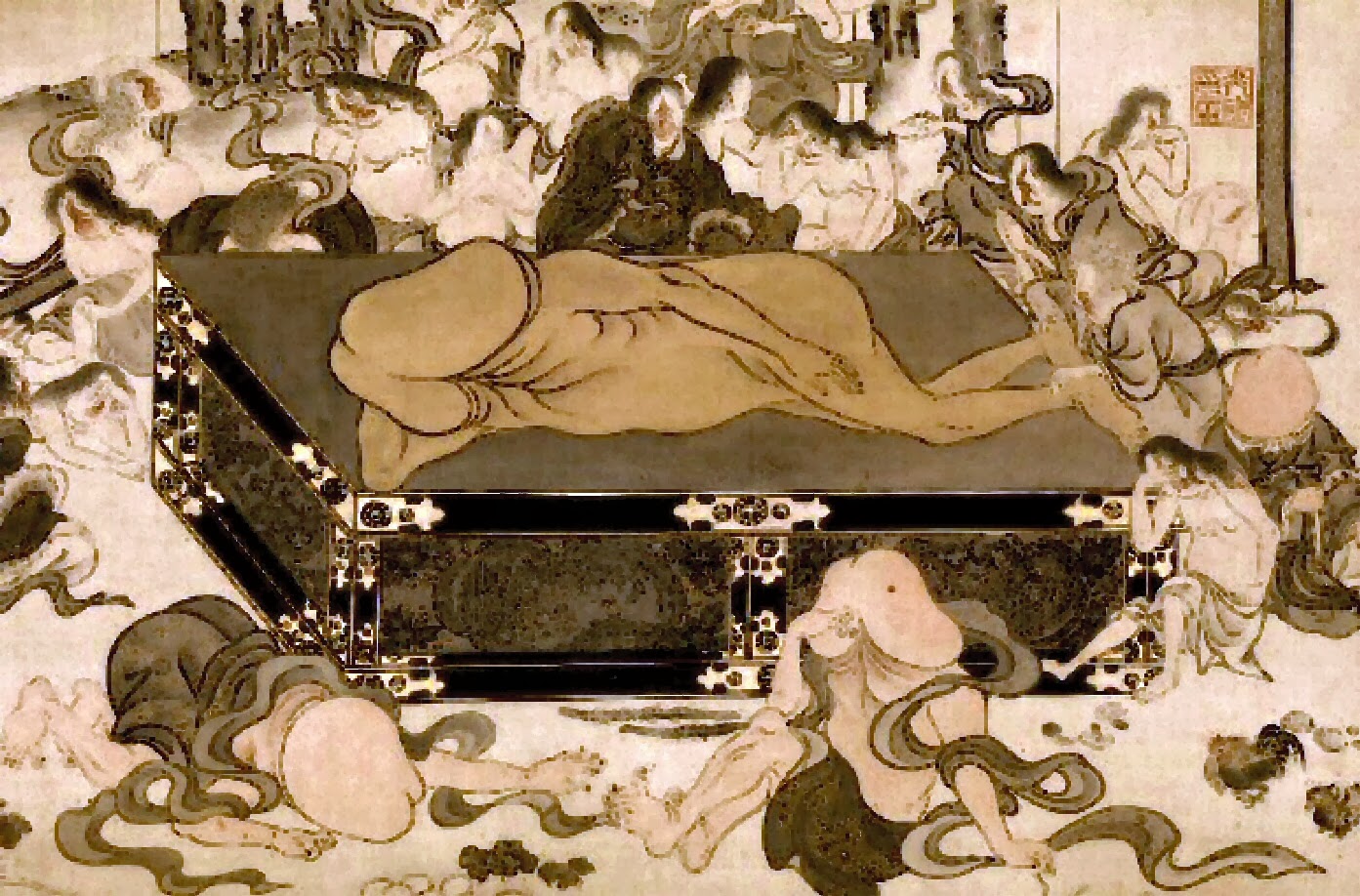
The highlight of the exhibition for me was the section dealing with shunga parodies. Alongside illustrated books on such perfectly innocent topics as etiquette, cooking and geography, there were X-rated parodies in which the words and images were subtly altered using standard schoolboy formulas such as “sounds a bit like penis” or “looks a bit like a vagina”. Probably the most outrageous example was entitled “Penis Parinirvana”, dating from the mid-19th century (the image shown here comes from the museum’s website, because photography wasn’t allowed in the exhibition). The word “Parinirvana” is used to describe the death of the Buddha, and it’s a common subject in Buddhist art. A typical example is this one from Wikimedia Commons. As you can see, Penis Parinirvana is pretty much the same thing, except that the Buddha and several of the mourners take the form of giant sex organs!
With its combination of sexual imagery and religious irreverence, you might think Penis Parinirvana would fall foul of the official censors. Apparently, however, although shunga were technically illegal, the authorities almost always turned a blind eye – the only time they enforced the law was if a politician or other public figure was satirized!

There is another image in the British Museum collection (although not on public display) that is very reminiscent of Penis Parinirvana: “Small figures gathered around a giant phallus”. This engraving is the work of Vivant Denon – a name that will be familiar to anyone who has visited the Louvre in Paris, since one of the museum’s three wings (the one with the Mona Lisa) is named after him. Denon’s fame rests on the fact that he was the first director of the Louvre, but he also produced a number of erotic engravings in the 1790s entitled Oeuvre Priapique. This particular example is a parody of several popular engravings of the time that depicted beached whales. In Denon’s version, which has a distinctly cryptozoological feel, the beached creature is an enormous phallus!

Sunday, 20 October 2013

Phallic Symbols (mostly small ones)

When I first spotted this statue of Balzac at the Musée Rodin in Paris, I though it was something else altogether. But I was wrong. Gigantic erections are something you almost never see in mainstream European art. I’m not sure why, because male genitalia are hardly a rarity in classical sculptures and paintings. It’s just that they always seem to be little ones.

There is a word for the artistic representation of an erect penis: ithyphallic. You can do a Google image search for “ithyphallic” if you want to, but you’ll be disappointed – most of the results come from the ancient world (where erections were believed to have magical properties – see Phascinating Phacts). It all changed with the Renaissance – big dicks were out and tiny dicks were in. The result is particularly comical in the case of mythological figures like the Greek god Zeus (≈ the Roman god Jupiter), who spent much of his career inseminating females. The only picture I’ve found that shows him with anything approaching a hard-on is a fresco by the 16th century Italian painter Giulio Romano, depicting Jupiter seducing Olympia.

Although some ancient Roman figures are shown with enormous erections, these always seem to depict specifically “phallic” gods such as Priapus. Even the great hero Hercules is generally shown with an unheroic little wiener, despite having an otherwise heavily muscled physique and heroic posture. Usually, anyhow. I saw this irreverent statue of Hercules at the British Museum’s Pompeii exhibition earlier this year (photography wasn’t allowed, so this is an official image, not mine). Notice how his dick is smaller than his little finger.

It’s not just the great mythological figures of Europe who are underendowed in the genital department. There’s a type of statue you sometimes see that I used to think of as a “naked Buddha”, but actually they don’t depict the Buddha at all – they come from another Asian religion called Jainism.
According to the label on the statue depicted here, which I saw in London’s V&A Museum, it depicts the Jina Parshvanatha, the 23rd Jain saviour, engaged in “sky-clad” meditation. His penis is about the same size as his thumb.

The Buddha is described in a Mahāyāna text called the Gaṇḍhavyūha as having a sex organ “like a thoroughbred elephant or stallion”, that can be retracted into his body when not in use. Presumably for that reason, depictions of the Buddha never show his penis – in fact the clingy drapery sometimes shows the very obvious absence of a penis.

Nevertheless, like Zeus or Jupiter, there’s no doubt the Buddha knew how to use it – witness the countless images of Buddha-incarnations copulating with female consorts (in the Tantric form of Buddhism at least). Here’s one I saw on my recent trip to Paris, in the Musée Guimet. It’s a type of devotional painting called a thangka, although at first glance you could be forgiven for thinking it was an example of early mediaeval interracial porn...

Sunday, 3 February 2013

Fortean Opera

I recently came across this gothically surreal image, which illustrates an early 19th century opera called Der Freischütz. Reading up about this, it turns out to be quite a Fortean opera, which started me thinking. A Google search for “Fortean opera” turns up nothing of relevance, so I decided it was time to rectify the situation. Two or three titles sprang to mind, in addition to Der Freischütz, and some further research turned up a few others. In the end I came up with the following list (in chronological order of composition):

Il Mondo della Luna (The World of the Moon) by Haydn (1777). As the title suggests, this opera features a trip to the Moon and an encounter with its inhabitants. That wouldn’t be particularly Fortean... except that the “aliens” are fakes and the journey to the Moon is all a big hoax. As such, Il Mondo della Luna is probably the first opera ever written about a fake Moon landing – all the way back in 1777! It isn’t a well-known work (Haydn is more famous for his symphonies than his operas), but I found this clip on YouTube from a recent performance in New York. It looks quite jolly!

Die Zauberflöte (The Magic Flute) by Mozart (1791). This is a famously nutty opera that turns fairy tale conventions on their head. It begins with the hero, Prince Tamino, running away from a giant snake and fainting with fright. He is saved by three young women, followers of the Queen of the Night, who give him a magic flute and a mission to rescue the Queen’s daughter Pamina from a man named Sarastro. And why is this Fortean? Because it’s all a lie! When Tamino eventually catches up with Sarastro, it turns out he isn’t a villain at all, but a wise priest of Isis and Osiris (I should have mentioned this takes place in ancient Egypt). It’s true that Sarastro abducted Pamina, but only to free her from her mother’s clutches. He was keeping her safe so she could marry Tamino... but only after the latter has proved himself worthy by undergoing an arcane, Masonic-style initiation ritual. Strange as it may seem, he is assisted in this task by his magic flute, which was given to him by the evil Queen of the Night... who incidentally also steals the show.

Der Freischütz (The Freeshooter) by Weber (1821). This is a Pact with the Devil story.... the specific pact in this instance relating to the manufacture of magic bullets which always hit their target. The catch is that the seventh and last bullet does what the Devil—or rather the demon Samiel—wants it to... after which he takes your soul as per the standard agreement. The picture above illustrates the Wolf’s Glen scene, in which the magic bullets are forged while various spirits and demons look on. The whole scene is viewable on YouTube in two parts, here and here.

Der Fliegende Holländer (The Flying Dutchman) by Wagner (1843). The tale of the Flying Dutchman is a distinctly Fortean piece of folklore, about an old, ghostly ship that is occasionally glimpsed by sailors, its captain having been cursed to sail the seas forever. The original legend dates from the 17th century, but the opera turns it into a characteristically 19th century gothic romance. This is very early Wagner, and he went on to bigger and better things. It’s always struck me that, if the only thing that was known about Wagner was his operatic subject-matter, he would be considered an archetypal New Ager! You’ve got Celtic legends in Tristan und Isolde, the Holy Grail in Parsifal and paganism in the Ring – including this awesome invocation of the Earth Goddess!

La Nonne Sanglante (The Bleeding Nun) by Gounod (1854). Writing about Matthew Lewis’s novel The Monk (1796), H. P. Lovecraft wrote “In the sub-plot where the Marquis de las Cisternas meets the spectre of his erring ancestress, The Bleeding Nun, there are many enormously potent strokes; notably the visit of the animated corpse to the Marquis's bedside, and the cabalistic ritual whereby the Wandering Jew helps him to fathom and banish his dead tormentor.” This sounds like a great idea for an opera, but unfortunately Gounod’s attempt at it was a complete flop. Interestingly, the libretto was also offered to Gounod’s great contemporary Verdi, but he turned it down. If he hadn’t, The Bleeding Nun might have been up there with Rigoletto, Aida and La Traviata!

The Makropulos Case by Janáček (1926). I watched a production of this on a portable black and white TV when I was a student more than 30 years ago, and even then it occurred to me that it’s one of the few operas where the plot actually makes sense. The central character is a young woman named Emilia Marty, who takes an interest in a legal case that has been running for a century – and who talks about events of the 1820s as if she had been there. It gradually emerges that she’s lived for hundreds of years, using various different names all having the initials EM. But there’s an explanation for this which makes perfect sense. Anyone who is familiar with the story of John Dee and Edward Kelley will know that the Holy Roman Emperor Rudolf II (1552 – 1612) was obsessed with alchemy and the search for eternal life. Rudolf was based in Prague, which is where The Makropulos Case is set (Janáček was a Czech composer). When an alchemist named Hieronymus Makropulos offered Rudolf a life-extending potion, the Emperor asked him to test it on the alchemist’s daughter, Elina Makropulos, first. This caused her to fall into a coma, and the Emperor changed his mind about using the potion... but when Elina woke up a week later she discovered she had stopped aging! Hence her survival into the 20th century.

Wagner Dream by Jonathan Harvey (2007). Richard Wagner died of a heart attack in February 1883, at the age of 69. But, according to this opera, he didn’t give up without a Tibetan Book of the Dead style struggle. He was just embarking on his last opera, Die Sieger, and he argues with his spirit guide Vairochana that he ought to be allowed to go back and finish it. Wagner Dream is an opera within an opera (Wagner’s opera Die Sieger, as imagined by Harvey, framed inside Harvey’s own opera about Wagner’s battle against death). Die Sieger is set in ancient India, where the Buddha is busy setting up his community of monks. The hero is a young monk named Ananda who is trying to persuade the Buddha to allow women to join the monastic order. But isn’t that a bit far-fetched? Wagner may have been into a few New Age beliefs like Paganism and Celtic mythology, but surely not Buddhism? And feminist Buddhism at that? But it’s all true. Back in the 1850s, Wagner really did write a synopsis of Die Sieger along exactly these lines, and he really did return to the idea shortly before his death. I was aware of that (it’s mentioned by Philip K. Dick in VALIS, and in turn I referred to it in my Worldcon talk about Parsifal as Proto-SF)... but I’ve only just found out about Wagner Dream. Now I’m kicking myself that I missed its London performance last year – although there is a short clip of an earlier Dutch production on YouTube.
Sunday, 30 September 2012

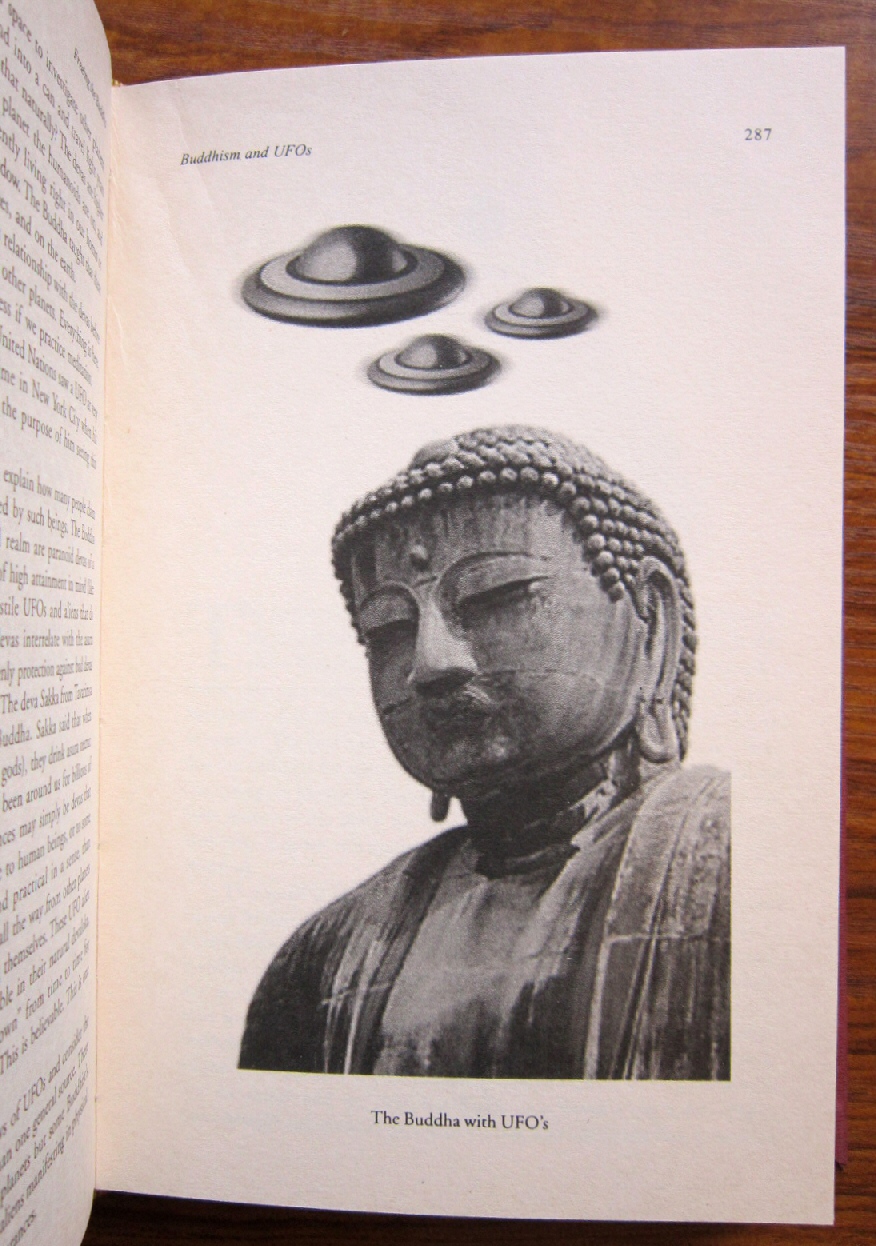
Buddhism and UFOs

“Buddhism and UFOs” is the title of one of the chapters in a book I bought recently called Freeing the Buddha, by Brian Ruhe. Before getting on to the author’s unique take on the subject of UFOs, it’s worth saying a few words about the book as a whole. It was originally published in 1999, but the second-hand copy I bought was printed in India in 2005. Brian Ruhe himself was born in Canada, but he is a formally trained Buddhist teacher who knows more about the history, beliefs and practices of Buddhism than most English-speaking writers on the subject. On top of that, he has a very readable and engaging writing style. All of this suggests that Freeing the Buddha is a book worth getting hold of – which of course is why I bought it. But having read it, the author’s interpretation of Buddhist teaching is unusual and highly individualistic, and – in my opinion – quite “un-Buddhist” in places.

“Buddhism” is a broad term that encompasses many different cultural traditions, which differ widely in their superficial trappings but share a common core of ethical and psychological teachings. My understanding (although I may be wrong, since I’m not an expert) is that the “superficial trappings” are intended to be symbolic only, and tailored to the cultural beliefs of the particular audience they were aimed at. An analogy that is often used is that of a raft. If you want to get from one side of a river to the other, you will make a raft of whatever material is available, but once the raft has got you safely to the other side you will discard it – not carry it around with you for the rest of your life. Clinging too strongly to the mythological, metaphysical or cosmological trappings of Buddhism is discouraged, because ultimately they are irrelevant to the deep psychological and moral truths that the teaching is trying to drive you towards.

But more than any other Buddhist writer I’ve come across, Brian Ruhe does have a deep and literal belief in the mythological, metaphysical and cosmological trappings of the particular form of Buddhism that he subscribes to. In his case, this is Theravada Buddhism – the earliest form of Buddhist teaching, which originated in India 2500 years ago. At that time the dominant culture of India was Brahmanism – a precursor of modern Hinduism – so not surprisingly most of the Theravada writings are steeped in Brahmanical mythology and cosmology (though not all of them – when the Buddha preaches to sun-worshippers or fire-worshippers or ancestor-worshippers or atheists he talks to these groups in their own terms, not those of Brahmanism). But Brian Ruhe, unless he’s indulging in a level of deadpan irony which is over my head, believes in the literal truth of the various heavenly realms and supernatural beings that are spoken of in the Theravada canon.

Hopefully you can see where this is leading, and that I’m finally getting around to the subject of this post. Based on the popular mythological beliefs current in India when they were first written down, the Theravada scriptures talk a lot about “devas” – a term that is often translated as “gods” (and probably comes from the same root as our word “deity”), but is closer in concept to the Western idea of “angels”. These are supernatural beings that are superior in many ways to human beings, but far from being omnipotent, who normally reside on higher planes of existence but can descend down to the mundane world and appear to mortals when they want to. Ergo, in Brian Ruhe’s world-view, devas are UFOs and UFOs are devas. It’s as simple as that.

On the face of it, Ruhe’s theory is simply saying that “Unexplained speculative phenomenon A can be explained in terms of unexplained speculative phenomenon B”... which is a perfectly valid statement but not a particularly helpful one. But at another level, there may be a lot of truth in what he says. Practitioners of Theravada Buddhism sometimes claim to experience contact with devas and deva-worlds while they are in a trance-like state during meditation. Objectively, this can be dismissed as a form of lucid dreaming or self-hypnosis, but there may well be an underlying mystical experience – that has nothing to do with devas or UFOs – that the meditators are interpreting in terms of the cultural beliefs and expectations that are most familiar to them. Many westerners having exactly the same subjective experience might well objectivize it in terms of a UFO or alien abduction.

Sunday, 9 September 2012

A Brief History of Tantric Sex

My interest in Tantric sex is purely theoretical. Like all my other theories, my theory of Tantric sex is ingenious and almost certainly wrong. One point that is emphasized by all modern writers on the subject is that Tantra stems from an ancient tradition. Up to a point, I’m sure that’s right. The word Tantra was certainly in use on the Indian subcontinent 2000 years ago, and encompassed a good deal of what would nowadays be called sacred sexuality. And the religious use of sexual imagery and rituals—not necessarily under the name of Tantra—was around for at least a thousand years before that. But in functional terms, I don’t think it had anything in common with present-day Tantra at all.

My theory is that Tantra underwent two massive reinventions: the first about 2000 years ago and the second within the last 50 years. If you go back to prehistoric times, I think people had a very confused idea of how the natural world worked. Their lives were dominated by things like droughts, disease and crop failures, and they desperately wanted to be able control these things but had no idea how to go about it. The most powerful thing that was within their control was sex—an act that seemed to create new life out of nothing. So they reasoned, illogically by modern standards, that performing the right kind of sexual rituals could have other “magical” effects as well. Prior to the Axial Age of circa 500 BC, when most modern religions have their origin, religious rituals—including sexual ones—were misguided attempts to control the natural world rather than having any kind of spiritual dimension (New Agers will disagree vehemently with this... but as I said, it’s just my theory and probably wrong).

The big change that started around 500BC, when the more mystical aspects of the Hindu-Buddhist, Graeco-Roman and Judaeo-Christian traditions have their roots, was the shift of religion away from superstitious ritual towards soteriology. Now “soteriology” is one of my favourite words, even though I don’t really know what it means. I use it to mean the idea that there are higher states of existence than those of everyday life, which can be attained through appropriate religious practices. If you sat down with a blank piece of paper, and tried to think up a list of “appropriate religious practices” to attain a higher state of existence, then all-night drug-fuelled sex orgies, or the visualization of animal-headed, multi-limbed deities copulating with each other, probably wouldn’t immediately spring to mind. But people had a long tradition of doing these things, albeit for completely different reasons, so (presumably because they enjoyed them) they decided to keep the sexual elements and redefine their function in soteriological terms. I suspect this happened in all the traditions—Judaeo-Christian, Graeco-Roman and Hindu-Buddhist—but it’s only in the last (and then only in a small minority of practitioners) that’s it’s survived to the present day.

The object shown on the left can be seen in the Victoria and Albert Museum in London. It isn’t exactly clear what’s going on, but it’s obviously sexual (and quite possibly illegal). According to the caption: “For Buddhist Tantric practitioners, the ass-headed protective deity Kharamukha Samvara is an embodiment of the enlightened state. The sexual imagery is a metaphor for enlightenment, with the male representing compassion and the female wisdom.” If you look closely, the “embodiment of the enlightened state” is wearing a necklace of human skulls, and trampling on two small human-like figures (cf. my earlier post on Tantric Buddhism). I think the imagery is far easier to understand if it originated in some ancient pagan magical superstition, and was later glossed over with a Buddhist “soteriological” interpretation.

I first encountered the idea of Tantric sex in 1980, when I was looking for a book on yoga (but I bought the book on Tantric sex anyway). In those days, it still had a strongly spiritual dimension, and interest was limited to the “hippie” mystical fringe. But since then the subject has snowballed to the extent that it is now a mainstream industry that everyone has heard of. But in today’s world, you can’t be mainstream and talk about spirituality – it’s a contradiction in terms. There’s a limit to the number of punters who are desperate to attain a higher level of spiritual awareness... and they tend to lead alternative lifestyles with limited disposable income for high-end workshops and one-on-one counselling sessions. On the other hand, there is a never-ending supply of well-to-do, middle-aged couples who want to liven up their sex lives. So modern Tantric practitioners tend to say things like “Tantra had its origins way back in the past when people believed in Gods and Goddesses, but many people nowadays are uncomfortable with such ideas so we can safely dispense with them.”

I’m not criticizing neo-Tantra per se – it’s probably more socially useful, less ludicrous and certainly no more cynical than the traditional form of Tantra. But why do people have to call it Tantra? Sacred Sex without the Sacred is just Sex!

Sunday, 12 August 2012

The Buddha in Mediaeval Europe

When I was reading up about the ancient Chinese sage Fu Xi for last week’s post, I discovered that some of the Jesuit missionaries to China in the 17th and 18th century believed that Fu Xi was one and the same person as the Biblical patriarch Enoch, and that the I Ching contained “precious vestiges from the remains of the most ancient and excellent philosophy taught by the first patriarchs of the world” (see the Wikipedia article on Figurism). This is interesting in its own right, because both the character of Enoch and the philosophy of the I Ching loom large in the modern-day esoteric literature of the New Age movement.

But the Enoch—Fu Xi connection reminded me of something else that has always struck me as rather surprising. During the Middle Ages, one of the most popular books in the early days of printing was called The Golden Legend -- a huge collection of moral tales and parables about saints and other holy people. And one of the stories—the story of Barlaam and Josaphat—is derived from an old Indian legend about the Buddha.

There are countless speculations about supposed interactions and parallels between different cultures of the ancient world (the Enoch—Fu Xi speculation is one of them). Many of these speculations (as mentioned in an earlier post) take the form of rather shaky amateur scholarship based on perceived similarities which probably have no grounding in historical fact. But the Josaphat—Buddha link seems to be stronger than that. Even the ultra-conservative Wikipedia article states that “Barlaam and Josaphat or Joasaph is a Christianized version of the story of Siddhartha Gautama, who became the Buddha”. No weasel words like “is believed by some people to be” or “has at times been alleged to be”. So it must be true.

The idea is that the story found its way to Europe from India via Persia, and that “Josaphat” is a multiply corrupted form of the Sanskrit word “Bodhisattva”. You can tell this is based on real professional scholarship, and not the amateur armchair kind, because it is all so obscure! The connection between “Josaphat” and “Bodhisattva” is not at all obvious to the eye, and apart from its setting in India there is little in the story to suggest its Buddhist origin. Josaphat is a convert to Christianity, not Buddhism!

In the context of the Middle Ages, there is nothing that unusual about one culture appropriating a moral tale from another culture and adapting it to their own teaching. As its name suggests, The Golden Legend is a book of fables -- fictitious stories with a morally instructive message. It doesn’t claim to be the literal truth, only the symbolic truth. There was plenty of room in the mediaeval world for subtle thinking of that kind, before it was edged out by the Biblical literalists and skeptical atheists of the 17th and 18th centuries.

Incidentally, the picture above has nothing to do with the legend of Barlaam and Josaphat -- it’s a painting called “Christ et Buddha” by the French artist Paul Ranson. It looks like a typical New Age composition from the 1980s or 90s, but actually it was painted in 1880!

Friday, 2 September 2011

Satori - ape, goat-man or deer?

I've come across the Japanese word Satori in several different contexts. Richard Freeman's Great Yokai Encyclopaedia (which I mentioned recently in Ningyo: the ugly little mermaid) describes a legendary Satori which is "a long-haired ape-like beast [that] can read minds and is therefore very hard to catch." I think this must be the creature shown in the picture (which I found on Wikimedia Commons).

The ape-like Satori is also discussed in a recent blog post by Dale Drinnon called "Pink Tentacle Abominable Yokai". However, Dale adds that the name Satori may be a direct transliteration of the European word Satyr, referring to a mythical creature composed of the upper half of a man and the lower half of a goat. The speculation is that the word was introduced to Japan by Portuguese missionaries in the 16th or 17th century.

Satori is also the Japanese word for "understanding", and this may have been conflated with a garbled version of the Satyr legend to transform the Satori into a mind-reading creature. Regarding Satori's ape-like incarnation, Dale writes: "When it encounters travellers passing through the mountains, the creature approaches them and begins speaking their thoughts aloud. Once the victims become thoroughly confused and disoriented, the Satori captures and eats them. It is said that an empty mind is the best protection against a Satori attack. Thinking nothing at all causes the creature to turn away in boredom or flee in fear."

The idea of an "empty mind" links to yet another meaning of Satori (and probably the most familiar meaning to Westerners) -- the moment of enlightenment in Zen Buddhism. At the London Buddhist Society in the 1990s, the Venerable Myokyo-Ni and her pupil Martin Goodson (now the Venerable Sochu) used to recount a Zen fable called "The Satori Deer", about a creature which behaves in a very similar way to the Satori Ape described above. The following (slightly abridged) is taken from an article by Martin Goodson in the February 1997 issue of The Middle Way magazine:
A woodcutter went into the forest and began cutting down a tree. He happened to glance up and there on the other side of the clearing was a strange animal. It was rather like a deer but totally white from top to toe. As he looked at it the animal said: "You're wondering what I am". The man jumped in surprise, at which the animal said: "You're surprised that an animal has spoken". The man was flabbergasted. The Satori deer said: "You are beginning to think I am telepathic and can read your thoughts". The man shuffled from one foot to the other. The Satori deer said: "You are beginning to get a little irritated with me". And he was -- he was quite cross. The Satori deer went on and said: "You are thinking of picking up that axe and throwing it at my skull". The man picked up the axe and made a lunge for this creature, but of course the Satori deer knew exactly what he was going to do. Every time a thought occurred to him, the Satori deer could anticipate it by jumping the other way. So after several futile attempts the man decided that the best thing he could do was ignore the creature and just get on with cutting down the tree. The Satori deer said: "You're trying to ignore me and continue cutting down that tree". But as the man concentrated all his energy into cutting down the tree, the Satori deer spoke less and less until eventually he fell silent. The woodsman continued to cut down the tree with the Satori deer standing there waiting until, as the woodsman raised his axe, the axe-head broke away from the handle, flew across the clearing and killed the Satori deer stone dead. And that is how to kill the Satori deer.
In the Zen interpretation, the Satori deer represents the mental commentary that goes on all the time inside your head, which you're supposed to "kill" before you achieve enlightenment. No doubt the Zen version substituted a cute-looking deer, instead of a man-eating ape, because the thought of having to kill it has greater shock value. That's Zen for you!

Saturday, 30 July 2011

Descartes and the Buddha

"The seeker after truth must once in his lifetime doubt everything that he can doubt." This could be a quotation from Charles Fort -- an admonition against mindless acceptance of scientific authority. Actually it was written by the French philosopher René Descartes (1596-1650)... although with more or less the same purpose in mind. Descartes (left, as painted by Franz Hals) was the ultimate doubter. He didn't believe anything he'd read or had been taught, and he was even distrustful of his own senses. Instead, he tried to reason from first principles -- from axiomatic statements that he was absolutely certain were true.

The first and foremost of Descartes' axioms was cogito ergo sum: "I think, therefore I exist". To him, that was the single most certain fact in the universe: "we can easily suppose that there’s no God and no heaven, that there are no bodies -- that we don’t have bodies, hands and feet and so on. But we can’t suppose that we, who are having such thoughts, are nothing!"

But is "cogito ergo sum" really that obvious? Long before Descartes, there were those who doubted the truth of "I think, therefore I exist"... the most they would concede was "There is thought, therefore thought exists". These were the authors of an early Buddhist treatise called Dhammasangani, written in the Pali language in the third century BC. The title translates roughly as "Compendium of States", and it's as close as the Buddhists of the time got to writing a scientific textbook (or proto-scientific, to use a phrase that cropped up in a comment to an earlier post).

The first part of the Dhammasangani contains a detailed analysis of mental processes -- enumerating the various different types of thought with their concomitant factors. For each thought-type there is a section called "Emptiness" in which, according to a footnote in the English translation (by Caroline Rhys Davids, 1900): "emphasis is laid on the principle that this same thought-complex is an aggregate or combination of such factors, and nothing more... there is no permanent entity or self which acquires the states". This is explained further in the Atthasalini, a 5th century commentary by Buddhaghosa: "... here there are only states: no permanent being, no soul is known. These are mere states without essence, without a guiding principle... there is nothing else whatever, neither a being, nor an individuality, nor a man, nor a person."

The idea that thoughts could exist in the absence of a guiding "self" was central to the form of Buddhism described in the Dhammasangani and Atthasalini. It was an idea that came out of the Buddhist practice of meditation, and books like these were written to help monks to experience the truth in their own meditation. It's a difficult idea, if not downright bizarre, but the basic message is clear enough: Cogito ergo non sum!

Friday, 20 May 2011

Paranormal Classification, circa 250 BC

The earliest Buddhist writings, called "suttas", are presented in the form of discourses reputedly given by the Buddha himself. However, they probably date from a couple of centuries after the Buddha's time, during the reign of King Asoka the Great in the middle of the 3rd century BC (the extract from the suttas shown above is taken from a later Chinese copy, circa 400 AD).

Traditionally, the suttas are divided into a number of collections, of which the first is called the Digha Nikaya. Of the suttas in this collection, the second is called the Samaññaphala Sutta... which can be translated as "A Discourse on the Fruits of Contemplative Life". In it, the Buddha describes the various advanced states of consciousness that can be attained through assiduous meditation. Amongst these is Abhiñña (usually translated as "direct knowledge") -- whose Fortean relevance will become apparent when it is broken down into its constituent components:

1. Supernormal Powers
a. Having been one he becomes many; having been many he becomes one.
b. He appears; he disappears.
c. He goes unimpeded through walls as if through space.
d. He dives in and out of the earth as if it were water.
e. He walks on water as if it were dry land.
f. Sitting cross-legged he flies through the air like a bird.
g. With his hand he touches the sun and moon.
h. He exercises bodily influence throughout the created world.

2. The Divine Ear
  • He hears subtle and coarse sounds, both far and near.

3. The Knowledge of Other Minds
  • -He reads the thoughts of others, and knows their state of mind.

4. The Recollection of Past Lives
  • He knows his past births, and the details of those births.

5. The Divine Eye
  • He sees heavenly and earthly events, both far and near.

Of these, only 1g seems unfamiliar (and indeed ludicrous) to a modern reader. Apart from that, all the commonly accepted paranormal classifications are there: Bilocation (1a), Teleportation (1b), Astral Projection (1c/d), Levitation (1e/f), Telekinesis (1h), Clairaudience (2), Telepathy (3), Past-Life Recall (4) and Clairvoyance (5)!

Thursday, 14 April 2011

Tantric Buddhism

Here is the last of three interesting pictures I took in the British Museum last week (the others were a prophetic print and a crystal ball):

In the modern sense of the term, Tantric Sex is about as bland and innocuous as anything you can think of which has the word "Sex" in the title... but it still comes as a bit of a surprise to see the Buddha indulging in it. Furthermore, if you look closely, some of the imagery is far from bland and innocuous!

This particular object, originating from Nepal and made of gilt copper, depicts the Buddha (in his esoteric form of Samvara) embracing his female "wisdom partner". She is holding a ritual dagger in her right hand, while he is wearing a long dangling necklace made of human skulls. Both of them are stomping on two small figures... not demons, as you might guess, but gods -- one is Bhairava (a manifestation of the Hindu god Siva), and the other is the goddess Kali.

The usual explanation for this kind of "Tantric" Buddhist imagery is that it was devised by early Buddhists as an aid to meditation. Visualizing the sex act is supposed to be conducive to the union of wisdom (symbolized by the dagger) and mental purification (symbolized by the skulls). Personally I find this explanation rather cynical (a few years ago my career as a book reviewer for the Buddhist Society came to an abrupt end when I dared to suggest this!)... but it's a pretty cool idea nevertheless. In any other religion, if you close your eyes and visualize people having sex they call you a pervert!

The fact is that Tantric visualization is quite a rare thing in Buddhism -- as far as I know it's not practiced by Zen Buddhists in Japan, or by Theravada Buddhists in South Asia. My guess is that it originally had nothing to do with Buddhism at all, but started out as a fairly standard "sex magic" practice in the Himalayan region -- then got grafted onto Buddhism when the missionaries realized it was the only way they were going to convert the locals!