Search This Blog

Showing posts with label Lionel Fanthorpe. Show all posts

Sunday, 31 March 2024

Popular Culture in Fortean Times


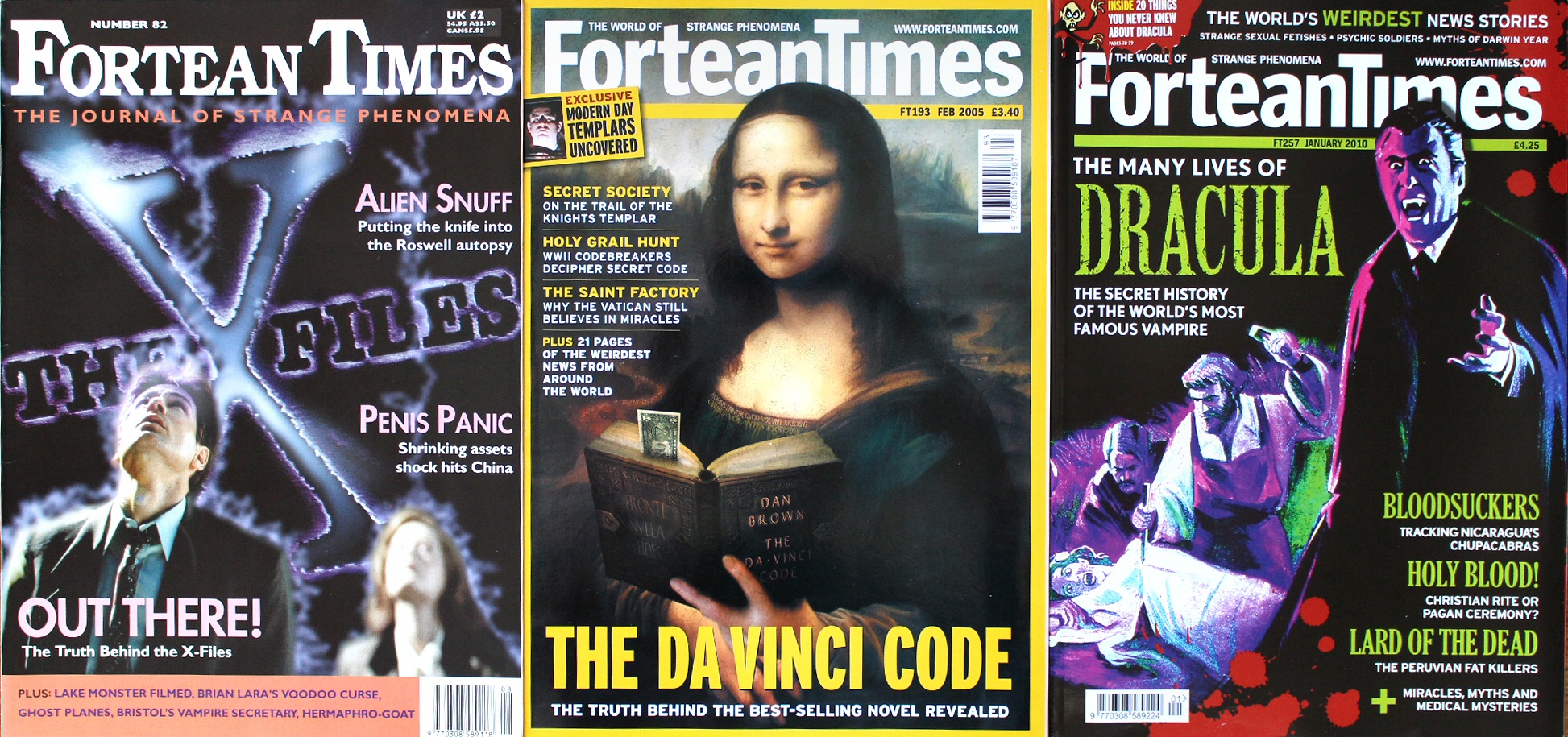
In the comment thread to last week's post, I mentioned that Fortean Times occasionally touches on various aspects of popular culture, from cult TV and movies to comics and pop music. So I thought I'd do a quick run-through of a few examples today.

To start with some very obvious topics, there are the three shown above. The X-Files (FT 82, August 1995) was not only one of the most fortean TV shows of all time, but its first appearance in 1993 coincided with the wider distribution of FT to "mainstream" retailers like WH Smith, and almost certainly contributed to the magazine's popularity at that time. Around a decade later, Dan Brown's novel The Da Vinci Code (FT 193, March 2005) was a publishing phenomenon, bringing fringe theories that had previously been the realm of specialist writers (and FT contributors) like Lionel Fanthorpe and Lynn Picknett to a much wider audience. Just over a century earlier, Bram Stoker had done something similar in his novel Dracula - the title character of which went on to become one of the most recognisable and ubiquitous pop-culture icons of them all, as recounted in the cover feature of FT 257 (January 2010).

At a less obvious level, you can find references to popular culture in almost every issue of FT. Taking the one I discussed last week, for example - FT 73 from February/March 1994 - there's an interview with cult author William Gibson, generally credited as the originator of the cyberpunk genre. And I spotted something else in that issue, too: a book review by comics legend Alan Moore. I don't mean a review of one of his graphic novels - I mean a review written by him of someone else's work. Looking online, I see he actually did quite a few reviews for FT in those days - which pleases me enormously, as I've done over 40 of them myself. It's always nice to discover that you have something in common with a famous person!

Sticking with books and comics for a moment, here are three more covers that caught my eye. No apologies for a second appearance of The Da Vinci Code (FT 212 this time, from August 2006) - both because it's one of my favourite novels, and because I love the illustration on the cover. In addition to people like Picasso and Orson Welles, it features Da Vinci himself in the act of strangling Dan Brown! The middle cover (FT 256, December 2009) features Dennis Wheatley - best remembered today for The Devil Rides Out (the only one of his novels that I've read), although in his day he was Britain's most prolific author of occult fiction. Finally there's the only comics-themed cover I could find - FT 320 (November 2014), relating to the Fredric Wertham-inspired anti-comics paranoia than swept America in the 1950s.


I found a few shorter comic-related pieces on interior pages as well. The most interesting of these was an article in FT 277 (July 2011) called "The Morning of the Mutants", speculating that Stan Lee and/or Jack Kirby got the idea for the X-Men from the seminal (though now largely forgotten) fortean conspiracy book The Morning of the Magicians, written in 1960 by Louis Pauwels and Jacques Bergier. There's also a feature about Marvel Comics' Doctor Strange in FT 349 (January 2017, to tie in with the movie), which discusses the character's origin and fictional predecessors.

Regarding the "popular culture" of the mid-20th century, I can't resist mentioning a couple of pieces by myself - in fact the only two full-length feature articles I've had in FT. First there was "Fanthorpe's Fortean Fiction" (FT 297, February 2013) about the large number of mass-market paperback novels that Lionel Fanthorpe churned out in the late 1950s and early 60s. This was followed by "Astounding Science, Amazing Theories" (FT 355, July 2017), looking at fortean themes in the pulp science fiction magazines of the 1940s.

Pulp magazines were a huge part of popular culture in the first half of the 20th century, but - with a few notable exceptions - they're only of interest to die-hard fans today. Of those exceptions, perhaps the most important is H. P. Lovecraft, whose Cthulhu Mythos first took form in the pages of Weird Tales in the 1920s and 30s, before going on to develop a life of its own to rival that of Bram Stoker's Dracula. I found no fewer than three Lovecraft-inspired FT covers: FT 184 (June 2004), FT 369 (August 2018) and FT 390 (March 2020 - this one tying in with the movie adaptation of The Color Out of Space). Here they are:


As regards cult TV shows, I've already mentioned the most fortean of all, The X-Files - which not surprisingly made several further appearances after the one pictured at the top of this post (including FT 85 from February 1996, which had a rundown of all the fortean references in the show's first season). Three other TV-related covers are shown below, the middle of which - FT 215 from October 2006, celebrating 40 years of Star Trek - needs no introduction. The other two relate to the screenwriters (both with wider fortean interests than you might expect) behind two of Britain's most famous sci-fi icons: Kit Pedler, who created Doctor Who's second-most-famous villains, the Cybermen (FT 209, May 2006), and Nigel Kneale, creator of Professor Quatermass (FT 418, May 2022). The latter may no longer be a household name, but back in the 1950s he was really the first great TV sci-fi hero, in this country at least.


Turning to movies - I was spoiled for choice here, so I've picked out three covers that really speak for themselves. First there's a celebration of 50 years of Hammer Horror films (FT 223, June 2007), then a look at one of the mainstays of those films, Peter Cushing, on the 100th anniversary of his birth (FT 301, May 2013), and finally a 40-years-on retrospective about The Exorcist (FT 313, April 2014):

To be honest, my favourite thing about The Exorcist is the music - the snippet from Mike Oldfield's Tubular Bells that it uses, I mean - which brings me neatly onto the next subject. When I talk about "pop culture" on this blog, I most often mean fairly specialized things like pulp magazines, comics (from the pre-multimedia franchise days) and cult TV shows such as The X-Files. But to most people, pop culture means just one thing, and that's pop music. This is such a pervasive part of modern life that it's acquired a plethora of fortean connections - so much so that I'm going to split them into two distinct parts.

To start with, here are three cover features that deal with direct fortean influences on musicians. The first, from FT 88 back in July 1996, describes how various pop stars from David Bowie and Jimi Hendrix to Kate Bush and The Orb absorbed ufological and similar speculations into their music. Second, there's a somewhat more arcane take on the same subject by Ian Simmons (FT 244, January 2009), featuring the likes of Stockhausen and Sun Ra - a much-referenced source for my own book The Science of Sci-Fi Music. Finally, in the immediate wake of David Bowie's death, there was a cover feature about the numerous fortean influences on his work (FT 338, March 2016) - including the aforementioned Morning of the Magicians by Pauwels and Bergier.


Another aspect of pop music that's of fortean interest is the way weird conspiracy theories grow up around the subject. So to round off what I honestly believed would be a shorter-than-usual post when I started it, but has ended up as probably my longest ever - here are three cover features addressing this aspect. The one on the left (FT 166, January 2003) deals with the numerous legends and conspiracy theories associated with Elvis, while the one on the right (FT 384, October 2019) does much the same for the Beatles. As for the one in the middle (FT 258, February 2010), it concerns the notion that the "Illuminati" employ popular music - and the musicians themselves - to manipulate the thoughts, beliefs and behaviour of the general public. But that's not really a conspiracy theory, is it? I mean, if you substitute "global media" for "Illuminati", I'd say it's an indisputable fact.


Sunday, 3 March 2024

The Evolving Treasure of Oak Island


(courtesy of Bing Image Creator)

This is basically a sequel to last week's post, about the way certain "fringe" topics evolve and adapt to changing times. There's another link to the previous post too, in the form of Britain's most fortean free-to-air TV channel, Blaze. This is home to Ancient Aliens, which prompted last week's musings, and The Curse of Oak Island, which set me thinking about this one (both shows originated on America's History channel, then came over to the UK's subscription-only Sky History, before ending up on Blaze where cheapskates like myself can enjoy them).

Wikipedia has a fairly substantial entry on the Oak Island mystery, which begins as follows:

The Oak Island mystery is a series of stories of buried treasure and unexplained objects found on or near Oak Island in Nova Scotia. Since the 18th century, attempts have been made to find treasure and artifacts. Theories about artifacts present on the island range from pirate treasure to Shakespearean manuscripts to the Holy Grail or the Ark of the Covenant.

As cool as that sounds, the legend of Oak Island isn't widely known, even in Canada (my cousin in Montreal said she hadn't heard of it until I asked her yesterday). Probably most people who have heard of it did so through the TV show, which is now in its 11th season. In contrast to Ancient Aliens - which is hugely entertaining, but ultimately mostly nonsense - The Curse of Oak Island is a really great show. I can see why some viewers are cynical about it (because it's a TV show first, and a serious archaeological project second) but this really doesn't bother me. I find it fascinating to watch them digging up the island's history even if, treasure-wise, it's mostly all dead ends. On top of that I really like all the participants, who strike me as much nicer people than the cast of most TV shows (several of them remind me of the sort of people I've worked with over the years).

Browsing through various online forums, I get the impression some viewers think the Oak Island "treasure legend" was artificially created for the series, simply because the people behind it own the island and wanted a premise for a reality show. But I was aware of the Oak Island mystery long before the TV series hit the airwaves in 2014. I first encountered it in the 1990s, either in a talk that Lionel Fanthorpe gave at one of the Fortean Times Unconventions, and/or his short-lived but fondly remembered Fortean TV series. It also features in a book I've got by Lionel and his wife, Mysteries and Secrets of the Templars (2005), as well as another book I read around the same time. That was when my then-work colleague (and subsequent co-author on Random Encounters on the London Tourist Trail) Paul Jackson lent me his copy of The Secret Treasure of Oak Island by D'Arcy O'Connor.

So I can vouch for the fact that most of the speculative theories (as well as historical snippets, such as the fact that future US president F D Roosevelt took part in an Oak Island dig in 1909) that crop up in The Curse of Oak Island were around long before the show started. Of course, there's nothing intrinsically fortean about a legend of buried treasure, but what makes Oak Island so fascinating is the sheer number of theories associated with it. While none of these are really far-fetched - nothing paranormal or involving aliens or other dimensions, I mean - several of them are sufficiently fringy to make them interesting. To paraphrase a list from the Fanthorpe book, here are some of the explanations put forward to explain Oak Island's elusive treasure vault:

  • Constructed by the British during the American war of independence to protect their army's payroll;
  • Built by Sir Francis Drake and his men to hide gold they'd seized from the Spanish;
  • Dug by William Kidd or some other pirate in the 17th century;
  • Designed to house precious manuscripts, possibly ones proving the true authorship of the plays commonly attributed to Shakespeare;
  • Constructed by ancient Celtic or Norse sea rovers as a burial place for a great chief;
  • Built by the Knights Templar to protect the secret treasures they'd uncovered beneath Temple Mount in Jerusalem.

What jumps out is that some of these theories are more exciting than others. To be specific, the first three (which personally I'd class as boring) could comfortably fit inside the scope of accepted history, while the last three (all of which I find a lot more interesting) are way outside it. Not surprisingly, the TV show gives more prominence to these "exciting" theories - as do the Fanthorpes in their book, where they firmly align with the Templar hypothesis.

The thing that worries me slightly (and the main point I wanted to make in this post) is that the exciting theories came into existence after the boring ones. The earliest speculations and "legends" were solely about pirate treasure (yawn), with no Templars, Celts or lost manuscripts in sight. As the Wikipedia article says:

According to the earliest theory, the pit held a pirate treasure buried by Captain Kidd; Kidd and Henry Avery reportedly took treasure together, and Oak Island was their community bank. Another pirate theory involved Edward Teach (Blackbeard), who said that he buried his treasure "where none but Satan and myself can find it".
So the rational part of my brain tells me that, if there's any truth at all behind the Oak Island treasure, it was probably nothing more dramatic than a pirate hoard. On the other hand, my mystery-loving side insists it could have been the Templars' secret hiding-place for the Holy Grail, or the Ark of the Covenant, or something equally spectacular!

Half-way through writing this post, I realized it could do with a picture of the two books I mentioned. The only problem was that one of them belongs to Paul Jackson, who lives 60 miles away. But thanks to the miracles of modern technology, he'd taken a photo of it and I'd saved it on my computer within 3 minutes of me asking him for it! So here's Paul's copy of The Secret Treasure of Oak Island, alongside my copy of Mysteries and Secrets of the Templars:

Thursday, 28 December 2023

Fortean shelfies


Following on from last week's instalment What does fortean mean? I thought I'd post a couple of "shelfies" featuring books that fit my wider definition of the word. The one above contains newer books (what I think of as "newer" anyway, i.e. post-1990), while the one below shows books I've acquired second-hand - some of them genuine "retro-forteana" dating back to the 1950s or even earlier.

Although these are what I think of as my "fortean" books, they don't include everything I own that might fit the definition. For example, I've amassed a vast collection of fiction, much of which (as pointed out in the previous post) could easily be considered fortean. I also have numerous science books (many of them acquired as review copies for Fortean Times, or as research for my own writing) which are "fringy" enough to class as borderline forteana. But just two of them managed to squeeze into the picture above, both by my colleague Brian Clegg: How to Build a Time Machine and Extra-Sensory.

Another near-fortean topic that I have a whole shelf of books about is Buddhism (again many of them review copies, having spent 10 years as a book reviewer for the Buddhist Society). But I tend not to think of Buddhism as a fortean subject - unlike "alternative" religions, New Age beliefs and holistic therapies, all of which are quite well represented above. Amongst the latter is Scent Therapy by Raje Airey - who of the 10 or so authors featured here that I know personally, is the one I've known longest - since I went to school with her!

Looking at the picture above, I was surprised to see how biased my book-buying habits seem to be towards British authors. I honestly hadn't been aware of that until now. But certainly on subjects like UFOs, I do prefer the more methodical, less sensational approach of researchers like Jenny Randles, Nigel Watson, David Clarke and Mark Pilkington - with How UFOs Conquered the World and Mirage Men (book and DVD) by the latter two probably being my all-time favourite takes on the subject.

Turning to the older books pictured below, you'll spot quite a few classic UFO titles there - plus one oddity I was particularly pleased to find in a second-hand bookshop: The House of Lords UFO Debate (1979). Another rarity, which I've written about previously on this blog, is The Riddle of the Flying Saucers by Gerald Heard. Dating from 1950, it's the oldest of my UFO books - though not the oldest on this shelf, that honour going to Paranormal Cognition from 1944.

Another book I was pleased to get hold of was Damon Knight's biography of Charles Fort (with the brilliant subtitle "Prophet of the Unexplained", which sadly isn't shown on the spine). I bought this from a UK bookseller, but it's actually stamped "Miami Public Library" inside, so I'm not sure how and when it crossed the Atlantic. Another ex-library book - and a particularly battered and much-read copy it is too - is Three Men Seeking Monsters by Nick Redfern. In this case the library in question is much closer to home, on the Isle of Portland - specifically, the library of Portland Prison. The inmates there obviously include some very discerning readers!


Saturday, 10 May 2014

Creeping Coffins

What have these three books got in common (apart from being battered mass-market paperbacks dating from the early 60s?). There’s a murder mystery by John Dickson Carr called The Sleeping Sphinx, a science fiction novel by Lionel Fanthorpe (using the pseudonym “Bron Fane”) called U.F.O. 517, and a non-fiction compendium called Great World Mysteries by Eric Frank Russell.

No prizes for guessing the answer is going to be Fortean in some way. Eric Frank Russell, although he was best known as a science fiction author, was one of the earliest British disciples of Charles Fort. There have been several articles about him in the last few issues of Fortean Times, as part of Bob Rickard’s series on “The First Forteans”. The other two authors have also featured in fairly recent FT articles – I know because I was responsible for both of them! I wrote about “Fanthorpe’s Fortean Fiction” in FT297, and about the Fortean aspects of John Dickson Carr’s “Locked Room Mysteries” in FT 288.

The cover of the Carr novel depicts an old coffin, and the strapline mentions “restless coffins”. And that’s the connection between the three books – coffins that move of their own accord!

The relevant chapter in Russell’s book – the only non-fiction one of the three – is called “The Creeping Coffins of Barbados”. This seemingly poltergeist-like case will probably already be familiar to readers who, like me, can remember a time when there was more to Forteana than Bigfoot videos and leaked government UFO documents.

The events occurred in the early 19th century, in a churchyard on the south coast of Barbados. Over a period of several years, every time the Chase family’s private vault was unsealed to add a newly deceased relative, the coffins were found to be in wild disarray – often standing on end. The coffins were always carefully put back in their correct places, only to be found scattered about at random the next time the vault was opened. Increasingly elaborate precautions were taken to prevent unauthorised entry to the vault, but all to no avail. Eventually they gave up and abandoned the vault.

Exactly the same story is recounted in the Fanthorpe novel, where it’s given a characteristically Fanthorpian explanation involving a time-travelling flying saucer. A number of more conventional explanations are discussed in Russell’s book, ranging from malicious damage and natural phenomena to supernatural activity. The Barbados case wasn’t unique – Russell also mentions a similar case that occurred on the island of Oesel in the Baltic, as well as two in England. For himself, Russell says he “refuses to credit that any coffins have been moved around anywhere by ghosties or eerie beasties or things that go bump in the night. Whatever shifted the coffins at Barbados and elsewhere was, I believe, a force natural enough though not within our knowledge even at the present date.”

Others who investigated the case came to very different conclusions. Sir Arthur Conan Doyle, the creator of Sherlock Holmes, favoured a supernatural explanation, referring (as quoted by Russell) to “bodily emanations, and the residual life-force supposedly remaining in the bodies of suicides and others who have died before their time.”

Talk of Conan Doyle and Sherlock Holmes brings us neatly to John Dickson Carr and his own fictional detective, Gideon Fell. Carr is best known for his “locked room murders”... and the creeping coffins case is a classic example of a locked room puzzle. Strangely, however, this particular novel – The Sleeping Sphinx – isn’t a locked room murder at all. It’s a very clever mystery, as you’d expect from Carr, but it’s one of the few Dr Fell stories in which the murder itself doesn’t have any “physically impossible” aspects to it.

My guess is that either Carr’s publisher or his agent told him the novel had to include an “impossible mystery” in order to please his readership (the book dates from 1947, by which time Carr’s name was virtually synonymous with the locked room genre). So the scene with the coffins was tacked on as an afterthought. That’s not a spoiler, by the way – there’s no suggestion in the novel that the “restless coffins” have any direct connection to the murder, except for the tenuous link that one of the coffins involved is that of the murder victim.

In the novel, the solution to the coffin mystery comes at the very end of the book, even after the solution to the murder itself. So I won’t say what it is – except that it’s not supernatural! Carr doesn’t mention the Barbados case explicitly, although he refers briefly to the Oesel case and the two English ones. However, he does borrow a detail from the Barbados case, where fine sand is sprinkled on the floor of the vault in a vain attempt to detect the footprints of any intruders.

In a footnote Carr mentions a book called Oddities, dating from 1928, by Rupert T. Gould. Russell’s book also refers to Gould’s Oddities. I’m not sure if this is the same book, under a different title, as one I saw for sale a few years ago – “A Book of Marvels”, also by Rupert T. Gould. I would have bought it, except that the copy in question was thoroughly saturated with stale cigarette smoke – one of the few things that can totally ruin the pleasure of reading an old book, as far as I’m concerned. So I had to settle for photographing the cover and contents page... which as you can see includes a chapter entitled “The Vault at Barbados”:

Sunday, 31 March 2013

Cosmic Relics

There’s something very appealing about “ancient aliens” – the idea that it might be possible to find archaeological evidence on Earth (or elsewhere in the Solar System) of alien visitation in the distant past. In the popular mind, of course, the subject is associated with the fringe theories of people like Erich von Daniken, David Hatcher Childress and Giorgio Tsoukalos... but there is a more serious side to the subject as well. From an a-priori point of view, the probability that aliens visited the Earth at some random time in the last 4.5 billion years is a lot higher than the probability that they should suddenly arrive on the scene in the last 65 years, just when human civilization got to grips with the idea that interstellar travel might be possible.

I’ve already mentioned a scientific paper with the intriguing title “On the likelihood of non-terrestrial artifacts in the Solar System”, in my post on Searching for alien artifacts. There is even a scientific name for the subject – xenoarchaeology. But when scientists say they’re looking for alien artifacts, they mean real technological hardware. A chunk of limestone bearing a vague resemblance to a Soyuz re-entry capsule doesn’t count.

Sadly, “alien relics” that are unambiguous enough to convince hardnosed scientists are yet to be found in the real world. But in science fiction it’s a different matter. The discovery of an obviously artificial construct on the Moon is the starting point for the film 2001: A Space Odyssey (1968), which was developed from Arthur C. Clarke’s 1951 short story “The Sentinel”. Another film from the same period, Quatermass And The Pit (1967), deals with the unearthing of an ancient spacecraft, deep beneath the streets of London, in the same archaeological strata as five-million-year-old fossil hominids. Again, that film had its origins in the previous decade (a TV serial that aired in 1958/9).

Overlapping to some extent with the ancient astronaut theories is the idea of ancient high-tech civilizations here on Earth – often associated with the “lost continents” of Atlantis and Lemuria. Like ancient aliens, lost continents are very much a fringe topic. Hard archaeological evidence for a high-tech “lost continent” is—like unequivocal evidence for ancient aliens—easier to find in the pages of science fiction than in the real world. And sometimes evidence for one turns out to be evidence for both! In my recent article in Fortean Times about Lionel Fanthorpe’s Badger Books, one of the titles I referred to was Space No Barrier (1964), which was published under the pseudonym of Pel Torro. All I said about the story in the article was that it “starts with an alien artifact being unearthed at an archaeological dig in Iraq”. In fact the artifact turns out to be a buried spaceship, inside which there is a robot-like alien in suspended animation. It turns out he’s been stuck there since the days of Atlantis!

An interesting inversion of this idea can be found in Eric Frank Russell’s short story “The Cosmic Relic”. This was originally published in 1947, and reprinted in the June 1961 issue of Fantastic Stories (from which the illustration at the top of this post is taken). The “relic” featured in the story isn’t an archaeological find, but a battered-looking spacecraft that lands on the Isle of Man one day. After much consternation among the locals, and lengthy investigation by scientists, the spacecraft eventually yields its secret. It isn’t extraterrestrial at all, but a product of Earth! The spaceship was built and launched by the lost civilization of Lemuria, thousands of years ago. The “Cosmic Relic” finally returned home after travelling all the way round the Galaxy! For an even longer-term version of the same idea, see my Dinosaur Orbit post from two years ago.

Sunday, 10 March 2013

Charles Fort in Fiction

At the end of February, Nick Redfern wrote a blog post about The Lurker at the Threshold – a novel that is purportedly by “H.P. Lovecraft and August Derleth”, although it’s generally considered to be almost pure Derleth, worked up from just a brief fragment by Lovecraft that was discovered after his death. Like Agatha Christie’s N or M, which I mentioned a couple of weeks ago, The Lurker at the Threshold is a book I’d had sitting unread on the shelf for years. I was finally prompted to read it by Nick’s very positive words about it... and particularly because he mentioned that it “cites the work and books of Charles Fort”.

I happen to have a special fascination with that small and exclusive sub-genre of fiction which mentions Charles Fort by name... if for no other reason than that the first few times I ever came across Fort’s name was in works of fiction. I can’t be absolutely sure, but I think the very first time was in a short story by R.A. Lafferty called “Nor Limestone Islands”, which was part of an anthology entitled Universe 1 that was published in 1971, although I read it in 1977 (I know, because I used to write down the title of every book I read and the year I read it... in fact, I still do). Often when a fiction writer namedrops Fort it’s just to say “look, weird things really do happen” – but Lafferty’s “Nor Limestone Islands” is a genuinely Fortean tale. The limestone islands in question are islands in the sky, from which mysterious things sometimes fall to earth. And you can’t get more Fortean than that.

As a general rule, the notion of “citing a reference” is much commoner in non-fiction than in fiction. One prominent exception to this rule is H.P. Lovecraft, whose fiction is often packed with citations. Sometimes the works cited are themselves fictitious, such as the Pnakotic Manuscripts or the infamous Necronomicon, but often they are real works – the books of Charles Fort among them. So it’s no surprise that August Derleth—who was a master of imitation—copied this aspect of Lovecraft’s fiction in The Lurker at the Threshold and some of his other Lovecraftian pastiches. But H.P. Lovecraft wasn’t the only writer that Derleth strove to imitate – he also wrote numerous Sherlock Holmes pastiches featuring his own Holmesian detective, Solar Pons... and Charles Fort is mentioned in at least one of these stories too!

Over on my website devoted to Astounding Science Fiction magazine, there’s a page entitled Charles Fort and Astounding. This was originally intended to describe appearances of Fort’s own work, and discussions thereof, in that magazine. However, as time went on I started to add in any other allusions I found to Fort in various works of fiction. Since the resulting list is hidden away in a fairly obscure location, I thought I’d reproduce it here (in slightly abbreviated form):
  • Two or three fanatical extremists went so far as to hint at possible meanings in the ancient Indian tales which gave the hidden beings a non-terrestrial origin; citing the extravagant books of Charles Fort with their claims that voyagers from other worlds and outer space have often visited the earth. (H.P. Lovecraft: “The Whisperer in Darkness”, from Weird Tales, August 1931)
  • If there are extra-terrestrial races further advanced than ourselves, why haven’t they visited us already? Charles Fort gave me what may well be the answer. He said “I think we’re property”. (Eric Frank Russell: “Sinister Barrier”, from Unknown, March 1939)
  • A very large, though usually suppressed, body of occurrences antipodally contradictory to the total scientific knowledge of mankind, which occur daily in all parts of the world, some of which have been collected and chronicled in two remarkable books by a comparative unknown named Charles Fort—The Book of the Damned and New Lands. (H P Lovecraft and August Derleth: The Lurker at the Threshold, Arkham House 1945)
  • Charles Fort was one of those who came closest to guessing, or knowing the mysteries contained in the artificial cave world beneath this Earth’s surface. He thought that we were ‘fished for’, or that the possibility existed that we were fished for.... Before the reader dismisses the question with “ridiculous!” let him read any of the daily papers of the past few years, or the books of Charles Fort for literally thousands of unexplained ‘disappearances’. (Richard Shaver and Bob McKenna: “The Return of Sathanas”, from Amazing Stories, November 1946)
  • He believed that science, orthodox science, especially astronomy and meteorology, was screwy, that it had gone off the beam somewhere and led us astray. He gathered facts—mostly in the form of news clippings from everywhere—of things that didn’t fit in with the current opinions of the scientists and are therefore ignored or explained away. Rains of frogs, rains of fishes, mysterious appearances and disappearances, werewolves, spaceships, sea serpents, earthquakes and meteors... Take something that happened comparatively recently—this flying disk business. That would have been meat and drink for Charles Fort. (Fredric Brown: Compliments of a Fiend, Dutton 1950)
  • Yet Fort himself assuredly made exciting reading, as Danny found out directly afterward at the public library. He could see why writers loved the man. He wrote in a continuous and highly poetic display of verbal fireworks, superbly controlled, intricately balanced, witty and evocative at once... But his explanations for the things he had observed, collected at second hand, or simply collated were deliberately outrageous. Every now and then Danny found in one or another of Fort’s four books a glimmering trail toward something useful—and every time Fort took the developing insight and stood it on its head. (James Blish: Jack of Eagles, Greenberg 1952)
  • The fictions of H P Lovecraft had, it seemed to me, the same relation to truth as the facts, so inexplicable to science, reported by Charles Fort. (August Derleth: “The Seal of R’lyeh”, from The Mask of Cthulhu, Arkham House 1958)
  • She had seen photographs of Fort. He was a big bear-like man, rather shy, and boasting of a brown, walrus moustache. His eyes peered out at the world from behind thick glasses. Those who knew him said his apartment was filled with shoe boxes crammed with notes and clippings.... His fourth book was called “Lo!” The title was suggested by his old friend Tiffany Thayer, because, he said, astronomers are for ever calculating and pointing to the sky where they figure a new star should be, and then saying “Lo”, and there is nothing whatever to be seen where they point. (Lionel Fanthorpe, writing as John E Muller: The X-Machine, Badger Books SF-74, 1963)
  • Ah, there was a man! There was a man who knew how to doubt, and what to doubt! Fort was a rebel; like all rebels he was impetuous and he probably went too far in a number of directions, but basically, what he said and did was good—which takes us back to what we were saying earlier—Truth cannot hurt the truth. (Lionel Fanthorpe, writing as Bron Fane: UFO 517, Badger Books SF-115, 1965)
  • I suddenly had a definite suspicion that Karel had gone insane. In my youth, I had read the books of Charles Fort, with their suggestions of giants, fairies and floating continents. But Fort’s extraordinary farragoes of sense and nonsense have an air of humorous exaggeration. Karel Weissman’s ideas sounded as mad as Fort’s, but they were obviously advanced in all seriousness. (Colin Wilson: The Mind Parasites, Panther Books 1969)
  • We haven’t the exact citation of this. It’s from Charles Fort or from one of his imitators. It’s of a scientist who refused to believe that several pieces of limestone had fallen from the sky, even though two farmers had seen them fall. They could not have fallen from the sky, the scientist said, because there is no limestone in the sky. (R. A. Lafferty: “Nor Limestone Islands”, from Universe 1, Ace Books 1971)
  • A favourite gambit of investigators, like Charles Fort, of curious, unexplained facts: that of strange, motiveless disappearances... as vanishings into ‘holes in space’ or into other dimensions, or some such phenomenal ‘openings’ in time and space. (August Derleth: “The Adventure of the Missing Tenants”, from Chronicles of Solar Pons, Robson Books 1975)
  • Orthodox science ignores these events, of course. They don’t fit into the scheme anywhere, so they can’t have happened... All that Charles Fort did to earn your scorn, my dear, was simply collect reports from perfectly respectable sources—annual registers, weather reviews, meteorological reports. He never invented a damn thing. (Ian Watson: Miracle Visitors, Gollancz 1978)

Sunday, 23 September 2012

Fifty Years of British UFO Research

As a sweeping generalization, British UFO researchers are less single-mindedly fixated on the extraterrestrial hypothesis (and concomitant beliefs such as alien abductions and government conspiracies) than their American counterparts. Of course there are exceptions on both sides, but British ufologists do tend to adopt a “more things in Heaven and Earth” approach to the subject. This was certainly the message that came across during the first day of the BUFORA (British UFO Research Association) 50th Anniversary Conference that I attended yesterday.

The first speaker was Lionel Beer, who (although he doesn’t look old enough) was a founder member of BUFORA back in 1962, before I had even started school. He talked mainly about the development of British ufology in the 60s and 70s, when it’s probably fair to say the focus was still on the extraterrestrial hypothesis here as in America. But I was really interested in what Lionel had to say about government involvement in the subject. He brought out a subtlety that hadn’t occurred to me before, but makes perfect sense based on what I know of that period in British history.

There is no doubt that during the 1970s the police Special Branch (whose responsibility was national security and counter-insurgency) took a strong and active interest in UFO groups. That’s a well-documented fact. But it’s not the same thing as saying that they took an interest in the subject of ufology. The British authorities in the 1970s weren’t all that paranoid about an alien invasion, but they were paranoid about far-right anti-government extremists. The authorities believed that certain far-right political activists were infiltrating UFO groups in order to recruit new members. That sounds very unlikely to me, because I’ve never met a far-right UFO enthusiast in my life (although I’ve met many far-left ones)... but the fact is that it’s what the authorities believed. And it’s certainly true that if you’re looking for people with a deep-seated hatred of the establishment, a UFO group is as good a place as any to start.

The second talk was by Heather Dixon, whose subject was “Developing an understanding of the Reality behind the Myths”. Essentially this was a very lucid exposition of the statement, often made by people in BUFORA, that “98 per cent of UFO cases turn out to have a perfectly rational explanation”. In some cases the explanation is physical—for example an astronomical object or atmospheric phenomenon—and in others it is physiological, for example sleep paralysis. Almost by definition, a UFO sighting is something that is novel and inexplicable to the witness, and outside their previous experience. If they have an interest in UFOs, or have been immersed in sci-fi popular culture, they may interpret what they see in ufological terms even if it is something completely different that is outside their experience, such as a rare conjunction of two astronomical objects.

Many people will dismiss this sort of talk as “scepticism”, but it’s really the only way to go about serious ufological investigation. In the real world, it’s inevitable that some UFO reports will turn out to have perfectly mundane explanations. At the same time, other cases—the ones Heather calls “High Strangeness” cases—defy rational explanation. Something is going on that science can’t explain. But that still doesn’t mean it’s extraterrestrials. Many people in the Western world, seeing something they’ve never seen before, will mentally pigeonhole it as a UFO because that’s the way they’ve been brought up. You sometimes hear patronizing statements about primitive peoples along the lines “of course, if they encountered extraterrestrial aliens, they would interpret them as gods or angels or spirits”. But why not the other way around? If a sci-fi geek encountered a god/angel/spirit he or she would interpret them as a space alien!

The next talk was by John Spencer, on the subject of “Political, Cultural and Social Influences of UFOs”. This was a strong contender to be the single best talk I’ve ever seen on the UFO subject... and I’ve seen a lot. Essentially it was about the “cultural tracking” aspect of the UFO phenomenon—the way UFO experiences reflect the technology, political issues and popular culture of the time in which they occur. Again, some people will dismiss this as scepticism, but it’s a real effect that has to be faced up to. This became particularly clear as John went through the history of the subject from the 1940s to the present day. In many UFO cases something undeniably extraordinary—and maybe even extraterrestrial—occurred, but the way it was described by witnesses is shaped by the concerns and obsessions of the time.

An interesting point John made is that the contactees of the early 1950s—people like George Adamski—recounted long conversations with the Space Brothers, in which the latter warned the people of Earth in dire terms about the dangers of nuclear weapons. But in those days, every thinking human being on the planet was worried spitless about the threat of nuclear weapons. The Space Brothers never thought to warn the people of the 1950s about something they weren’t already obsessing about, such as ozone depletion, greenhouse gases or global warming.

John’s take on the Roswell incident was also interesting. This took place in 1947, of course, but when I started reading about UFOs in the late 60s and early 70s it was never mentioned. Books of that time never bothered to mention the biggest UFO case of all time, even though it had occurred more than 20 years earlier. In order to believe in Roswell, you have to believe that the United States government is capable of lying, scheming and deception on an industrial scale. Cultural tracking wasn’t ready for that yet. So there was a long pause from 1947 to 1974, when the Watergate scandal proved beyond doubt that the United States government was indeed capable of lying, scheming and deception on an industrial scale. It was only in the post-Watergate world that people were culturally primed and ready to believe in Roswell.

The next talk was by the legendary Jenny Randles, via a live video link from her home in North Wales. Despite her lower public profile of recent years, Jenny was as lively and entertaining a speaker as when I first saw her almost 20 years ago. The subject of her talk was “solved” UFO cases—cases that have been definitively explained as non-extraterrestrial in origin. Who wants to hear about such things? Well I do, because I think such cases can tell you a lot about people’s perceptions and motivations, but apparently most people don’t—Jenny said her book on the subject ended up being sold for a fraction of the cover price in remainder bookshops!

One striking example came from the 1960s, when a glowing orange ball was filmed hovering over an English primary school, as well as being witnessed by dozens of 10 and 11 year old children at the school. Despite having all the hallmarks of a UFO, the cameraman thought it might have something to do with the fact that a US Air Force F-111 fighter-bomber crashed nearby on the same day (in those days, the USAF was allowed to maintain a small number of air bases in the UK, as a goodwill gesture from the British government—and by inference, the British people). But when the USAF saw the photo of the orange ball hovering over the English school, their response was along the lines “Nothing to do with us. The picture was taken 14 minutes before the crash-landing of the F-111, which at no point caught fire. So it’s nothing to do with us. No, sir. If you ask us, it looks like one of them there extraterrestrial spacecraft people are always talking about.” So contrary to popular belief, this was a case of the US authorities actually encouraging an extraterrestrial interpretation of a UFO sighting.

Many years later the truth emerged in a way that leaves no room for any doubt. When the F-111 first got into trouble, 14 minutes before the eventual crash-landing, the crew went through a standard procedure to reduce the risk of an explosion on landing. They ejected all the aircraft’s fuel, and used the afterburner to ignite it, causing a massive fireball. The US aircrew chose to do this immediately over an English primary school. Had it become known at the time that they had effectively placed their own safety over that of British schoolchildren, the goodwill of the British people would have evaporated... and the USAF would have been kicked out of the country. That’s the kind of cover-up and conspiracy I find easier to believe than the extraterrestrial kind.

The last talk I attended was by another living legend: Lionel Fanthorpe. Lionel is now 77, although he looks ten years younger. His talk was on the subject of six alternative theories as to what UFOs (the kind that don’t have mundane explanations) might be. Only one of the six involved extraterrestrials -- the others ranged from ancient Atlantis and Lemuria to the paranormal. There’s no use pretending the talk was anything but an excuse for Lionel to hold forth about the subjects he’s always been fascinated by: timeslips, werewolves, poltergeists etc. But needless to say it was the most entertaining talk of the day, and it did reinforce what I saw as the whole theme of the conference: that there are more things in Heaven and Earth than are dreamed of by the average ETH-believer.

Tuesday, 12 July 2011

Montségur and the fall of the Cathars

The above view of Montségur is another of the pictures Paul Jackson took in France last year. I meant to post it soon after the last one (The Devil of Rennes-le-Château) but I forgot!

About 50 km west of Rennes-le-Château, Montségur is a mountain fortress in the historic region of Languedoc. The site is famous as one of the last strongholds of the Cathars, a mediaeval religious sect who practiced a variant form of Christianity that was linked to Gnosticism. The Cathars became so firmly rooted in Languedoc that a crusade (called the Albigensian crusade) was launched against them. In March 1244, after a long siege, Montségur finally fell to the forces of the French king -- who promptly reduced the fortress to rubble (the castle visible in the picture dates from several hundred years later).

In their book Mysteries and Secrets of the Templars (2005), Lionel and Patricia Fanthorpe state that the Cathars were offered a stark choice shortly before the fall of Montségur: "Provided that no-one left the fortress or attempted to take anything away from it, the garrison could more or less go home quietly as if nothing had happened -- but if anyone attempted to leave prematurely, they would all be burned." Instead of taking the first option, the Cathars elected to go with the second! During the night, a small group was lowered down the cliff face carrying something described as pecuniam infinitam - Latin for "infinite wealth". As a result, over two hundred Cathars were burnt alive. So the "pecuniam infinitam" must have been pretty valuable if it was worth that price! The Fanthorpes speculate that it may have been the Emerald Tablet of the alchemists, the Ark of the Covenant, or the Holy Grail.

In October 2004, when the manuscript of Mysteries and Secrets of the Templars was still in draft form, Lionel Fanthorpe gave a sneak preview of it at that year's Fortean Times UnConvention. At a time when Dan Brown's The Da Vinci Code was making headlines, Lionel's talk was a real scoop for the event -- in effect the keynote speech. Then 18 months later, after the book had been published, Fortean Times covered it in their review section (FT211:62). It was one of the worst reviews I've ever seen! The book received a score of 2 out of 10, and was described as a "deeply cynical exercise" and "a dishonourable crock of a book". There's gratitude for you!

Saturday, 25 June 2011

Space Odyssey

In an earlier post I talked about the Fortean fiction that Lionel Fanthorpe produced in the 1950s and 60s, and mentioned that his science fiction novels were generally of a much lower standard than his (often excellent) supernatural stories. One reason for this may have been that his enthusiasms at the time were for subjects like history, folklore, archaeology and mythology -- subjects which were generally much easier to work into stories set on Earth than into his outer space adventures!

One notable exception to this is the 1963 novel Negative Minus (pictured left), which is nothing less than a retelling of Homer's Odyssey in outer space. The various islands of the original story become planets, while their mythological inhabitants become alien beings... and the names of all the characters and locations are spelled backwards!

The central character of Fanthorpe's novel is a spaceship captain named Suessydo (Odysseus), a native of the planet Acahti (Ithaca). In the first episode recounted, a large part of Suessydo's crew is massacred on the planet of Suramsi (Ismarus). The survivors, trying to navigate their way back to Acahti, stop off at the planet of Naybil (Libyan), where they almost fall victim to a narcotic local fruit called Sutol (Lotus).

They then proceed to the planet of Spolcyc (Cyclops), where Suessydo defeats a gigantic one-eyed alien named Sumehpylop (Polyphemus). It turns out that the alien was a protégé of a powerful superbeing named Nodiesop (Poseidon), which will have repercussions later.

Not everyone they meet is hostile to them. A disembodied, ethereal being called Suloea (Aeolus) helps them on their way by providing a gadget which (until they manage to lose it) allows them to control the forces of nature.

After a brief encounter with the hostile world of Senogyrtseal (Laestrygones), the ship lands on Aeaea (Aeaea!) where a female alien named Ecric (Circe) converts several crewmembers into ungainly quadrupeds. Suessydo, with the assistance of a superbeing called Semreh (Hermes), manages to defeat Ecric and persuade her to help them return to Acahti.

Ecric hypnotizes Suessydo and transports him into a strange dimension called Suratrat (Tartarus), or the Land of the Dead, where he is given plenty of good advice by the wraithlike people living there. On his return to the land of the living, Suessydo blasts off with his crew and they enter hyperspace (the "Negative Minus" of the book's title) where they narrowly escape an attack by alien radio-beings called Sneris (Sirens).

Passing through a region of space called Anissem (Messina), the ship navigates past the twin hazards of Allycs (Scylla) and Sidbyrahc (Charybdis) -- the description of the latter sounding almost exactly like a Black Hole! They survive this ordeal only to encounter two seriously hostile superbeings, Soileh (Helios) and Suez (Zeus)... and the ship is completely destroyed by an energy blast from the latter. Only Suessydo manages to escape in a life capsule.

The capsule crash-lands on the planet of Aigygo (Ogygia), where a female alien named Ospylac (Calypso) helps Suessydo make the necessary repairs. In space again, he is assailed by a meteor storm generated by Nodiesop, who is still sore at Suessydo for his treatment of Sumehpylop.

Eventually Suessydo lands on the planet Airehcs (Scheria), where the king's daughter Aacisuan (Nausicaa) persuades her father to help Suessydo build a new spaceship so he can finally return to Acahti. This he eventually does -- but only after he has recounted all his adventures to a minstrel named Remoh (Homer)!

Monday, 7 February 2011

Fanthorpe's Fortean Fiction


Lionel Fanthorpe is one of Britain's most popular Fortean writers, but his fiction (of which there is a lot) is less well known. Between 1958 and 1965, under a variety of pseudonyms, he wrote most of Badger Books' supernatural and science fiction titles -- something like 170 books in all, or an average of 20 books a year. That's the sort of productivity normally associated with pulp writers of the 1930s, such as Lester Dent (Doc Savage) or Norvell Page (The Spider). Fanthorpe's novels, however, are less formulaic than the pulps, with a huge range of subjects and (it has to be said) a huge range of quality. His space adventure stories are pretty abysmal -- a fact which has given the entire Fanthorpe opus a bad reputation, although this reputation really isn't deserved by the novels that are set here on Earth (whether in the past, present or future). These stories are often highly Fortean in tone, with plenty of mad scientists, alchemists, ghosts, UFOs, mythological references and psychic phenomena. At least a couple of the novels, The X-Machine (1962, as by John Muller) and UFO 517 (1965, as by Bron Fane), even mention Charles Fort himself. The second of these is especially interesting in that it provides an "explanation" both of UFOs (as you might guess from the title) and two well-documented Fortean phenomena of the 19th century: the Creeping Coffins of Barbados and the Exe Valley "Devil's Footprints". Another Fortean event of the 1800s, the unexplained disappearance of the diplomat Benjamin Bathurst, forms the basis of Time Echo (1959, as by Lionel Roberts). But perhaps the most impressively arcane Fortean reference comes in The Negative Ones (1965, as by John Muller), which provides a rationalized explanation of the vimana flying machines of Indian mythology -- a subject imported to the West a few years earlier by Desmond Leslie in Flying Saucers Have Landed.